
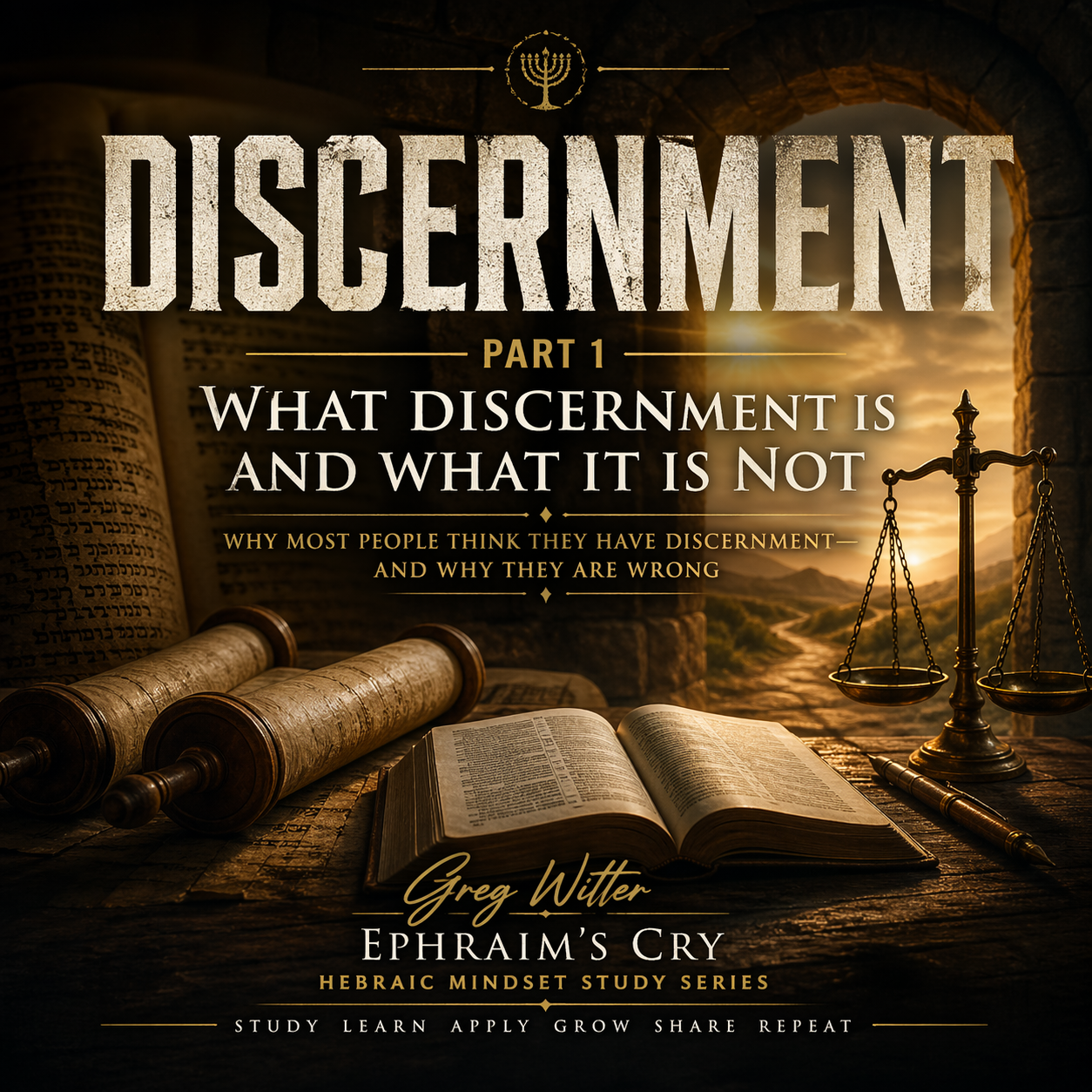
Discernment
Part 1: What Discernment Is and What It Is Not
Why most people think they have discernment—and why they are wrong
Greg Witter | Ephraim’s Cry
Hebraic Mindset Study Series
Study Learn Apply Grow Share Repeat

Discernment is one of the most claimed and least understood realities in the life of a believer. Many speak of it, few can define it, and even fewer have actually developed it. What is often called discernment today is nothing more than preference, personality, reaction, suspicion, or religious instinct dressed up in spiritual language. People say, “I feel like something is off,” or “that doesn’t sit right with me,” and they label that as discernment. But feelings are not a standard, reaction is not revelation, suspicion is not maturity, and instinct is not covenant judgment. If discernment is built on emotion, then it will shift with every circumstance, every influence, every relationship, every trend, and every voice that enters the room. True discernment cannot be rooted in what you feel. It must be rooted in what is established.
From the beginning, discernment has always been tied to the ability to distinguish—to separate, to divide correctly, to identify what belongs and what does not. This is not a modern idea, a denominational specialty, or a mystical category reserved for a few unusually perceptive people. It is woven into the very fabric of creation itself because it reflects the character of the One who creates, orders, names, separates, and defines. When 𐤉𐤄𐤅𐤄 (Yahuah) began forming the world, He did so through distinction and boundary: light from darkness, waters above from waters below, land from sea (Genesis 1:4–10). He did not create throughconfusion, mixture, and blur. He created through order, separation, identity, and placement. Discernment reflects that same pattern. It is the ability to see distinction where others see mixture, to recognize boundary where others see blur, and to refuse confusion where Elohim has already spoken clearly.
Without distinction, there is confusion. And where there is confusion, there is no discernment.
This means discernment is not first a human skill. It is first a covenantal participation in the order and judgment of Elohim. Discernment exists because 𐤉𐤄𐤅𐤄 (Yahuah) is not a God of mixture. He is holy. He separates. He defines. He assigns limits. He calls things what they are. He does not collapse categories to make man comfortable. He does not erase boundaries to make rebellion feel acceptable. He does not call darkness light just because men have grown accustomed to the dark. If discernment reflects His nature, then discernment itself must be holy, ordered, and governed by truth. It cannot be self-created, self-defined, or self-authorized.
Scripture consistently defines discernment through contrast, and it roots that contrast in covenant responsibility, not personal insight. The prophet Ezekiel rebukes those who failed in this very area, declaring that they did not “put difference between the holy and profane, neither have they showed difference between the unclean and the clean” (Ezekiel 22:26). That failure was not intellectual—it was covenantal. They were no longer operating within the boundaries that 𐤉𐤄𐤅𐤄 (Yahuah) had established. They no longer judged as He judged. They no longer separated as He separated. And once that line is blurred, everything else begins to collapse. Worship collapses. Leadership collapses. teaching collapses. Community collapses. Once the difference between holy and profane is lost, the people are left vulnerable to every counterfeit that still uses spiritual words while emptying them of covenant substance.
From the beginning, His people were commanded to distinguish: “You shall therefore put difference between clean beasts and unclean…” (Leviticus 20:25), and again, “they shall teach my people the difference between the holy and profane, and cause them to discern between the unclean and the clean” (Ezekiel 44:23). This language matters. It is not optional language. It is not the language of mere preference. It is not, “if this resonates with you,” or “if this is your gift.” It is command language. It is covenant language. It is identity language. The people of Elohim are expected to know the difference, teach the difference, preserve the difference, and live according to the difference. Discernment is not an extra for the advanced student. It is a requirement for covenant faithfulness.
This is where the first correction must be made. Discernment is not the ability to detect what is “off” according to your personal perception. It is not merely a negative sensation. It is not the internal discomfort of a suspicious mind. It is not cynicism with Bible vocabulary. It is the ability to measure everything against what is right according to the standard of the Word. It is righteous judgment according to what 𐤉𐤄𐤅𐤄 (Yahuah) has spoken. If there is no standard, there is no discernment—only opinion. If the standard moves, discernment collapses with it. If the standard is self, culture, tradition, church systems, personal experience, trauma, preference, personality, charismatic influence, academic speculation, or inherited theology, then what a person calls discernment will merely be the defense mechanism of whatever they are already committed to protecting.
Many people operate as though discernment is a spiritual instinct that functions independently of study, obedience, structure, and tested alignment. They assume that because they are sincere, they are accurate. But sincerity has never been the measure of truth. A person can be fully convinced and completely wrong. A person can be passionate and still be deceived. A person can be confident and still be unstable. A person can sound spiritual and still be governed by flesh, tradition, or self-interest. This is why Scripture warns that “there is a way which seemeth right unto a man, but the end thereof are the ways of death” (Proverbs 14:12). What “seems right” is not discernment. It is perception without testing, confidence without submission, and judgment without a lawful standard.
Discernment requires testing, and testing requires a standard. That is not negotiable. This is why discernment cannot exist apart from the Word. The Word is not one voice among many. It is not merely inspirational material to balance alongside other influences. It is the measuring rod by which all voices are judged. “To the law and to the testimony: if they speak not according to this word, it is because there is no light in them” (Isaiah 8:20). That statement does not allow man to sit over Scripture. It does not allow private imagination to overrule what is written. It does not allow culture to revise covenant. It establishes a fixed reference point. Either something aligns, or it does not. Either it speaks according to the Word, or it does not. Either there is light in it, or there is not. There is no middle ground hidden under religious flattery.
But before a person can even apply that standard, there must be a right posture toward the One who gave it. “The fear of 𐤉𐤄𐤅𐤄 is the beginning of knowledge” (Proverbs 1:7), and “the fear of 𐤉𐤄𐤅𐤄 is the beginning of wisdom” (Proverbs 9:10). This fear is not terror in the shallow sense, but reverence, weight, submission, moral seriousness, covenant awareness, and recognition of authority. It is the abandonment of self-rule. It is the refusal to place your own thoughts on the throne. Without this fear, a person will not truly bow to the standard. They may quote it, use it, decorate themselves with it, debate with it, and selectively appeal to it, but they will not submit to it. And if there is no submission, there is no beginning. Discernment begins where self-rule ends.
This means discernment does not begin with observation. It begins with surrender. It does not begin with analyzing others. It begins with bowing before 𐤉𐤄𐤅𐤄 (Yahuah). It does not begin with suspiciously scanning the world for error. It begins with acknowledging that His Word is true, His boundaries are good, His authority is final, and your own heart is not trustworthy on its own. If there is no fear of 𐤉𐤄𐤅𐤄 (Yahuah), there will be no true alignment. If there is no alignment, there will be no correct measurement. If there is no correct measurement, what a person calls discernment will simply be self-confirmation with spiritual packaging.
This is one of the most dangerous conditions a person can live in: believing they are discerning when they are actually reinforcing themselves. The greatest threat is not merely being deceived by others. It is deceiving yourself. Scripture warns of this repeatedly. “Be doers of the word, and not hearers only, deceiving your own selves” (James 1:22). Paul writes of men “deceiving, and being deceived” (2 Timothy 3:13). That is a terrible condition—when a person is not only vulnerable to deception but becomes an active participant in its spread while remaining convinced of their own clarity. Self-deception is more dangerous than open ignorance, because ignorance may still be corrected, but self-deception often hides behind confidence, experience, and religious language.
The first failure of discernment in Scripture reveals exactly how this happens. In the garden, the command was clear: “Of every tree of the garden you may freely eat: but of the tree of the knowledge of good and evil, you shall not eat of it” (Genesis 2:16–17). There was no confusion in the command. There was no lack in the Word. There was no defect in the standard. But then came the distortion: “Yea, has Elohim said…” (Genesis 3:1). That opening move matters. The deception did not begin with obvious blasphemy. It began with questioning the Word. Then the Word was altered. Then the consequence was contradicted. Then desirewas activated. Then the false promise was elevated. Genesis 3 gives the ongoing anatomy of deception: question the Word, alter the Word, contradict the Word, replace the consequence, appeal to desire. That pattern has never changed.
This is why the failure in the garden was not lack of information. It was failure to discern that the Word had been distorted. This is the pattern that continues in every generation. Deception rarely presents itself as the opposite of truth. It presents itself as a modified version of truth, a softened version, an improved version, a more reasonable version, a more marketable version, a more comforting version, or a more culturally acceptable version. It still uses the language of truth while severing the meaning from the standard. Discernment, therefore, is not just recognizing what is false in its obvious form. It is recognizing when truth has been slightly altered. And that is where many fail. They think deception must look openly evil, openly hostile, openly anti-biblical. Often it looks familiar. Often it sounds spiritual. Often it quotes Scripture. Often it promises wisdom, growth, freedom, relevance, grace, unity, or deeper insight. But if it departs from what 𐤉𐤄𐤅𐤄 (Yahuah) has established, it is still deception.
This brings us to another critical misunderstanding: knowledge is not discernment. A person can know Scripture and still lack the ability to rightly divide it, apply it, and judge according to its full covenant structure. The adversary himself quoted Scripture in the wilderness (Matthew 4:6), yet he twisted its application. That one fact should silence the shallow assumption that information alone equals truthfulness. Knowledge is the accumulation of information. Discernment is the correct application, judgment, and alignment of that information under the authority of Elohim. Knowledge can fill the mind while leaving the heart untouched. Knowledge can be used to win arguments, defend tradition, preserve ego, manipulate others, and protect systems. Discernment is different. Discernment submits all knowledge to the full counsel of the Word.
You can know verses and still be blind. You can quote passages and still be unstable. You can memorize Scripture and still use it lawlessly. You can know what the text says in fragments and still not understand what it establishes in covenant continuity. Discernment is what separates information from truth, citation from submission, familiarity from understanding, and religious literacy from covenant alignment.
This is why discernment is not intuitive—it is trained. One of the most damaging assumptions people carry is that if something is wrong, they will automatically recognize it. Scripture directly contradicts that assumption. Hebrews speaks of those “who by reason of use have their senses exercised to discern both good and evil” (Hebrews 5:14). “Reason of use” implies consistent practice. “Exercised” implies intentional training, development, repetition, and maturity. Discernment is not passive. It does not drop on a person merely because they are interested in spiritual things. It is built in those who submit to the process of learning, testing, obeying, correcting, and continuing.
That matters because many want the outcome without the process. They want clarity without discipline. They want precision without study. They want discernment without systematic exposure to Torah, Prophets, Writings, and Apostolic witness. They want to identify error in others while excusing laziness in themselves. But discernment does not come through occasional inspiration. It comes through sustained contact with the standard. It comes through reason of use. It comes through repeated judgment under the Word. It comes through being corrected when wrong, refined when immature, and sharpened by obedience over time. Those who refuse that process do not lack discernment because it is unavailable. They lack discernment because they have not submitted to what produces it.
And this process is not merely intellectual—it is deeply connected to the condition of the heart. Scripture says, “The heart is deceitful above all things, and desperately wicked” (Jeremiah 17:9). That statement strips away the flattering lie that sincerity equals reliability. The heart can want what is wrong and then build a theology to defend it. The heart can resist what is true and then call its resistance discernment. The heart can love comfort, crave acceptance, fear rejection, seek status, protect tradition, and cling to systems that provide emotional security. Then, after doing all that, it can still speak as though it is only interested in truth. This is why discernment must deal with the inner man, not merely the outer argument.
“Keep your heart with all diligence; for out of it are the issues of life” (Proverbs 4:23). What a person desires, they will be tempted to justify. What they fear losing, they will be tempted to protect. What they are attached to, they will be tempted to excuse. This is why desire functions as a filter. Desire becomes bias. Bias affects interpretation. Interpretation produces false conclusions. False conclusions, when repeated and defended, become fortified error. That is the mechanism. Desire leads. Perception follows. Interpretation serves. And then the person imagines they have arrived at truth objectively when in reality they have been carried by what they wanted from the beginning.
This is why two people can hear the same teaching and respond differently. One hears under the fear of 𐤉𐤄𐤅𐤄 (Yahuah), willing to be corrected. The other hears through the lens of self-protection, tradition, identity, comfort, or appetite. One says, “What is true?” The other says, “What can I keep?” One says, “Where must I submit?” The other says, “How can I preserve what I already believe?” Discernment is not just about what is being presented. It is about what is already governing the one receiving it.
This is why discernment is not neutral. It does not sit outside obedience as a detached observational skill. It is directly tied to how a person lives. “He that saith, I know him, and keepeth not his commandments, is a liar, and the truth is not in him” (1 John 2:4). If truth is not in a person, their ability to discern truth is already compromised. Disobedience does not just affect conduct—it affects perception. It dulls judgment. It distorts categories. It weakens separation. It teaches the soul to tolerate what once should have been rejected. Over time, this becomes inversion, where a person begins to “call evil good, and good evil; that put darkness for light, and light for darkness” (Isaiah 5:20). This is not a minor error. It is moral and covenant collapse at the level of judgment.
Discernment operates within the realm of light. “Light is come into the world, and men loved darkness rather than light” (John 3:19). That verse does not merely describe ignorance. It describes preference. Men often do not fail to discern because they cannot see anything at all. They fail because they do not want what the light will expose. Discernment is resisted because it is costly. It brings hidden things into view. It reveals mixture. It exposes compromise. It turns vague discomfort into defined judgment. It strips away excuses. “Have no fellowship with the unfruitful works of darkness, but rather reprove them” (Ephesians 5:11). Discernment does not coexist peacefully with darkness. It exposes, reproves, identifies, and separates from it.
At this point, the line must be drawn clearly. What people commonly call discernment today often falls into categories that produce instability rather than clarity. Emotional reaction is mistaken for spiritual insight (Proverbs 28:26). Personal preference is elevated to the level of truth (Colossians 2:8). Cultural influence shapes perception instead of Scripture (Romans 12:2). Selective use of Scripture is employed to support pre-existing beliefs (2 Peter 3:16). Blind trust in teachers replaces testing their words (1 John 4:1). Charisma is mistaken for authority. Boldness is mistaken for accuracy. Familiarity is mistaken for truth. None of these produce discernment. They produce instability, confusion, vulnerability, and eventually bondage.
This brings us to the judgment function of discernment. Many have been trained to fear the language of judgment because they have heard only fleshly judgment, hypocritical judgment, or self-exalting judgment. But Scripture does not abolish righteous judgment. It commands it. “Judge not according to the appearance, but judge righteous judgment” (John 7:24). Discernment is the ability to judge rightly according to the standard of Elohim. It is not the condemnation of man from pride. It is the lawful evaluation of things according to truth. Paul prays that love may abound “in knowledge and in all judgment; that you may approve things that are excellent” (Philippians 1:9–10). That is discernment. It is not passive tolerance. It is not doctrinal laziness. It is not emotional niceness masquerading as humility. It is the capacity to approve what is excellent because what is common, corrupted, or distorted has been measured and recognized.
Without this judgment function, discernment becomes sentimental language with no teeth. But true discernment has teeth. It must. It is meant to preserve holiness, protect the flock, expose error, and keep covenant boundaries intact. That is also why discernment is essential in relation to authority. Without discernment, people submit to voices, systems, teachers, coverings, and structures that are not aligned with Elohim. Yahusha warned, “Beware of false prophets, which come to you in sheep’s clothing, but inwardly they are ravening wolves” (Matthew 7:15). Paul warned that “grievous wolves” would enter in, and that even from among the brethren men would arise “speaking perverse things, to draw away disciples after them” (Acts 20:29–30). Discernment protects against false authority because it refuses to confuse platform with legitimacy, gifting with truth, charisma with covenant faithfulness, or influence with authorization from Elohim.
Without discernment, a person will submit to what sounds spiritual, follow what feels powerful, defend what is familiar, and call it faithfulness. Without discernment, people do not merely believe error. They organize around it. They protect it. They teach it. They build identity around it. They resist correction as though correction itself were the enemy. That is why the consequences of lacking discernment are not theoretical. “My people are destroyed for lack of knowledge…” (Hosea 4:6). Not merely uninformed—destroyed. Without discernment, a person becomes susceptible to false doctrine, dependent on others to interpret truth for them, vulnerable to spiritual manipulation, unable to distinguish between what is clean and unclean, holy and profane, lawful and lawless, faithful and counterfeit. Without discernment, deception is accepted, error is normalized, truth is questioned, correction is resisted, and growth is halted.
True discernment, by contrast, is stable because it is anchored. It measures everything—teaching, doctrine, behavior, systems, claims of revival, structures of authority, prophetic assertions, theological traditions, and even personal beliefs—against the same unchanging standard. It is what allows separation to function. “Be holy; for I am holy” (Leviticus 11:44). Holiness requires distinction, and distinction requires discernment. Without discernment, there is no clear line. Without a clear line, there is no separation. Without separation, holiness becomes undefined. And once holiness is undefined, everything becomes negotiable except the truth.
Discernment is therefore not about being harsh, suspicious, elitist, or argumentative. It is about being aligned. It is not about winning debates while losing the fear of 𐤉𐤄𐤅𐤄 (Yahuah). It is not about identifying error in others while remaining blind to self. It is not about developing a critical personality and calling it maturity. It is about being governed by the Word so thoroughly that truth and error no longer appear interchangeable. It is about having your categories shaped by Elohim rather than by culture, appetite, reaction, or inherited systems.
This is why discernment will always expose. It will expose error, but it will also expose the one holding onto it. It will not only identify falsehood in the room; it will identify compromise in the heart. Many do not lack discernment because they are unable to understand. They lack discernment because they are unwilling to submit. That must be said plainly. If someone is more committed to comfort than truth, discernment will be resisted. If someone is more committed to tradition than Scripture, discernment will be avoided. If someone is more committed to acceptance than accuracy, discernment will be suppressed. If someone is more committed to preserving their teacher, denomination, tribe, system, public image, or personal peace than they are to aligning with the full counsel of Elohim, discernment will be treated as a threat.
That is because discernment always confronts what a person wants to keep. It confronts cherished assumptions. It confronts inherited lies. It confronts sentimental theology. It confronts man-made systems that protect error. It confronts lazy study habits. It confronts self-trust. It confronts the misuse of grace, the neglect of Torah, the isolation of the Apostolic writings from the covenant foundation, and the habit of quoting fragments while ignoring the whole. Discernment tears at mixture. It demands definition. It insists that things be called what they are.
This is where the cost becomes clear. Discernment is not merely intellectual—it is covenantal. It requires alignment with truth regardless of the consequences. And those consequences are real. Once discernment begins to form, things that once seemed acceptable will no longer sit comfortably. Teachings that once sounded right will begin to unravel. Teachers once admired will need to be tested. Systems once trusted will need to be examined. Relationships built around shared assumptions may become strained. Voices that once carried unquestioned authority will be measured. And the individual will be forced to choose between what is familiar and what is true.
That is where most people stop. They say they want discernment until discernment demands a cost. They want to see clearly until clarity requires change. They want the ability to identify error, but not if that error is tied to something they love, something that shaped them, something that comforts them, or someone they fear losing. But discernment that never costs you anything is usually not discernment. It is usually preference affirmed by convenience.
Discernment is not the end—it is the doorway. It is the beginning of seeing clearly. And once clarity comes, responsibility follows. What you see, you are accountable for. You cannot honestly pray for discernment and then complain when 𐤉𐤄𐤅𐤄 (Yahuah) begins dismantling the false categories, unstable mixtures, and inherited assumptions you have lived with for years. If He grants light, He is also requiring response.
So the question is no longer whether discernment is desirable. The question is whether you are willing to pursue what produces it. Are you willing to fear 𐤉𐤄𐤅𐤄 (Yahuah) more than you fear man? Are you willing to submit to the standard rather than use it selectively? Are you willing to study systematically instead of living off fragments? Are you willing to be corrected? Are you willing to let the Word judge you before you attempt to judge anything else? Are you willing to lose what cannot survive the light?
Because discernment will not leave you where you are.
It will require you to change.
It will require you to learn, to unlearn, to test, to reject, to separate, to obey, and to continue.
And that is where most people stop.
But for those who continue, the next step must be established. If discernment requires a standard, then that standard must be defined clearly and completely—not partially, not selectively, not through denominational filters, and not through isolated proof texts, but in full alignment across Torah, the Prophets, the Writings, and the Apostolic witness. The standard must be seen as one whole, one testimony, one covenantal measuring rod. That is where we turn next.
Discernment is not something that is understood in a moment—it is something that must be built, trained, and walked out over time through consistent alignment with the Word. If what has been exposed here reveals gaps, assumptions, or areas where what you have called discernment does not stand up under the standard of Scripture, then the next step is not simply more information—it is structured formation. This is exactly why Ephraim’s Cry Academy exists: to take what is foundational and develop it into something stable, tested, and lived. Discernment cannot remain theoretical if it is to endure. It must be formed through disciplined study, correction, application, and accountability within a covenant framework. If you are serious about not being led astray, not being shaped by every voice, and not remaining where you are, then you need more than exposure—you need formation.
https://EphraimsCry.com/academy
Discernment — Part 2: The Standard — The Word as the Measuring Rod

#GregWitter, #EphraimsCry, #HebraicMindset, #Discernment, #BiblicalDiscernment, #TruthVsError, #SoundDoctrine,
#StudyTheWord, #TorahFoundation, #WholeCounselOfElohim, #ScriptureAlignment, #CovenantTruth,
#SpiritualGrowth, #TestEverything, #HoldFastTruth, #Hebrews514, #Isaiah820, #1John4, #ObedienceMatters,
#TruthOverTradition, #RenewYourMind, #SeparateHolyFromProfane, #BiblicalTeaching, #FaithAndObedience
