
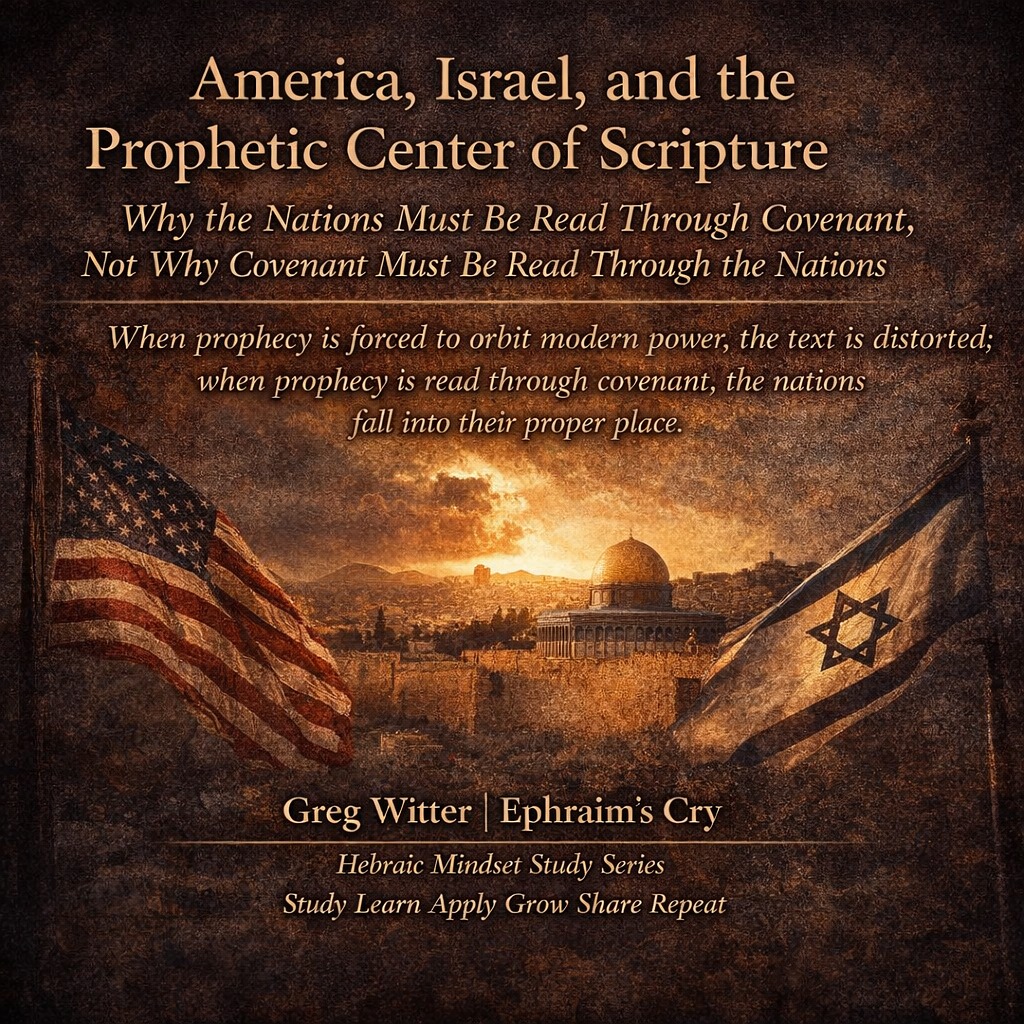
America, Israel, and the Prophetic Center of Scripture
Why the Nations Must Be Read Through Covenant, Not Why Covenant Must Be Read Through the Nations
When prophecy is forced to orbit modern power, the text is distorted; when prophecy is read through covenant, the nations fall into their proper place.
Greg Witter | Ephraim’s Cry
Hebraic Mindset Study Series
Study Learn Apply Grow Share Repeat
Before anything else is said, one false foundation has to be confronted directly, because if it is left standing, everything built afterward will lean in the wrong direction. Many people want to make America Babylon. They try very hard to make that shoe fit. They look at American wealth, military power, commercial dominance, cultural influence, moral corruption, luxury, entertainment, global reach, and political pride, and they say, “There it is. That must be Babylon.” And once they have emotionally attached themselves to that conclusion, they begin forcing every prophetic detail to fit it. They stretch symbols. They stretch chronology. They stretch context. They flatten historical setting. They ignore audience relevance. They read backward from the modern world into the text instead of forward from the text into the modern world. That is not sound interpretation. That is pressure placed on Scripture until it echoes what they already wanted it to say.
Now something must be said carefully and clearly, because there is a partial truth hidden inside that error. Yes, America is part of the system of the nations. Yes, America participates in the moral, economic, military, and cultural machinery of the present world order. Yes, America shares in the arrogance, corruption, luxury, violence, compromise, and self-exalting tendencies of the nations of this age. Yes, America can be judged. Yes, America can fall. Yes, America can become an instrument of blessing or cursing in relation to covenant realities. But participation in the system is not the same thing as being the specific prophetic identity of Babylon. America is part of the world system. America is not Babylon.
That correction must come at the beginning because once America is wrongly enthroned as the interpretive center, the reader stops following the text and starts chasing emotional parallels. Babylon in Scripture is not defined by “whatever looks most powerful and corrupt to me right now.” Babylon is defined in context, in covenant contrast, in prophetic continuity, and in relation to the audience and symbolic framework of the passages where it appears. If that discipline is abandoned, then prophecy becomes a mirror for modern obsession rather than a revelation of Yahuah’s order. That is one of the great dangers of our time. People are not merely misreading a symbol. They are recentering the prophetic story around the modern nation-state instead of around covenant, Jerusalem, Israel, kingdom, judgment, sanctuary, Messiah, and reign.
So the first corrective truth must stand immovable: the prophetic center of Scripture is not America. The prophetic center of Scripture is not any modern superpower. The prophetic center of Scripture is covenant. More specifically, the prophetic lens of Scripture is fixed on Yahuah’s covenant purposes in relation to the land, the people, the city, the throne, the sanctuary, the nations as they intersect His purposes, and the kingdom of Yahusha that will crush and outlast every kingdom of men. That is why Jerusalem matters. That is why the land matters. That is why Israel matters. That is why empires matter only where and when they touch the covenant line. Once that is understood, many confusions begin to dissolve.
When Daniel sees the statue in Daniel chapter 2, the sequence is not a random catalog of famous empires. Nor is it a codebook inviting every generation to find its favorite nation hidden in the image. The empires named in the broad sequence matter because they bear directly on covenant history. Babylon matters because Babylon marched into Jerusalem in 586 BC, burned the House, broke the kingdom order, and carried Judah into exile. Persia matters because Persia overthrew Babylon in 539 BC and became the imperial framework through which the exiles returned and the Temple was rebuilt by decree. Greece matters because the Greek world gave rise to the Seleucid oppression that culminated in Antiochus IV Epiphanes, whose desecration of the sanctuary became a major prophetic shadow and covenant crisis. Rome matters because Rome ruled the land in the days of Yahusha, presided over the imperial context of the apostolic witness, and destroyed the Second Temple in 70 AD. These empires are not included because they were globally impressive. They are included because they intersected Yahuah’s covenant purposes in the land and over the people.
That is a crucial distinction. Scripture does not name powers simply because they are large. Scripture names powers where they are relevant to the covenant story. And that means the absence of a later superpower from explicit naming is not a flaw to be corrected by human imagination. It is a boundary to be respected. Yahuah does not need to name every major nation in order to govern every major nation. His silence is not oversight. His silence is not forgetfulness. His silence is not proof that a nation is irrelevant to history. His silence simply means that His prophetic focus is not governed by the same standards men use when they rank importance.
This is where many readers go wrong. They cannot bear the thought that a nation as dominant as America might not occupy the center of the prophetic page. So they begin inserting America into every commercial city, every maritime power, every western image, every debated nation list, every lion, every eagle, every unnamed coastland, every alliance, every merchant network, until the text yields something resembling what they wanted. But this is not reverence for Scripture. It is impatience with Scripture. It is a refusal to let the text keep its own focus. And the moment that refusal sets in, prophecy becomes a playground for national fascination rather than a watchtower for covenant truth.
The deeper issue is not merely that people misidentify Babylon. The deeper issue is that they have adopted the wrong center. They are asking, “Where is America?” before they have asked, “What is Yahuah doing through covenant, kingdom, judgment, and Messiah?” They are asking, “How can I find my nation?” before they have asked, “What has Yahuah actually made central?” That is why the whole framework must be reset.
Now let us move carefully into Babylon itself, because this matter needs more than a passing correction. The figure of Babylon in Revelation 17–18 is not to be ripped loose from the whole biblical storyline and then pasted directly onto the latest global power. Babylon in Scripture begins as a symbol of proud human civilization in rebellion against Yahuah, concentrated in self-exalting ambition, false worship, organized defiance, and a counterfeit center of unity. That line runs from Babel in Genesis 11 through historical Babylon and into later prophetic uses of Babylonian imagery. By the time one reaches Revelation, Babylon has become more than one ancient city in one historical moment. It is a symbolically loaded, covenantally charged representation of organized human rebellion, idolatrous power, luxurious corruption, persecuting arrogance, and seducing worldliness concentrated in a final form. But that does not mean the symbol can be assigned to any modern nation at whim.
The text itself still matters. Context still matters. John’s audience still matters. The allusions still matter. The woman sits on seven mountains. The great city is described in relation to the world John knew. The language is saturated with Roman-imperial resonance, with covenantal overtones, and with the imagery of a corrupt world-order center hostile to the saints. One may debate precise layers of symbolic and historical fulfillment. One may discuss whether Rome is the immediate horizon, whether a later Rome-like system is in view, whether the final form has both continuity and escalation. Those are real discussions. But one may not simply leap from “wealthy and powerful” to “therefore America is Babylon.” That is careless. That is emotionally compelling and textually weak.
Again, the correction must be sharp: America may participate in Babylonian characteristics. America may drink from the spirit of Babylon. America may contribute to the global order that reflects Babylonian pride, luxury, bloodguilt, seduction, and rebellion. But that is not the same as proving America is the prophetic identity of Babylon. One must not confuse participation in a system with being the defining biblical symbol of that system.
Once that is corrected, the larger prophetic structure becomes much easier to see. Yahuah’s prophetic lens is covenantal before it is geopolitical. That means the text tracks nations, kings, wars, and judgments in relation to covenant land, covenant city, covenant people, sanctuary profanation, kingdom conflict, and the reign of Yahusha. This is why Ezekiel can name a coalition against Israel and why Zechariah can focus on Jerusalem as a burdensome stone and a center of final conflict. This is why Daniel’s kingdom sequence matters. This is why the Mount of Olives matters. This is why the Temple matters in both its historical destruction and prophetic significance. This is why the nations matter in relation to how they stand before Yahuah’s throne and against His purposes. The issue is not whether the nations matter. The issue is how they matter.
That must be pushed further, because many people hear “prophecy is covenant-centered” and then make the opposite mistake of treating modern nations as though they do not matter at all. That is also false. Nations matter morally. Nations matter covenantally. Nations matter judicially. Nations are judged. Nations are gathered. Nations rage. Nations are shattered. Nations are held accountable for pride, violence, idolatry, oppression, bloodshed, blasphemy, and for how they stand in relation to Yahuah’s purposes. America is not exempt from that simply because it may not be explicitly named in a debated prophetic list. Silence in naming does not equal immunity in judgment.
This is where Genesis 12:3 still carries immense weight. “I will bless those who bless you, and him who curses you I will curse.” That word is not sentimental. It is operational covenant reality. But it must be handled with sobriety. It is one thing to say that nations are accountable in relation to Abram’s line and covenant purposes. It is another thing to look at every hurricane, stock-market crash, geopolitical stumble, or national crisis and declare with prophetic infallibility, “This exact event is direct retaliation for that exact policy.” The desire to make those links may arise from a real instinct that nations are accountable. But if the teacher speaks beyond what Scripture itself authorizes, he moves from warning into speculation. He ceases to prove truth and begins overstating correlation as though it were revelation.
That distinction matters because a true watchman must be text-governed, not excitement-governed. A nation may indeed come under judgment for arrogance, covenant hostility, lawlessness, and rebellion. A people may indeed reap what they sow. A civilization may indeed cross lines that bring judicial consequences. But not every observed pattern can be preached as a divinely interpreted timeline unless the text gives that level of clarity. Otherwise, people begin speaking for Yahuah where Yahuah has not chosen to speak that specifically.
Now the issue of apostasy must be addressed with greater depth. The falling away is real. Paul speaks in 2 Thessalonians 2 of apostasy and the rise of lawlessness in relation to the end. Isaiah condemns the inversion of moral order in calling evil good and good evil. Romans 1 describes a people and society being given over as judgment intensifies through rebellion. Those texts are highly relevant to modern nations, including America. But again, care is needed. The temptation is to make America the unique center of apostasy, as though rebellion against truth were an exclusively American phenomenon. That would be too narrow. The apostasy is larger than one nation. It is civilizational, spiritual, covenantal, and transnational. Yet America may indeed exemplify it in especially visible ways, especially because a people given much light become all the more accountable when they turn from it.
That is where the warning becomes sharper. The issue is not merely that a nation is “declining.” The issue is that lawlessness is celebrated, moral inversion is institutionalized, covenant order is despised, truth is relativized, and comfort becomes the great anesthesia that makes rebellion look normal. One of the great tragedies of modern nations that once enjoyed great biblical exposure is not merely that they do evil, but that they do evil while imagining themselves mature, advanced, liberated, and righteous. That is a far deeper judgment than visible collapse. That is being turned over while still boasting of health.
Now we must return to Daniel 2, because if that text is not allowed to dominate, everything else becomes unbalanced. Daniel does not climax with a surviving superpower. He does not climax with one empire successfully navigating the last days. He does not climax with America, Europe, Russia, China, or any other present power retaining final significance. He climaxes with the stone cut without hands. He climaxes with the kingdom of Yahuah overthrowing the whole image. He climaxes with the end of the kingdoms of men as ruling realities. That is the point.
This must be driven harder because it exposes the hidden idolatry inside much prophecy obsession. Many readers are not actually searching the Scriptures to see the triumph of Yahuah’s kingdom. They are searching for reassurance that their civilization still matters, that their national story still occupies the center of history, that their flag still belongs somewhere near the climax. Daniel will not allow that comfort. The image falls. All of it. Gold falls. Silver falls. Bronze falls. Iron falls. Clay falls. Greatness does not preserve the kingdoms. Power does not preserve the kingdoms. Age does not preserve the kingdoms. The stone destroys them all, and the kingdom of heaven fills the earth.
That means the deepest error in much modern prophecy teaching is not merely that it guesses wrong about Babylon or Tarshish or unnamed nations. The deeper error is that it still thinks like the image. It still thinks in imperial terms. It still asks, “Which kingdom will remain important?” instead of bowing before the answer Daniel already gave: none of them. The kingdom remains. Yahusha remains. The reign of Yahuah remains.
That is the truth that must be sounded like a trumpet. America will not save the world. Europe will not save the world. A revived alliance will not save the world. The system will not save the world. The nations will be judged. The image will fall. The kingdoms of men are temporary, fragile, and already under sentence. Only the kingdom of Yahusha is permanent.
Now the falsehoods must be exposed in plain terms.
It is false to preach speculation as certainty. Where the text is debated, say it is debated. Where the text is silent, say it is silent. Where the text is explicit, stand there with boldness.
It is false to build prophetic identity on emotional similarity. “This sounds like us” is not proof.
It is false to treat America as the center of biblical prophecy simply because America is large in modern history.
It is false to think that a nation’s missionary legacy, economic dominance, or military reach grants it a guaranteed prophetic centrality.
It is false to confuse providential patterns with explicit prophetic fulfillment.
It is false to read the Bible through the lens of national anxiety rather than through covenant order.
And it is false to care more about where your nation fits than where the King stands.
Now the positive truth must be constructed more deeply.
Yahuah’s covenant is the center.
Yahuah’s city matters because He made it matter.
Yahuah’s land matters because He bound covenant history to it.
Yahuah’s people matter because He chose to work through that line and bring Messiah through it.
Yahuah’s kingdom matters because it is the end of all rival claims.
The nations matter, yes. But they matter under judgment, in relation to covenant, and in submission to the coming reign of Yahusha. They are not the center. They are accountable actors within the story, not the authors of it.
That truth also guards the reader from despair. If America is not the center, then the decline of America is not the collapse of Yahuah’s purposes. If a nation once used for great missionary activity falls into rebellion, that is grievous and serious, but it is not the unraveling of prophecy. Yahuah’s kingdom was never hanging by the thread of one civilization’s health. That kind of thinking is not biblical. It is civil religion masquerading as prophetic insight.
The final issue, then, is allegiance.
Do not ask first where your nation appears. Ask where your allegiance rests.
Do not ask first whether your civilization will survive. Ask whether you belong to the kingdom that cannot be shaken.
Do not ask first how to preserve the image. Ask whether you have bowed before the stone.
This is where Daniel, Zechariah, Ezekiel, Matthew 25, and Revelation all converge in weight and warning. Nations will be judged. Systems will fall. Powers will collapse. The kingdoms of this world will not endure. The question is not which modern state receives the spotlight of your fascination. The question is whether your name is written in the book of life, whether your allegiance belongs to Yahusha, whether you discern the times through covenant and not through national vanity, and whether you fear Yahuah more than you fear the fall of empire.
That is where the teaching must finally stand.
America is not Babylon.
America is part of the system.
America can be judged.
America can fall.
America can bless or curse in relation to covenant realities.
But America is not the center of prophecy.
Yahuah’s covenant is the center.
Jerusalem is central because He made it so.
Israel is central because covenant history runs through it.
Messiah is central because all prophecy terminates in Him.
The kingdom is central because every rival kingdom falls before it.
That is the truth to prove.
That is the falsehood to expose.
That is the foundation to build.
Not empire-centered prophecy.
Not headline-driven speculation.
Not national self-importance.
Covenant.
Kingdom.
Judgment.
Messiah.
Reign.
That is the true center of Scripture.
#GregWitter, #EphraimsCry, #HebraicMindset, #BiblicalProphecy, #AmericaIsNotBabylon, #CovenantOverNation,
#IsraelAndTheNations, #Jerusalem, #Daniel2, #Daniel7, #Ezekiel38, #Zechariah12, #Zechariah14, #Matthew25,
#Revelation17, #Revelation18, #Revelation20, #KingdomOfYahuah, #KingdomOfYahusha, #KingdomThatCannotBeShaken,
#TruthVsSpeculation, #Watchman, #Torah, #Messiah, #Yahusha, #Yahuah
