
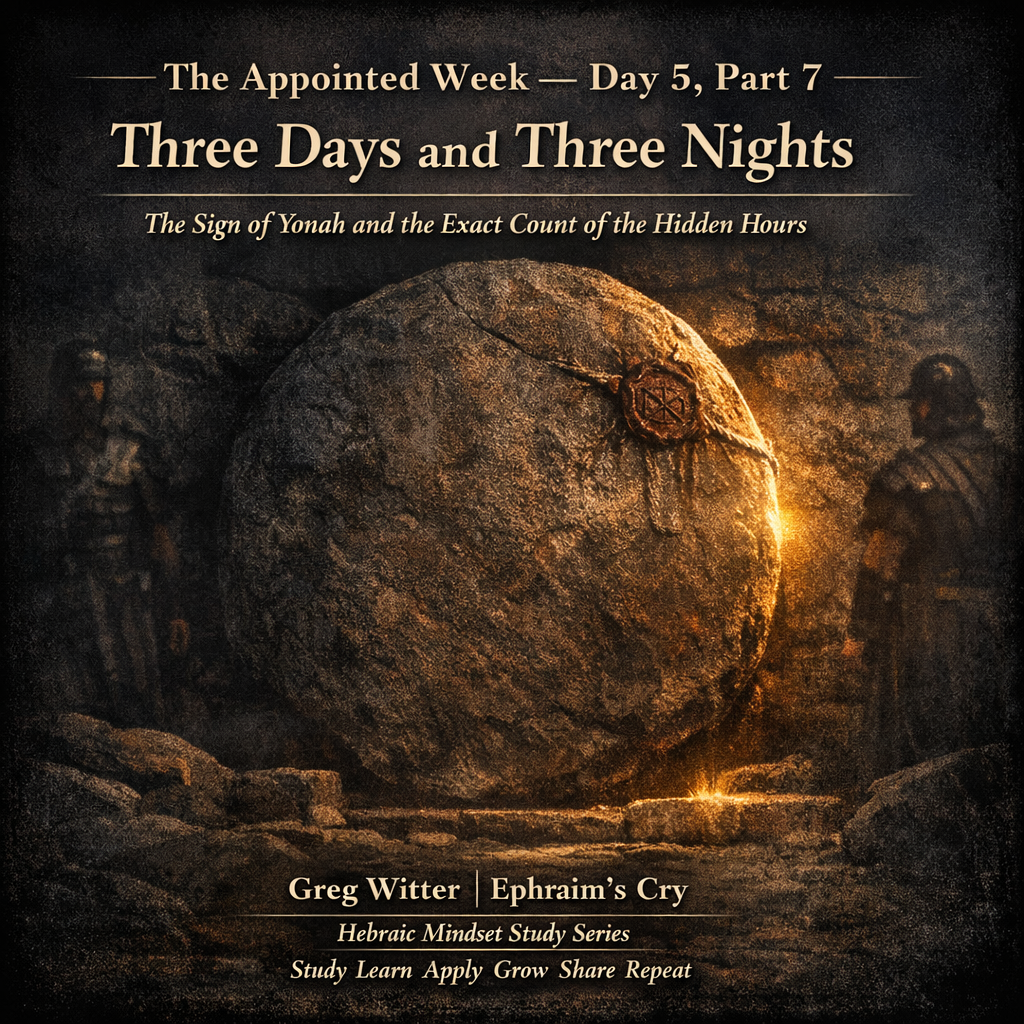
The Appointed Week — Day 5, Part 7: Three Days and Three Nights
The Sign of Yonah and the Exact Count of the Hidden Hours
If the count begins in the wrong place, the whole pattern is broken
Greg Witter | Ephraim’s Cry
Hebraic Mindset Study Series
Study Learn Apply Grow Share Repeat
So we stand at the point where the entire structure must now be locked into place—not by emotion, not by assumption, not by inherited teaching, but by covenant precision. This is where everything either holds or collapses. Not at the cross. Not at the burial. Not at the empty tomb. Here—at the count. The phrase “three days and three nights” is not casual language. It is not decorative language. It is not something that can be flexed to fit preference. It is the Messiah’s own time marker, and if that marker is not handled correctly, the entire framework fractures.
The question that must now be answered, without deflection and without adjustment, is this: when does the count begin? Everything hinges on that point. If the beginning is wrong, the nights will not align, the days will not align, the comparison to Yonah will fail, and the integrity of the sign collapses—not because the sign is unclear, but because it has been forced into a structure that does not belong to it.
Yahusha did not give a loose illustration. He established a measurable pattern. “As Yonah was three days and three nights in the belly of the great fish, so shall the Son of Man be in the heart of the earth.” This binds the timeline of Messiah to the timeline of Yonah. Yonah was not in the fish symbolically. He was not there partially. He was not there approximately. He was there for a complete, countable duration. That duration becomes the governing standard. If Yonah’s time was literal, Messiah’s time must be literal. If Yonah’s count was exact, Messiah’s count must be exact. There is no room for compression, reinterpretation, or adjustment.
This forces us back to the only place the count can begin: the moment the condition begins. The condition is not resurrection. The condition is not discovery. The condition is not public revelation. The condition is the Son of Man in the heart of the earth. That begins at burial.
The body is taken down. The burial is completed before sundown. The tomb is sealed. The stone is set. The guard is posted. The earth has received Him. At that moment, the condition is established. At that moment, the sign begins. At that moment, night one begins. The count is not waiting for observation. It is already in motion.
The phrase “heart of the earth” must now be pressed to its full depth, because this is where many reduce what must be understood precisely. It is not merely geographical language. It is not simply the idea of being underground. It is the full condition of being placed within the domain of death—enclosed, sealed, separated from the land of the living, and placed within what appears to be final authority. It is the realm where every son of Adam is lawfully held because of sin and corruption. But here is the distinction that cannot be softened: He is in the heart of the earth physically, but He is not under its authority legally. The body is placed in the tomb, but the claim of death has already been broken. The condition is present, but the jurisdiction has collapsed. That is the contradiction that breaks the system.
Physically, the tomb is sealed.
Legally, the authority of death is broken.
Physically, the stone stands.
Legally, it guards nothing final.
Physically, the system appears intact.
Legally, it has already been overturned.
This is why the sign begins in hiddenness. The decisive work is not announced first—it is accomplished first. The legal collapse of death’s authority happens at the point of encounter, not at the point of revelation. That is why the count begins at burial. That is when the condition is met. That is when the system receives what it cannot lawfully retain. That is when the legal contradiction is introduced, and that is when the authority of death begins to collapse from within.
Now the structure of time must be governed without compromise. A day does not begin at sunrise. A day begins at evening. “And the evening and the morning were the first day.” Evening initiates. Morning completes. That is the order. That is the framework. So when the body is placed into the tomb before sundown, and the sun sets, the transition into the 15th begins the next day. That is the beginning of night one. That is the beginning of day one. The clock is now running.
This defines what a full unit of time is. A day and night is not a partial reference. It is a complete unit. Night followed by day equals one full count. That means the structure must hold:
Night one followed by day one.
Night two followed by day two.
Night three followed by day three.
This is not compressible. It is not symbolic. It is not adjustable. It is exact. If you remove a night, shorten a day, or merge units together, you are not simplifying the sign—you are altering it. And if the sign is altered, it is no longer the sign that Yahusha gave.
This raises the question that must now be answered fully: why three days and three nights? Why not immediate resurrection? Why not one day? Why not a shorter period? Because the duration itself is part of the proof. The full count removes ambiguity. It prevents dismissal. It establishes completeness. A shortened timeline introduces doubt. A full timeline removes it. The sign must be undeniable, not arguable. That is why the duration stands exactly as given.
This is also why this sign was given to a resistant and unbelieving generation. It was not given as comfort. It was given as proof. It was not meant to be vague. It was meant to be undeniable. The very structure of the sign removes the ability to reinterpret it honestly. Either it stands exactly as given, or it has been altered. That is why it carries such weight. It validates the authority of Messiah Himself. If the sign holds, His words stand. If the sign is altered, His words are misrepresented. That is why this is not a minor detail—it is tied directly to the authority of His testimony.
Now this must be brought back into the flow of Day 5. The burial has taken place. The first night has begun. The hidden work is underway. The authority of death has been broken. The jurisdiction has collapsed. And yet nothing visible has changed. The stone remains. The seal remains. The guard remains. This is where the distinction between appearance and covenant must be held. Appearance has not shifted. Covenant time has. The clock is moving even though the environment looks frozen.
The first night passes into the first day. Light comes, but clarity does not. The tomb remains sealed. The system appears unchanged. The disciples do not suddenly understand. The silence does not break. And yet that day is not empty—it is counted. Time is advancing even though nothing appears to be happening.
This is where the weight of time presses in. The first night brings shock. The first day brings sustained confusion. Time exposes what a person is anchored in. Anyone can stand in a moment. Few can remain steady across time without reinforcement. This is where false conclusions begin to form.
Nothing is happening.
It failed.
We misunderstood.
It’s over.
These conclusions must be dismantled completely. Nothing is happening? No—the most decisive work has already taken place. It failed? No—the authority of death has already been broken. We misunderstood? No—the sign is unfolding exactly as spoken. It’s over? No—the count has only just begun. These are not conclusions drawn from Scripture. They are conclusions drawn from interpreting silence through expectation instead of covenant.
This is where most people quit. Not at the cross. Not at the miracle. Not at the public display of power. But here—in the silence that follows. When nothing changes. When confirmation does not come. When the environment remains the same. They disengage—not because truth has failed, but because it has not been reinforced in the way they expected.
The command has not changed. The feast continues. Unleavened Bread is still in motion. The house must still be searched. The leaven must still be removed. While He is hidden, they are still responsible. This is obedience without reward, obedience without visible fruit, obedience that proves whether it is rooted in covenant or in experience.
This is where the separation becomes clear. The crowd follows what is visible. The remnant follows what has been spoken. The crowd requires confirmation. The remnant remains aligned in silence. The crowd moves when things change. The remnant stands when nothing changes.
Now the resistance must be addressed directly, because this is why the timeline is so often mishandled. Tradition does not usually begin with Scripture—it begins with assumption. It begins with what has been handed down. It begins with what is familiar. Then it works backward, forcing the text to fit what has already been accepted. This is why partial-day arguments appear. This is why compressed timelines appear. This is why inclusive reckoning is misapplied. These are not neutral adjustments—they are attempts to preserve a structure that did not originate in the text.
But covenant does not work that way.
Covenant begins where the text begins.
Covenant submits to what is written.
Covenant allows the structure to stand as given.
This is not merely a timeline issue. This is a submission issue.
Will you let Scripture define the count?
Or will you redefine the count to protect what you have been taught?
That is the dividing line.
Now the consequence must be made unmistakable. If the starting point is wrong, everything collapses. The feast alignment breaks. The Sabbath alignment breaks. The resurrection timing breaks. The entire appointed week loses its structure. This is not isolated. It affects everything. If the count is wrong, the framework is wrong. If the framework is wrong, the understanding is wrong.
Now the transition must be set clearly. The first night has been counted. The first day has been counted. The sign is in motion. The second night will follow. The second day will deepen the silence. Day 6 approaches. Preparation day is ahead. The movement toward the Sabbath is set. But none of that can be understood correctly unless this is fixed:
The count began at burial.
That is the anchor.
That is the foundation.
That is what secures everything that follows.
So let it be stated without any room for retreat.
If you move the starting point, you break the sign.
If you compress the timeline, you distort the pattern.
If you adjust the count, you override Messiah’s words.
There is no neutral ground here.
Either the sign is exact, or the interpretation is wrong.
Either the count is preserved, or the timeline is broken.
The Lamb has been given.
The body has been buried.
The sign has begun.
The first night has been counted.
The first day has been counted.
The clock is running.
Whether anyone sees it or not.
This is Day 5, Part 7.
The sign of Yonah is in motion.
The timeline is fixed.
And everything that follows will reveal what has already been established.
Full teaching series available at:
https://ephraimscry.com/blog
Inspection is uncomfortable.
But covenant demands it.
#GregWitter, #EphraimsCry, #HebraicMindset, #TheAppointedWeek, #Day5, #Part7, #ThreeDaysAndThreeNights,
#SignOfYonah, #HeartOfTheEarth, #BiblicalTimeline, #Torah, #Messiah, #Yahusha, #Yahuah, #CovenantTruth,
#FaithWithoutSight, #HiddenVictory, #Remnant, #Watchman
