
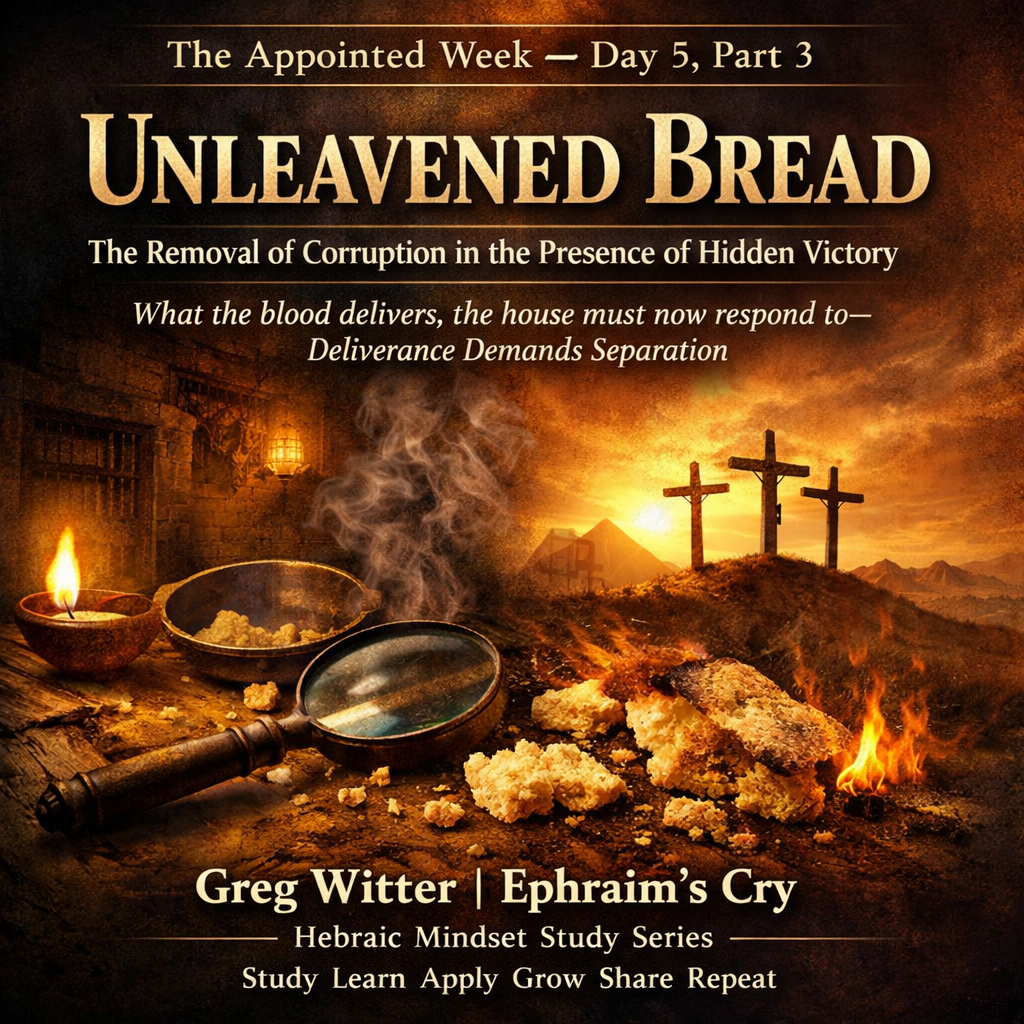
The Appointed Week — Day 5, Part 3: Unleavened Bread
The Removal of Corruption in the Presence of Hidden Victory
What the blood delivers, the house must now respond to—deliverance demands separation
Greg Witter | Ephraim’s Cry
Hebraic Mindset Study Series
Study Learn Apply Grow Share Repeat
The command does not end at the table, and that is exactly where this teaching must begin if the structure of Day 5 is going to remain intact. Most people stop too soon because most people are trained to stop too soon. They stop at the sacrifice. They stop at the blood. They stop at the language of deliverance. They stop at the emotional relief of knowing the Lamb has been given. They stop at the memorial meal and act as though everything that follows is little more than symbolic afterthought. But Torah does not permit that reading, and the appointed sequence does not support it. Deliverance is not the end of the matter. Deliverance is the beginning of the demand. Deliverance is the opening of the way. Deliverance is the moment that places a covenant obligation upon the people who have now been brought under the reality of the Lamb.
That is why Unleavened Bread must never be treated as decorative or secondary. It is not a liturgical accessory attached to the more important reality of the blood. It is not the optional devotional response of especially committed people. It is not religious garnish. It is commanded separation. It is the house answering what the blood has declared. It is the environment of the redeemed being brought into alignment with the act of redemption. It is the proof that deliverance is not merely admired but received in truth.
The Lamb has already been given. The blood has already been poured out. The body has already been placed into the earth. The Passover meal has already begun at the opening of the 15th. The memorial has been observed. The command has continued. But the moment the meal is in place, the house comes into focus. That is where this teaching must press with full force. The table is not the end. The table leads to the house. The memorial leads to the search. The blood leads to the removal of mixture. The meal leads into the feast. The feast leads into cleansing. This is not accidental movement. This is covenant order. Passover without Unleavened Bread is incomplete obedience. To stop at the meal while refusing the removal is to receive the sign and reject the demand that follows it.
“Seven days shall there be no leaven found in your houses.” That instruction is not soft. It is not symbolic in the weak modern sense. It is not poetic suggestion. It is covenant law. It is commanded separation. It is Yahuah saying plainly that what has been delivered by blood must now be reflected in the condition of the house. This means the people cannot eat the memorial and then return to normal as though nothing has changed. They cannot claim participation in the Lamb while permitting corruption to remain untouched. They cannot receive the benefit of deliverance while refusing the demand of separation. That contradiction is forbidden by the structure itself. If the Lamb has been given, the leaven must go.
This is exactly where many fail. They want redemption without rearrangement. They want deliverance without disruption. They want the Lamb without the demand. They want the blood without the house being searched. They want the comfort of being brought out while refusing the cost of being cleaned out. But that is not covenant. That is not Torah. That is not the appointed pattern. The pattern says the Lamb is slain, the blood is applied, the meal is eaten, and then the house must be free of leaven. Not mostly free. Not partially free. Not improved. Free of leaven.
That is where leaven must be defined properly, because if leaven is defined weakly, the command will be weakened with it. Leaven is not merely a vague religious word for something generally bad. Leaven is corruption that spreads. It is mixture that infiltrates. It is influence that grows quietly. It is tolerated compromise that does not remain where it began. It works its way through the whole lump. That is its nature. It is invasive. It is active. It is transformative in the wrong direction. It changes the condition of everything it is allowed to touch. That is why the language of a little leaven leavening the whole lump matters so much. The danger of leaven is not only what it is in itself, but what it becomes once it is allowed to remain. It never stays isolated. It never agrees to remain contained. It overtakes.
That means the problem is not simply open rebellion in its largest form. The problem is tolerated corruption in its smallest tolerated form. This is where people deceive themselves. They think in terms of scale. They say it is small, limited, manageable, under control, not that serious, not that influential, not that dangerous. But the command never measures leaven by size. It measures it by presence. If it is present, it is a problem. If it is found, it must be removed. The command is not, “Reduce it to a manageable level.” The command is, “Let none be found.” That is total absence. That is zero tolerance. That is covenant seriousness.
The command to let none be found establishes a legal absolute that cannot be softened without corrupting the instruction itself. This is not the language of gradual adjustment. This is not the language of “do your best” spirituality. This is not the language of “be more aware” or “try harder over time.” This is the language of alignment or misalignment. If leaven is present, the house is out of order. If leaven remains, the command has not been fulfilled. The standard is defined by Yahuah, not by the comfort of the people attempting to obey. That is why this feast is so searching. It leaves no room for self-flattering interpretations. It demands measurable separation.
This also means the house must be searched intentionally. The command assumes inspection. It assumes looking. It assumes effort. It assumes that the people must go into the places where leaven hides and bring those places into the light. This is not passive spirituality. This is not inward sentiment alone. This is active obedience. The house is examined. The hidden places are brought under scrutiny. The tolerated corners are confronted. The overlooked spaces are no longer overlooked. The command forces the people to ask what has been allowed to remain in their environment, in their structure, in their practices, in their habits, in their agreements, in their tolerances, in their influences, and in their way of life.
And that phrase, “in your houses,” must be driven harder, because it defines the zone of responsibility. The command is not to remove leaven from the whole world. The command is to remove it from your house. That means what remains inside your domain is your responsibility. What is permitted within your authority is not neutral. What is tolerated inside your house is something you have allowed to remain. That raises the seriousness of leadership, household order, and covenant accountability. This is not vague spirituality detached from real life. This is authority exercised under command. Fathers, mothers, families, households, ordered life, ordered space, ordered practice—this is where the command lands. The house is the place of responsibility. The house is the place of alignment. The house is the place where the command is either obeyed or ignored.
But the house is more than a physical location. It is also an order, a pattern, a system, a way of life. What is found in the house is not merely what sits in a visible place. It is what is built into the structure. It is what the household normalizes. It is what the environment feeds, excuses, shelters, protects, or refuses to confront. That means leaven can be present not only in obvious form but in the operating system of the house. If the system remains corrupted, the leaven will return even after a visible cleanup. If the order still welcomes compromise, compromise will come back. If the structure itself has not been changed, then the leaven has not truly been removed. It has only been disturbed. That is why the search must go deeper than surfaces. It must reach structure, rhythm, access, permission, agreement, and design.
This is also why the household dimension must not be lost. Passover was never built around isolated individuals detached from covenant structure. It is a lamb for a house. It is blood on the house. It is a meal in the house. It is leaven removed from the house. It is children asking in the house. It is remembrance preserved in the house. It is identity formed in the house. This means Unleavened Bread is not merely about personal reflection. It is about the ordering of covenant life. The home must reflect what the Lamb means. The table and the house cannot be separated. If the table declares covenant reality, the house must demonstrate covenant consequence.
The Torah itself presses this further in Exodus 13, where the memory of coming out of Egypt “with a strong hand” is tied directly to eating unleavened bread, and where the command is bound to remembrance, instruction, and identity. “It shall be for a sign upon your hand and for a memorial between your eyes” (Exodus 13:9). This means Unleavened Bread is not merely about removing physical leaven. It is about aligning thought, action, identity, and memory with the reality of deliverance. It is about ensuring that what the people do (hand) and how they think (forehead) are brought into agreement with what Yahuah has done. The removal of leaven is therefore not isolated from the broader covenant framework—it is embedded within it.
Deuteronomy 16 reinforces this, calling it “the bread of affliction,” reminding the people that they came out in haste, and commanding that they remember the day of their departure all the days of their life. This means Unleavened Bread is tied to humility, urgency, and memory. It strips away pride. It removes the illusion of control. It reminds the people that deliverance came not through their strength but through Yahuah’s intervention. It keeps the people from romanticizing Egypt or forgetting what bondage required. It prevents the reintroduction of what they were delivered from by keeping the memory of affliction alive alongside the reality of redemption.
The children matter here as well, because the house is where covenant understanding is transmitted. The feast is not merely for the present generation. It is for those who will ask what this service means. If leaven remains in the house, then mixture is not merely tolerated in the present; it is taught into the future. If the house is not searched, then corruption is not merely preserved; it is inherited. If the environment remains compromised, then the next generation learns compromise as normal rather than covenant separation as required. That is why the search of the house carries generational force.
Now the timing must be held in its full weight. The Lamb is already in the earth. The visible Messiah is hidden. The public miracles are absent. The disciples are scattered. Fear is active. Confusion is real. The visible outcome has not yet been revealed. And at that exact moment, the command still stands. Remove the leaven. This is obedience without sight. This is alignment without visible confirmation. This is covenant faith under pressure.
While Messiah is confronting death in the hidden, the people are confronting corruption in the visible. One work is hidden. One work is assigned. He deals with what man cannot reach. The people deal with what has been entrusted to them. He addresses the consequence of sin. They remove the presence of it. This is covenant coordination, not duplication. And it means the hidden work of Yahuah never excuses the visible obedience of His people.
Leaven works by time. It rises through delay. It grows through inaction. Unleavened bread declares the opposite—no delay, no waiting, no time given to corruption. That means obedience must be immediate. Delay is not neutral. Delay is the ally of leaven. Delay is how compromise deepens. The command does not allow delay. It demands response.
What is removed must not be preserved as a hidden remainder. What does not belong cannot be stored for later use. What cannot remain must be eliminated as an option. There is no covenant category for reserved corruption. There is no acceptable hidden access. What is judged out of place must be cut off completely.
This also exposes the difference between external and internal deliverance. Pharaoh can release externally, but leaven can remain internally. Egypt can be left geographically while being carried structurally. That is why Unleavened Bread is necessary. It confronts what remains after the visible act of deliverance. It asks whether the people will truly leave Egypt or simply relocate with Egypt still alive inside them.
The seven-day cycle reinforces that this is not momentary. It is sustained. It is complete. It is carried through. The people are not called to a single act of removal, but to a maintained condition of separation. This forms them. It trains them. It teaches them to recognize and reject what does not belong.
This also becomes a direct rebuke against any system that honors the Lamb outwardly while tolerating leaven inwardly. A system that remembers the Lamb but permits mixture is not covenant—it is imitation. A system that preserves ritual while excusing corruption is not obedience—it is performance. The feast exposes that contradiction.
Now bring everything back to the center.
The Lamb has been given.
The blood has been poured out.
The meal has been eaten.
The hidden work has begun.
The command stands.
The house must be searched.
The leaven must be removed.
The source must be cut off.
The influences must be confronted.
The tolerances must end.
The obedience must be immediate.
The separation must be complete.
While—
the Lamb is in the earth,
the work is hidden,
the outcome is not yet revealed,
the people must still obey.
This is where covenant is proven.
Not at the miracle.
Not at the moment of deliverance.
But in the obedience that follows when everything becomes hidden.
So let it stand plainly.
You cannot eat the meal and keep the leaven.
You cannot claim the Lamb and preserve mixture.
You cannot speak of deliverance while tolerating corruption.
You cannot honor the feast while ignoring the command.
You cannot celebrate Passover while rejecting Unleavened Bread.
If the Lamb has been given, the leaven must go.
If the blood has been poured out, the house must change.
If the command has been spoken, the people must obey.
This is Unleavened Bread.
This is the removal of corruption in the presence of hidden victory.
This is Day 5, Part 3.
Full teaching series available at:
https://ephraimscry.com/blog
Inspection is uncomfortable.
But covenant demands it.
#GregWitter, #EphraimsCry, #HebraicMindset, #TheAppointedWeek, #Day5, #Part3, #UnleavenedBread,
#RemovalOfCorruption, #HiddenVictory, #DeliveranceDemandsSeparation, #RemoveTheLeaven,
#NoMixture, #SearchTheHouse, #HouseholdCovenant, #FaithWithoutSight, #Torah, #Messiah,
#Yahusha, #Yahuah, #CovenantTruth, #GospelOfTheKingdom, #BiblicalTimeline, #Holiness,
#Separation, #Remnant, #Watchman, #StudyLearnApplyGrowShareRepeat
