
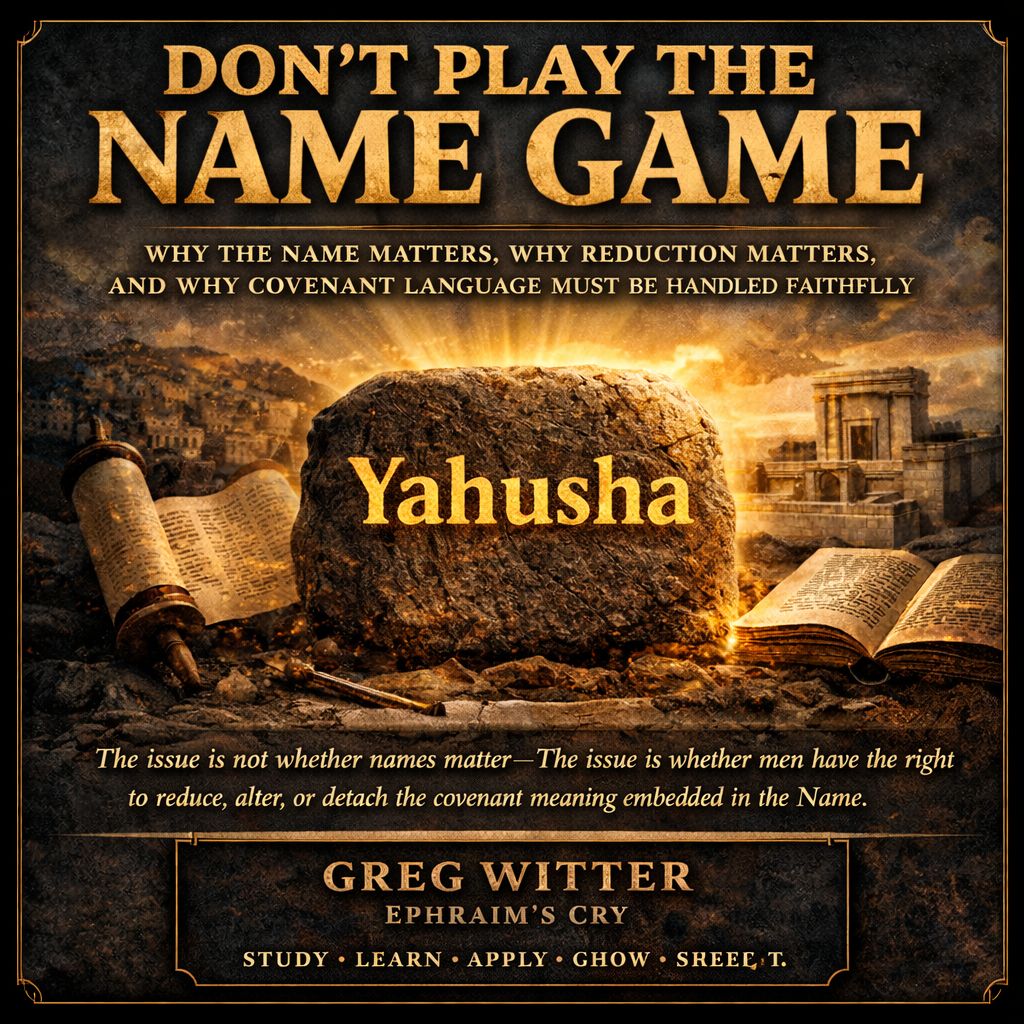
Don’t Play the Name Game
Why the Name Matters, Why Reduction Matters, and Why Covenant Language Must Be Handled Faithfully
The issue is not whether names matter—the issue is whether men have the right to reduce, alter, or detach the covenant meaning embedded in the Name.
Greg Witter | Ephraim’s Cry
Hebraic Mindset Study Series
Study Learn Apply Grow Share Repeat
The phrase “don’t be drawn into the name game” sounds wise at first, but in this case it is being used as a shield to cover a false and sloppy claim. The claim is that “Yeshua is the Hebrew word salvation,” and that this settles the matter. It does not settle anything. It confuses related words, flattens Hebrew structure, removes covenant meaning, and then mocks those who refuse to go along with the reduction.
That is not discernment. That is linguistic carelessness dressed up as simplicity.
Let us begin where the error starts. The name being discussed is treated as though it is simply identical to the noun “salvation.” But that is not precise. The Hebrew root is connected to saving, delivering, rescuing. That much is true. But a root connection is not the same thing as saying every related form is identical in meaning or function. That is exactly the kind of shallow word handling that creates confusion. Related words can come from the same root and still carry different forms, emphases, and functions. That matters in Hebrew. It matters in Scripture. It matters in covenant language.
So when someone says, “Yeshua is just the Hebrew word for salvation,” they are already oversimplifying the issue and presenting that oversimplification as if it were a settled fact. It is not. It is a reduction.
And then the deeper problem emerges. Once the reduction is accepted, the embedded covenant declaration inside the Name is treated as though it is irrelevant. But throughout Scripture, names are not random labels. They carry testimony. They carry witness. They carry meaning tied to Yahuah’s action, character, and covenant dealings. This is why names across Scripture preserve the Father’s Name within them. This is not a minor detail. This is part of how the text speaks.
Consider the pattern. Yeshayahu does not merely point to a generic idea of salvation. It bears witness that Yahuah is salvation. Yirmeyahu does not merely point to rising or appointing in the abstract. It preserves the Name and the action together. Eliyahu bears witness that Elohim is Yahuah. The theophoric element matters because it identifies who is acting. It identifies the source. It identifies the covenant frame. Remove that, and you do not merely shorten a name. You cut into its witness.
That is why this matters. The issue is not just pronunciation. The issue is not just whether a shortened form existed in some period of later usage. The issue is whether men now take a reduced form and then use that reduction to deny, diminish, or detach the fuller covenant declaration embedded in the Name. That is where the corruption enters.
The full force of the Hebraic form points to 𐤉𐤄𐤅𐤔𐤏 (Yahusha). And the covenant force of that Name is not simply “salvation” as an abstract noun floating in the air. The force is that 𐤉𐤄𐤅𐤄 is the One who saves. The source and the action are held together. Yahuah is not detached from the salvation. Yahuah is the source of the salvation. That is the point. That is the witness. That is the declaration.
This is why the statement “Yeshua is the Hebrew word salvation” is not just weak. It is misleading. It turns a covenant declaration into a generic label. It shifts the Name from testimony to simplification. It reduces the force of what is being borne witness to.
And this is also why the attempt to mock concern over the Name by calling it a “name game” is dishonest. Men play games with names when they treat them lightly, when they reduce them, when they detach them from their covenant content, and when they mock those who insist on precision. The problem is not that people care too much about the Name. The problem is that too many care too little.
Now let us go further. Some will respond by saying that shortened forms exist, and therefore the concern is overblown. But that does not solve the problem. A shortened form existing does not mean the fuller meaning disappears. A contracted form does not erase the underlying testimony. The danger begins when the contracted form is treated as though it is the complete and sufficient explanation, and the embedded witness of the Father’s Name is ignored, denied, or dismissed. That is not harmless. That is reduction.
And reduction is exactly how corruption works. First men shorten. Then they detach. Then they redefine. Then they mock anyone who objects. That pattern is not new. It is the same kind of drift that has happened in many other places where covenant meaning was steadily thinned out until only a shell remained.
The proper response is not to shrug and say, “Don’t play the name game.” The proper response is to ask whether the Name is being handled faithfully, whether its covenant content is being preserved, whether the whole counsel of Elohim supports the claim being made, and whether the witnesses align.
And that is where this false teaching fails completely.
It does not align with Torah’s pattern of names bearing covenant testimony. It does not align with the Prophets’ preservation of the Father’s Name in the names of His servants. It does not align with the Hebraic structure of names as witness-bearing declarations. And it certainly does not align with a covenant understanding that refuses to separate Yahuah from His saving work.
The whole counsel must agree. Torah, Prophets, Writings, and Apostolic witnesses do not speak in fragments. They do not contradict one another. They testify together. And when they testify together, the pattern is not vague. The Name carries witness. The Father’s Name matters. Covenant meaning matters. The source of salvation matters. The embedded declaration matters.
So no, this is not a harmless simplification. It is a reduction that weakens the witness of the Name. And no, dismissing the issue as a “name game” does not make the reduction acceptable. It only exposes that the speaker is unwilling to handle the matter with the care it deserves.
The truth is plain. The Name is not merely “salvation.” The Name bears witness that Yahuah is the One who saves. That is why the fuller Hebraic force matters. That is why preserving the Father’s Name matters. That is why reduction matters. And that is why those who mock the issue while offering sloppy linguistic shortcuts are not protecting truth. They are cutting pieces out of it.
The issue is not whether names matter. The issue is whether men have the right to strip out the covenant declaration embedded in the Name and then call the reduction “good enough.” They do not.
The Name is not a toy. It is not a slogan. It is not a convenience. It is witness.
And witness must be handled faithfully.
#GregWitter, #EphraimsCry, #HebraicMindsetStudySeries, #StudyLearnApplyGrowShareRepeat, #HebraicMindset,
#WholeCounselOfElohim, #Torah, #Prophets, #Writings, #ApostolicWitnesses, #Covenant, #CovenantFaithfulness,
#RestoredNames, #Yahuah, #Yahusha, #NameMatters, #SetApart, #Qadash, #TruthMatters, #ScriptureInContext,
#HebrewRoots, #PaleoHebrew, #CovenantWitness, #SoundDoctrine, #ExposeError, #ProveAllThings
