
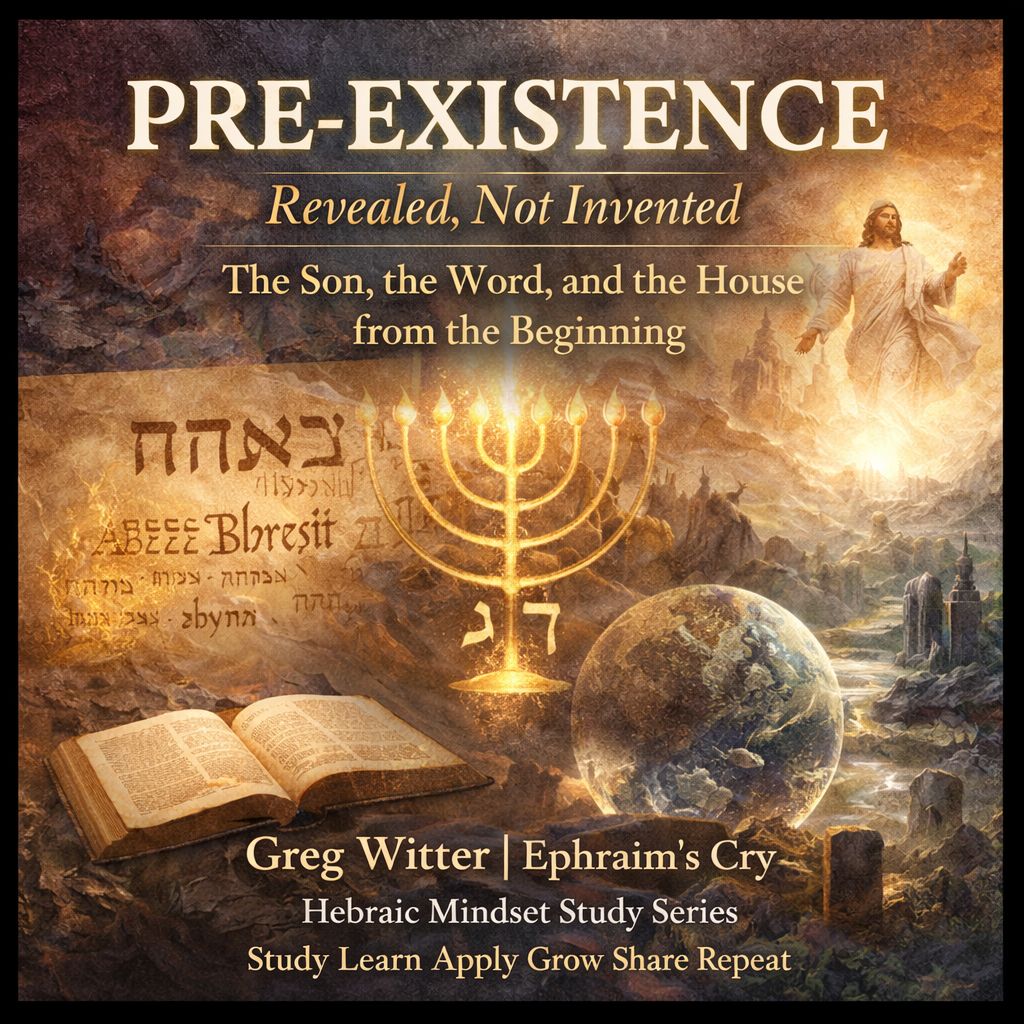
Pre-Existence: Revealed, Not Invented
The Son, the Word, and the House from the Beginning
From Bereshit to Bethlehem—What Was Eternal Was Made Visible
Greg Witter | Ephraim’s Cry
Hebraic Mindset Study Series
Study Learn Apply Grow Share Repeat
There are some subjects in Scripture that people treat like optional side roads, as though they are interesting but not essential. This is not one of them. This reaches into the very structure of the text, the identity of Messiah, the continuity of covenant, the meaning of the opening word of Scripture, and the relationship between creation, redemption, dwelling, sacrifice, and kingdom. If this subject is mishandled, then Messiah is reduced, the opening of Torah is flattened, the testimony of the prophets is fragmented, and the apostolic witness is forced into categories it was never meant to serve. So this cannot be handled lightly. It has to be handled from the ground up, from the beginning, in order, with the full counsel of Elohim intact.
Most people come to the question of pre-existence already carrying someone else’s categories. They come either with the philosophical assumptions of later trinitarian formulations, or with a reactionary denial that treats any strong witness to pre-existence as if it must automatically mean multiple Elohim or a divided divine essence. Both errors start in the wrong place. Both errors impose a framework onto the text. And both errors end up distorting what the Hebrew text actually does. The right way to handle this is not to start with doctrine and search for support. The right way is to start with Scripture and allow Scripture to build its own categories. Torah must be the foundation. The Prophets must function as the guardrails. The Writings must deepen the wisdom and pattern recognition. The apostolic witness must confirm what was already present and bring it to manifestation. That is the only safe path.
So we begin where Yahuah begins. We begin with the first verse, the first word, the first letter, the first structure. Because if Messiah truly pre-exists, then He cannot suddenly appear late in the story as a theological patch. He must already be there. He must already be embedded in the structure of revelation itself. And that is exactly what the text shows.
The Beginning Is Not Empty—It Is Full
Genesis 1:1 does not begin with emptiness. It does not begin with abstraction. It does not begin with a generic statement about origins. It begins with a loaded declaration, a carefully structured line that functions like a doorway into the whole scriptural universe. The problem is not that people have never read Genesis 1:1. The problem is that most have only read it in translation, only read it on the surface, and only read it as information instead of revelation.
Genesis 1:1 reads:
בְּרֵאשִׁית בָּרָא אֱלֹהִים אֵת הַשָּׁמַיִם וְאֵת הָאָרֶץ
This is not merely a chronological statement. It is architectural. It is covenantal. It is layered. It is structured with intention. It establishes not only that Yahuah created, but how the text itself is going to speak from that point forward. The opening verse is like a seed. Everything is already in it in form, and the rest of Scripture unfolds what is already embedded there. That means this verse must be handled with reverence, precision, and patience.
What matters here immediately is that the beginning of Scripture is already full of order, pattern, and witness. There is no sense in which Messiah has to be inserted into the story later by theological argument. If He is truly from the beginning, the text itself will show it. And it does.
What Genesis 1:1 establishes immediately
Creation is not random but ordered.
Revelation begins with structure, not chaos.
The opening line is covenantal and prophetic, not merely informative.
The beginning already contains patterns that unfold across the whole of Scripture.
Bereshit—The Word That Contains More Than “Beginning”
The first word, Bereshit (בְּרֵאשִׁית), is often translated simply as “in the beginning.” That is not false, but it is thin. It tells part of the truth, but not the depth of it. Hebrew is not built like English. Hebrew words carry internal echoes, root associations, pictographic history, and structural relationships that create layered meaning. So when the Torah opens with Bereshit, the word is not functioning only as a timestamp. It is functioning as a doorway.
Within the internal structure of this word, Hebraic readers have long seen patterns and composite possibilities. One of the recognized ways of bringing that out is through the internal word-picture often rendered as:
בֵּן רֹאשׁ בַּיִת — Ben Rosh Bayit
The Son, the Head, of the House
This is often identified in our conversation as the Bottop Sheet layer, the embedded internal witness within the first word itself. This is not a childish word game. This is not forcing random syllables into doctrine. This is the recognition that Hebrew words can carry composite prophetic structure, especially when viewed through the lens of covenant, name, and role. The beginning is not just a starting moment. It is already pointing to the House, the Head, and the Son.
That should stop the reader immediately. Before light appears in Genesis 1:3, before the firmament is divided in Genesis 1:6–8, before dry land appears in Genesis 1:9–10, the opening word is already pressing beyond mere chronology into identity. That matters. It means that the story does not develop from silence into Messiah. It develops from Messiah already embedded in the beginning.
And once you see that, you can no longer honestly talk about Messiah as though He simply begins in Bethlehem. Bethlehem is not origin. Bethlehem is manifestation. Bethlehem is appearance in flesh. Bethlehem is revelation in time of what was already present in the beginning.
What Bereshit already carries
The beginning is tied to identity, not just sequence.
The House is already implied in the first word.
The Head is already implied in the first word.
The Son is already implied in the first word.
Messiah is therefore not absent from the opening of Scripture.
Paleo-Hebrew—The Letters Themselves Speak
The argument becomes stronger when the letters themselves are allowed to speak. Paleo-Hebrew preserves pictographic associations that deepen the internal witness of the word. The letters are not arbitrary marks. They arise from ancient visual meaning. And while that must never be abused into wild speculation, it must also never be ignored when the patterns are coherent and covenantally aligned.
The letters in בראשית can be understood as follows:
ב (Bet) — house, dwelling, inside
ר (Resh) — head, chief, first, authority
א (Aleph) — strength, leader, first
ש (Shin) — consume, press, refine, teeth
י (Yod) — hand, work, action
ת (Tav) — mark, sign, covenant mark
When viewed together, the opening structure carries a prophetic movement. The House is there. The Head is there. Action is there. The covenant mark is there. The Son is not an afterthought. The text is already moving in His direction before anything is spoken into visible form. The One who will bear the covenant mark, the One whose hands will act, the One who stands as the Head of the House, is already latent in the structure of the opening word.
This matters because it means the pre-existence of Messiah is not first argued from John. John confirms it. Paul confirms it. Micah confirms it. But the seed is already in Torah. That is what we are after. We are not trying to prove a doctrine by cherry-picking a later verse. We are trying to show that the entire text already carries this witness.
What the Paleo-Hebrew layer reinforces
The opening word is not empty grammar.
Covenant is embedded in the structure.
Action by the hand is embedded in the structure.
The mark or sign of covenant is embedded in the structure.
The Head of the House is already implied before creation unfolds.
The Enlarged Bet—The First Jot, the First Tittle, the House of Eternity
The Torah does not merely begin with the letter Bet. It begins with an enlarged Bet. That is not decorative. It is deliberate. The first visible feature of the written Torah is a magnified house-letter. The first jot and tittle matter. The first visual signal matters. And the fact that Torah opens with an enlarged Bet tells the reader: pay attention to the House.
Bet means house, dwelling, what is inside, what is contained, what is built for habitation. But when that Bet is enlarged at the opening of Scripture, it presses the reader to think beyond human houses and earthly dwellings. It points to the eternal dwelling, the house from which creation itself proceeds. Before there is earth, before there is sky, before there is human habitation, there is already the dwelling of Elohim. There is already the house. And if the story begins in the House, then the story begins in the realm of eternal dwelling, not merely in the realm of physical matter.
That enlarged Bet therefore becomes deeply prophetic. It points to eternity as home. It points to the building of a dwelling. It points to the divine purpose to dwell. And once you trace that house theme forward, you discover that it runs through the entire Bible. The House in Genesis becomes the Tabernacle in Exodus 25:8. The dwelling theme becomes the Temple pattern in 1 Kings 8. It becomes the Word tabernacling among us in John 1:14. And it culminates in Revelation 21:3, where the dwelling of Elohim is with men.
So from the first enlarged Bet to the final dwelling in Revelation, the House is not a side theme. It is a central covenant thread. And if the opening letter is declaring the House, then the Head of the House and the Son of the House are not foreign ideas later brought in. They belong to the structure from the start.
What the enlarged Bet should make us see
The story begins with the House.
The House is tied to eternity.
The House is tied to dwelling, not merely architecture.
The House theme runs through Tabernacle, Temple, incarnation, and kingdom.
Messiah as Head of the House belongs to the opening structure.
The Seven Words of Genesis 1:1—Completion Before Manifestation
Genesis 1:1 contains seven words. That is not accidental. Seven in Scripture is the number of completion, fullness, oath structure, and covenantal wholeness. The week of creation itself is a sevenfold pattern culminating in the Sabbath in Genesis 2:1–3. The oath structure of שבע carries the idea of sevening oneself, of fullness and covenantal binding. So before the visible process of creation unfolds, the opening verse already presents itself in completed structure.
That means something profound: creation proceeds from completion, not toward it. The pattern is whole before the process is seen. The seed is complete before the plant emerges. In other words, Yahuah is not improvising. The opening line is already architected in covenant fullness. And if Messiah is embedded in the architecture of that opening line, then His role is not reactive. It is built into the completed design from the beginning.
This is one of the reasons the notion of Messiah as emergency plan or later solution must be rejected. Revelation 13:8 presents the Lamb as slain from the foundation of the world. First Peter 1:20 says He was foreknown before the foundation of the world. That does not mean a wooden literalism that confuses foreordination with historical execution. It means the completed covenant purpose is already present before creation proceeds. The seven-word structure of Genesis 1:1 fits that reality perfectly.
What the seven-word pattern establishes
Completion is embedded before creation unfolds.
The covenant pattern is whole before manifestation.
Messiah is therefore not response but design.
The opening verse itself carries an oath-like fullness.
The Menorah Structure in Genesis 1:1—Aleph–Tav at the Center
The seven-word structure of Genesis 1:1 can also be seen in a Menorah-like symmetry. When the seven words are laid out, they create a center with three words on each side:
Bereshit
Bara
Elohim
Et
Hashamayim
Ve’et
Ha’aretz
At the center stands את—the Aleph–Tav. The Menorah in Exodus 25:31–32 is structured with a central shaft and three branches on each side. The light-bearing structure of the sanctuary thus becomes a useful visual echo of the opening verse. At the center of the opening creation line stands the Aleph–Tav. At the center of the light-bearing sanctuary structure stands the central shaft. The correspondence is not casual. It is revelatory.
Now bring Revelation 1:8 into view:
“I am the Aleph and the Tav.”
That means the One who identifies Himself as beginning and end stands structurally at the center of the first verse. Not hidden in the margins. Not appended later. Centered. This is one of the strongest structural witnesses to Messiah in Genesis 1:1. It does not replace the grammatical function of את as a direct object marker. It deepens it. The text carries both visible function and deeper witness. That is how Hebrew often works. The grammar serves the sentence, and the structure serves the revelation.
The Menorah connection matters further because the Menorah is a light-bearing object in the sanctuary. It is tied to priestly ministry, divine presence, ordered worship, and the house of Elohim. So when the opening verse takes a sevenfold pattern with Aleph–Tav at the center, it is not merely aesthetically pleasing. It is prophetically loaded. It shows that light, presence, dwelling, and the central One are all connected.
What the Menorah structure reveals
Genesis 1:1 is symmetrical and purposeful.
The Aleph–Tav stands at the center.
Messiah is central to creation, not peripheral.
The House, the light, and the center all align.
The Aleph–Tav—Signature, Marker, Presence
The Aleph–Tav appears in Genesis 1:1 twice:
אֵת הַשָּׁמַיִם וְאֵת הָאָרֶץ
Most readers are never taught to see it. It is untranslated in English because it functions grammatically. But the fact that it is grammatical does not make it spiritually empty. The first and last letters of the Hebrew aleph-bet appear in the opening verse in direct relation to the heavens and the earth. Then the risen Messiah identifies Himself with precisely that range:
“I am the Aleph and the Tav” (Revelation 1:8; compare Revelation 22:13).
This must be handled carefully. It must not be turned into superstition or mechanical mysticism. But neither may it be flattened into irrelevance. The fact is that the opening creation verse carries the full alphabetic span in a way that aligns with the One who later declares Himself beginning and end. That is not a coincidence without meaning. It is a signature. It is a marker. It is an identity witness embedded in the line.
And once that is seen, the opening verse becomes even more charged. Creation itself is framed by the One who is first and last. Heaven and earth are held inside a structure that already carries His sign. That aligns beautifully with Colossians 1:16–17, where all things are created through Him and held together in Him.
What the Aleph–Tav adds to the witness
Messiah’s signature is present from the beginning.
Heaven and earth are framed by His identity.
Creation already bears the witness of the One who is first and last.
Heaven and Earth Symmetry—The Center as the Bridge
The seven-word structure also creates a visible relationship between heaven and earth with the center acting as a bridge. Word 5 is “the heavens.” Word 7 is “the earth.” The center line involving Aleph–Tav and the mirrored structure creates a sense of mediation. That is not the full doctrine yet, but it is a structural anticipation. Scripture later confirms that the One at the center is the One through whom heaven and earth are joined.
John 1:51 records Yahusha telling Nathanael that he will see heaven opened and the messengers of Elohim ascending and descending upon the Son of Man. That is Jacob’s ladder language from Genesis 28:12, but now centered in the Son. Heaven and earth meet in Him. That reality is anticipated in the opening structure of Genesis itself. The One at the center is the bridge. The One at the center holds the structure. The One at the center makes the connection possible.
What this symmetry points toward
Messiah stands between heaven and earth as the appointed center.
The opening verse anticipates mediation.
The Son is the meeting point of heaven’s authority and earth’s manifestation.
Light Before the Sun—Presence Before Luminaries
Genesis 1:3 says:
“Let there be light.”
The sun, moon, and stars do not appear until Genesis 1:14–18. That means light precedes luminaries. This is often treated as a scientific puzzle, but textually it is also revelatory. Light is not ultimately dependent on created lamps. Light originates in Yahuah. And when John 1:4 says that in Him was life and the life was the light of men, and when John 8:12 records Yahusha saying He is the light of the world, the connection intensifies.
The Menorah is a light-bearing object in the sanctuary. The opening verse can be seen in Menorah pattern. The Aleph–Tav stands at the center. Light appears before the heavenly lamps. The Word is declared to be life and light. The pattern is coherent. The One in the center of creation is the One who is source-light before the created lights appear. So the text is not merely saying that physical illumination exists before the sun. It is also pointing to the deeper reality that the source of light is the presence and expression of Yahuah Himself.
What the light pattern contributes
Light in Genesis is not merely physical.
The source of light is tied to the divine presence.
The Menorah, the Word, and the light all converge in Messiah.
The Word—Hebraic Expression, Not Greek Abstraction
John 1 must be handled from a Hebraic framework, not through later philosophical categories. “The Word” is not best understood as an abstract Greek logos detached from covenant speech. The Hebrew concept of Dabar is active, effective, expressive, and manifesting. Yahuah speaks and reality responds. Yahuah commands and history bends. Yahuah declares and His purpose stands. That is the world John is writing into.
So when John says:
“In the beginning was the Word, and the Word was with Elohim, and the Word was Elohim” (John 1:1),
he is not trying to force a later creedal formulation onto Torah. He is saying that the active self-expression of Yahuah, the one by whom all things came to be, was present in the beginning and was not separate from Elohim’s own identity. Then:
“And the Word became flesh and tabernacled among us” (John 1:14).
That is manifestation language. That is Tabernacle language. That is House language. The Word that was with Elohim and was Elohim did not cease to be what He was when made visible in flesh. Rather, what was from the beginning entered visible human manifestation.
This is why Bethlehem is not origin. Bethlehem is revelation. The Word did not begin there. The Word became flesh there.
What John 1 establishes
The Word is already present in the beginning.
The Word is not external to Elohim.
The Word becomes flesh; He does not begin in flesh.
The House/Tabernacle theme continues through incarnation.
Messiah Came Down—He Did Not Begin
The direct pre-existence statements in the Gospels cannot honestly be reduced away. Yahusha says:
“I have come down from heaven” (John 6:38).
“What if you see the Son of Man ascend where He was before?” (John 6:62).
“Glorify Me together with Yourself, with the glory which I had with You before the world was” (John 17:5).
These are not vague metaphors. They are explicit. They speak of prior existence, prior glory, and prior place. This does not require us to adopt philosophical categories foreign to Scripture. It simply requires us to let Yahusha speak for Himself. He came down. He was before. He had glory with the Father before the world was.
That must be held together with Luke 1:35 and Galatians 4:4, which speak of His birth and manifestation in flesh. Scripture does not present a contradiction. It presents revelation in stages. The One who was with the Father before the world was is manifested in time, born of a woman, under the law, to redeem those under the law. Pre-existence and incarnation are not rivals. Incarnation is the visible entry of the pre-existent One into the human covenant story.
What these direct sayings prove
Yahusha speaks of prior existence.
Yahusha speaks of prior glory.
Yahusha speaks of prior location with the Father.
Bethlehem therefore cannot be the beginning of His existence.
Micah 5:2—From of Old, From Everlasting
Micah 5:2 must not be left as a passing citation. It needs to be brought out fully:
“But you, Bethlehem Ephrathah… from you shall come forth to Me the One to be ruler in Israel, whose goings forth are from of old, from everlasting.”
This is one of the clearest prophetic witnesses. Bethlehem is named as the place of coming forth in manifestation, but that is immediately followed by language that stretches backward beyond ordinary human origin. His goings forth are from of old, from everlasting. The prophet does not present a man whose existence begins in Bethlehem. He presents a ruler whose historical manifestation in Bethlehem is grounded in a reality that precedes it.
That is exactly the distinction the whole teaching has been making: manifestation is not origin. Bethlehem is the earthly appearing of One whose “goings forth” precede the event.
What Micah 5:2 contributes
It ties Messiah to Bethlehem in manifestation.
It simultaneously denies Bethlehem as absolute origin.
It anchors Messiah’s emergence in everlasting reality.
Colossians 1:16–17—Before All Things
Paul writes:
“Because in Him were created all things… all have been created through Him and for Him. And He is before all things, and in Him all hold together.”
This is one of the strongest apostolic witnesses to pre-existence. It is not enough to quote it. It must be felt in its force. Paul does not say Messiah merely outranks all things. He says He is before all things. Paul does not say all things merely reflect Him. He says all things are created in Him, through Him, and for Him. Paul does not say the world continues independently after being made. He says in Him all things hold together.
This is not language that can honestly be reduced to mere foreordination in a weak sense. It is cosmic, but covenantal. It aligns perfectly with Genesis 1:1, with John 1:1–3, and with Revelation’s declaration of the Aleph and Tav. The One at the center of creation is the One in whom creation coheres.
What Colossians 1 adds
Messiah is before all things, not merely before some.
Creation is through Him and for Him.
The coherence of creation is in Him.
Philippians 2:5–7—Existing in the Form of Elohim
Philippians 2 must be taken seriously:
“Who, existing in the form of Elohim, did not consider equality with Elohim something to be seized, but emptied Himself, taking the form of a servant, having come to be in the likeness of men.”
The force of the text is clear. There is an existence prior to taking the form of a servant. There is a voluntary self-emptying. There is a movement into human likeness. This is not the language of a mere man whose existence begins at birth. It is the language of descent into flesh and servanthood by One who already exists in a prior state.
Again, this need not be loaded with philosophical abstractions foreign to Scripture. It simply needs to be believed as written. Messiah existed in the form of Elohim and then entered servanthood in flesh. That aligns with John 1:14 and John 17:5 and confirms the same witness.
What Philippians 2 clarifies
Pre-existence is tied to voluntary humiliation.
Incarnation is an act of descent, not origin.
Servanthood is the manifestation of One who existed prior.
First John 1:1–2—The Life Was with the Father and Was Manifested
First John opens with a remarkable statement:
“The Life was manifested, and we have seen, and bear witness, and announce to you the everlasting life which was with the Father and was manifested to us.”
This is devastating to the idea that Messiah begins to exist at birth. The life was with the Father. Then that life was manifested. John does not say it came into existence when manifested. He says it was with the Father and was manifested to us. Manifestation is appearance. It is making visible what already was.
This is one of the cleanest ways Scripture speaks. It requires no philosophical machinery. It only requires honesty. What was with the Father was manifested.
What First John 1 contributes
The life was with the Father before manifestation.
Manifestation is not creation.
The apostolic witness confirms what was already there.
Tanakh Manifestations—The Text Already Hints at Complexity
The Hebrew Scriptures repeatedly present moments in which Yahuah is encountered in ways that refuse simplistic flattening. Genesis 1:26 says, “Let Us make man in Our image.” Genesis 19:24 says, “Yahuah rained on Sodom and Gomorrah sulfur and fire from Yahuah out of the heavens.” Exodus 3:2–6 presents the Messenger of Yahuah appearing in the bush, yet the speaker is identified as Elohim and as the Elohim of Abraham, Isaac, and Jacob. Judges 13:18–22 ends with Manoah saying, “We shall surely die, because we have seen Elohim.”
These passages must not be abused. They do not teach multiple gods. They do not overthrow Deuteronomy 6:4. But they do show that the one Elohim reveals Himself in ways richer than flat unitarian reduction can handle. The text itself already contains manifestation language, messenger language, appearance language, and identity overlap that prepare the reader for the fullness of revelation in Messiah.
What these manifestations show
The one Elohim reveals Himself with complexity.
Messenger language can overlap with divine self-disclosure.
The Tanakh prepares the reader for manifestation, not merely abstract monotheism.
Deuteronomy 6:4—Oneness Preserved, Not Denied
The Shema stands:
“Hear, O Israel: Yahuah our Elohim, Yahuah is one” (Deuteronomy 6:4).
Nothing in this teaching overturns that. The error would be to think pre-existence must mean multiple Elohim or divided deity. That is not what Scripture teaches. The error on the other side is to use the Shema to flatten every manifestation text into silence. The oneness of Elohim is not threatened by the Word being with Elohim and being Elohim, nor by the Name being in Him, nor by the Life being with the Father and manifested. The problem is not the text. The problem is the categories forced onto the text.
The Hebraic position preserves oneness while allowing revelation, manifestation, expression, and embodied authority. That is stronger and more textually faithful than either philosophical trinitarianism or flattening unitarianism.
What the Shema guards
There is one Elohim.
Manifestation does not equal polytheism.
Pre-existence does not require a divided Godhead.
The Name in Him—Exodus 23:20–21
This witness must be given its full weight:
“See, I am sending a Messenger before you… guard yourselves before His face and obey His voice… because My Name is in Him.”
The Name is not a label. The Name carries authority, identity, presence, and delegated power. This is not a generic messenger. This is not mere angelic function. The command is to obey His voice because the Name of Yahuah is in Him. That means that when this figure acts, He does so in a uniquely charged revelatory way. This is one of the strongest Torah witnesses to the manifestation principle that reaches fulfillment in Messiah.
What Exodus 23 establishes
The Name in Him means authority and identity.
This messenger is not a mere ordinary messenger.
Torah already anticipates embodied divine authority.
Psalm 110:1 and Daniel 7—Authority Before Bethlehem
Psalm 110:1 says:
“Yahuah said to my Master, Sit at My right hand until I make Your enemies Your footstool.”
This is already messianic enthronement language. David speaks of one greater than himself. Daniel 7:13–14 then gives the vision of the Son of Man coming with the clouds of heaven and receiving dominion, glory, and a kingdom. This is not a late church invention. This is prophetic witness. The Son of Man receives kingdom authority in heaven’s court before the visible kingdom fills the earth.
That matters because it shows Messiah in the realm of heavenly authority, receiving dominion that later becomes visible in history and ultimately universal in manifestation. Bethlehem is not the start of the Son’s significance. Bethlehem is the moment He enters flesh as the One already bound to heavenly authority and eternal purpose.
What Psalm 110 and Daniel 7 add
Messiah’s authority precedes earthly manifestation.
The Son of Man is linked to heavenly dominion.
David and Daniel both point beyond mere human emergence.
The Covenant Spine—Seed, Lamb, Offering, Firstfruits
Pre-existence is not an isolated idea floating above the covenant. It is woven into the covenant spine of Scripture. Genesis 3:15 introduces the Seed conflict. Genesis 22 presents the substitution pattern on Moriah. Exodus 12 reveals the Passover Lamb. Leviticus 23 orders the appointed times. First Corinthians 15:20 calls Messiah the Firstfruits. Revelation 13:8 and First Peter 1:20 show the Lamb foreknown before the foundation of the world.
That means the One from the beginning is the One who fulfills the appointed times. The One embedded in Genesis 1:1 is the One who is selected as the Lamb, inspected, slain, buried, raised, and presented. Pre-existence is not merely about where He was before. It is about the fact that the whole covenantal script was already centered in Him from the foundation.
What the covenant spine proves
Messiah is not inserted into covenant; He is its center.
Passover, Firstfruits, and the Seed promise all align in Him.
Pre-existence is tied to foreordination and fulfillment.
The House Thread—From Bet to Tabernacle to Kingdom
The enlarged Bet at the start declares the House. That thread continues everywhere. Yahuah says in Exodus 25:8, “Let them make Me a sanctuary, and I shall dwell among them.” John 1:14 says the Word became flesh and tabernacled among us. Revelation 21:3 announces that the dwelling of Elohim is with men.
This is one line. One House thread. The purpose of creation is not simply existence. It is dwelling. It is house-building in covenantal form. That means the Head of the House and the Son of the House are not optional interpretive additions. They are inseparable from the purpose of the House itself.
What the House thread reveals
Creation is ordered toward dwelling.
Tabernacle and Temple are not isolated institutions.
Incarnation is a dwelling event.
The kingdom culminates in permanent dwelling.
John 20:17 and Firstfruits—Presentation of the One from the Beginning
When Yahusha says to Miryam in John 20:17, “Do not cling to Me, because I have not yet ascended to My Father,” that is not random. It is tied to the Firstfruits pattern. First Corinthians 15:20 identifies Messiah as the Firstfruits. The One who was from the beginning is not only the creator and the Word. He is also the offering. He is the Lamb. He is the Firstfruits presentation.
This matters because it means pre-existence is not merely backward-looking. It is also forward-driving. The One who was embedded in Genesis 1:1 is the same One fulfilling the appointed times in exact covenant precision. The One from the House of eternity is the One who rises and is presented before the Father as the Firstfruits of the coming harvest. That is why this subject cannot be isolated from your Appointed Week teaching framework. It belongs there. It strengthens it.
What the Firstfruits layer adds
The pre-existent One is the fulfilling One.
Creation and resurrection are tied through the same Messiah.
The beginning and the new creation meet in Him.
Proverbs 8 and Wisdom—A Supporting Witness
Proverbs 8 must be handled carefully, but it does contribute to the theme. Wisdom is portrayed in pre-creation terms, present before the ordering of the world. While it should not be simplistically equated with Messiah in every line, the pattern contributes to the broader biblical witness that Yahuah’s active ordering wisdom precedes creation and is intimately bound to it. When later Scripture presents Messiah as the wisdom and power of Elohim (First Corinthians 1:24), the connection strengthens.
What Proverbs 8 contributes
The pattern of pre-creation presence is not foreign to Scripture.
The wisdom theme supports the concept of active divine expression before creation.
Later apostolic application to Messiah deepens the witness.
What This Teaching Refuses
This teaching refuses two opposite errors. It refuses the reduction that says Messiah is merely a man whose existence begins at birth. And it refuses the imported philosophical constructions that push the text into categories it does not itself build. It does not need either. Scripture is richer than both. The one Elohim reveals Himself through His Word, His Name, His manifestation, His embodied authority, and His Son. The Son is not an afterthought. The Son is not a late adjustment. The Son is not foreign to Torah. The Son is embedded from the beginning.
Errors exposed
Unitarian reduction collapses manifestation into mere future plan and weakens direct pre-existence testimony.
Trinitarian overreach imports philosophical categories not required by the Hebrew text.
Hebraic covenantal reading preserves one Elohim and honors the full witness of manifestation and pre-existence.
What Most Readers Still Miss
Even after all of this, many still miss the force of what the text is doing. They read Genesis 1:1 and see only sequence. They read John 1:1 and see only doctrine. They read Micah 5:2 and skip over “from everlasting.” They read Colossians 1 and reduce “before all things” to rank instead of existence. They read John 17:5 and explain away shared glory. They read the Aleph–Tav and never notice it. They read the enlarged Bet and never ask why it is enlarged. They read the seven-word structure and never consider why it is seven. They read the Menorah and never connect it back to Genesis. They read the House theme and never follow it through to Revelation.
But the text is patient. It keeps saying it. It keeps showing it. It keeps layering witness upon witness until the honest reader can no longer pretend that Bethlehem is origin.
Final Synthesis
Now step back and look at the whole pattern.
The enlarged Bet declares the House.
Bereshit carries the Son and the Head of the House.
The seven words declare completion.
The Menorah structure places the Aleph–Tav at the center.
The light appears before the sun.
The Word is with Elohim in the beginning.
The Name is in Him.
Micah says His goings forth are from everlasting.
John says He came down from heaven and had glory before the world was.
Paul says all things are through Him, for Him, and held together in Him.
John says the Life was with the Father and was manifested.
The covenant spine reveals Him as Seed, Lamb, and Firstfruits.
The House thread moves from Genesis to Tabernacle to incarnation to kingdom.
This is not a loose collection of ideas. This is a unified scriptural reality. Messiah does not begin in Bethlehem. He is revealed there. He is manifested there. He is made visible there. But He was already there from the beginning—in the House, in the Word, in the Name, in the structure, in the covenant, in the purpose of Elohim.
Bottom Line
Pre-existence is not:
philosophy,
tradition,
speculation,
or a doctrine patched together from isolated verses.
Pre-existence is:
structural,
textual,
covenantal,
embedded in the beginning,
confirmed by the prophets,
deepened by the writings,
and manifested in the apostolic witness.
Final Line
From the House of Eternity,
the Head of the House,
the Son,
the Word,
the Aleph and the Tav,
the One whose Name carries the authority of Yahuah,
the Lamb foreknown before the foundation,
the Firstfruits of the coming harvest,
was already there.
Bethlehem did not create Him.
It revealed Him.
#GregWitter#EphraimsCry#HebraicMindset#Torah#Yahuah#Yahusha#Bereshit#AlephTav#PaleoHebrew
#WordMadeFlesh#CovenantTruth#ReturnToTorah#WholeCounsel#Firstfruits#KingdomTruth#HouseOfElohim
#BenRoshBayit#MenorahPattern#PreExistence#SeedPromise#PassoverLamb
