
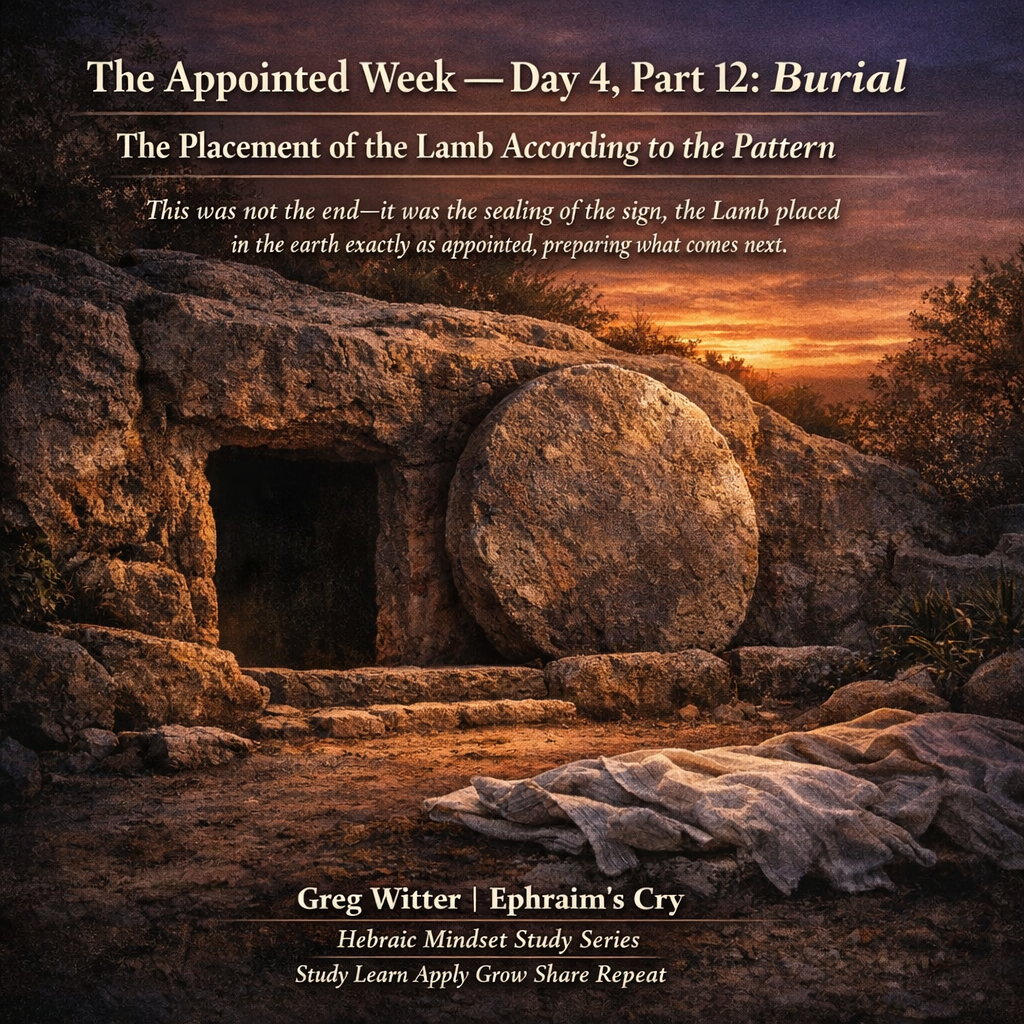
The Appointed Week — Day 4, Part 12: Burial
The Placement of the Lamb According to the Pattern
This was not the end of the story, but the sealing of the sign—the Lamb placed in the earth exactly as appointed, confirming death, beginning the count, fulfilling the pattern, and preparing for what was to come.
Greg Witter | Ephraim’s Cry
Hebraic Mindset Study Series
Study Learn Apply Grow Share Repeat
Burial must never be treated as an afterthought. It must never be treated as cleanup after the visible violence of the stake. It must never be treated as the quiet fading out of the scene after the “real” event has already happened. Burial is part of the appointed pattern. Burial is part of the witness. Burial is part of the sign. Burial is part of the covenant execution. What was declared at the table, yielded in the garden, exposed in the trials, mocked by men, lifted up before the people, and confirmed in death through blood and water is now carried into the earth according to the requirement. This is not a minor transition note between death and resurrection. This is the placement of the Lamb according to the pattern. This is the closing of one phase and the sealing of the next. This is where the body of the Lamb is handled according to Torah, prophecy, honor, timing, priestly pattern, and covenant order. If this part is weakened, then the sign is weakened. If this part is rushed, then the sequence is broken. If this part is flattened into a simple statement that “He was buried,” then much of the covenant weight is lost. Burial matters because the Lamb must not only die according to what is written—He must also be placed according to what is written.
This part begins where Death (Blood & Water) leaves us. The offering has been confirmed. The side has been pierced. The blood and water have come forth. The witness has been given. The death is real. The Lamb has yielded His spirit. The earth has answered. The veil has been torn. The body is now no longer living, and that matters because burial cannot begin until death is certain. Burial does not begin from assumption. Burial begins from confirmed death. The soldiers know it. Pilate verifies it. The body is not removed as though there were uncertainty. The body is released because the execution is complete. This must remain clear, because the burial is not the concealment of a man who survived. It is the placement of the Lamb who truly died. The sacrifice has been made. The witness stands. Now the body must be handled according to the pattern.
And the pattern still governs. Death did not suspend Torah. Suffering did not erase appointed order. The same Elohim who established the appointed times, the same Word that governed the Lamb before death, still governs what happens after death. The body may not remain hanging there. It may not stay exposed overnight. It may not be left publicly displayed as though this were simply Roman disposal of a criminal corpse. The day is moving toward its close. The High Day is approaching. The Sabbath is near. Time is short. The body must be removed. The burial must happen within the appointed window. That urgency matters, because it means the burial is not disconnected from the calendar. It is not random. It is not simply when people happened to find time to handle the body. The burial is bound to the holy timetable. The same precision that marked the death now marks the burial. The Lamb dies on Yahuah’s clock and is buried on Yahuah’s clock.
And this is exactly where the sign of Yonah must be brought in with force and clarity. As it was with Yonah, so it would be with the Son of Man. The sign was not merely death. The sign was not merely suffering. The sign was not merely disappearing from public view. The sign was being in the earth. The language matters. Three days and three nights in the belly of the great fish pointed forward to three days and three nights in the heart of the earth. That means burial is not a side issue. Burial is the beginning of the count. The body entering the tomb is the body entering the earth. The sign is now underway. The count has begun. This is the evening that closes Day 4. This is the evening that the Passover would be eaten. The Lamb has died at the time of the Passover sacrifice, approximately the ninth hour, around 3 p.m., and before the coming High Day He is placed into the earth. That placement matters because without burial the count has no rightful beginning. The sign begins not simply at the final breath, but with the confirmed death and the body laid into the earth according to the pattern.
That point must be driven in because many mishandle the count by treating burial as secondary. It is not secondary. The phrase “in the heart of the earth” is not vague religious poetry. It is burial language. It is placement language. It is sign language. It is timing language. The body must be in the tomb. The body must be hidden in the earth. The body must enter that phase from which the three nights and three days are reckoned in the unfolding story. So this burial is not only honorable handling of the body. It is the beginning of prophetic count. It is the moment when the sign transitions from spoken prophecy to embodied fulfillment. He has said what would happen. Now the earth receives Him, and the count begins.
And that means Day 4 does not merely end with sorrow. It ends with precision. It ends with sequence. It ends with the sealing of the sign. The day that began with covenant meal and spoken meaning closes with the body in the tomb and the countdown underway. The Lamb who spoke over the bread and cup now lies in the earth. The Lamb who was examined, condemned, mocked, pierced, and confirmed dead is now hidden from sight. This is not random collapse. This is appointed transition.
This is where Joseph of Arimathea steps forward, and his role must not be reduced to a brief mention. Joseph matters because he embodies a shift in the witness. Up to this point, the public scene has largely been ruled by hostility, mockery, violence, rejection, cowardice, and abandonment. Now another kind of witness begins to emerge. Hidden loyalty begins to move into visible action. Joseph is a man of standing, a counselor, a man with access, a man of means, a man waiting for the kingdom, and yet until this point he has not been one of the loud public faces of loyalty. But now he comes forward, and the timing of his movement matters. He does not step forward when the crowds are favorable. He does not act when association would be cheap. He does not move when alignment would cost little. He moves after the execution. He moves after the condemnation. He moves after the shame. He moves after the public rejection has run its course. He goes to Pilate and asks for the body. That is not a small act. That is public identification with the one whom the world has just condemned.
There is something here that must be pressed in. It is one thing to admire Yahusha when the crowds are listening. It is another thing to stand near Him when the system has marked Him for death. It is one thing to follow when miracles are multiplying, when the crowds are gathering, when hope feels visibly triumphant. It is another thing entirely to ask for the body of the executed one after the public machinery of shame and judgment has done its work. Joseph is stepping into risk. He is attaching himself to the condemned. He is making visible alignment with the one just publicly rejected. This is costly identification. This is not emotional admiration. This is not private sympathy. This is action. This is a hidden disciple becoming visible when visibility costs something.
And Nicodemus matters too. He must not be left in the background as a supporting footnote. Nicodemus is the one who first came by night. He came earlier in secrecy, under darkness, asking questions, seeking understanding, moving carefully around the public implications. But now he also comes forward, and he comes not empty-handed. He brings spices in abundance. That matters. His movement mirrors Joseph’s. A man who once came quietly now comes publicly into the handling of the body. So the burial scene is not only about the placement of the Lamb. It is also about the exposure of hidden discipleship. Men who were not yet public are now made visible by what they do with the body of Yahusha. This is one of the quiet but powerful reversals in the scene. Some who once spoke boldly have scattered in fear. Some who once remained hidden now step into visible loyalty. Burial exposes hearts too.
And Pilate himself becomes part of the burial sequence in a way that matters. He confirms the death. He does not release the body on rumor. He does not hand it over on emotional request alone. He verifies that Yahusha is indeed dead. This reinforces what Part 11 already established. Death is real. The sacrifice is complete. The burial is not based on uncertainty. It is based on confirmation. The body is released because the execution has reached its end. That matters, because it closes off every weak attempt to reduce the burial to the concealment of a half-dead man. No. The governor confirms the death. The soldiers have verified the death. The spear has confirmed the death. The blood and water have witnessed the death. The body given to Joseph is the body of the Lamb who has truly died.
Then the body is taken down. That moment itself must be allowed to carry its own weight. The body that had been scourged, mocked, struck, pierced, bloodied, and lifted up is now removed from the stake. This is not just a physical action. This is the transition from public sacrifice to hidden placement. The body is no longer before the eyes of the mocking crowd in the same way. It is now in the hands of those who honor Him. That shift matters. Men may have treated Him with violence, contempt, and humiliation, but the body is not left to dishonor. The Lamb is handled with care. He is not discarded. He is not thrown into a common pit. He is not abandoned as refuse. He is taken down. He is received. He is borne away from the place of public execution into the hands of those who will prepare Him for burial. Even here the honor due the Lamb begins to reassert itself after the public disgrace.
And the preparation of the body matters because it shows that burial is ordered, not chaotic. The body is wrapped. Linen is used. Spices are brought. The burial is done according to the burial custom of the Yehudim. This is not sentimental excess. This is not decorative detail. This is ordered preparation. This is reverent handling. This is covenant dignity being maintained even under time pressure. And time pressure is real here. The High Day approaches. Sunset is drawing near. Everything must be done quickly, but not carelessly. That balance matters. The burial is hurried in timing, but it is not sloppy in honor. The body is prepared with what can be done within the available time, and that itself shows the intersection of urgency and reverence. They do not have endless hours. They do what the moment allows, and they do it with care.
And that care matters all the more because of what the body has just endured. This is the body that bore scourging. This is the body that was struck on the head. This is the body that wore the crown of thorns. This is the body that carried the stake. This is the body whose hands and feet were pierced. This is the body whose side was opened. This is the body from which blood and water came forth. The burial preparation is the first moment in which the body is treated not by enemies in contempt but by disciples in reverence. That contrast belongs in the teaching. The world wounds. The remnant handles with care. The system humiliates. The faithful prepare with honor. Public violence gives way to covenant tenderness.
Then comes the tomb, and here the burial must go deeper still. The tomb is not random. It is not a borrowed cave in the general sense of convenience. It is a new tomb. Unused. Untouched. No one had yet been laid there. That matters. It is set apart. It is distinct. It is not confused with the remains of another. It is not a shared burial place cluttered with previous bodies. There is no mixture. There is no uncertainty. There is no contamination of identity. This is a prepared place. That must be emphasized because the burial is as precise as the death. The place that receives the body is marked by distinctness. The Lamb is placed in a location fitted to clarity, witness, and prophetic precision.
And there is more here. The tomb belongs to a rich man. That matters because the burial fulfills what had already been spoken. The one rejected, condemned, mocked, and executed with criminals is nevertheless with the rich in His death. That is not contradiction. That is prophecy fulfilled in tension. Public shame and burial honor meet in the same figure. Men treated Him as cursed. Yahuah still ordered the burial according to the word already spoken. The world says criminal. The prophetic word says the grave will still bear witness to something more. So the tomb of Joseph becomes part of the witness. Burial is not happening in a forgotten ditch. Burial is happening in a way that fulfills what was written.
The newness of the tomb also matters in another way. Just as there was no confusion in life about His identity, there must be no confusion in burial about His body. No prior body had occupied that place. No previous remains could be mistaken for His. The location itself serves the witness. The burial is clear. The placement is clear. The body laid there is His and His alone. This matters for sequence, for testimony, and for the coming resurrection witness. The tomb itself is part of the ordered pattern.
And the location of the tomb in a garden is not without significance. The last hours of Day 4 have already moved through a garden at Gethsemane, where the will was pressed and obedience was settled. Now another garden receives the body. The movement from garden to garden should not be ignored. In the garden the Son yielded. In the garden the body is laid. The place of prayer and surrender gives way to the place of hiddenness and burial. There is a deep pattern there: obedience in the garden leads to placement in the garden. The one who yielded to the Father’s will in the place of pressing is now laid in the place of quiet concealment. This is not accidental storytelling. This is ordered movement.
Then the body is laid in the tomb, and this moment must be handled with covenant seriousness. Burial is not just putting a body somewhere. Burial is placement. Burial is positioning. Burial is the beginning of the sign in the earth. The Lamb must go into the earth. This cannot be treated symbolically only. It is physical. It is real. The body is placed into the tomb. The heart of the earth language begins to take on its full form here. The sign of Yonah requires more than death. It requires burial. It requires being in the earth. That is why burial is not optional to the sign. Without burial, the sequence is incomplete. Without burial, the three days and three nights language is mishandled. Without burial, the earth has not yet received the body. So when the body is placed into the tomb, the sign enters its sealed phase.
This is one of the reasons burial must not be softened into passive language. Burial is not simply the sad conclusion to the day’s tragedy. Burial is a covenant act within the pattern. The body is placed according to what must unfold next. The seed goes into the earth. That language matters too. Burial is not just finality. Burial is planting. Burial is not just closure. Burial is positioning. Burial is not just concealment. Burial is the necessary placement before emerging life. The world sees burial as end. The covenant pattern knows burial can also be beginning. That does not lessen the reality of death. It deepens the meaning of placement.
And here is where the priestly layer you raised belongs. This burial also points toward priestly transition and priestly isolation. The old order is giving way. The Lamb has died. The offering has been made. The body is placed into hiddenness. There is a withdrawal from public visibility. There is an interval before open presentation. There is a movement from sacrifice to concealed priestly transition and then toward ascension and presentation before the Father. That pattern matters. The priest who goes into seclusion, the priestly waiting, the interval before appearing, the movement from offering into presentation—these threads come into sharper focus here. The burial is not only kingly and sacrificial in meaning. It is also priestly in movement. He is not merely a slain Lamb. He is moving as the Melchizedek Priest through the appointed process.
And that means the three days and three nights are not empty waiting time. They are not meaningless delay. They are part of priestly transition. They are part of the hidden interval between sacrifice made and open presentation. The burial marks the beginning of that concealed priestly phase. The body is placed in the earth. The public work goes hidden. The visible ministry stops. The priestly transition moves in the unseen. And then, in the larger pattern, there is emergence, resurrection, and presentation before the Father in relation to first fruits and wave offering. That means the burial is not only about the body in the tomb. It is about what the tomb represents in the transition from one priestly order to another. It is the hidden interval between public sacrifice and openly manifested priestly presentation.
That point should not be left vague. The Melchizedek priesthood is not an abstract doctrine floating above the story. It is embodied in the sequence. The old order could offer repeated sacrifices and still leave the worshiper in ongoing need. Here the offering is made once, completely, and then the one who offers is not merely victim but priest. Burial marks that concealed transition. The Lamb is laid away from public sight. The visible phase closes. The next movement will not simply be “coming back to life” in a bare physical sense. It will be resurrection within priestly, firstfruits, and ascensional pattern. So yes, this burial does indicate a transition toward the Melchizedek priesthood, and that layer belongs here because it deepens the meaning of the hidden interval.
And then the stone is rolled into place. This too must not be treated as mere physical detail. The stone closes the tomb. The visible entrance is shut. The public view is blocked. The body is now hidden from sight. That matters because Day 4 has been a day of visible action until now. The table was visible. The room was visible. Judas leaving was visible. Gethsemane was visible. The arrest was visible. The trials were visible. Pilate was visible. The scourging was visible. The lifting up of the Lamb was visible. The blood and water were visible. But now a line is crossed. The stone marks the transition from visible work to hidden work. The body is no longer before the eyes of the people. The Lamb is hidden. The scene closes. The visible drama ends. Silence takes over. That shift is part of the pattern.
And with the stone comes sealing. The tomb is not merely closed. It is secured. The authorities remember enough to fear the possibility of what had been said about rising. They may not believe the promise, but they are troubled by it. This is one of the bitter ironies of the scene. The enemies remember words about the third day more readily than the disciples seem to understand them. So they ask for the tomb to be secured. A guard is set. A seal is placed. Men try to lock down what Yahuah has already ordered. This matters because burial becomes the occasion for the world to attempt to hold the Lamb within the domain of death. The authorities do not merely want Him dead. They want Him contained. They want the witness controlled. They want the future cut off at the tomb.
But this only deepens the witness. The guard does not weaken the resurrection witness. The seal does not weaken it. The secured tomb only makes the coming event even more undeniable. Men attempt to fortify death against the promise of Yahuah. They set watch over the stone as though the decree of heaven can be restrained by Roman procedure and official sealing. This is the blindness of worldly authority. It can confirm death. It can authorize burial. It can station guards. It can seal stones. But it cannot stop what Yahuah has appointed next.
And here another layer must be brought in: burial is the point at which faith is tested in the absence of visible activity. Once the body is in the tomb, there are no miracles on display. There is no teaching voice in the streets. There are no public signs in that moment coming from the body laid in the earth. The Lamb is hidden. The stone is rolled. The tomb is closed. And that means belief must stand on what has already been spoken. This is a hard transition. As long as Yahusha is visible, walking, speaking, healing, confronting, there is something present for the eyes. Burial removes that. Burial forces the issue. Will those who heard Him hold fast when there is no visible activity? Will those who followed Him endure the silence of the tomb? Burial becomes a test of belief because it removes visible immediacy.
And this too belongs to the covenant logic. There are seasons when Yahuah speaks openly and acts visibly, and there are seasons when what He has spoken must be held while the visible seems shut behind a stone. Burial teaches that the absence of visible motion does not mean the absence of divine action. The world sees a sealed tomb and assumes finality. Heaven sees a sealed tomb and knows the appointed sequence is still moving. This is one of the deepest lessons in the burial. Hidden does not mean defeated. Silent does not mean inactive. Buried does not mean abandoned. The stone does not stop the purpose of Yahuah. It only marks the interval between what has been openly witnessed and what will soon be openly revealed.
There is also a covenant contrast here between man’s judgment and Yahuah’s order. Men condemned Him publicly as though they had final authority over His life and meaning. But once the burial begins, the pattern slips out of their interpretive control. Men may have called Him blasphemer, criminal, deceiver, threat. Yet the burial unfolds according to honor, prophecy, timing, priestly pattern, and covenant order. The body is not left under the categories the system imposed upon it. The body is received by faithful hands. The body is prepared with dignity. The body is placed in a new tomb. The body is sealed in the earth according to the sign. So even in burial, Yahuah is overruling the verdicts of men without yet reversing them publicly. The world says, “Finished.” Yahuah says, “Placed.” The world says, “Ended.” Yahuah says, “Awaiting the next appointed movement.”
The women also matter here in a very practical and vital way. They watch where He is laid. That detail must not be lost. They are not absent from the burial sequence. They observe the tomb. They know the location. They witness the placement. This is important because the burial is not a vague event carried out in secret without those faithful witnesses knowing where the body was taken. They see. They remember. They observe. The continuity of witness remains intact. The same faithful women who were present near the death remain tied to the burial. That matters for the integrity of the sequence and for what comes after. Burial is not rumor. It is observed placement.
And the burial closes Day 4 in a way that must be felt. The day that began with covenant meal and spoken meaning closes with the body in the tomb. The day that opened with words over bread and cup ends in silence behind stone. The day that moved through betrayal, pressure, false witness, civil compromise, mock coronation, lifting up, final cry, visible death, and blood-and-water witness now ends in hiddenness. That is the emotional and covenantal arc of the day. It began with explanation and ends with concealment. It began with the Lamb speaking and ends with the Lamb buried. The evening that would bring the eating of Passover now arrives with the true Lamb already sacrificed and placed in the earth. The count has begun. The sign is underway. The first night is beginning.
But this must be said as sharply as possible: burial is not defeat. Burial is not failure. Burial is not evidence that the plan collapsed one step short of victory. Burial is alignment. Burial is placement. Burial is preparation. Burial is the sealing of the sign. Burial is the moment where the Lamb enters fully into the earth according to the appointed pattern. Burial is the beginning of the three nights and three days count. Burial is the concealed priestly interval. Burial is the hidden transition toward firstfruits presentation. The stone does not cancel the promise. The tomb does not overturn the word. The burial does not negate the covenant. It completes the necessary movement before the next one arrives.
So this teaching must leave no doubt. Burial belongs here. Burial matters. Burial is full of detail, full of witness, full of covenant logic, full of prophetic integrity, full of Torah order, full of priestly movement, full of hidden discipleship, full of honor, full of timing, full of sealing, full of silence, full of expectation concealed from the eyes of the world. The body is taken down. The death is confirmed. Joseph steps forward. Nicodemus comes with spices. The body is wrapped. The timing presses. The new tomb receives Him. The rich man’s grave fulfills the word. The garden becomes the place of hiddenness. The body enters the earth. The count begins. The stone is rolled. The seal is placed. The guard is set. The women watch. The sign is underway. The priestly transition has begun in hiddenness.
This is Burial.
The Lamb has been placed according to the pattern.
The body has entered the earth.
The three nights and three days count has begun.
The sign has been sealed.
The visible work has gone hidden.
The priestly transition is underway.
And what the world thinks is over is only waiting for the next appointed unveiling.
#GregWitter, #EphraimsCry, #HebraicMindset, #TheAppointedWeek, #Day4, #Part12, #Burial, #PlacementOfTheLamb,
#CovenantPattern, #PassoverLamb, #ThreeDaysAndThreeNights, #HeartOfTheEarth, #SignOfYonah,
#MelchizedekPriesthood, #HiddenWork, #JosephOfArimathea, #Nicodemus, #𐤉𐤄𐤔𐤅𐤏, #𐤉𐤄𐤅𐤄
