
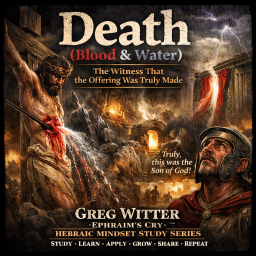
The Appointed Week — Day 4, Part 11: Death (Blood & Water)
The Witness That the Offering Was Truly Made
This was not the collapse of a victim, but the confirmed death of the Lamb, the outpouring of the witness, and the visible testimony that the sacrifice had been made.
Greg Witter | Ephraim’s Cry
Hebraic Mindset Study Series
Study Learn Apply Grow Share Repeat
This is the moment where the offering is no longer approaching completion. This is the moment where it is confirmed. This is the moment where the sacrifice is no longer moving toward its appointed end, but has reached it. This is the moment where what had been declared at the table, yielded in the garden, exposed in the trials, mocked by men, and lifted up before the world now stands as fully made. This is why this part must remain exactly where it belongs in the sequence of Day 4. Not before the stake. Not after the burial. Not blurred into a vague religious summary. Right here. Death. Blood and water. The witness that the offering was truly made.
Most people move too quickly through this part because they think the main thing to say is simply that He died, and then they rush on to the tomb. But Scripture does not rush here, because this is not a minor transition point. This is not filler between crucifixion and burial. This is the moment where the sacrifice is visibly, publicly, covenantally confirmed. The Lamb must not only suffer. The Lamb must truly die. The life must truly be poured out. The witness of that death must truly be given. There must be no uncertainty, no ambiguity, no room left for confusion. The offering must be shown, not merely asserted. The text slows down here because this moment matters that much.
This cannot be separated from the words, “It is finished,” because those words establish the frame for everything that follows. When 𐤉𐤄𐤔𐤅𐤏 (Yahusha) says, “It is finished,” He is not saying, “I am finished,” as though He were merely drained, overwhelmed, and brought to ruin by the violence of men. He is declaring that what had to be accomplished had been accomplished. What was appointed had reached its intended end. What the Father had given Him to do had been brought to completion. The suffering had not interrupted the plan. The suffering was part of the plan. The betrayal had not overturned the purpose. The betrayal served the appointed hour. The trials had not exposed weakness in Him. They had exposed corruption in the system judging Him. The stake had not become the place of defeat. It had become the place of fulfillment. So when He says, “It is finished,” that is completion speaking. That is covenant speaking. That is the obedient Son declaring that the required work has been fully carried through.
And that means the death that follows must not be read as if it were the uncontrolled collapse of a helpless man. It is not. He does not drift into death because His enemies finally succeeded in wearing Him down. He does not lose a struggle against Rome. He does not have His life taken from Him in the ultimate sense. He lays it down. He gives it. He yields it. That must be made explicit, because if that is not made explicit, people slide into weak-Messiah theology, victim theology, and passive death narratives that do not match the text. He is not simply submitting because He has no alternative left. He is exercising authority in obedience. He had authority to lay down His life, and this is the moment where that authority is exercised in full covenant alignment with the will of the Father. That means death did not seize Him. He entered death. Death did not conquer Him. He laid down His life at the appointed moment. The difference matters. It matters doctrinally. It matters covenantally. It matters prophetically. It matters for how the entire scene is understood.
This is why the yielding of His spirit is so important. He commits His spirit into the Father’s hands. Even at the last breath, He is not overtaken by men. He is not surrendered into the hands of the priests, Pilate, soldiers, or mob. He entrusts Himself to the Father. The final movement is not panic. It is not disintegration. It is not confusion. It is ordered surrender. What was settled in Gethsemane is carried through on the stake. In the garden, the will was pressed. In the death, the offering is completed. In the garden, the cup was faced. In the death, the cup is drained. In the garden, obedience was affirmed. In the death, obedience reaches its visible end. There is no break in the covenant logic. There is no moment where things spiral out of control. The whole scene remains governed by the will of 𐤉𐤄𐤅𐤄 (Yahuah).
And even the timing matters. This is not merely “during Passover season.” This is not approximate. This is not loose religious association. This is exact. The Lamb dies on the appointed day, in the appointed sequence, in alignment with the Passover pattern. That precision is part of the witness. He is not simply called a Passover Lamb because that language sounds meaningful. He dies on Yahuah’s clock. He dies within the appointed framework. He dies in covenant time, not just in historical time. The pattern established in Torah is not hovering in the background as vague symbolism. It is governing the hour. That is why the details cannot be treated as incidental. The identity of the Lamb is proven not just by titles, but by alignment. Timing, sequence, condition, witness, and handling all remain under the pattern.
And creation itself responds because this is not the death of an ordinary man. Darkness had already covered the land. That alone should stop shallow readings. Heaven and earth were not indifferent to what was happening. Creation itself was bearing witness that this hour was unlike any other. The visible world dimmed because the death of the Lamb was not a private tragedy hidden beneath human politics. This was covenant reality breaking into the visible order. The darkness was not decoration. It was testimony. It was as though the created order itself refused to pretend that this was normal. Men could mock. Priests could manipulate. Rome could execute. The crowd could sneer. But creation responded with witness.
Then the earth quakes. The rocks split. The ground itself answers the death of the obedient Son. Again, this is not ornamental drama. This is covenant witness. When Yahuah acts in covenant history, creation often responds. The shaking of the earth belongs to that pattern. Sinai shook when covenant was being established openly with Israel. Here the earth shakes again at the death of the Lamb, because covenant fulfillment is not small. The same Elohim who shook the mountain when His law was revealed now shakes the earth when the Lamb dies in fulfillment of what the law, the sacrificial system, and the prophets had pointed toward. The quake is witness. The split rocks are witness. Creation is not passive. It is answering the moment.
And then there is the veil. The veil of the temple is torn from top to bottom. That detail must not be softened, mishandled, or hijacked by lawless interpretations. The tearing of the veil does not mean holiness is abolished. It does not mean Torah is discarded. It does not mean boundaries no longer matter. It does not mean that now anything goes, anyone may approach however they please, and obedience no longer matters. No. The veil tears from top to bottom because the witness is from Yahuah, not from man. The action is from above, not from below. Access is being addressed through the accepted offering, not through rebellion. The death of the Lamb is affecting the entire covenant structure of approach. What had stood as a witness of restricted access is now made to testify that the acceptable offering has been presented. But this is not access apart from holiness. It is access through the Lamb. It is not disorder. It is not freedom from covenant. It is the opening made possible by the accepted sacrifice. That distinction must remain sharp, or else the veil will be turned into a banner for lawlessness, which it is not.
And then the text narrows even further, because now the body itself becomes a witness. Because the High Day is approaching, the bodies cannot remain on the stake. This too matters. Death does not suspend covenant order. Suffering does not erase Torah. The same Word that established the appointed times, the same Word that governed the Lamb before death, still governs what happens after death. The body cannot simply hang there indefinitely. It must be dealt with according to the appointed requirement. This is not practical cleanup. It is lawful handling. That is why the soldiers come to hasten death.
They break the legs of the other two crucified men. That brutal act was meant to force the end more quickly. But when they come to 𐤉𐤄𐤔𐤅𐤏, they find Him already dead. Already dead. That must stand in all its force. Not almost dead. Not in a faint. Not unconscious. Not barely breathing. Dead. The offering is not partial. The sacrifice is not nearly complete. The Lamb has died. And because He is already dead, they do not break His legs. This is not random. This is not convenient. This is not accidental mercy from Roman hands. This is the Passover pattern still governing the body of the Lamb. Not one bone broken. The same requirement that marked the Passover lamb in Torah now stands fulfilled in the death of 𐤉𐤄𐤔𐤅𐤏. This is legal identity proof. This is not mere symbolism. This is courtroom evidence that the Lamb remains qualified, whole, and unbroken even in death.
That point needs full weight. The unbroken bones are not a small prophetic flourish. They are proof of qualification. The Lamb had been examined. The Lamb had been found without defect. The Lamb had endured the pressure of men without disqualification. The Lamb had suffered without ceasing to be what He was appointed to be. And now, even in death, the body remains in alignment with the Passover requirement. Unbroken. Whole. Complete. That is not sentiment. That is validation of the offering. It is evidence that the sacrifice has not slipped outside the pattern. The Lamb remains the Lamb all the way through death itself.
Then comes the spear, and here the teaching must go all the way in and leave nothing on the table.
One of the soldiers pierces His side. That is not a passing detail. That is not simply another cruel act in an already brutal scene. That is an act that produces visible witness. The side is opened, and immediately blood and water come out. This is why the part must be named exactly as it is named: Death (Blood & Water). Because this is not just death in the abstract. This is death witnessed in outpouring. This is death confirmed in visible testimony. This is death opened before the eyes of men so that the sacrifice cannot be reduced to a slogan or left as an assumption.
The blood matters. Blood is life poured out. Blood is sacrifice. Blood is covenant cost. Blood is atonement. Blood is the witness that the offering has truly been made. Blood is not theoretical here. It is not ritual language detached from reality. The blood comes forth from the pierced side of the Lamb. The life has been poured out. The offering stands openly before those present. The sacrifice has cost life, and that life has been given.
The water matters. Water is not an incidental fluid detail. Water is witness. Water is cleansing. Water is purification. Water is visible confirmation. Water stands with blood as a twofold testimony flowing from the opened side. Blood speaks of sacrifice and covenant cost. Water speaks of cleansing and covenant application. Blood speaks of what has been paid. Water speaks of what is applied. Blood speaks of offering. Water speaks of washing. This is not a contradiction. It is fullness. The outflow is layered because the covenant work is layered.
And this can be driven further, because the side opening itself is not random. The side matters. The opening of the side reaches back into the covenant pattern of Adam. The first Adam’s side was opened, and from that opening the bride was brought forth. Here the side of the greater Adam is opened, and from that pierced side flow blood and water. That is not a small thread. That is a deep covenant pattern. The people of the covenant, the cleansed people, the prepared bride, come forth in relation to the opened side of the Lamb. The first Adam’s side brought forth the woman. The opened side of the second Adam testifies to the covenant means by which a people are cleansed, formed, and prepared. That does not mean we force strange allegories into the text. It means we recognize that covenant patterns are not random, and the opening of the side is one of those moments where the Scripture’s own earlier patterns echo into the fulfillment.
And that thread can go wider still. You have already locked in Cana as a covenant transformation pattern, and it belongs here as an echo. There, water stood within the realm of external purification and was transformed. Here, at the death of the Lamb, blood and water flow from the side. What had stood in old structures of outward purification finds its covenant fulfillment in the opened side of the Lamb. External washing alone is not enough. The sacrifice must be made. The side must be opened. The blood must flow. The water must witness. The old cannot remain external only. The covenant work must reach inward. That thread belongs here because it deepens the movement from external system to covenantal fulfillment in the person and work of Yahusha.
The spear also functions as legal confirmation. Before the body can be removed, death must be certain. The spear is not only a wound. It is verification. It confirms that the Lamb has truly died. This matters because the body cannot be buried according to the pattern unless death has truly occurred. There can be no uncertainty, no half-measure, no vague assumption. The sacrifice must be visibly confirmed. The spear does that. And when the side is pierced, the blood and water come forth as the witness of that confirmed death. So the spear is not an afterthought. It is part of the covenant logic of the sequence.
And it is prophetic as well. The one pierced is the one upon whom eyes will look. The spear is not outside the written pattern. Men think they are checking a body. Scripture reveals that they are fulfilling the witness. The opened side, the outflow, the unbroken bones, the exact timing, the yielding of the spirit, the darkness, the quake, the torn veil, the public confession of observers—all of it belongs to one layered testimony. Heaven answers. Earth answers. Torah answers. Prophecy answers. The body answers. The witness is complete.
And even the eyewitness insistence matters. The record itself stresses that the one who saw this bore witness and that his witness is true. That means the blood and water are not abstract theological invention. They are historical witness. They were seen. They were remembered. They were recorded intentionally because they matter for how the death of the Lamb is understood. The text itself slows down and marks this moment because it refuses to let the death be generalized. The Lamb really died. The side really was pierced. The blood and water really did come forth. The witness really does stand.
Then there is the centurion and those with him. Hardened men accustomed to violence, bloodshed, and executions are shaken by what they see. The confession that breaks from the mouth of the centurion matters because it shows that the scene itself has become proclamation. This is not only Israel’s story. This is not only internal covenant witness. Even a Roman authority figure, standing within the machinery of imperial power, is forced into recognition by the weight of the scene. That does not mean he understood the full depth of the covenant. But it does mean the death itself preached. The nations are already being touched at the point of the Lamb’s death. One standing in the service of Rome is confronted by a truth that the covenant leaders rejected. That too belongs here. It is a foreshadowing that what many in Israel reject, the nations will begin to recognize.
The women watching also matter. Their presence keeps continuity in the witness. They do not all flee into oblivion. They remain. They see. They watch the death, and their witness will carry forward into burial and resurrection. The death is not hidden. The death is observed. The faithful remnant remains present. That matters because the Day 4 sequence is not to be reconstructed later from imagination. It is witnessed as it unfolds.
And another layer belongs here as well: the silence that follows the cry. After the final declaration, after the yielding of the spirit, after the quake, after the visible witness, there is a terrible stillness to the scene. The shouting has reached its end. The accusations have spent themselves. The mockery hangs in the air with no answer coming back from the stake. The Lamb is dead. The scene itself has shifted. That silence matters because it marks the end of the offering and the pause before the next appointed movement. The noise of violence yields to the stillness of accomplished sacrifice. That pause belongs here. It is the silence after the life has been poured out.
And this is also where the realm of death itself begins to shake. The opening of tombs belongs to the larger witness surrounding this death, even though the coming forth of the raised awaits resurrection order. That matters because it shows that the death of the Lamb is already disturbing the dominion of death. The ground is shaken. Tombs are affected. The grave is being put on notice. Yet the order remains. The full breaking forth comes later. That is important. Even here the sequence holds. Death (Blood & Water) is not resurrection, but it is the death that shakes the realm resurrection will soon openly confront.
This is why this part is so weighty. If it is flattened, the burial that follows becomes weaker. If it is generalized, the sacrifice is blurred. If it is reduced to a few devotional lines, the covenant witness is lost. This is not merely “He died for us,” though that is true. This is the appointed death of the Lamb in full covenant integrity. This is the life poured out at the appointed time. This is the unbroken Lamb. This is the pierced side. This is blood and water. This is creation answering. This is the veil torn. This is the nations beginning to confess. This is the grave being disturbed. This is the witness that the offering was truly made.
And this is where many fail because they either sentimentalize the death or abstract it. Some speak only of pain and sorrow, as though this were merely a tragic martyrdom. Others speak only in doctrinal shorthand, as though a phrase alone can carry the weight of the scene. But the text gives more than sentiment and more than shorthand. It gives sequence. It gives detail. It gives witness. It gives covenant structure. It gives legal proof. It gives prophetic fulfillment. It gives visible testimony. If we are going to teach this rightly, then all of that must remain. The death of the Lamb is not weak theology, not vague devotion, not mere emotion, and not generic atonement language. It is the open, visible, covenantal confirmation that the sacrifice was truly made.
So this part must stand exactly as it is named.
Death (Blood & Water).
The work has been completed.
The spirit has been yielded.
The timing has been exact.
Creation has answered.
The veil has been torn.
The bones remain unbroken.
The side has been pierced.
The blood has flowed.
The water has witnessed.
The sacrifice has been confirmed.
The testimony stands.
This is the visible witness that the offering was truly made.
And only now can the next appointed movement begin.
Coming Soon — Another Teaching Series
The Turning at Cana
The Wedding, the Vessels, the Wine, and the Covenant Pattern of Transformation
The first sign was not about wine—it was the unveiling of how Yahuah prepares a people for union, transformation, and kingdom manifestation.
This next teaching will build directly on the covenant patterns revealed here—moving from the outflow of blood and water to the transformation of vessels, the preparation of a people, and the unveiling of the bride.
Coming Soon!!!
#GregWitter, #EphraimsCry, #HebraicMindset, #TheAppointedWeek, #Day4, #Part11, #DeathBloodAndWater, #TheWitnessThatTheOfferingWasTrulyMade, #PassoverLamb, #ItIsFinished, #CovenantExecution, #BloodAndWater,
#UnbrokenLamb, #PiercedSide, #BridePattern, #TorahAndTestimony, #𐤉𐤄𐤔𐤅𐤏, #𐤉𐤄𐤅𐤄
