
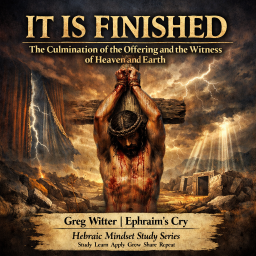
The Appointed Week — Day 4, Part 10: It Is Finished
The Completed Offering, the Final Yielding, and the Witness of Heaven and Earth at the Culmination
“It is finished” did not mean covenant ended—it meant the appointed work of the offering had been brought through to completion, the debt had been answered, and the witness stood in full.
Greg Witter | Ephraim’s Cry
Hebraic Mindset Study Series
Study Learn Apply Grow Share Repeat
Now we come to the culmination. Now we come to the closing sequence of the offering. Now we come to the moment where everything that has been building from the covenant meal, through Gethsemane, through the arrest, through the trials, through the scourging, through the mock coronation, and through the lifting up of the Lamb is brought to its appointed completion in this phase. This is not a side note. This is not a brief closing sentence at the edge of the crucifixion. This is the moment where the work assigned for this hour is declared complete by the one who alone had authority to say so. This is the moment where the righteous Son, having walked the path without deviation, speaks the word of completion over the offering. This is the moment where heaven and earth answer.
This part must be handled with the utmost care because “It is finished” has been abused, twisted, and weaponized against the very covenant structure that made the offering necessary. Men hear completion and imagine abolition. Men hear fulfillment and imagine cancellation. Men hear the closing cry from the stake and immediately run to lawlessness. They use the phrase as though 𐤉𐤄𐤔𐤅𐤏 had announced the end of righteousness, the end of Torah, the end of obedience, the end of covenant obligation, the end of holy distinction, the end of the Kingdom call to repentance, faithfulness, and endurance. That is false. That is not what the text says. That is not what the crucifixion reveals. That is not what the death of the righteous one accomplishes.
When 𐤉𐤄𐤔𐤅𐤏 said, “It is finished” (John 19:30), He was not declaring that covenant had ended. He was not declaring that the commandments no longer matter. He was not declaring that holiness is now optional, that sin is now trivial, that grace now means exemption from obedience, or that the Kingdom has been reduced to inward feeling detached from covenant life. He was declaring that the appointed work of that hour had been completed. The offering had been brought through to its intended end. The burden assigned to Him in that sacrificial phase had been carried fully. The debt being answered in that act had been answered. The witness required for that moment had been established. The path of obedience had been walked without softening, without retreat, without compromise, and without failure. The work was finished.
That must be said again because men keep corrupting the phrase. The work was finished. Not righteousness. Not Torah. Not the Kingdom. Not the future resurrection. Not the future regathering. Not the future judgment. Not the future reign. The work of the offering for that hour was finished.
And this can only be understood rightly when placed inside the full Day 4 structure. The covenant meal had already declared the body and the blood. The Upper Room had already exposed the hearts. Judas had already gone out into darkness. Gethsemane had already revealed the settled obedience of the Son. The arrest had already exposed how darkness moves. The trials had already shown the corruption of false priesthood and compromised authority. The scourging and mock coronation had already displayed what fallen systems do to the true King when they cannot recognize Him. The crucifixion had already lifted Him up before the eyes of heaven, earth, rulers, soldiers, mockers, criminals, faithful women, John, His mother, and the watching world. Now comes the culminating declaration over that whole sequence. Nothing appointed for this hour has been left undone.
The text itself leads us there carefully. John writes, “After this, 𐤉𐤄𐤔𐤅𐤏, knowing that all things were now accomplished, that the scripture might be fulfilled, saith, I thirst” (John 19:28). That statement is already loaded with meaning. He knows. He is not drifting unconsciously toward death in a haze of pain. He is not simply reacting bodily, though the bodily suffering is real. He knows that all things are now accomplished in the sense that the work has reached its closing point and the last details tied to Scripture must be brought into full witness. This is awareness. This is order. This is deliberate completion.
“I thirst” must therefore be read as both bodily truth and covenant truth. It is bodily truth because the suffering is real. The body has been scourged, blood has been poured out, strength has been drained, the hours on the stake have taken their toll, and the thirst is real. But it is also covenant truth because John explicitly says it is spoken that the Scripture might be fulfilled. The righteous sufferer of the Psalms had already spoken: “They gave me also gall for my meat; and in my thirst they gave me vinegar to drink” (Psalm 69:21). The suffering of the Son is not outside the written witness. It is the written witness coming into full manifestation.
Then John says, “Now there was set a vessel full of vinegar: and they filled a sponge with vinegar, and put it upon hyssop, and put it to his mouth” (John 19:29). That detail must be brought forward with strength. Hyssop is not decorative. Hyssop is covenant language. “And ye shall take a bunch of hyssop, and dip it in the blood that is in the basin” (Exodus 12:22). Hyssop belongs to Passover. Hyssop belongs to blood application. Hyssop belongs to covenant marking. So when hyssop appears here at the death of the Lamb, the pattern is still intact. The Lamb has not drifted away from the Passover structure. The witness is still consistent. Even at the final moment, the text is binding the crucifixion back to the Exodus pattern. The death of 𐤉𐤄𐤔𐤅𐤏 is not random martyrdom. It is covenant fulfillment.
That also means the drink itself must be distinguished from the earlier offered mixture. Earlier there had been wine mingled with myrrh, or vinegar mingled with gall, which carried pain-dulling properties (Matthew 27:34; Mark 15:23). He refused that earlier mixture. The offering would not be numbed. The obedience would not be anesthetized. The suffering would be borne consciously. That matters. The Son will not dull the cup given by the Father with a remedy offered by men. But now, in the final sequence, the sour wine on hyssop is received in connection with fulfillment. The earlier offered dulling mixture was refused. The later Scripture-fulfilling vinegar is received. That distinction belongs here, because the order matters.
Then comes the declaration: “When 𐤉𐤄𐤔𐤅𐤏 therefore had received the vinegar, he said, It is finished” (John 19:30). This is the center of Part 10. This is the declaration that the assigned work of that hour has been brought to completion. The Greek term carries the sense of bringing something to its intended goal, completing what was required, even the settling of what was due. The work is not nearly complete. It is complete. The offering is not partial. It is complete. The obedience is not almost enough. It is complete. The required witness of that phase is not lacking. It is complete.
So what was finished? The obedient offering of the righteous one for that phase was finished. The sacrificial work appointed for that hour was finished. The path from meal to yielding had been walked. The Lamb had been presented. The blood had been poured out. The visible and spoken witness had been established. The work assigned by the Father for that sacrificial hour had been completed in full.
And what was not finished? The resurrection was not yet complete. The burial was not yet complete. The ascension was not yet complete. The high-priestly heavenly ministry was not yet publicly unfolded in full. The regathering of the house of Israel was not yet complete. The judgment of the nations was not yet complete. The restoration of all things was not yet complete. The reign in public fullness was not yet complete. The destruction of the last enemy was not yet complete. This matters because “It is finished” must not be used as a lawless shortcut to erase everything else Scripture still carries forward. The offering-work of that hour was completed. The whole story was not ended.
This is where the true gospel of the Kingdom must be stated with force. The gospel is not that men may now live however they want. The gospel is not that grace has abolished the need for submission. The gospel is not that the commandments of 𐤉𐤄𐤅𐤄 are now irrelevant. The gospel is that the King has made a way for the debt of the guilty to be answered, for the estranged to return, for the defiled to be cleansed, for covenant standing to be restored, and for obedience to be written on the heart through the mercy purchased by the righteous one. Debt paid. Covenant intact. Obedience restored. Kingdom still coming. Truth still standing. That is the gospel.
And this must be said with text-first clarity: the problem was never Torah. The problem was always the transgressor. The commandment did not become evil. The violator proved himself guilty before what was righteous. The record standing against the sinner was not the righteousness of 𐤉𐤄𐤅𐤄. It was the sinner’s violation of it. So when the offering is finished, the righteous standard has not been abolished. Rather, the cost of violating it has been answered through the blood of the obedient Son. The cross therefore does not lower righteousness. It proves its seriousness at the highest possible cost.
This is also why “It is finished” must be joined to the whole life and mission of 𐤉𐤄𐤔𐤅𐤏. “My meat is to do the will of him that sent me, and to finish his work” (John 4:34). “I have glorified thee on the earth: I have finished the work which thou gavest me to do” (John 17:4). He came to do the Father’s will, not His own. He came to complete the work given from above. That means this cry from the stake is not a random exclamation. It is the culmination of the entire obedient mission brought to its appointed point in this sacrificial phase. The Son does not merely die. The Son completes the Father’s work for this hour.
And then comes the final yielding. John says, “and he bowed his head, and gave up the spirit” (John 19:30). Luke records the full final prayer: “Father, into thy hands I commend my spirit: and having said thus, he gave up the ghost” (Luke 23:46). This must be brought out fully. His life is not taken from Him against His will. Rome does not seize it from Him. The priests do not overpower Him into death. The crowd does not finally crush Him into surrender. He yields the spirit. He entrusts the spirit. The life is given. Earlier He had already said, “No man taketh it from me, but I lay it down of myself” (John 10:18). That word governs the scene. The body is wounded by men. The life is yielded by the Son in obedience to the Father.
This is why the order matters so much. He declares completion first, then He entrusts His spirit. He does not leave the meaning of the event to later interpreters. He names the completion Himself. The work is finished. Then the spirit is commended to the Father. That is not collapse. That is consummated obedience. That is finished offering followed by surrendered entrusting. The Son remains in covenant order to the very end.
And immediately heaven and earth respond. Matthew says, “And, behold, the veil of the temple was rent in twain from the top to the bottom” (Matthew 27:51). That must be opened fully. The veil is not torn from below upward, as if man has forced his way into the presence. It is torn from above downward. This is 𐤉𐤄𐤅𐤄 acting from above. This is divine testimony. The barrier that stood as witness to separation is struck at the completion of the offering.
But this must not be turned into shallow language either. The veil being torn does not mean holiness is canceled. It does not mean the presence becomes common. It does not mean men may now approach 𐤉𐤄𐤅𐤄 casually, irreverently, or without covenant seriousness. It means the way has been opened through the finished offering. The barrier is not ignored; it is answered. Access is not granted by abolishing holiness; it is granted through the blood and obedience of the Son. The old arrangement, still standing in earthly form, is struck at its boundary by what has just been accomplished at the stake.
This is one of the most powerful witnesses in the whole scene. Heaven bears testimony that the offering matters. Heaven bears testimony that the separation problem has been addressed. Heaven bears testimony that something decisive has happened. The veil tears because the offering is complete.
Then Matthew adds, “and the earth did quake, and the rocks rent” (Matthew 27:51). The earth itself responds. The rocks split. Creation cannot remain unmoved beneath the death of the righteous one. This is no ordinary execution. This is no private tragedy. This is an event with cosmic reverberation. The creation that groans beneath the curse is struck by the death of the one bearing that curse-sign. The ground answers. The rocks answer. The physical order bears witness.
Then comes another astonishing sign: “And the graves were opened; and many bodies of the saints which slept arose” (Matthew 27:52). Matthew then clarifies that they came out after His resurrection and appeared unto many in the holy city (Matthew 27:53). That means the realm of death itself is disturbed by what has taken place. The grave is not left untouched. The death of the righteous one strikes into the domain of death. The hold of the grave is shaken. Even here, before the resurrection is fully unfolded, there is already witness that death has been struck.
Then comes the centurion’s response. “Now when the centurion, and they that were with him, watching 𐤉𐤄𐤔𐤅𐤏, saw the earthquake, and those things that were done, they feared greatly, saying, Truly this was the Son of Elohim” (Matthew 27:54). That too belongs here in full force. The confession does not come from the chief priests. It does not come from the rulers. It comes from the Roman centurion and those with him. The witnesses of empire are forced by what they see to confess what the covenant leadership refused to receive. The signs are undeniable. The fear is real. The confession is real. The witness crosses boundaries. The truth stands in the mouth of those who came as execution overseers.
And the women remain present as witnesses as well. “And many women were there beholding afar off, which followed 𐤉𐤄𐤔𐤅𐤏 from Galilee, ministering unto him” (Matthew 27:55), including Miriam Magdalene, Miriam the mother of Ya’aqov and Yose, and the mother of Zebedee’s sons (Matthew 27:56). This matters because the cross is not witnessed only by mockers and soldiers. The remnant remains. The faithful remain. The grieving remain. The ones who ministered remain. Even if at a distance, they remain. The offering is seen by those who love Him, even as it is mocked by those who reject Him.
So what took place in this final sequence? The final Scripture was fulfilled. The thirst was spoken. The hyssop appeared. The declaration of completion was made. The spirit was yielded. The veil was torn from above. The earth shook. The rocks split. The graves were opened. The centurion confessed. The women remained as witnesses. Heaven and earth answered the completion of the offering.
And what does it all mean? The appointed work of that sacrificial hour was completed. The debt being answered in that offering was answered. The witness was established in full. The way was opened. The old barrier was struck. The earth and sanctuary bore record. The realm of death was shaken. The righteous Son did not fail. The Lamb did not stop short. The work was brought through.
This is why “It is finished” must be preached with force, with precision, and with covenant clarity. It is not the end of righteousness. It is not the end of obedience. It is not the end of the Kingdom. It is not permission for lawlessness. It is the completion of the offering. It is the answer to the debt in that sacrificial phase. It is the declaration that the assigned work was brought through fully. It is the cry of the obedient Son who has done the Father’s will all the way to its appointed end.
The work of that hour was complete.
The offering was brought through.
The witness stood.
The way was opened.
The earth responded.
The sanctuary responded.
The realm of death was shaken.
The Son yielded His spirit to the Father.
That is the culmination.
That is the closing of the offering-work of this hour.
That is “It is finished.”
You can get the booklet It Is Finished here:
https://ephraimscry.com/products/it-is-finished/
#GregWitter #EphraimsCry #HebraicMindset #TheAppointedWeek #Day4 #ItIsFinished #CompletedOffering
#TornVeil #Earthquake #GravesOpened #KingdomGospel #TorahAndTestimony #𐤉𐤄𐤔𐤅𐤏 #𐤉𐤄𐤅𐤄
