
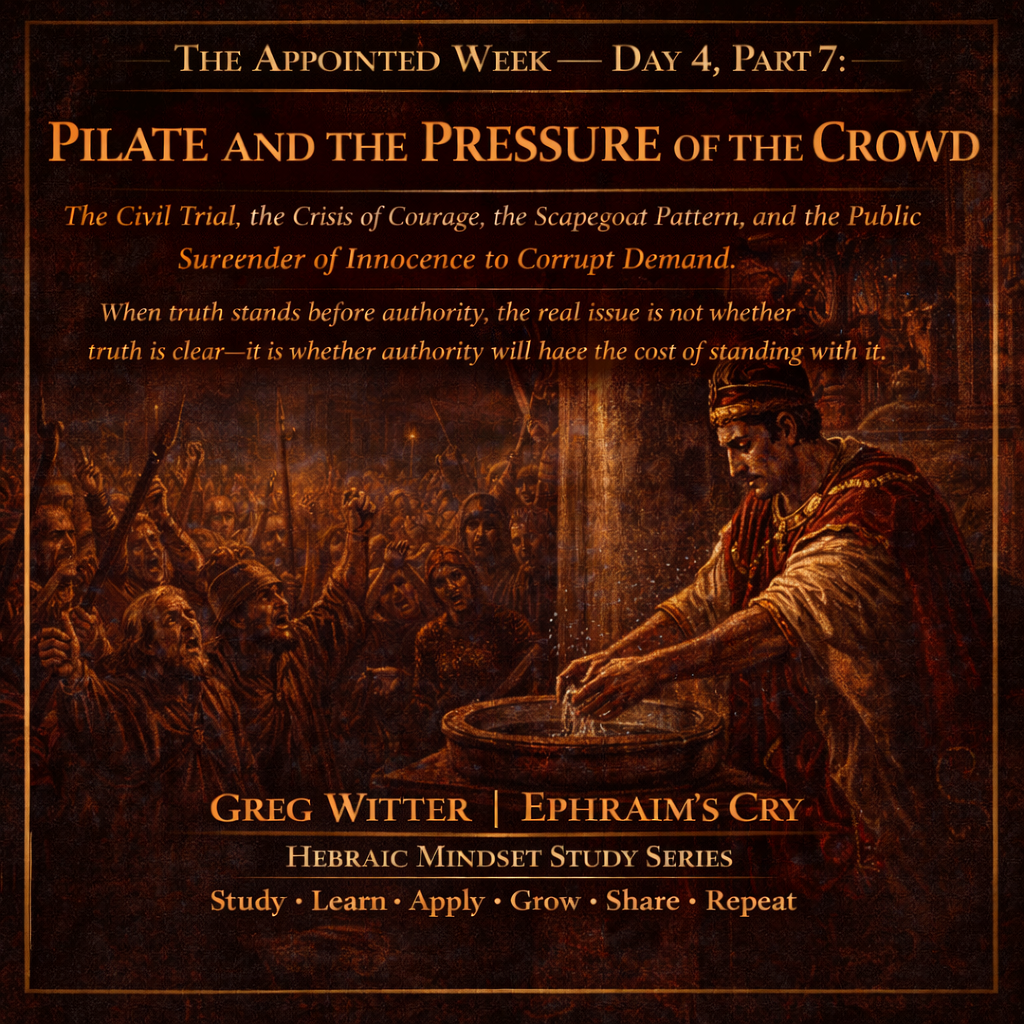
The Appointed Week — Day 4, Part 7: Pilate and the Pressure of the Crowd
The Civil Trial, the Crisis of Courage, the Scapegoat Pattern, and the Public Surrender of Innocence to Corrupt Demand
When truth stands before authority, the real issue is not whether truth is clear—it is whether authority will bear the cost of standing with it.
Greg Witter | Ephraim’s Cry
Hebraic Mindset Study Series
Study Learn Apply Grow Share Repeat
The movement into Pilate’s court is not a break in the sequence. It is the next unveiling. The religious system has already exposed itself. The priesthood has already shown its corruption. The council has already shown that it is not seeking truth, but a verdict. False witnesses have already been sought. The garments of the high priest have already been torn. The disciple has already begun to fail in the courtyard. Now the matter moves from religious condemnation into civil authority. And that matters, because once truth has been rejected by the spiritual system that should have received it, the question becomes whether civil authority will do what religious authority would not. Will the governor stand where the priesthood fell? Will the magistrate act with clarity where the council acted with manipulation? Will the one holding legal power restrain injustice once the theological arguments have already exposed themselves as fraudulent? This is the issue that stands before us in Pilate.
And the answer the text gives is one of the most sobering answers in all of Day 4.
Pilate does not fail because he cannot see. Pilate fails because he will not stand.
That distinction is critical. The civil trial is not the story of a man who is too confused to know what is right. It is the story of a man who knows more than enough to act rightly and yet refuses to bear the cost of acting on what he knows. That is what makes Pilate so dangerous as a pattern. He is not the openly hostile priest seeking false witness. He is not the furious crowd screaming for death. He is not the betrayer kissing in darkness. He is the official who can see enough truth to recognize innocence and still participates in injustice because truth becomes politically expensive.
That is a pattern the remnant must understand.
Many times the most dangerous authorities are not those who openly hate righteousness, but those who recognize righteousness and still will not defend it. The openly wicked do less damage in one sense than the compromised man in office who knows the innocent is innocent and still signs the order, still yields to pressure, still hands truth over because the crowd is louder than his conscience and position matters more than principle.
When 𐤉𐤄𐤔𐤅𐤏 (Yahusha) is brought before Pilate, the movement itself already reveals something important. The religious authorities do not carry out the final execution on their own. They need the machinery of Rome. They need civil authority to sanction what their own hatred has already decided. This too must be understood. Corrupt religion often seeks the backing of political force when it cannot achieve its ends by religious influence alone. It wants the state to ratify the verdict it has already formed in its own heart. It wants legal force behind spiritual rebellion. It wants public authority to make its private hatred effective. And so they bring Him to Pilate.
John tells us that they lead 𐤉𐤄𐤔𐤅𐤏 from Caiaphas to the Praetorium, but they themselves will not enter so that they should not be defiled, but might eat the Passover, John 18:28. That detail is devastating in its hypocrisy. They are concerned with ceremonial contamination while delivering the innocent one to death. They are worried about entering a Gentile structure while actively participating in judicial murder. That is the kind of blindness religion produces when it has severed outward piety from inward obedience. They can still speak the language of holiness while violating the very heart of covenant justice. They can still guard ritual boundary while trampling righteousness. This belongs here because Pilate’s court is not only exposing Pilate; it is also exposing the absurdity of a leadership class so morally inverted that it can preserve ceremonial concern in the middle of lethal corruption.
Pilate comes out and asks, “What accusation bring ye against this man?” John 18:29. That question matters. In civil process, charges matter. Evidence matters. Procedure matters. Pilate is asking for an accusation because law requires one. And the answer they give is telling: “If he were not a malefactor, we would not have delivered him up unto thee,” John 18:30. That is not a charge. That is an assertion of trust in their own judgment. In other words: do not ask us for evidence; accept our conclusion. That too is a profound warning. Corrupt systems often want deference instead of examination. They want authority to substitute for proof. They want the accusation itself to carry the force of verdict. Pilate’s question demands substance, and they respond with institutional presumption. That alone reveals how hollow their case already is.
Pilate tells them to judge Him according to their law, John 18:31, and that response opens the next layer. They answer that it is not lawful for them to put any man to death. That means they need Rome for the final sentence. It also means the process is now becoming a fusion of hostile religious will and civil enforcement power. This is exactly the kind of convergence that the remnant must understand. Corrupt religious leadership and compromised civil authority often reinforce one another when covenant truth becomes threatening enough. Neither side alone tells the whole story. The full danger lies in the alignment between them.
John then notes that this was so that the saying of 𐤉𐤄𐤔𐤅𐤏 might be fulfilled, signifying by what death He should die, John 18:32. That must stay before the reader at every stage. Nothing unfolding here is outside the appointed pattern. That does not excuse the wickedness of the actors, but it does keep the covenant framework in place. Messiah is not trapped by the court. He is moving through the court according to a word He already spoke. The corruption is real. The guilt of the participants is real. But the larger sovereign pattern of 𐤉𐤄𐤅𐤄 remains intact above and through the entire proceeding.
Then Pilate questions 𐤉𐤄𐤔𐤅𐤏 directly: “Art thou the King of the Yahudim?” John 18:33. That question is important because once the case reaches Rome, the issue must be translated into political terms. Religious leaders accuse in theological terms, but Rome must hear something administratively dangerous. Messiahship must be reframed as kingship. Revelation must be recast as rival rule. The issue has not changed, but the language of accusation has shifted because the audience has shifted. This too is a pattern. Truth gets relabeled according to whatever vocabulary will make it seem threatening to the current authority structure. Under the council the issue is blasphemy. Under Rome the issue is kingship. Same truth. Different accusation. Same rejection. Different legal framing.
The exchange that follows is profound. 𐤉𐤄𐤔𐤅𐤏 asks whether Pilate is speaking from himself or whether others told him concerning Him, John 18:34. That answer does not dodge the issue. It exposes the source of the issue. Is Pilate truly inquiring, or is he only inheriting a narrative already manufactured by others? Again, truth goes beneath the surface. Pilate is not merely asking a question; he is participating in a process already shaped by prior hostility. And Pilate’s response shows that distance: “Am I a Yahudi? Thine own nation and the chief priests have delivered thee unto me: what hast thou done?” John 18:35. Pilate is distancing himself even while receiving the case. He wants facts without owning the motives behind the transfer. That too will define his failure.
Then 𐤉𐤄𐤔𐤅𐤏 speaks words that must be handled with covenant depth: “My kingdom is not of this world: if my kingdom were of this world, then would my servants fight… but now is my kingdom not from hence,” John 18:36. This does not mean His kingdom has nothing to do with the earth. It means its source, order, and methods are not derived from fallen worldly systems. That matters greatly, because this statement also interprets the failure of Peter’s sword in the garden. The kingdom is real, but it is not advanced by fleshly reaction. It is not established by worldly force. It does not borrow the methods of fallen rule to protect itself. Pilate is being told that the one standing before him is indeed king, but not according to the categories Rome knows how to process. The problem for Pilate is not that Yahusha lacks kingship. The problem is that Pilate has no category for kingship rooted in truth rather than force.
Pilate presses again: “Art thou a king then?” And 𐤉𐤄𐤔𐤅𐤏 answers, “Thou sayest that I am a king. To this end was I born, and for this cause came I into the world, that I should bear witness unto the truth,” John 18:37. That statement belongs at the center of this whole scene. Kingship and truth are joined together. Not kingship and domination. Not kingship and crowd control. Not kingship and procedural self-preservation. Truth. He has come to bear witness unto the truth. And then He says, “Every one that is of the truth heareth my voice.” That is the dividing line. Not everyone hears because not everyone is of the truth. That applies to Pilate, to the priests, to the crowd, to Judas, to Peter, and to the remnant in every age. The issue is not merely exposure to truth. The issue is whether one belongs to truth deeply enough to hear and follow it.
Pilate’s famous answer, “What is truth?” John 18:38, must not be treated like philosophical curiosity. In context it sounds far more like weary dismissal, cynical distance, or unwillingness to remain under the weight of the answer already standing before him. He does not stay to hear more. He moves on. That is telling. Often men ask about truth only until truth threatens to demand a response. Pilate is not uninterested in the abstract. He is uninterested in paying the price truth would require from him in that moment.
And yet when he goes back out, he says plainly, “I find in him no fault at all,” John 18:38. This is one of the most important lines in the entire civil phase. Pilate finds no fault. Let that sit. The religious system has condemned Him. The witnesses have failed to agree. The temple charge has been twisted. The identity claim has been called blasphemy. But the civil authority, examining the case, finds no fault. That means the problem is no longer evidence. The problem is courage. The problem is not whether innocence can be recognized. It can. The problem is whether recognized innocence will be defended when the defense becomes costly.
This is where Pilate becomes such a powerful warning. He is not ignorant. He is not blind. He is not deceived in the simplest sense. He sees enough to know. He says enough to prove that he knows. But knowing truth is not the same as standing with truth. Recognition without action becomes complicity. Clarity without courage becomes participation in injustice. This is why Pilate is more than a Roman official in the story. He is the picture of authority that sees clearly and still bends under pressure. That kind of authority remains a danger in every generation.
Pilate begins trying to escape the decision. Luke records that when he hears 𐤉𐤄𐤔𐤅𐤏 is from Galilee, he sends Him to Herod, Luke 23:6–7. This is not wisdom. It is deflection. It is the attempt to move the burden elsewhere. He does not want to own the choice before him. That also belongs in the teaching because it exposes how compromised leaders often function. They know enough to hesitate, but not enough—or not courageously enough—to stand. So they shift. They delay. They defer. They hope another authority will absorb the cost of doing what they themselves do not want to do.
And when Herod returns Him, Pilate still continues looking for a way out. He proposes chastisement and release, Luke 23:16. But even that exposes the problem. If he truly finds no fault, why punish at all? Because compromise is already at work. Once a leader starts trying to partially satisfy injustice instead of confronting it outright, he has already begun to yield ground. Pilate wants a middle path between innocence and condemnation. But there is no righteous middle path when an innocent man is being delivered to death. There is only justice or participation in injustice.
Then comes Barabbas, and this is where the scapegoat pattern must be brought out clearly and carefully. Pilate offers the crowd a choice: Barabbas, a known criminal, or 𐤉𐤄𐤔𐤅𐤏, the one in whom he finds no fault. This is not just political theater. It is loaded with covenant and prophetic irony. Barabbas is guilty. Barabbas is insurrectionist, violent, condemned. Yahusha is innocent, righteous, and faultless. And yet the guilty one is released while the innocent one is handed over. That reversal is one of the most staggering pictures in the entire passion sequence.
And yes, this is where the scapegoat pattern belongs. In Leviticus 16, two goats are brought before 𐤉𐤄𐤅𐤄. One is for 𐤉𐤄𐤅𐤄 and one is sent away into the wilderness, bearing away the iniquities of the people in symbolic form. The details are not identical in a mechanical sense, so we must not force the pattern beyond what the text supports, but the covenantal logic is unquestionably resonant. One is released. One is handed over. One goes free. One bears the consequence. In the Barabbas scene, the crowd chooses the release of the guilty and the condemnation of the righteous. The innocent one is treated as though He were the criminal, and the criminal is treated as though he were released from judgment. That is substitutional irony at the civil level.
And the name itself deepens the picture. Barabbas can be heard as “son of the father.” That does not make him righteous, but it does sharpen the irony unbearably. A false “son of the father,” guilty and condemned, is released, while the true Son of the Father stands bound and is delivered over. The counterfeit goes free. The true Son is rejected. The crowd chooses the wrong son. They prefer the violent one, the insurrectionist, the disruptive guilty one, over the righteous king who bears witness to the truth. That must not be missed. This is not just a random prisoner exchange. This is revelation. It is a picture of the blindness of fallen humanity and of systems that prefer the guilty alternative to the holy truth standing before them.
The Barabbas episode also exposes something prophetic for the last days. Many will choose the false alternative because it speaks more directly to flesh, rage, force, rebellion, and worldly categories of power. The true king is too holy, too righteous, too confronting, too demanding of repentance and submission. So the crowd chooses the counterfeit. That pattern has not vanished. In every age, men are tempted to choose the substitute that fits the flesh over the truthful one who demands covenant obedience.
And the cry grows louder: “Crucify him. Crucify him,” Luke 23:21. That cry matters because it shows how pressure operates. Pilate is not dealing merely with a legal case anymore. He is dealing with social force, manipulated outrage, crowd momentum, and the fear of what refusal may cost him politically. That is why this teaching must go beyond history and become prophetic warning. There will always be crowds. There will always be voices. There will always be social pressure exerted on authority. There will always be the temptation to keep peace, preserve position, avoid upheaval, and surrender truth in exchange for temporary stability. Pilate stands as the permanent warning that clarity without courage will always collapse under that pressure.
Matthew adds the famous act of handwashing. Pilate washes his hands before the multitude and says, “I am innocent of the blood of this just person: see ye to it,” Matthew 27:24. But that statement is hollow. Authority cannot absolve itself by gesture when it still executes the decision it has the power to stop. This is not innocence. This is symbolic distancing from an action one is still authorizing. It is theater of conscience. It is public self-exoneration while participating in the very injustice one claims not to own. That too is a pattern. Compromised authority loves the appearance of moral distance while still enabling evil. It wants innocence without courage. It wants a clean conscience without a righteous stand. It wants to say, “I do not agree,” while still delivering the righteous into the hands of those who hate him. Pilate’s washed hands remain stained by the verdict he had authority to resist.
There is also background resonance here worth mentioning carefully. Washing the hands in Jewish thought could symbolize a claim of innocence or non-complicity, as in Deuteronomy 21:6–9, where elders wash their hands over the heifer in a case of unsolved bloodshed and declare they did not shed the blood. Pilate’s action appears to imitate the symbolism of innocence while emptying it of truth. In Deuteronomy, the washing is tied to actual non-complicity. Here, the washing is performed by the very man authorizing the surrender of the innocent. So even if the gesture borrows symbolic force from known innocence language, it becomes inverted in Pilate’s hands. He uses the form of innocence while committing the substance of complicity. That is exactly the kind of symbolic corruption false authority often performs.
Then comes one of the most sobering statements in the whole scene: “His blood be on us, and on our children,” Matthew 27:25. That is not merely a shouted line in the crowd. It is covenantal weight uttered in blindness. It is the public embracing of responsibility for rejecting the righteous one. It is a generational cry of inverted judgment. They are not merely rejecting Him; they are invoking the consequence of the rejection. This shows how deep blindness can go once truth has been thoroughly inverted. The innocent is declared guilty. The guilty is released. The righteous one is handed over. The crowd takes ownership of the demand. The authority yields. The system aligns. At that point, the verdict is no longer about evidence at all. It is about the full convergence of darkness across levels of power.
This is why Part 7 must be read as far more than “Pilate was weak.” He was. But weakness is not the whole picture. Pilate is the picture of compromised civil authority under crowd pressure. He is the man who sees enough truth to name innocence and still does not act on what he sees. He is the man who tries delay, transfer, compromise, half-measures, ceremonial distancing, and procedural maneuvering, all to avoid the one thing righteousness required of him: stand. And because he does not stand, he becomes part of the injustice. That is the lesson. In moments of pressure, refusing to stand for truth is not neutrality. It is participation in the triumph of falsehood at the civil level.
This scene is also deeply prophetic for what is ahead. The remnant must understand that there will be future Pilates. There will be leaders who know enough truth to recognize innocence, righteousness, or legitimacy—and still refuse to defend it because the crowd is too loud, the political cost too high, the social backlash too severe, the institutional risk too great. There will be religious voices stirring civil action. There will be civil voices trying to appease religious or popular outrage. There will be attempts to wash hands symbolically while still authorizing harm. There will be guilty men released while the righteous are condemned. There will be public pressure elevated above truth. This is not only what happened then. It is what happens when courage dies in leadership.
And the remnant must also hear the deeper warning: not all systems that recognize truth will defend truth. Recognition is not enough. Intellectual clarity is not enough. Private admission is not enough. Pilate’s repeated “I find no fault in him” is not righteousness if it does not produce righteous action. That is why this passage is so severe. It destroys the lie that seeing is the same as standing. It is not. One may see the righteous one clearly and still hand Him over. One may know the innocent and still comply with the demand to destroy him. One may hear truth and yet fear the crowd more than 𐤉𐤄𐤅𐤄.
That is why this section belongs so powerfully in the Appointed Week. Day 4 is not only about what is done to the Lamb. It is about the exposure of every category around Him. Judas exposes betrayal from nearness. The disciples expose weakness under pressure. The priesthood exposes false spiritual authority. Pilate exposes compromised civil authority. The crowd exposes collective participation in injustice. Barabbas exposes the perversity of choosing the guilty over the righteous and the counterfeit over the true Son. The washing of hands exposes hollow claims of innocence without actual righteousness. And through it all, 𐤉𐤄𐤔𐤅𐤏 exposes the unwavering truth that stands before all of them without being diminished by any of them.
So has this now been deepened? It needed to be. And it can bear the weight. Because Pilate is not a side figure in the sequence. He is essential to the exposure. The courts are not merely the next administrative step. They are the place where civil courage fails. The crowd is not just emotional noise. It is a force that reveals how collective pressure can be weaponized against truth. The washing of hands is not just memorable symbolism. It is the false ritual of conscience trying to separate itself from a verdict it still enables. The choice of Barabbas is not just historical irony. It is the public exposure of a world that prefers the guilty alternative, the counterfeit son, and the scapegoat-release pattern over the righteous king.
This is Part 7. This is the civil trial. This is the exposure of authority under pressure. This is the courtroom revelation that knowing the truth does not equal The in it. This is the release of the guilty and the handing over of the innocent. This is the counterfeit son preferred over the true Son. This is the symbolic washing that cannot cleanse actual complicity. And this is the warning to every generation after: when the crowd roars, when the cost rises, when truth stands before authority, the great question is no longer whether the truth is visible.
The question is whether anyone with power will still stand.
#GregWitter #EphraimsCry #HebraicMindset #TheAppointedWeek #Day4 #Pilate #Barabbas #ScapegoatPattern
#WashHisHands #CrucifyHim #CivilAuthority #TruthOnTrial #CovenantWitness #TorahAndTestimony #𐤉𐤄𐤔𐤅𐤏 #𐤉𐤄𐤅𐤄
