
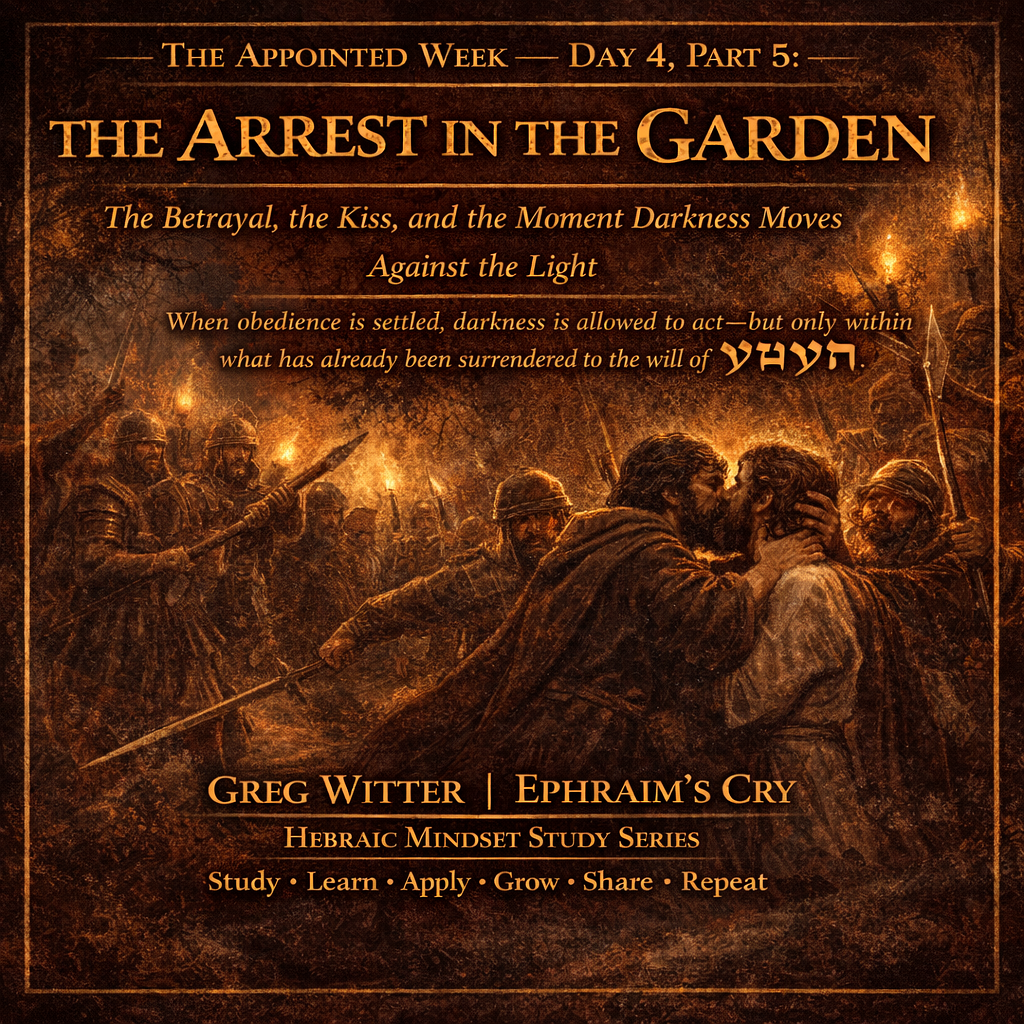
The Appointed Week — Day 4, Part 5: The Arrest in the Garden
The Betrayal, the Kiss, and the Moment Darkness Moves Against the Light
When obedience is settled, darkness is allowed to act—but only within what has already been surrendered to the will of 𐤉𐤄𐤅𐤄 (Yahuah).
Greg Witter | Ephraim’s Cry
Hebraic Mindset Study Series
Study Learn Apply Grow Share Repeat
What happens next is not chaos. It is not interruption. It is not a derailment of the plan. It is not the triumph of darkness, and it is not the moment when everything suddenly falls apart. It is the next appointed phase. It is the public manifestation of what has already been settled privately. Gethsemane has already done its work. The will has already been pressed. The cup has already been faced. The prayer has already been offered. The obedience has already been settled in full submission to the will of 𐤉𐤄𐤅𐤄 (Yahuah). What unfolds now does not replace that obedience; it reveals it. What happens in the garden after the prayer is not the collapse of the covenant plan but the execution of it.
That must be established at the beginning, because if the arrest is read without Gethsemane, it will always be misread. It will look like confusion. It will look like weakness. It will look like betrayal overpowering righteousness. It will look like evil moving faster than truth. But that is not what the text gives us. The text gives us something far more sobering and far more instructive. It gives us a picture of how darkness moves when truth has already submitted itself fully to 𐤉𐤄𐤅𐤄. It gives us a picture of what happens when the obedient do not resist the Father’s will, even when that will leads directly into the hands of hostile men. It gives us a picture of the difference between reaction and obedience, between zeal and understanding, between fleshly defense and covenant submission. And it gives us a picture not only of what happened to 𐤉𐤄𐤔𐤅𐤏, but of what will happen to those who walk in His testimony and remain loyal to the covenant in the days to come.
While He is still speaking, Judas arrives. That timing matters. The arrest does not begin at random. It comes while the words of Gethsemane are still hanging over the moment. The surrender is fresh. The prayer is fresh. The readiness is complete. And Judas does not come alone. He never comes alone. Matthew says a great multitude came with swords and staves (Matthew 26:47). Mark confirms it (Mark 14:43). Luke identifies the chief priests, captains of the temple, and elders (Luke 22:52). John goes further and speaks of a band of men and officers from the chief priests and Pharisees, carrying lanterns, torches, and weapons (John 18:3). This is not a spontaneous mob stirred up in confusion. This is organized force. This is religious structure, civil authority, temple enforcement, and coordinated hostility converging in one place, at one time, against one man who has done nothing in secret and nothing in violence.
That matters because this is how systems move when they cannot control truth. They gather force. They justify action. They assemble authority. They move in numbers. They cloak fear in procedure. They call seizure justice. They call force righteousness. They call hostility necessity. The arrest in the garden is therefore not just about Judas’s private betrayal. It is also about the alignment of institutional power against covenant truth. It is about what happens when religious leadership, threatened by obedient witness, chooses suppression instead of repentance. And that too is not merely historical. It is prophetic. It is part of the pattern that the remnant must understand, because this same alignment will appear again. Those who keep the commandments of 𐤉𐤄𐤅𐤄 and hold the testimony of 𐤉𐤄𐤔𐤅𐤏 will not merely be misunderstood by the world; they will also be opposed by systems that claim spiritual authority while rejecting covenant truth.
And at the front of that movement stands Judas. That detail must never be treated lightly. Judas is not a distant enemy. He is not a pagan outsider. He is not a Roman soldier. He is not one of the chief priests. He is the one who sat in the room. He is the one who heard the teaching. He is the one who dipped in the dish. He is the one who walked with 𐤉𐤄𐤔𐤅𐤏, saw the miracles, heard the rebukes, witnessed the compassion, watched the authority, and still remained inwardly misaligned. That is what makes this moment so heavy. Betrayal does not come first from the obviously hostile. It comes from the near one. It comes from the familiar one. It comes from the one who knows where to find Him.
This is one of the most important lessons in the entire scene. Who betrays? Not always the stranger. Not always the declared enemy. Often the one who was close enough to learn the pattern, speak the language, understand the setting, and exploit intimacy. Psalm 41:9 had already established it: “Yea, mine own familiar friend, in whom I trusted, which did eat of my bread, hath lifted up his heel against me.” The familiar friend. The bread-sharer. The near one. The betrayal at the garden is not just a historical fulfillment of that psalm; it is the unveiling of a covenant principle. Those who stand for truth will often be opposed not only by obvious enemies but by those who once stood near them, spoke with them, learned from them, and then turned. The remnant must understand this, because if they do not, they will be shocked by the wrong things. They will imagine betrayal only comes from the openly wicked, when in fact Scripture shows repeatedly that betrayal often comes through nearness, familiarity, compromised association, divided loyalty, and the offended insider.
Judas did not become a betrayer in that one night. He was revealed in that one night. That is different. The betrayal did not begin in the kiss. It did not begin in the garden. It did not even begin in the Upper Room. John had already told us that Judas was a thief and used to take what was put in the money bag (John 12:6). That means the fracture began long before the public act. It began in hidden compromise. It began in tolerated lawlessness. It began where darkness often begins—not in the dramatic act, but in the small unsubmitted place that a man refuses to bring into the light. That is how betrayal grows. It grows in secret agreements. It grows in unchecked appetite. It grows in offenses that are never crucified. It grows in desires that are never surrendered. It grows in a heart that stays near the truth outwardly while resisting it inwardly. By the time Judas kisses 𐤉𐤄𐤔𐤅𐤏 in the garden, the betrayal has already been feeding for some time beneath the surface.
That too is part of the warning. Betrayal is rarely sudden in its true origin. Sudden in manifestation, yes. Sudden in public appearance, yes. But not sudden in root. The outward act is usually the late fruit of a hidden inward alignment that has been maturing for a while. That means the arrest scene must be read not only as an event but as an exposure of process. Judas represents what happens when proximity to truth is not matched by submission to truth. He represents what happens when a man lives near holy things but does not let holy things govern him. He represents what happens when the language of discipleship is learned but the heart remains divided.
And then comes the sign. “Whomsoever I shall kiss, that same is he: hold him fast” (Matthew 26:48). This is not merely practical identification in the dark. It is symbolic corruption. In the covenant culture of Scripture, the kiss is not casual. It can signify honor, peace, welcome, reconciliation, and covenant closeness. Judas takes what should signify affection and uses it as a marker for seizure. He weaponizes intimacy. He turns closeness into exposure. He uses the sign of relationship to facilitate the act of betrayal. This is why the kiss matters so much. It is not just that Judas betrays. It is how he betrays. He betrays by cloaking treachery in the form of affection. He betrays by hiding violence inside the appearance of honor. He betrays by letting the external sign still speak closeness while the heart has already gone over to darkness.
That is another warning the remnant must understand. Betrayal does not always come looking like open hostility at first. Sometimes it comes clothed in affection, clothed in concern, clothed in shared language, clothed in spiritual courtesy. Sometimes the very sign that appears to communicate nearness is the instrument by which the betrayer identifies the one to be handed over. That means the issue is not the outward sign. The issue is the inward alignment. Judas says, “Hail, Rabbi,” and kisses Him (Matthew 26:49). The words sound respectful. The gesture looks familiar. But the act is filled with darkness. This is how deception works. It borrows the forms of closeness while emptying them of truth.
And 𐤉𐤄𐤔𐤅𐤏 answers him, “Friend, wherefore art thou come?” (Matthew 26:50). That response is not approval. It is exposure. He is not confused. He is not deceived by the kiss. He is not overtaken by the theater of the moment. He sees through it entirely. He names the role without collapsing into panic or rage. That matters because truth does not need to be theatrically shocked when betrayal manifests. Truth already knows. Truth is not discovered in the moment; it is unveiled in the moment. The one being betrayed is not the one who is confused. The betrayer is the one now fully exposed.
Then they step forward and lay hands on Him. Yet even here, John’s account refuses to let the reader imagine that the arrest is the triumph of the armed group over an unwilling victim. When they say they are seeking Yahusha, He answers, “I am he,” and they fall backward to the ground (John 18:4–6). That moment is one of the most important in the entire arrest narrative. An armed company, backed by religious authority, prepared with weapons and torches, comes to seize Him, and at His word they fall. That is not a decorative miracle. That is the revelation of authority. This is not a weak man finally cornered. This is the one who allows the process to go forward. The fall backward at His word proves the arrest only happens because He yields to it. It does not happen because they have finally overcome Him. Power has not shifted. Permission has been granted.
He then asks again whom they seek and says, “If therefore ye seek me, let these go their way” (John 18:7–8). Even while being taken, He is still shepherding. Even while surrendering, He is still protecting. Even while the system believes it is finally acting, it is still being governed by the word of the one it seeks to bind. John ties this directly to His prior statement that He had lost none of those given to Him (John 18:9). The arrest is therefore not a collapse of His leadership. It is leadership expressed through willing surrender. He is not merely enduring the moment; He is still ordering it.
Then Peter reacts, and this is where the teaching must deepen for the sake of the remnant. Peter draws a sword and strikes the servant of the high priest, cutting off his ear (John 18:10). Peter’s action is not rooted in treachery. It is rooted in zeal. But zeal is not always obedience. Loyalty is not always understanding. Urgency is not always alignment. Peter is trying to defend what 𐤉𐤄𐤔𐤅𐤏 has already yielded to the Father. He is trying to stop what Gethsemane has already settled. He is trying to act in a way that feels faithful, but his reaction reveals that he still does not fully understand the nature of the hour.
This must be heard carefully, because it is not just Peter’s lesson. It is ours. There are moments when action that looks bold is actually misaligned. There are moments when reaction that looks loyal is actually fleshly. There are moments when zeal outruns discernment. And when that happens, a man may sincerely believe he is defending the truth while actually resisting the will of 𐤉𐤄𐤅𐤄. Peter’s sword is therefore not just a moment of impulsive violence; it is a warning that covenant obedience requires more than sincerity. It requires understanding. It requires alignment. It requires the ability to distinguish between what feels right to the flesh and what is actually right before the Father.
This is critical for the remnant, because there will be pressures ahead that provoke reaction. There will be betrayal, hostility, organized force, and moments where the instinct to respond quickly will feel almost irresistible. But zeal is not the standard. Obedience is the standard. The question is not whether the reaction feels loyal; the question is whether it is aligned with the will of 𐤉𐤄𐤅𐤄. Peter’s mistake is not that he cares too much. His mistake is that he acts without fully understanding what has already been surrendered in prayer. That distinction matters. Many who love truth still fail because they react in the flesh instead of standing in the yielded obedience that the hour requires.
𐤉𐤄𐤔𐤅𐤏 immediately corrects him: “Put up thy sword into the sheath: the cup which my Father hath given me, shall I not drink it?” (John 18:11). That statement binds the arrest directly back to Gethsemane. The cup was not a figure of speech. It governs the arrest. The garden prayer governs the public seizure. What Peter wants to stop is precisely what the Son has already accepted from the Father. This is why zeal must be subordinated to revealed will. Peter still thinks in terms of defense, interruption, preservation. Yahusha thinks in terms of fulfillment, submission, and covenant obedience. The difference between the two is enormous. Peter sees the men. Yahusha sees the cup. Peter sees the weapons. Yahusha sees the Father’s will. Peter sees the moment. Yahusha sees the covenant structure moving exactly as appointed.
He goes further: “All they that take the sword shall perish with the sword” (Matthew 26:52), and then, “Thinkest thou that I cannot now pray to my Father, and he shall presently give me more than twelve legions of angels?” (Matthew 26:53). This is not helplessness. This is restrained authority. This is power under perfect submission. He could stop this. He could summon heaven. He could overturn the entire situation in an instant. But He does not, because obedience is not measured by the amount of force one can unleash. It is measured by the degree to which one remains aligned with the will of 𐤉𐤄𐤅𐤄 under pressure. That is a crucial lesson for those who will later face hostility. The remnant must learn the difference between fleshly defense and covenant obedience. Not every battle is won by striking first. Not every loyal impulse is righteous. There are moments where the holiest act is to stand fully aligned, even while darkness is permitted its hour.
Luke adds that He touches the servant’s ear and heals him (Luke 22:51). That detail belongs here because it shows that even in the moment of arrest, Yahusha remains who He is. Betrayal does not pull Him out of alignment. Violence does not make Him abandon mercy. The armed crowd does not cancel His authority. He is still restoring while being seized. He is still healing what Peter damaged. That means the kingdom does not disappear under pressure. The nature of the King does not change because darkness has been permitted to act. That too is vital for the remnant. Pressure reveals what is real. Under pressure, the flesh reaches for the sword. Under pressure, the obedient still heal, still align, still remain what they were in the light.
Then He turns and exposes the system itself: “Are ye come out, as against a thief with swords and staves for to take me? I sat daily with you teaching in the temple, and ye laid no hold on me” (Matthew 26:55). That statement unmasks the entire character of the arrest. They did not confront Him in the light. They did not take Him openly in the temple where His words could be examined before all. They came at night, with force, with numbers, with weapons. Why? Because darkness requires concealment. It cannot bear full exposure. This is how corrupt systems operate. They avoid clear light. They prefer managed settings, controlled procedures, and moments where force can be used without public clarity. Again, this is not only history. It is pattern. Those who walk in covenant truth must expect that opposition will often come clothed in procedure but motivated by fear of truth. It will call itself righteousness while acting in darkness.
Luke gives the defining phrase: “This is your hour, and the power of darkness” (Luke 22:53). That must be read with care. “Your hour.” Not forever. Not ultimate rule. Not final victory. An hour. A permitted window. A measured allowance. Darkness is not reigning; darkness is being allowed to act within limits. That is profoundly important. It means the arrest does not prove darkness has won. It proves only that darkness has been granted a measured moment within the larger sovereignty of 𐤉𐤄𐤅𐤄. And why? “That the scriptures of the prophets might be fulfilled” (Matthew 26:56). The arrest is therefore not a breakdown of the covenant plan. It is one of its appointed phases. It is prophecy moving forward. It is fulfillment, not failure.
Then the disciples scatter. “All the disciples forsook him, and fled” (Matthew 26:56). That is not a minor note. The sleeping in Gethsemane now becomes running in the arrest. The weakness already exposed now manifests in movement. They do not stand. They do not remain. They flee. This must be understood rightly. Their scattering is not identical to Judas’s betrayal. Judas aligned with darkness. The disciples are overcome by fear and unreadiness. One is treachery. The other is weakness. But weakness still matters, because it shows that proximity to truth is not the same thing as readiness to endure for truth. They loved Him, but they were not yet prepared to stand in the hour of pressure.
And this too is prophetic. There will be many who love the truth in easier hours and still scatter in harder ones. There will be many who speak rightly in times of peace and collapse in times of pressure. There will be many who believe themselves ready until the armed hour comes, until the cost becomes visible, until the system moves openly against obedient witness. The arrest in the garden is therefore not only the arrest of Yahusha; it is a rehearsal of what the disciples would later face and what the remnant will face as well. Betrayal from the near one. Organized hostility from the system. Pressure that exposes the unprepared. The temptation to respond in fleshly zeal. The temptation to run. The need for deeper alignment than mere emotion or good intention can provide.
This is why the warning about betrayal must be brought all the way out. Who betrays? Often the one near enough to know where to strike. Often the one who learned the language of the room but never submitted to the truth of the room. Often the one who shared bread but not covenant loyalty. Often the one whose hidden compromise matured into open treachery. This is not meant to make the remnant paranoid; it is meant to make the remnant sober. We were warned. The familiar friend can lift up his heel. The one who appears close may not be aligned. Not all who say, “Master, Master,” are truly His. Not all who work around holy things belong to holy things. Judas is not only one man in history. He is a warning to every generation that proximity, participation, gifting, service, and shared language do not equal covenant fidelity.
This is also why Matthew 7 belongs in the larger framework. “Many will say to me in that day, Master, Master, did we not…” and He will declare, “I never knew you” (Matthew 7:22–23). The issue is not activity. The issue is alignment. The issue is not outward participation. The issue is obedience. Judas walked, heard, handled, and participated—but he was not aligned. He did not belong in the way that mattered most. The arrest scene makes that visible in narrative form. The one who was near enough to kiss was far enough inwardly to betray. That is how terrifying false nearness can be.
And then there is the future pattern for the remnant. This scene shows that those who stand in covenant truth should not be naive about what is ahead. There will be betrayal. There will be weaponized intimacy. There will be those who once stood near and then turn. There will be organized opposition clothed in religious legitimacy. There will be pressure that exposes who has merely been walking near truth and who has actually been formed by truth. There will be moments when zeal tempts action without understanding. There will be moments when the flesh wants to reach for the sword. There will be moments when the temptation to scatter feels overwhelming. This is why this teaching cannot stop at historical observation. It must move into covenant preparation. The remnant must learn from Peter. The remnant must be warned by Judas. The remnant must understand the system. The remnant must know that darkness gets an hour, but not forever. And the remnant must know that the pattern of obedient endurance is not reaction but submission to the will of 𐤉𐤄𐤅𐤄.
So the arrest in the garden is not just a scene of capture. It is a scene of revelation. It reveals the betrayer. It reveals the system. It reveals the fleshly reaction of zeal. It reveals the unreadiness of the disciples. It reveals the measured hour of darkness. And above all, it reveals the unwavering alignment of the Son. He is not carried along by events. He is walking in what He has already surrendered to the Father. That is why the arrest is not tragedy. It is the next movement of covenant execution.
Nothing here is out of order. Nothing here is accidental. Judas has not won. The armed band has not gained ultimate authority. The system has not taken control. The Son has yielded. And because He has yielded, everything that follows is not the story of defeat. It is the story of fulfillment moving forward exactly as appointed.
Gethsemane proved the obedience. The arrest reveals the alignment. The betrayal exposes the near false one. The scattering exposes the unready. The hour exposes the power of darkness for what it is—limited, measured, and ultimately subordinate to the will of 𐤉𐤄𐤅𐤄.
And that is why this part matters so much. This is not merely about what happened to Him. This is about what He warned would happen. This is about what did happen to the disciples. And this is about what will happen again to the remnant who walk in the covenant and hold His testimony.
The arrest in the garden is not just an event.
It is a pattern.
It is a warning.
It is a preparation.
It is a revelation.
And it must be read that way.
Because when the hour of darkness comes, the issue will not be who talks the loudest. The issue will be who is aligned. The issue will not be who can react fastest. The issue will be who understands the will of 𐤉𐤄𐤅𐤄. The issue will not be who appears closest outwardly. The issue will be who truly belongs inwardly.
And when all of that is seen, the arrest becomes clear. This is not the triumph of darkness over a reluctant Messiah. This is the next appointed phase after the obedient Son has already bowed His will in the garden.
Not defeat.
Fulfillment.
#GregWitter #EphraimsCry #HebraicMindset #TheAppointedWeek #Day4 #ArrestInTheGarden #JudasBetrayal
#TheKissOfBetrayal #TheHourOfDarkness #CovenantWitness #TorahAndTestimony #𐤉𐤄𐤔𐤅𐤏 #𐤉𐤄𐤅𐤄
