
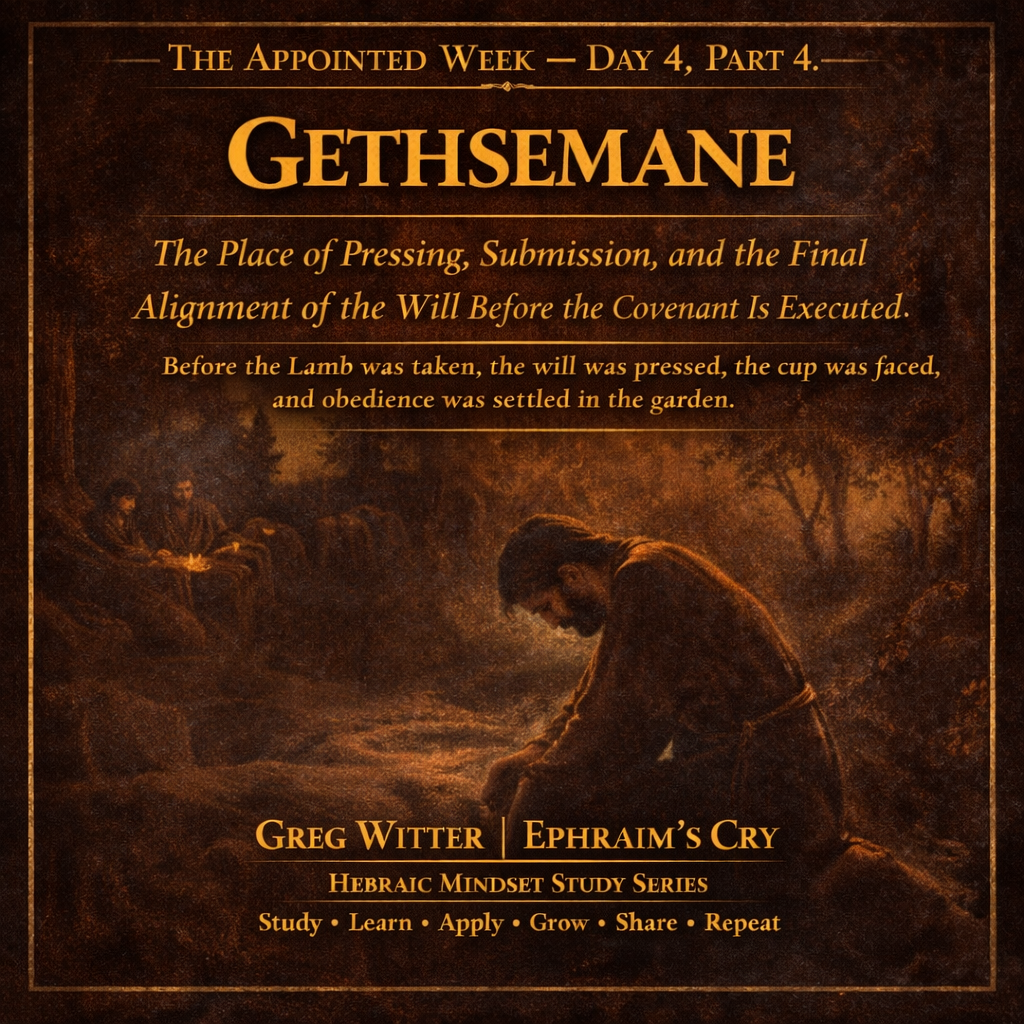
The Appointed Week — Day 4, Part 4: Gethsemane
The Place of Pressing, Submission, and the Final Alignment of the Will Before the Covenant Is Executed
Before the Lamb was taken, the will was pressed, the cup was faced, and obedience was settled in the garden.
Greg Witter | Ephraim’s Cry
Hebraic Mindset Study Series
Study Learn Apply Grow Share Repeat
Gethsemane is not a side scene.
It is not a quiet devotional pause between the Upper Room and the arrest. It is not merely the emotional prelude to the suffering. It is not just the place where 𐤉𐤄𐤔𐤅𐤏 (Yahusha) became sad before the soldiers arrived. Gethsemane is one of the deepest covenant moments in all of Day 4, because this is the place where pressure does not merely surround the Lamb—it presses upon Him. This is the place where the full weight of what is about to happen is faced directly in prayer. This is the place where obedience is not assumed but expressed. This is the place where the will is brought openly, consciously, fully, and without reservation into perfect alignment with the will of 𐤉𐤄𐤅𐤄 (Yahuah). If the Upper Room is the covenant chamber where truth is spoken before the night unfolds, then Gethsemane is the place where that truth is embraced under crushing pressure. The room declares. The garden presses. The room exposes. The garden proves. The room speaks. The garden seals the obedience in prayer before the arrest begins.
Even the name matters. Gethsemane is associated with pressing, with the crushing of olives, with the extraction that comes through weight. That is not incidental when read in the context of this night. The place itself becomes part of the teaching. What is inside is pressed out. Hidden things do not survive untouched under true pressure. Weakness surfaces. Sleep overtakes the unwatchful. Fear presses in. Surrender is tested. What is real becomes visible. That is why this garden must never be reduced to atmosphere. It is a revelatory place. The pressure in Gethsemane is not meaningless pain. It is the context in which the obedience of the Son is displayed and the unreadiness of the disciples is exposed. The olive is crushed so that oil may flow; the Son is pressed and what flows out is not rebellion, not hesitation, not resentment, but obedience, prayer, and perfect submission. That alone gives the garden covenant force. The pressing does not corrupt Him. It reveals Him.
This movement into the garden comes in direct sequence after the covenant meal, after the Upper Room, after Judas has departed into darkness, and after the words of instruction, warning, promise, and prayer have been spoken. That order matters. 𐤉𐤄𐤔𐤅𐤏 does not stumble unexpectedly into a crisis He did not foresee. He comes to Gethsemane knowing exactly what stands before Him. He has already declared the covenant in bread and cup. He has already washed the disciples’ feet. He has already identified the betrayer. He has already warned Peter. He has already promised the Set-Apart Spirit. He has already prayed in the hearing of heaven for His own. Now He enters the place where everything spoken is carried into direct confrontation with the cost. The Upper Room interpreted the night. Gethsemane embraces it. The room told the truth. The garden bears the truth. The room laid out the meaning of what was coming. The garden settled the will to walk fully into it.
Matthew tells us that 𐤉𐤄𐤔𐤅𐤏 came with them to a place called Gethsemane and said to the disciples, “Sit here, while I go and pray over there” (Matthew 26:36). Mark says the same, and Luke tells us that He came out and went “as he was wont” to the Mount of Olives, and the disciples followed Him (Luke 22:39). That detail matters too. This is not a random place chosen in panic. This is a place He knew, a place He was accustomed to going, a place familiar enough that Judas also knew where to find Him later (John 18:1–2). The garden is not a hiding place. It is not an escape route. He goes where He has often gone. That alone destroys the notion that He is trying to evade the hour. He is not running. He is walking into the appointed place of prayer before He is handed over. There is no panic in that movement. There is order. There is appointment. There is intent. He is not overtaken by the hour. He steps into the place where the hour must be faced before the Father.
There is already a lesson there. Before the arrest, He prays. Before the chains, He seeks the Father. Before the swords, He bows His will openly. Before the violence of men breaks in, communion with 𐤉𐤄𐤅𐤄 is intensified. That is not weakness. That is order. That is covenant fidelity. The one who has declared, “I do always those things that please Him” does not face the cup with bravado or fleshly noise. He faces it in prayer. This is how obedience is shown. Not by pretending the cost is nothing, but by carrying the cost honestly before the Father and remaining yielded. Gethsemane destroys every cheap idea of obedience. Obedience is not shallow positivity. Obedience is not smiling through the unbearable and pretending there is no burden. Obedience is looking directly at the burden, naming it truthfully, feeling its full weight, and still refusing to depart from the will of 𐤉𐤄𐤅𐤄.
Then the inner circle is drawn closer. Matthew says He took Peter and the two sons of Zebedee with Him, and began to be sorrowful and very heavy (Matthew 26:37). Mark says He “began to be sore amazed, and to be very heavy” (Mark 14:33). This language must not be flattened. The text is showing real weight, real sorrow, real agony, real pressure. This is not theater. This is not a staged scene. This is not 𐤉𐤄𐤔𐤅𐤏 pretending to struggle so later readers will feel moved. The pressure is real. The sorrow is real. The cup is real. The cost is real. And this must be stated carefully: the reality of His anguish does not diminish His obedience; it magnifies it. Easy obedience proves very little. Obedience under crushing weight proves everything. The garden shows that the Son is not insulated from the horror of what stands before Him. He faces it clearly, fully, and consciously—and still submits.
Then comes one of the most searching statements in all the Gospel record: “My soul is exceedingly sorrowful, even unto death” (Matthew 26:38; Mark 14:34). The garden therefore is not only a place of prayer; it is a place where the inner burden is spoken aloud. He does not hide the sorrow from the chosen disciples. He lets them hear it. That matters because this is not stoic detachment. It is honest revelation of the magnitude of the hour. The soul is sorrowful unto death. This tells the reader that what is about to unfold is not a light burden. It is not merely the fear of physical pain. Multitudes have faced physical death. Martyrs have endured torture. The anguish here is bound to the full covenant weight of the hour—the cup, the bearing of sin, the isolation, the coming judgment, the abandonment by men, the mockery, the crushing, the offering of Himself into the deepest cost of redemption. Gethsemane is where that weight presses upon His humanity in its full intensity. He is not only facing execution; He is facing the full burden of covenant curse, sin-bearing, wrath-bearing, and sacrificial offering in the role He alone can carry. That is why the sorrow is unlike ordinary sorrow. This is the sorrow of the appointed Lamb standing at the threshold of becoming the offering.
And still He instructs them: “Tarry ye here, and watch with me” (Matthew 26:38). That word “watch” matters. It is not only a request to remain awake in the ordinary sense. It is spiritual vigilance. It is participation in the seriousness of the hour. It is refusal to drift when the pressure is greatest. It is alertness in the presence of the crisis. The disciples are being asked to stand in watchfulness while He prays. They do not carry His cup. They do not bear His role. But they are called to watch. And they fail. That failure is not minor. It belongs in the teaching because the sleeping disciples form a necessary contrast to the praying Messiah. He is pressing into obedience while they collapse into sleep. He is watchful under agony while they are overcome in weakness. He is carrying the covenant weight consciously while they cannot stay awake one hour. The contrast is meant to sting. The faithful Son is awake in agony. The disciples are asleep in sorrow. The one who will stand is watching. The ones who will soon scatter are already slipping under the weight.
Then He goes a little farther, falls on His face, and prays: “O my Father, if it be possible, let this cup pass from me: nevertheless not as I will, but as thou wilt” (Matthew 26:39). This prayer must be handled with great care. It is not rebellion. It is not disobedience. It is not resistance to the Father’s plan. It is not an attempt to escape obedience. It is the perfect prayer of honest submission. The cup is faced in full truth, and the will is yielded in full obedience. He does not deny the horror of the cup. He does not minimize it. He does not pretend there is no cost. He names it. He asks concerning it. And then He subordinates His own will entirely beneath the will of the Father. This is what true submission looks like. It is not numbness. It is not indifference. It is not pretending the burden is light. It is bringing the full reality of the burden before 𐤉𐤄𐤅𐤄 and still saying yes. That is why Gethsemane must be read slowly. This is not the Son wavering between obedience and disobedience. This is the Son openly expressing the human cost of the cup while refusing to depart from the Father’s will. The prayer is not a crack in faithfulness. It is the very manifestation of faithfulness under pressure.
The cup must be understood if the garden is to be understood. Throughout Scripture, the cup is often associated with allotted portion, wrath, judgment, suffering, and what one must drink by divine appointment (Psalm 75:8; Isaiah 51:17, 22; Jeremiah 25:15–17). In this garden, the cup is not merely the physical events of crucifixion viewed in isolation. The cup is the full appointed suffering and covenant burden He is about to bear. It includes the bearing of sin, the offering of Himself, the curse-bearing aspect of the execution, the abandonment by men, and the descent into the deepest cost required for redemption. It includes what Isaiah 53 anticipates: the griefs, the sorrows, the wounding for transgressions, the crushing for iniquities, the laying on Him of the iniquity of us all. So when He speaks of the cup, the garden is not presenting reluctance toward obedience but honest confrontation with the full horror of what obedience requires in this hour. He is not shrinking from faithfulness. He is facing what faithfulness means.
Luke adds a crucial detail: “And there appeared an angel unto him from heaven, strengthening him” (Luke 22:43). That belongs here because it shows the Father does not abandon the Son in the garden even while the cup is not removed. Strength is given, not exemption. Help is supplied, not cancellation. That is a deep covenant pattern in itself. 𐤉𐤄𐤅𐤄 does not always remove the appointed suffering of the obedient; He strengthens the obedient within it. The cup remains, but strength is given to drink it. This too guards the teaching. The garden is not defeat. The garden is strengthening under pressure. Heaven answers, not by changing the assignment, but by fortifying the obedient One for the assignment. That matters greatly, because many expect heaven’s answer always to look like escape. But in Gethsemane, heaven’s answer looks like strength to endure, not release from the path. The obedient Son is not rescued from the cup; He is strengthened to drink it faithfully.
Luke then adds another detail that must not be softened: “And being in an agony he prayed more earnestly: and his sweat was as it were great drops of blood falling down to the ground” (Luke 22:44). Whether one emphasizes this medically or poetically, the point is unmistakable: the agony is intense beyond ordinary description. The pressure in Gethsemane is not shallow distress. It is deep, agonizing, crushing pressure. And what is the response? He prays more earnestly. The weight increases; the prayer intensifies. The agony deepens; the communion does not break. That is one of the central revelations of Gethsemane. Under crushing pressure, the Son does not turn away from the Father. He presses further into prayer. He is not escaping obedience; He is settling it more deeply. The pressing of the place corresponds to the pressing of the soul. And under that crushing, what comes out is not corruption but consecration. The olive press image belongs here. The crushing produces what flows. And here what flows from the crushed obedient One is prayer, surrender, and holy resolve.
Then comes the return to the disciples, and one of the most painful contrasts in the entire narrative is laid bare. “What, could ye not watch with me one hour?” (Matthew 26:40). There is no way to soften this. The Messiah is in agony, and the disciples are asleep. The covenant crisis is upon them, and they cannot watch one hour. This is not merely about physical tiredness, though their bodies are tired. Luke says they slept for sorrow (Luke 22:45), which means grief and heaviness are also operating. But the point remains: they are not spiritually prepared for the hour. The weakness of man is on full display. The flesh gives way where vigilance is required. The contrast is striking: 𐤉𐤄𐤔𐤅𐤏 is sorrowful unto death and praying; the disciples are sorrowful enough to sleep. He carries the weight toward obedience; they collapse under the atmosphere of the moment. This is why the garden belongs directly after Judas departs. Judas represents betrayal. The disciples here represent weakness. Both are exposed under pressure, but they are not the same thing. Judas chooses darkness. The others succumb to frailty. One departs to betray. The others fail to watch. One has aligned himself with opposition. The others have not yet learned vigilance. The garden sorts categories without confusing them.
Then comes the warning that must be preached plainly: “Watch and pray, that ye enter not into temptation: the spirit indeed is willing, but the flesh is weak” (Matthew 26:41; Mark 14:38). This is not a general proverb floating in space. It is spoken directly into the failure unfolding before Him. The disciples are already entering the pattern of what He is warning against. Watchfulness and prayer are the appointed means of readiness for temptation; sleep signals unreadiness. The willing spirit is not enough if the flesh is left unattended. Sincerity is not enough. Good intentions are not enough. Affection for 𐤉𐤄𐤔𐤅𐤏 is not enough. Without watchfulness and prayer, the flesh governs the moment, and when the test comes, men fail. That is why Peter’s later denial is not disconnected from this moment. The inability to watch in the garden belongs to the collapse that will unfold afterward. The sleeping disciples are already being measured and found unready for the hour. Public collapse almost always has a private prelude. Men do not simply fail in the high moment; they fail first in the quiet place where watchfulness should have been maintained. Gethsemane exposes that with painful clarity.
Then He goes again and prays a second time: “O my Father, if this cup may not pass away from me, except I drink it, thy will be done” (Matthew 26:42). Notice the movement. The first prayer asks concerning the possibility of the cup passing if possible; the second settles more directly into the necessity of drinking it. This is not wavering. It is deepening submission. The prayer is not becoming more resistant; it is becoming more fixed. The will is being pressed into complete, public, verbal alignment. This is why Gethsemane is not only a place of pain but a place of settled obedience. The garden reveals not indecision but the full cost of submission embraced in prayer. The Son is not becoming willing for the first time; the Son is bringing the full burden of the hour through the process of expressed submission until there is nothing left unspoken, nothing left withheld, nothing left unyielded. This is obedience pressed to the surface and declared in the face of the cup.
He returns and finds them asleep again, “for their eyes were heavy” (Matthew 26:43). Mark adds, “neither wist they what to answer him” (Mark 14:40). Their failure is now undeniable. The heaviness of the hour has found them unprepared. And still He goes again. Matthew says He left them, went away again, and prayed the third time, “saying the same words” (Matthew 26:44). This repetition matters. It shows persistence, not unbelief. He is not vainly repeating phrases; He is remaining in the place of submission until the matter is fully carried through in prayer. The same burden. The same cup. The same yielding. The same settled obedience. Gethsemane is therefore a place of sustained prayer, not momentary emotion. He remains there until the obedience is fully expressed under the weight of the hour. And the threefold return and prayer also bears witness-form force. The matter is established. The will is not expressed once in passing. It is confirmed, reinforced, carried through, and manifested repeatedly. The garden is therefore not a flash of intense emotion; it is the sustained pressing of the obedient Son beneath the full appointment of the cup.
This also teaches something profound about true prayer. Prayer is not always about receiving a different assignment. Sometimes prayer is where the soul is brought into complete alignment with the assignment already given. Gethsemane is not the place where the Father reveals a new path. It is the place where the Son embraces the already appointed path without reserve. That is why the garden is indispensable. The cross will show the public execution. Gethsemane shows the private surrender. The cross reveals the body given. Gethsemane reveals the will yielded. The cross will show what men do to Him. Gethsemane shows how He gives Himself before they touch Him. This is why it can rightly be said that the arrest does not take the Lamb by surprise, nor does it overpower Him. The yielding is already accomplished in the garden. Once the prayer has settled the will, the arrest only manifests outwardly what has already been embraced inwardly.
Then comes the final transition. “Sleep on now, and take your rest: behold, the hour is at hand, and the Son of man is betrayed into the hands of sinners. Rise, let us be going: behold, he is at hand that doth betray me” (Matthew 26:45–46; Mark 14:41–42). There is no panic here. No scrambling. No confusion. No attempt to flee. The garden has done its work. The hour is acknowledged. The betrayer is near. The time has come. And 𐤉𐤄𐤔𐤅𐤏 rises from prayer ready to meet what is coming. That is one of the greatest proofs that Gethsemane is about obedience, not collapse. He does not emerge broken in the sense of defeated. He emerges resolved. The pressing has not shattered His submission; it has displayed it. The cup has not driven Him into retreat; it has brought His will into visible alignment. The one who entered the garden sorrowful unto death rises to meet the betrayer without hesitation. Gethsemane is the place where the sorrow remains real but the obedience stands firmer still. The garden has not removed the cost; it has removed all hesitation in walking through it.
And still more belongs here. Gethsemane is also the place where Adam’s failure and the last Adam’s obedience stand in profound contrast. The first garden in Scripture becomes the place where man chooses his own will over the command of 𐤉𐤄𐤅𐤄. In Eden, man reaches, takes, and falls. In Gethsemane, the obedient Son bows, yields, and stands. One garden reveals rebellion. The other reveals submission. One brings death through disobedience. The other moves toward death through obedience in order to conquer death. The garden motif is too strong to ignore. Where the first Adam chose his own will, 𐤉𐤄𐤔𐤅𐤏 says, “Not my will, but Yours.” That is not accidental. The reversal is covenantally massive. The obedient Son is undoing in faithfulness what the first man introduced through rebellion. Eden is man seizing. Gethsemane is the Son yielding. Eden is desire overruling command. Gethsemane is submission overriding all natural recoil. Eden leads outward into curse. Gethsemane moves through curse-bearing toward restoration.
The garden also has priestly force. Before the sacrifice is publicly offered, the priestly work of consecrated yielding is on display. He is not merely victim; He is willing offering. He is not merely acted upon; He actively presents Himself in obedience. This matters because the execution of the covenant is not just what wicked men do. It is what the obedient Son embraces according to the will of the Father. That is why John’s Gospel later emphasizes that no one takes His life from Him; He lays it down of Himself (John 10:17–18). Gethsemane is where that truth is seen in lived form. The laying down begins in the surrendered will before the arrest arrives. Here the Priest and the Offering stand together in the same person. He is the one who will be offered, and He is the one who willingly presents Himself unto the Father in full submission. The priestly dimension therefore belongs in the garden, not only at the cross.
And the sleeping disciples still matter. Their failure is not included only to shame them but to teach us what unreadiness looks like in the face of spiritual crisis. They have heard the teachings. They have seen the signs. They have sat in the Upper Room. They have received warning. Yet when watchfulness is required, they sleep. That is one of the great warnings of this passage for every generation. Spiritual privilege does not equal spiritual readiness. One may have heard much and still be unprepared for the hour of testing. One may love the Master sincerely and still collapse in the moment without vigilance and prayer. Good intentions do not sustain men under pressure. Watchfulness and prayer are not optional extras; they are the appointed means by which the weak flesh is kept from rushing headlong into temptation. That is why this passage must never be preached only as history. It is a present warning. Many speak strongly in the Upper Room and then sleep in Gethsemane. Many mean well until pressure comes. Many have affection without readiness. Many have willingness without discipline. The garden exposes all of that.
This means Gethsemane exposes multiple realities at once. It reveals the obedience of the Son. It reveals the weakness of the disciples. It reveals the seriousness of the cup. It reveals the necessity of prayer. It reveals the difference between honest sorrow and disobedient retreat. It reveals the difference between pressure that leads to deeper submission and pressure that leads men to sleep. It reveals the contrast between the one faithful watchman and the failing companions around Him. It reveals that the deepest battle of the night is not first fought with swords or accusations but in prayer, in the will, in the unseen place where obedience is settled before events explode outwardly. It also reveals that victory is not first public. The public victory at the cross is preceded by private victory in the garden. The battle of the will must be won before the body is handed over. And it is won here, in prayer, in agony, in pressing, under the eye of the Father.
This is also why Gethsemane must not be reduced to “Jesus was afraid to die.” That is far too shallow. The passage reveals far more than fear of pain. It reveals the holy horror of the cup, the covenant burden of the hour, the deep agony of bearing what He alone can bear, and the immeasurable cost of obedience in that role. To strip the garden down to mere fear of physical death is to miss the theological weight of the scene. The Son is facing the cup appointed by the Father in the full context of redemption, judgment, suffering, sin-bearing, and offering. The agony therefore is covenantal, not merely physical. And yet even there, the prayer remains obedient. That is the glory of Gethsemane. The depth of the burden does not overturn the depth of the submission. The greater the pressure, the clearer the obedience.
So what happened in Gethsemane? The will was pressed. The cup was faced. The disciples were commanded to watch. They slept. The Son prayed repeatedly. The anguish intensified. Heaven strengthened. The flesh of the disciples failed. The obedience of the Son was settled. And when the betrayer approached, 𐤉𐤄𐤔𐤅𐤏 rose to meet the hour He had already embraced before the Father. Nothing after Gethsemane can be read rightly if Gethsemane is skipped. The arrest does not begin the yielding. The garden does. The cross does not begin the obedience. The garden displays it openly. The soldiers do not seize an unwilling victim. They step toward the one whose will has already been pressed into perfect submission.
Additional covenant and structural anchors within Gethsemane must remain in view as this teaching is held together. The garden follows the covenant meal and the Upper Room, which means it comes after declaration and exposure. It follows Judas’s departure, which means it comes after darkness has already separated itself from the covenant chamber. It precedes the arrest, which means it functions as the final private settlement before public violence. It stands as the counterpart to Eden, revealing the obedience of the last Adam where the first Adam failed. It reflects the cup imagery of Scripture, where portion and judgment are spoken of in terms of drinking what is appointed. It exposes the weakness of discipleship without vigilance and prayer. And it reveals that the deepest victory in the night is not first visible at the cross but already present in the garden where the obedient Son says yes. All of that belongs here, and all of it must remain integrated if Gethsemane is to be read as part of the execution of the covenant rather than as an isolated emotional moment.
Gethsemane is therefore not just the place of sorrow. It is the place of surrender. It is not just the place of agony. It is the place of alignment. It is not just the place where the disciples sleep. It is the place where their unreadiness is uncovered and the contrast between fleshly weakness and faithful obedience is made unmistakable. It is not just the place before the arrest. It is the place where the Lamb yields Himself in prayer before men lay hands on Him. It is not just where tears fall. It is where covenant obedience stands under the crushing weight of the appointed hour and does not turn aside.
Before the betrayer arrived, the will was settled. Before the swords flashed, the prayer had been offered. Before the chains were felt, the cup had been faced. Before men took hold of Him, He had already given Himself to the will of the Father.
That is Gethsemane.
The place of pressing. The place of prayer. The place of sorrow. The place of strength. The place of exposure. The place of surrender. The place where obedience is not assumed but proven under the full weight of the hour.
And once that is seen, everything that follows in Day 4 becomes clear: the arrest is not the triumph of darkness over a reluctant Messiah. It is the next appointed phase after the obedient Son has already bowed His will in the garden.
#GregWitter #EphraimsCry #HebraicMindset #TheAppointedWeek #Day4 #Gethsemane #CovenantObedience
#WatchAndPray #NotMyWillButYours #TorahAndTestimony #𐤉𐤄𐤔𐤅𐤏 #𐤉𐤄𐤅𐤄
