
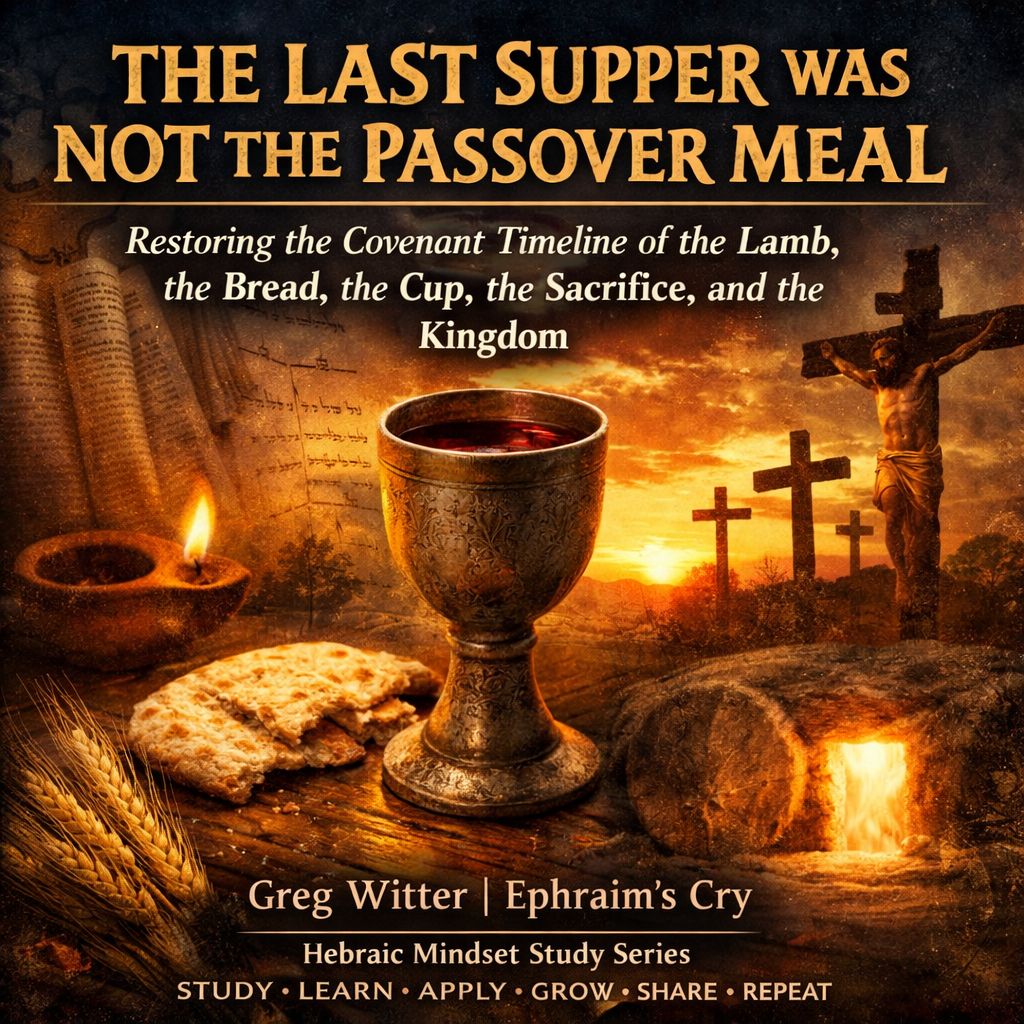
The Last Supper Was Not the Passover Meal
Restoring the Covenant Timeline of the 14th, the Lamb, the Bread, the Cup, the Washing, the Betrayal, the Covenant, and the Kingdom
He did not merely sit at table to observe a meal—He declared the restoration of the covenant in His blood, cleansed His disciples, exposed corruption, and then became the Lamb at the exact appointed time
Greg Witter | Ephraim’s Cry
Hebraic Mindset Study Series
Study Learn Apply Grow Share Repeat
Yahusha honored Passover. That point must be stated at the beginning and guarded all the way through. The issue is not whether He honored Passover. The issue is how He honored it, when He honored it, what took place in the Upper Room, and whether the meal commonly called “the Last Supper” was the Torah-defined Passover meal itself. That distinction matters because once the distinction is lost, the timeline is broken, the Lamb is displaced from His appointed hour, the covenant meal is flattened into a vague religious ceremony, the bread and the cup are severed from Torah and covenant, and tradition begins to speak louder than Scripture.
And once tradition begins to speak louder than Scripture, it does not merely adjust details—it reorders the entire covenant structure. What was once precise becomes assumed. What was once commanded becomes symbolic. What was once anchored in time becomes floating theology. And when that happens, the reader no longer sees what the text is actually saying; they see what they have been told it must mean. That is the danger here. Not a minor misunderstanding, but a structural misalignment that ripples across Torah, the Prophets, the Writings, and the Apostolic witness.
The problem is not that Scripture is unclear. The problem is that many people have inherited a compressed story and then force every passage into that compressed version instead of letting the passages stand in their own covenant order. When Scripture is read carefully, it does not present a single flattened scene where all categories collapse into one meal. It presents a sequence. It presents progression. It presents declaration, cleansing, separation, covenant, sacrifice, and Kingdom in ordered relation. Once that order is restored, the whole event becomes far more powerful than the reduced version people are used to repeating.
Because covenant does not function in fragments. It functions in phases. Every covenant in Scripture follows an order—words are spoken, then blood is applied, then participation follows. That pattern is seen in Genesis 15, where the covenant is declared and then cut. It is seen in Exodus 24, where the words of the covenant are spoken before the blood is applied and the people are bound. It is seen again and again across the whole counsel of Elohim. And that same structure governs what takes place in the Upper Room. If that structure is ignored, the event is misunderstood.
Torah must define Passover first. Exodus 12 does not speak in devotional generalities. It speaks with covenant precision. The lamb is selected from the flock. It is kept until the fourteenth day. It is slain “between the evenings.” Its blood is applied. Its flesh is eaten that night with bitter herbs. It is roasted with fire, not boiled. None of it is to remain until morning. Not one bone is to be broken. A lamb is assigned by household and shared if necessary according to what each can eat. The people are to eat in readiness, as those prepared for deliverance. Leviticus 23 confirms the order: Passover on the fourteenth day of the first month, and the Feast of Unleavened Bread beginning on the fifteenth day. These are not poetic suggestions. These are covenant instructions.
And those instructions are not flexible. They are not open to reinterpretation based on later tradition. They are anchored in time, action, and sequence. The lamb must be slain at a specific time—between the evenings, in the late afternoon before sunset. The meal must follow that sacrifice, not precede it. The blood belongs to the structure. The act of slaying belongs to the structure. The eating belongs to the structure. If that order is altered, the meaning of Passover itself is altered.
That means the Passover meal is not whatever later assumption says it is. It is what Torah says it is. The victim must be slain at the appointed time. The blood belongs to the structure. The meal belongs to that sacrifice. If that structure is moved, the meaning of Passover itself is altered.
Now Yahusha must be placed into that framework without forcing the framework to bow to inherited tradition. John preserves the timing with unmistakable force. John 13:1 says the meal occurs before the Feast of Passover. John 18:28 says the leaders do not enter the praetorium so that they might eat the Passover. John 19:14 identifies the moment of Yahusha’s sentencing as the Preparation of Passover. Those are not decorative details. They are the spine of the chronology.
And they do not stand alone. They form a legal chain of timing markers that cannot be dismissed without dismissing the integrity of the text itself. John is not vague. John is precise. He is telling you that the Upper Room meal has already taken place, and yet the official Passover meal is still ahead. The lambs are still to be prepared. The leaders are still guarding their ability to eat. The preparation is still in motion. That is not compatible with the idea that the Last Supper was the completed Exodus 12 meal.
They tell the reader plainly that after the Upper Room meal had already occurred, the official Passover meal was still ahead, the lambs were still to be prepared and slain, and Yahusha was moving toward the stake at the very time the lambs were being prepared. If the Last Supper had already been the Torah-defined Passover meal, that timeline would collapse. It does not collapse. Therefore the common assumption collapses instead.
And this is where the weight of covenant law must be allowed to speak. Because if the Lamb is required to be slain between the evenings on the fourteenth, and Yahusha dies at that exact window—as confirmed by the Gospel accounts—then He is fulfilling the slaying of the Lamb at the appointed time. That fulfillment cannot be moved backward into the night before without breaking the command. The timing is not incidental. It is the anchor.
This is the place where many run to the Synoptic accounts and act as though one phrase settles everything. But Scripture does not let one phrase erase the full witness. Matthew 26:17, Mark 14:12, and Luke 22:7 speak of the day of Unleavened Bread when they killed the Passover. That is broad feast language and preparation language. Luke 22:15 says, “I have earnestly desired to eat this Passover with you before I suffer.” That statement must be honored.
But it must also be understood in the full covenant frame. Desire does not equal completion. Declaration does not equal ratification. Yahusha is expressing urgency, intent, and covenant purpose. He is not stating that the entire Exodus 12 structure has already been fulfilled at that table. The lamb has not yet been slain. The blood has not yet been applied. The sacrifice has not yet occurred. Therefore, the statement cannot be forced to override the rest of the witness.
The easiest question cuts through the confusion. Where is the lamb?
Torah does not allow the lamb to become background scenery. The lamb is the center of the Passover meal. Yet at the Last Supper, the lamb is not identified, not described, not emphasized, and not handled according to the detailed requirements of Exodus 12. No roasting emphasis. No flesh-of-the-lamb focus. No instruction tied to its consumption. Instead, the focus shifts.
And that shift is the point.
Instead of directing attention to a lamb on the table, Yahusha takes the bread and the cup and assigns them covenant meaning. He redirects the focus from a physical lamb to Himself. Not because the lamb no longer matters—but because He is about to become it.
The lamb is absent from the table because the Lamb is present at the table.
And that distinction cannot be softened. It must be pressed all the way through. Because if the lamb were already being eaten in full Exodus 12 form, then the focus would remain on that meal. But it does not. The focus moves forward—to the body, to the blood, to the covenant, and ultimately to the sacrifice that has not yet occurred.
The Upper Room, therefore, is not the completion of Passover. It is the declaration of what Passover is about to become in Him.
The Upper Room is not just a dinner. It is not just fellowship. It is not just a farewell meal. It is not just a “preparation meal” in some shallow sense. It is the covenant meal of declaration. It is the moment where words are spoken that will be sealed in blood only hours later. It is where meaning is revealed before fulfillment takes place. It is where Yahusha does not simply participate in a tradition—He interprets it, redirects it, and brings it into its intended purpose.
And the order of what takes place in that room matters more than most realize. Because covenant order is never random.
Before the bread is interpreted and before the cup is identified, Yahusha rises and washes the disciples’ feet. John 13:4–10 cannot be treated like a side lesson detached from the covenant scene. He rises from supper, lays aside His garments, girds Himself with a towel, pours water, and begins washing the disciples’ feet.
This is not ornamental humility.
This is covenant qualification.
Because in Torah, no one approaches service in the presence without washing. Exodus 30:18–21 establishes it clearly—Aaron and his sons must wash before ministering or they die. Washing is not symbolic politeness. It is preparation for participation. It is the difference between access and exclusion.
So when Yahusha says, “If I do not wash you, you have no part with Me” (John 13:8), He is not giving a moral illustration. He is speaking in covenant terms. “No part” is inheritance language. Participation language. Priestly language.
That means the Upper Room begins not with eating, but with preparation. Not with consumption, but with cleansing. Not with ritual, but with qualification.
He is preparing a people to stand in covenant participation.
And that connects directly to what Israel was always called to be—a kingdom of priests (Exodus 19:6). Not spectators. Not observers. Participants. Those who stand in covenant, serve within it, and carry its responsibility.
So the washing is not secondary. It is foundational.
Before covenant is declared, the participants are prepared.
Then corruption is exposed.
“You are clean, but not all of you” (John 13:10–11).
This is where the room is divided without anyone leaving yet. There is already a fracture inside the company. Judas is present, but he is not aligned. And Scripture makes it clear that this is not a sudden development. John 12:6 identifies him as a thief. Matthew 26:14–16 shows premeditated betrayal. This is not a momentary weakness. This is established corruption within proximity to truth.
And this matters because covenant does not proceed blindly. It reveals what is hidden before it establishes what is binding.
Yahusha identifies the betrayer. He gives the morsel. Satan enters Judas. Judas departs.
“And it was night” (John 13:30).
That statement carries more than time. It marks separation. Light remains in the room. Darkness receives the one who refuses covenant alignment. What is corrupt exits. What remains is what will participate.
This is the removal of leaven in real time.
Exodus 12:15 commands the removal of leaven before participation. Leaven represents corruption, mixture, infiltration that spreads unseen until it affects everything. Judas embodies that principle in this moment. Not as the total definition of leaven, but as a living example of corruption within the house.
And he leaves.
Not after the covenant.
Before it.
That order matters.
Cleansing comes first.
Corruption is exposed next.
Separation follows.
Then covenant proceeds.
Now the table is ready.
Now the bread is taken.
“This is My body” (Luke 22:19).
That statement does not exist in isolation. It is not a new invention disconnected from everything that came before. It is anchored in Torah, in manna, in instruction, and in life itself. Bread is never just bread in Scripture.
Deuteronomy 8:3 makes it clear—man does not live by bread alone, but by every word that proceeds from the mouth of Yahuah. Bread becomes a picture of sustenance, of dependence, of what gives life. Manna in the wilderness reinforces this—daily provision from heaven, unable to be stored, requiring continual reliance.
Now Yahusha brings all of that forward and centers it in Himself.
“I am the bread of life” (John 6:35).
“The bread that I will give for the life of the world is My flesh” (John 6:51).
That teaching was already given before this night. Many rejected it when they heard it. It was too strong. Too direct. Too covenantal. But here in the Upper Room, it is no longer explained—it is enacted.
He takes the bread and identifies it with His body.
Not symbolically detached.
Covenantally anchored.
And this must be understood correctly. Because the question often arises—was this unleavened bread? Was this already the Feast meal? And that question, while important, cannot override the central point. Whether one presses the exact bread category at that moment or recognizes the broader covenant meaning, the reality remains:
He is identifying Himself as the source of life, the sustainer, the one without corruption.
Leaven represents corruption.
Unleavened represents purity.
And He stands as the uncorrupted body given for His people.
Then the cup.
“This cup is the renewed covenant in My blood” (Luke 22:20).
Now the language shifts from sustenance to legal binding.
This is Exodus 24 language.
“Behold the blood of the covenant” (Exodus 24:8).
At Sinai, the covenant was spoken, then sealed with blood. The people were bound to the words that had been declared. Now Yahusha stands in that same pattern—but not repeating it—fulfilling it.
He is not referencing covenant in theory.
He is declaring that His blood is the blood by which the covenant is restored.
But the blood has not yet been shed.
That is the key.
This is declaration before ratification.
Just as in every covenant pattern before it.
Words first.
Blood second.
And this is where the timeline must remain intact. Because if this moment is treated as the completed Passover sacrifice meal, then the entire covenant order is reversed. Blood would be declared after it has already been applied. The Lamb would be spoken of after it has already been consumed. That is not how covenant works.
So this moment stands exactly where it must:
The covenant is being declared.
The blood that will seal it is being identified.
But the sacrifice itself is still ahead.
And this is reinforced in what Yahusha says next—He will not drink again until the Kingdom (Luke 22:18; Matthew 26:29). The meal is not finished. The final cup is not taken. The completion is deferred.
That means the Upper Room is not the end of something.
It is the beginning of something that will move forward through sacrifice and into the Kingdom.
And immediately after this, the movement continues.
Not into celebration.
Into pressure.
Not into completion.
Into submission.
They leave the table and go to the garden.
And what was declared in the room is now faced in reality.
They leave the table and go to the garden.
And what was declared in the room is now faced in reality.
Because covenant is not proven in comfort. It is proven under pressure.
Gethsemane is not a quiet place of reflection. It is a place of crushing. The very name points to it—an oil press. Olives are crushed to release what is inside them. Pressure is applied until what is hidden is brought forth. And that is exactly what is happening here.
What was spoken at the table is now being pressed in the garden.
“This cup is the covenant in My blood.”
“If it is possible, let this cup pass from Me… nevertheless, not My will but Yours” (Matthew 26:39).
The same cup.
The same covenant.
Now faced under full weight.
This is not fear of death. This is the weight of what the covenant requires. The cup in Scripture is not only blessing—it is also judgment. Psalm 75:8 speaks of the cup of wrath. Isaiah 51:17 calls it the cup of trembling. Jeremiah 25:15 calls it the cup of fury.
So when Yahusha speaks of the cup, He is not speaking lightly. He is facing the full measure of covenant judgment that will be poured out through His obedience. The declaration made at the table now meets the reality of what it will cost.
And He does not withdraw.
He submits.
“Not My will, but Yours.”
Where the first man in a garden chose his own will, the last Adam in a garden submits completely. Genesis 3 records the failure—taking what was not commanded, acting outside covenant instruction. Here in Gethsemane, the pattern is reversed. The will of the Father is not resisted—it is embraced.
This is covenant restoration at the deepest level.
And from that moment forward, everything unfolds with precision.
The arrest is not chaos. It is controlled surrender. When they come for Him, He does not hide. He does not run. He steps forward.
“I am He” (John 18:5).
And they fall backward.
That moment alone makes it clear—He is not being overpowered. He is allowing what must happen to happen. Authority has not shifted away from Him. It is being exercised through obedience.
“This is your hour, and the power of darkness” (Luke 22:53).
Even darkness has a boundary. Even opposition operates within a defined window. Nothing here is outside the control of Yahuah’s covenant order.
Then the legal process begins.
And it is not random.
He is brought before multiple authorities—religious, political, regional. The high priest. The council. Pilate. Herod. Each one examines Him. Each one finds no fault. Each one, in effect, testifies to His innocence.
And yet each one hands Him over.
This is not just betrayal. It is legal transfer.
The word used repeatedly—paradidōmi—means to hand over, to deliver up, to transfer custody. Judas initiates it. The leaders continue it. Rome executes it. This is a chain of legal handovers that moves Him step by step toward the stake.
And in doing so, every level of authority exposes itself.
They reject the righteous one.
They declare, “We have no king but Caesar” (John 19:15).
They disqualify themselves.
And the true King continues forward.
Not resisting.
Not stopping the process.
Fulfilling it.
And all of this is moving toward one fixed point—the appointed time of the Lamb.
Exodus 12:6 set that time long before this moment ever arrived. The lamb is to be slain between the evenings—late afternoon, before sunset. That timing is not symbolic. It is precise.
And when the Gospel accounts are aligned, that is exactly when Yahusha dies.
Darkness covers the land from the sixth hour to the ninth (Matthew 27:45). Creation itself bears witness. Light withdraws. The world is marked by what is taking place. This is not random darkness. This is covenant judgment being executed.
Then, at the appointed time, He gives up His spirit.
“It is finished” (John 19:30).
Not ended.
Completed.
Brought to its intended purpose.
The covenant declared in the Upper Room has now been ratified in blood.
And even in death, the precision continues.
Not one of His bones is broken (John 19:36), fulfilling Exodus 12:46. That is not a small detail. That is a direct connection to the Passover lamb requirement. If He were not the Lamb in function, that detail would not matter. But it matters, because He is fulfilling it exactly.
A spear pierces His side.
Blood and water flow (John 19:34).
That is not incidental. That is witness. Blood for covenant. Water for cleansing. Spirit bearing testimony (1 John 5:6–8). Heaven and earth agreeing on what is taking place.
Even the hyssop appears (John 19:29), connecting back to Exodus 12, where hyssop was used to apply the blood to the doorposts. The pattern is not broken. It is repeated, fulfilled, brought to its full meaning.
Everything is aligned.
The Lamb is slain at the appointed time.
Not the night before.
Not during the meal.
At the exact moment Torah required.
And this is where the distinction must be held firmly.
Because if the Last Supper is forced into the role of the Passover meal, then this entire alignment is destroyed. The timing of the Lamb is moved. The covenant order is reversed. The sacrifice is misplaced. The structure collapses.
But when the events are allowed to stand in their proper sequence, everything holds.
The Upper Room becomes what it truly is—the covenant declaration.
The garden becomes submission under pressure.
The trials become the exposure of false authority.
The stake becomes the moment of sacrifice.
And Passover is fulfilled—not by eating a lamb at the table—but by the Lamb being slain at the appointed time.
Then the burial comes.
And it must happen quickly.
Because the fifteenth is approaching.
John 19:31 makes it clear—this was a high Sabbath. The Feast of Unleavened Bread is beginning. The body must be taken down before sunset. He is placed in the tomb before the day transitions.
Which preserves everything.
The fourteenth holds the sacrifice.
The fifteenth begins the feast.
Nothing overlaps incorrectly.
Nothing collapses.
Nothing is out of order.
And from there, the pattern continues forward.
Not stopping at death.
Moving into life.
And from there, the pattern continues forward.
Not stopping at death.
Moving into life.
Because the covenant does not end at sacrifice. It moves through it.
The burial completes the transition into Unleavened Bread. The body is placed in the tomb before sunset, before the fifteenth begins, preserving the structure exactly as Torah defines it. The Lamb has been slain on the fourteenth. Now the feast begins without corruption—without leaven—without mixture.
And then, at the appointed time, the next piece unfolds.
The resurrection.
Not random.
Not disconnected.
Not simply “three days later” without meaning.
But aligned with Firstfruits.
Leviticus 23:10–11 establishes the pattern—the sheaf is waved before Yahuah on the day after the Sabbath during the feast. It is the first of the harvest. The guarantee of what is to come. Not the full harvest, but the beginning of it.
And 1 Corinthians 15:20 makes the connection explicit:
“Messiah has been raised from the dead, the firstfruits of those who have fallen asleep.”
That means the resurrection is not just victory over death. It is covenant continuation. It is the next appointed marker in the same sequence that began with Passover.
Passover → Lamb slain
Unleavened Bread → burial without corruption
Firstfruits → resurrection life
This is not symbolic layering added afterward. This is the structure that was always there, now fulfilled in order.
And that order does not stop there.
Because what began in the Upper Room is still not complete.
He said it plainly:
“I will not drink of the fruit of the vine again until the Kingdom” (Luke 22:18).
That means the meal is still open.
The cup is still unfinished.
The covenant has been declared.
The covenant has been ratified.
But the covenant has not yet reached its full expression in the Kingdom.
Which brings the entire teaching forward into its final direction.
Because the Upper Room is not only Sinai language.
It is also wedding language.
“I go to prepare a place for you… I will come again and receive you” (John 14:2–3).
That is not abstract comfort.
That is covenant structure.
A bridegroom establishes covenant.
He departs.
He prepares a place.
He returns.
He brings the bride into the completed union.
And that union is marked by a meal.
Revelation 19:7–9:
“The marriage supper of the Lamb.”
That is where the final cup is taken.
That is where the meal is completed.
That is where what was declared in the Upper Room reaches its full expression.
So the Upper Room must be seen correctly.
Not as the end.
Not as the completed Passover.
But as the beginning of a covenant movement that stretches from declaration to sacrifice to resurrection to Kingdom.
And this is why the distinction matters so deeply.
Because once everything is merged into one moment, the movement is lost.
The progression is flattened.
The covenant is reduced.
The reader is left with a single scene instead of a living sequence.
But when the order is restored, everything comes back into alignment.
Cleansing before participation.
Corruption exposed and removed.
Covenant declared.
Submission embraced.
Authority tested and exposed.
The Lamb slain at the appointed time.
Burial aligned with Unleavened Bread.
Resurrection aligned with Firstfruits.
Kingdom still ahead.
Nothing forced.
Nothing assumed.
Nothing out of place.
Everything in order.
And once that order is seen, the conclusion is no longer a matter of interpretation—it is the result of alignment.
The Last Supper was not the Passover meal.
It was the covenant declaration meal.
The Lamb was not consumed at the table.
The Lamb was present at the table—and then given at the appointed time.
The covenant was not completed in the room.
It was declared in the room and sealed at the stake.
Passover was not observed in full at the table.
Passover was fulfilled in full at the sacrifice.
And the meal itself is not finished.
It is still moving forward.
Toward the Kingdom.
Toward the return.
Toward the moment when the final cup is taken and the covenant reaches its full expression.
Two distinct events.
One unbroken covenant.
One perfect alignment across the whole counsel of Elohim.
That is the structure.
That is the order.
That is the truth.
#GregWitter, #EphraimsCry, #HebraicMindset, #HebraicMindsetStudySeries, #CovenantTruth, #PassoverTruth, #LastSupper, #CovenantRestored, #TorahAndMessiah, #YahushaTheLamb, #Exodus12, #Exodus24, #Exodus6, #John6, #John13, #John14, #John18, #John19, #Luke22, #Matthew26, #Mark14, #Jeremiah31, #Acts15, #1Corinthians5, #1Corinthians11, #Isaiah53, #Psalm34, #Revelation5, #Revelation19, #CovenantMeal
