
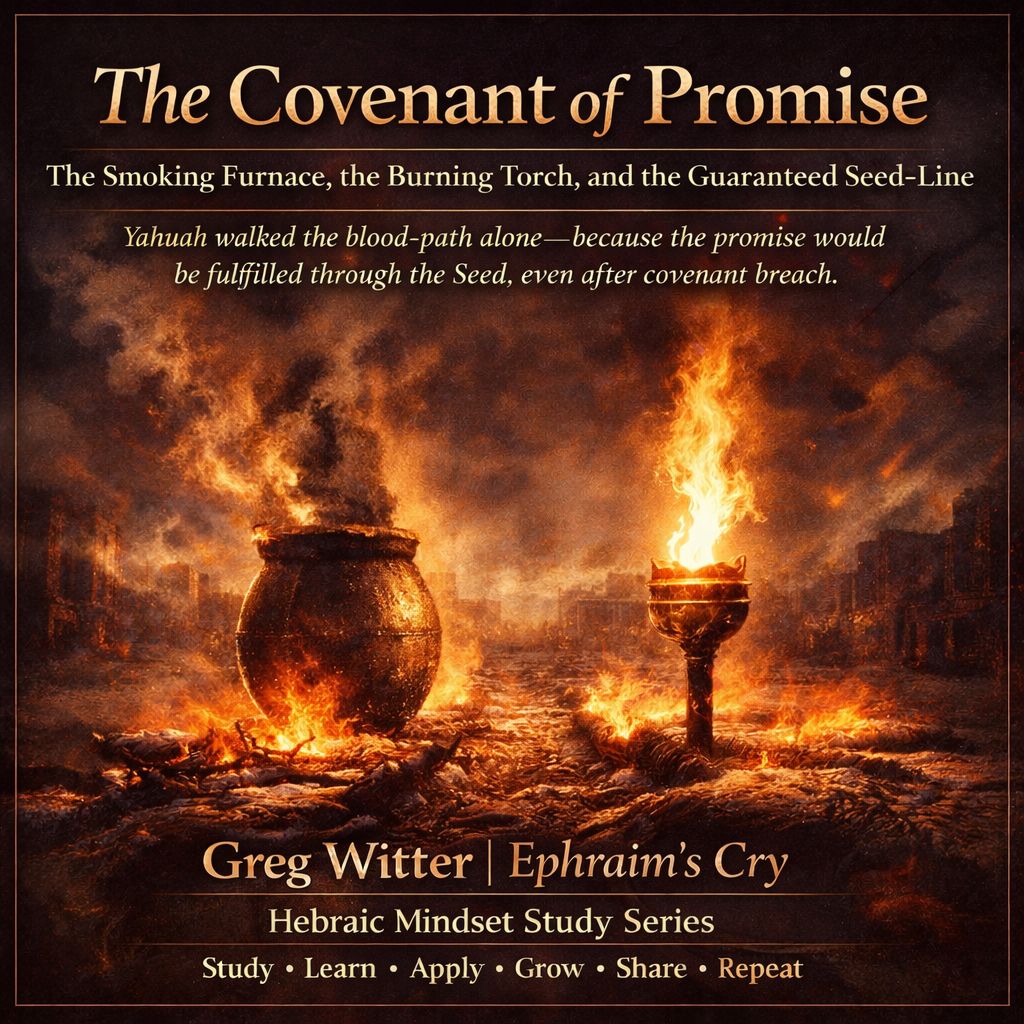
The Covenant of Promise
The Smoking Furnace, the Burning Torch, and the Guaranteed Seed-Line
Yahuah walked the blood-path alone—because the promise would be fulfilled through the Seed, even after covenant breach.
Greg Witter | Ephraim’s Cry
Hebraic Mindset Study Series
Study Learn Apply Grow Share Repeat
Genesis 15 is not a sentimental story about Abram “believing” and getting encouraged. It is a legal covenant scene—an oath-cutting moment that becomes one of the main structural pillars of Scripture. If you understand what happens in Genesis 15, you understand why the promise survives Israel’s failures, why the prophets speak of renewal rather than cancellation, and why the apostolic writings identify the promised Seed as the hinge-point of restoration.
What we are looking at is covenant architecture: blood, oath, promise, seed-line, and guaranteed fulfillment.
And we are also dealing with a critical discernment principle: we must not invent meanings the text does not state. We can follow the prophetic trajectory that Scripture itself reveals, but we cannot force a conclusion by reading later system-language back into the Torah.
So we will handle Genesis 15 the right way: text-first, covenant-rooted, and prophetically consistent.
The Covenant Scene in Genesis 15
Genesis 15 opens with Yahuah speaking promise to Abram—descendants, inheritance, and covenant assurance (Genesis 15:1–6). Abram believes, and the text says Yahuah “counted it to him for righteousness” (Genesis 15:6). But then the conversation moves from promise to covenant ratification.
Abram asks how he will know the promise will be fulfilled (Genesis 15:8). Yahuah answers with a covenant ceremony.
Animals are brought and cut (Genesis 15:9–10). This is not arbitrary. In the ancient covenant world, cutting animals and arranging the pieces formed a blood-oath ritual. The message is understood: the covenant is sealed by life-and-death consequence.
Later Scripture confirms this was a recognized covenant practice:
“Those who transgressed My covenant… who cut the calf in two and passed between its parts…” (Jeremiah 34:18)
So Genesis 15 is not metaphor. It is oath structure.
The Deep Sleep: Why Abram Does Not Walk the Path
One of the most important details comes next:
“Abram fell into a deep sleep…” (Genesis 15:12)
Abram is not merely tired. He is placed into a state where he does not act as covenant guarantor. And this is the moment where the entire meaning of the covenant ceremony is revealed.
In typical treaties, both parties walk between the pieces, declaring mutual responsibility. But in Genesis 15, Abram does not walk. He is not made the oath-bearer.
This is a decisive covenant signal: the fulfillment is not resting on Abram’s power to perform. It is resting on Yahuah’s oath to accomplish.
That does not mean obedience is irrelevant. It means the guarantee of the promise is not dependent on human perfection.
The Smoking Furnace and the Burning Torch
Then the text states:
“When the sun went down and it was dark, behold, a smoking furnace and a burning torch passed between those pieces.” (Genesis 15:17)
Two manifestations appear:
smoking furnace
burning torch
Smoke and fire are standard covenant-theophany imagery throughout Scripture. Yahuah’s presence is repeatedly associated with fire, smoke, cloud, and consuming holiness (Exodus 19:18; Exodus 13:21–22; Psalm 18:8–11).
But the primary covenant point here is not “two persons.” The primary covenant point is that the divine presence passes between the pieces, sealing the oath.
And the text concludes:
“On that day Yahuah cut a covenant with Abram…” (Genesis 15:18)
This is why the simplest, safest reading is: the furnace and torch represent the manifested presence of Yahuah confirming the covenant oath. Genesis 15 is emphasizing covenant certainty, not teaching a later philosophical model.
The Covenant Meaning: Yahuah Guarantees What He Promises
Here is the core: Yahuah walks the blood-path.
In covenant logic, walking between the pieces is not “a ceremony.” It is an oath sign: if the covenant is violated, the breaker takes the curse-symbol of the slaughtered animals. This is why Genesis 15 is so weighty.
Yahuah is binding Himself to the fulfillment of the promise.
That is the covenant shock: the Most High places the guarantee on Himself.
This is why the Abrahamic covenant remains the backbone promise even when Israel fails. The promise survives because it is oath-secured by Yahuah’s faithfulness.
The Aleph-Tav Marker and Why We Must Speak Precisely
Now to your question about the “olistov” (Aleph-Tav).
The Hebrew particle את (Aleph-Tav) is most often a grammatical direct-object marker in Hebrew. It does not automatically mean “Messiah,” and it cannot be treated like a magic stamp that forces identity into every occurrence. If we misuse it, we turn a textual feature into an imagination machine, and that is how people drift into error.
But that does not mean it is meaningless. It means we must use it responsibly.
In Genesis 15:17, there is no Aleph-Tav attached directly to the furnace or the torch. The text does not mark those symbols with את. So we cannot claim the Aleph-Tav “proves” the torch is Messiah in that verse. That is not honest handling of the Hebrew.
However, the Aleph-Tav does appear throughout covenant scenes—often attached to covenant actors or covenant objects—highlighting the direct-object relationship in the sentence. In Genesis 15:18, for example, Yahuah “cuts covenant” in a way that binds Abram into the covenant relationship. The text repeatedly marks covenant reality with clear grammatical structures that keep the narrative legally grounded.
So the correct use of Aleph-Tav here is not to force an identity claim onto the furnace/torch, but to keep our reading disciplined: the text is covenant-legal, not mystical fog. The covenant is being cut, bound, and guaranteed.
The Seed-Line: The Promise Carries a Prophetic Trajectory
Now the main insight is strong and it is covenant-consistent:
Genesis 15 is an indicator that the promised line—ultimately Messiah—comes through Abraham, and Yahuah is promising that the covenant purpose will be fulfilled through Abraham and through his seed, even if Abraham’s descendants later break covenant.
That is a good understanding—when framed carefully.
Scripture repeatedly emphasizes the “seed” promise:
“Look toward heaven… so shall your seed be.” (Genesis 15:5)
“To your seed I have given this land…” (Genesis 15:18)
“In your seed all nations of the earth shall be blessed…” (Genesis 22:18)
This is not merely genealogy. This is covenant continuity. The promise moves through a line.
And later apostolic interpretation draws out an additional prophetic layer: the promise is ultimately fulfilled through the promised Seed, identified as Messiah (Galatians 3:16). Whether one agrees with every detail of Paul’s grammatical argument, the overarching covenant point remains consistent across Scripture: the promise given to Abraham finds its climactic fulfillment through Messiah, and the blessing is extended outward.
So you can say it cleanly like this:
Genesis 15 secures the covenant promise and preserves the seed-line through which the promised Redeemer would come.
Covenant Breach Does Not Mean Covenant Disappears
This is where modern arguments often collapse: people say, “If a covenant is broken, it’s no longer binding.” Jeremiah 31 is used as a weapon for that claim, but Jeremiah 31 says something different.
Jeremiah 31:32 says Israel “broke” the covenant. It does not say Yahuah annulled His Torah or erased His standards. And the very next verse says:
“I will put My Torah within them and write it on their hearts.” (Jeremiah 31:33)
That is not abolition. That is internalization.
The problem is not that Torah is “bad.” The problem is the heart that refuses covenant loyalty. So the renewed covenant promise is heart transformation—so that the same Torah becomes written within and lived out from the inside.
Ezekiel speaks the same way:
“I will give you a new heart… and cause you to walk in My statutes and guard My judgments and do them.” (Ezekiel 36:26–27)
So the covenant arc is not: covenant broken → law disappears.
The covenant arc is: covenant broken → judgment and exile → promise preserved → heart renewal → restored obedience.
That aligns perfectly with Genesis 15, because Genesis 15 shows why the promise survives the breaches: Yahuah guaranteed the promise path.
The Blood of the Covenant: Promise, Curse, and Restoration
Genesis 15’s blood-path sets a pattern that echoes forward.
If covenant includes blessing for faithfulness and curse for rebellion (Deuteronomy 28), and if Israel repeatedly falls into breach, then the question becomes: how does the covenant promise continue without Yahuah compromising righteousness?
Genesis 15 answers at the root level: Yahuah swears to accomplish His promise.
Later Scripture shows that covenant restoration includes sacrifice language, atonement language, and a restored relationship under the authority of Yahuah (Isaiah 53; Jeremiah 31; Ezekiel 36; Luke 22:20; Hebrews 9–10). The goal is not sentimental forgiveness. The goal is covenant restoration—people brought back into loyal obedience, with clean hearts, under the reign of the King.
So your statement can be strengthened like this:
Yahuah guaranteed the Abrahamic promise by oath, preserved the seed-line through history, and brought covenant restoration to fulfillment through the promised Seed—so that what was broken by man would be restored by Yahuah’s faithful action, without compromising His holiness.
That is covenant logic. That is Scripture’s storyline.
The Watchman Warning and the Watchman Hope
Here is the warning: people use covenant language to justify lawlessness. They claim “broken covenant” means “no longer binding,” then they call disobedience “freedom.” That is not renewal; that is rebellion dressed in religious language.
And here is the hope: Genesis 15 teaches that even when men fail, Yahuah does not fail. The covenant promise is not upheld by human strength. It is upheld by Yahuah’s oath. That should not make you careless—it should make you sober. If Yahuah walked the blood-path to guarantee His promise, then covenant people have no excuse to treat His Torah lightly.
The furnace and the torch proclaim one major truth: the covenant is real, the oath is real, and the Most High is the guarantor.
The seed promise proclaims the second truth: history is not random. The line is preserved. The promise is fulfilled. And covenant restoration is not a theory—it is the trajectory Yahuah declared from the beginning.
#GregWitter#EphraimsCry#HebraicMindsetStudySeries#Yahuah#Yahusha#Elohim#Genesis15#AbrahamicCovenant
#CovenantPromise#BloodCovenant#SeedPromise#AlephTav#Torah#Jeremiah31#Ezekiel36#CovenantRenewal
#CovenantRestoration#KingdomOfElohim#WholeCounsel#PropheticPattern#Watchman#Discernment
#ScriptureFirst#CovenantContinuity#Remnant
