
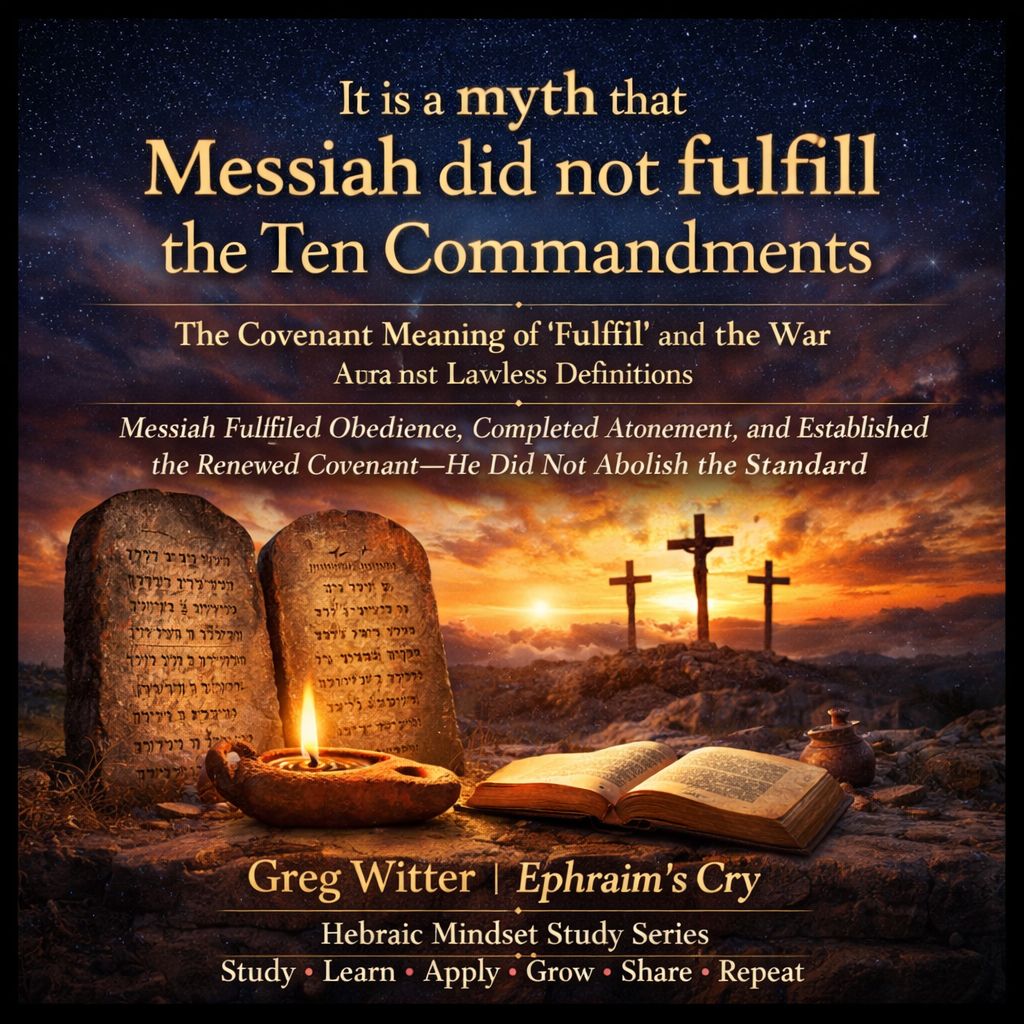
It is a myth that Messiah did not fulfill the Ten Commandments
The Covenant Meaning of “Fulfill” and the War Against Lawless Definitions
Messiah Fulfilled Obedience, Completed Atonement, and Established the Renewed Covenant — He Did Not Abolish the Standard
Greg Witter | Ephraim’s Cry
Hebraic Mindset Study Series
Learn Apply Grow Share Repeat
Introduction — The Word “Fulfill” Is the Battlefield One sentence can expose a whole religious system.
“It is a myth that Jesus Christ did not fulfill the Ten Commandments.”
If someone says that and means, “Messiah obeyed perfectly,” that statement is true.
But in practice, most people don’t use “fulfilled” that way.
They use it as a weapon.
They use “fulfilled” to smuggle in abolition. They use “fulfilled” to cancel obedience. They use “fulfilled” to turn covenant into sentiment. They use “fulfilled” to rebrand lawlessness as grace.
So the issue is not whether Messiah “fulfilled” the Ten Commandments. The issue is what kind of “fulfill” you’re preaching.
Because there is a fulfill that produces obedience, and there is a counterfeit fulfill that produces rebellion.
And Scripture draws the line plainly.
I. Define the Terms or You’ll Be Deceived The most dangerous deception is not denial. It is redefinition.
People keep using biblical words while changing biblical meanings.
• “Grace” becomes permission
• “Faith” becomes mental agreement
• “Spirit-led” becomes unaccountable feelings
• “Fulfilled” becomes abolished
That is how deception survives. It never has to reject Scripture. It only has to twist the definition.
So we define “fulfill” the way Messiah defined it — in context, in covenant, and in the courtroom of Torah + testimony.
II. Messiah Did Fulfill the Ten Commandments — In the Only Way Righteousness Can Fulfill Them If “fulfill” means “obey perfectly,” Messiah did.
“He committed no sin.” (1 Peter 2:22)
“Tempted in all points as we are, yet without sin.” (Hebrews 4:15)
And Scripture defines sin:
“Sin is lawlessness.” (1 John 3:4)
So if Messiah had no sin, then Messiah had no lawlessness. That means His entire life was covenant alignment. He walked in obedience. He embodied righteousness.
Not as theory. Not as spirituality. As an actual way of life.
That alone destroys the idea that Torah is inherently opposed to Messiah. If Torah were the enemy, Messiah would have been fighting it. Instead, He lived it.
III. Messiah Settled the “Abolish vs Fulfill” Question With His Own Mouth Messiah did not leave this unclear.
“Do not think that I came to destroy the Torah or the Prophets. I did not come to destroy but to fulfill.” (Matthew 5:17)
That is not a suggestion. That is a prohibition.
Do not think I came to destroy.
Then He gives the time-marker that crushes abolition:
“Till heaven and earth pass away, one jot or one tittle shall by no means pass from the Torah till all be done.” (Matthew 5:18)
Then He gives the warning that destroys “least-commandment” theology:
“Whoever then breaks one of the least of these commandments, and teaches men so, shall be called least in the reign of the heavens.” (Matthew 5:19)
So if someone uses “fulfilled” to mean “abolished,” they are contradicting Messiah.
They are not interpreting Him. They are overriding Him.
And at that point, it is not misunderstanding. It is rebellion.
IV. What “Fulfill” Actually Means in Context The Greek term in Matthew 5:17 is plēroō. It carries the idea of filling up, bringing to fullness, bringing to full expression, bringing into its intended completeness.
A simple way to understand it:
A man fulfills a vow by keeping it — not by canceling it. A judge fulfills a law by enforcing it — not by throwing it away. A son fulfills a father’s instruction by obeying it — not by redefining it.
So when Messiah says He fulfills Torah, He is saying: I bring Torah to its full and intended expression. I embody it. I interpret it correctly. I establish it. I confirm it. I walk it.
If anyone says: “Messiah fulfilled Torah so we don’t have to obey,” they have turned “fulfill” into “destroy.”
And Messiah specifically said: Do not think that.
V. The “Cancellation Test” — The Lie Exposes Itself Immediately Here is how you expose the deception in ten seconds.
If fulfilling the Ten Commandments means they no longer matter, then by that logic:
• He fulfilled “Do not murder,” so murder is now fine.
• He fulfilled “Do not commit adultery,” so adultery is now fine.
• He fulfilled “Do not steal,” so theft is now fine.
• He fulfilled “Do not bear false witness,” so lying is now fine.
No one will openly say that, because it is obviously insane.
So what do they do?
They selectively cancel. They keep the commandments they already like, and they attack the ones that expose them — especially Sabbath, set-apartness, and covenant separation.
That isn’t theology. That is self-justification.
And Torah already diagnosed it:
“You have turned aside quickly from the way which I commanded you.” (Exodus 32:8)
Human nature always wants a religion where it can keep the parts that feel safe and cancel the parts that require surrender.
That is exactly why Messiah warned about deception and lawlessness.
VI. What Messiah Actually Completed — Atonement, Priesthood Fulfillment, and Covenant Ratification Now we get precise.
Messiah did not “complete” the moral standard by abolishing it. He completed the atonement system that pointed to Him.
Hebrews makes this plain:
“The blood of bulls and goats is unable to take away sins.” (Hebrews 10:4)
“But we have been set apart through the offering of the body of Yahusha Messiah once for all.” (Hebrews 10:10)
“For by one offering He has perfected forever those who are being set apart.” (Hebrews 10:14)
So what was fulfilled in the sense of completed?
• Sacrificial shadows fulfilled in the true sacrifice
• Levitical administration fulfilled in the greater priesthood order
• Repeated offerings fulfilled in the once-for-all offering
• Temporary covering fulfilled in conscience-cleansing atonement
That is the category of “finished.”
Not “obedience is finished.” Not “commandments are finished.”
Atonement was finished. Payment was finished. The ransom was finished. The blood was poured out.
The standard was not erased. The standard was upheld — and the penalty for breaking it was carried.
That is why grace exists at all.
VII. The Renewed Covenant Is Not a Replacement Covenant This is where most people show they have not read Jeremiah 31 honestly.
Jeremiah does not say: “I will delete My Torah.”
It says:
“This is the covenant that I will make with the house of Israel… I will put My Torah in their inward parts and write it on their hearts.” (Jeremiah 31:33)
Hebrews quotes Jeremiah directly:
“I will put My laws into their mind, and write them on their hearts.” (Hebrews 8:10)
“I will put My laws into their hearts…” (Hebrews 10:16)
So the renewed covenant does not remove Torah. It moves Torah.
From external tablets to internal inscription. From outward proximity to inward governance. From knowledge without power to obedience empowered by the Spirit.
Ezekiel says the same thing:
“I will put My Spirit within you and cause you to walk in My statutes, and guard My right-rulings and do them.” (Ezekiel 36:27)
Notice: Spirit does not replace obedience. Spirit produces obedience.
So anyone claiming: “The Spirit replaced the commandments,” is preaching against Ezekiel, Jeremiah, Hebrews, and Messiah.
VIII. Messiah Himself Defined the Renewed Covenant at the Table Messiah did not speak like a Greek philosopher. He spoke like Torah.
“This cup is the renewed covenant in My blood.” (Luke 22:20)
“This is My blood of the covenant, which is poured out for many for the forgiveness of sins.” (Matthew 26:28)
That is covenant ratification language.
At Sinai:
“See, the blood of the covenant…” (Exodus 24:8)
Messiah intentionally echoes Sinai, because He is restoring covenant standing. Not creating a new morality. Not authorizing a new lawless religion. Restoring the covenant through blood.
The people broke covenant. The covenant terms did not fail. The people failed.
Hebrews even says it plainly:
“For finding fault with them…” (Hebrews 8:8)
Not with Torah. With them.
So when Messiah seals the covenant in His blood, the covenant is not rewritten into permissiveness. It is restored to its intended function: A holy people walking in holy ways by a holy Spirit.
IX. Paul Did Not Teach Torah Abolition — He Taught the Correct Order Paul is constantly abused by lawless doctrine.
So we let Paul interpret Paul.
“Do we then nullify Torah through belief? Let it not be! On the contrary, we establish Torah.” (Romans 3:31)
“The law is holy, and the commandment holy and just and good.” (Romans 7:12)
Paul’s argument is not: Torah is abolished.
Paul’s argument is: Torah cannot justify you. Torah exposes sin. Messiah provides atonement. And then the Spirit empowers you to walk rightly.
That is exactly why Paul says: Messiah is the goal — the telos — of Torah (Romans 10:4). Goal does not mean trash can. Goal means destination.
Torah aims at righteousness. Messiah embodies righteousness. We are called to resemble Messiah.
So when people say: “Messiah is the end of the law,” meaning termination, they are twisting Paul into contradiction with Messiah.
And the Spirit does not author contradictions.
X. The End-Times Test Is Not Gifting — It Is Obedience Messiah’s own end-times warning isn’t about tongues. It’s about lawlessness.
“Not everyone who says to Me, ‘Master, Master,’ shall enter… but he who does the desire of My Father.” (Matthew 7:21)
“Depart from Me, you workers of lawlessness.” (Matthew 7:23)
So the final rejection comes on this basis: They claimed Him. They did things. They had manifestations. They had ministry. But they lived in lawlessness.
That means: Spiritual activity is not readiness. Giftings are not the seal. Words are not covenant loyalty.
Obedience is.
And the apostolic witness confirms the remnant standard:
“Those guarding the commandments of Elohim and the testimony of Yahusha.” (Revelation 12:17)
“Those guarding the commandments of Elohim and the belief of Yahusha.” (Revelation 14:12)
Both. Not one. Not either/or. Commandments + testimony.
XI. The Myth Exposed Cleanly So here is what is true, and what is false.
True: Messiah fulfilled the Ten Commandments by obeying them perfectly. Messiah fulfilled the sacrificial system by becoming the sacrifice. Messiah fulfilled priestly mediation by becoming the High Priest in the greater order. Messiah fulfilled prophecy by accomplishing what was written. Messiah fulfilled covenant promises by sealing the renewed covenant in blood.
False: Messiah fulfilled the Ten Commandments so you don’t have to obey. Messiah fulfilled Torah so Torah is now abolished. Messiah fulfilled righteousness so lawlessness is now grace. Messiah fulfilled covenant loyalty so covenant loyalty is optional.
That is not fulfillment. That is deception.
Conclusion — Fulfillment Produces Resemblance The entire purpose of Messiah’s life is not to excuse sin. It is to destroy sin and reproduce righteousness.
Torah defines righteousness. Messiah embodies righteousness. The Spirit empowers righteousness. The renewed covenant internalizes righteousness.
So if someone wants to claim: “Messiah fulfilled it so I don’t have to,” they are not honoring Messiah.
They are using Messiah as a loophole to protect the flesh.
And Messiah already told us what He will call that in the end:
Lawlessness.
So the truth stands:
Messiah fulfilled the Ten Commandments. And because He fulfilled them, His people are called to walk in that same obedience — not to be saved by it, but because they have been redeemed into covenant loyalty.
He didn’t die to make rebellion acceptable. He died to make obedience possible.
If you would like to see the full, in-depth teaching on this subject and go deeper into the covenant, linguistic, and prophetic foundations behind it, consider joining my private subscription group. It’s just 99¢ a month, and your support helps keep these uncompromised, text-anchored teachings going out consistently and without dilution. Support here. Join here: https://www.facebook.com/greg.witter/subscribenow…
#GregWitter#EphraimsCry#HebraicMindset#FulfillNotAbolish#TenCommandments#TorahAndTestimony#RenewedCovenant
#TorahWrittenOnTheHeart#Matthew5#Matthew7#Romans331#Romans712#Hebrews10#Ezekiel3627#Revelation1412
#CovenantFaithfulness#GuardHisCommandments#NarrowPath#EndureUntilTheEnd
