
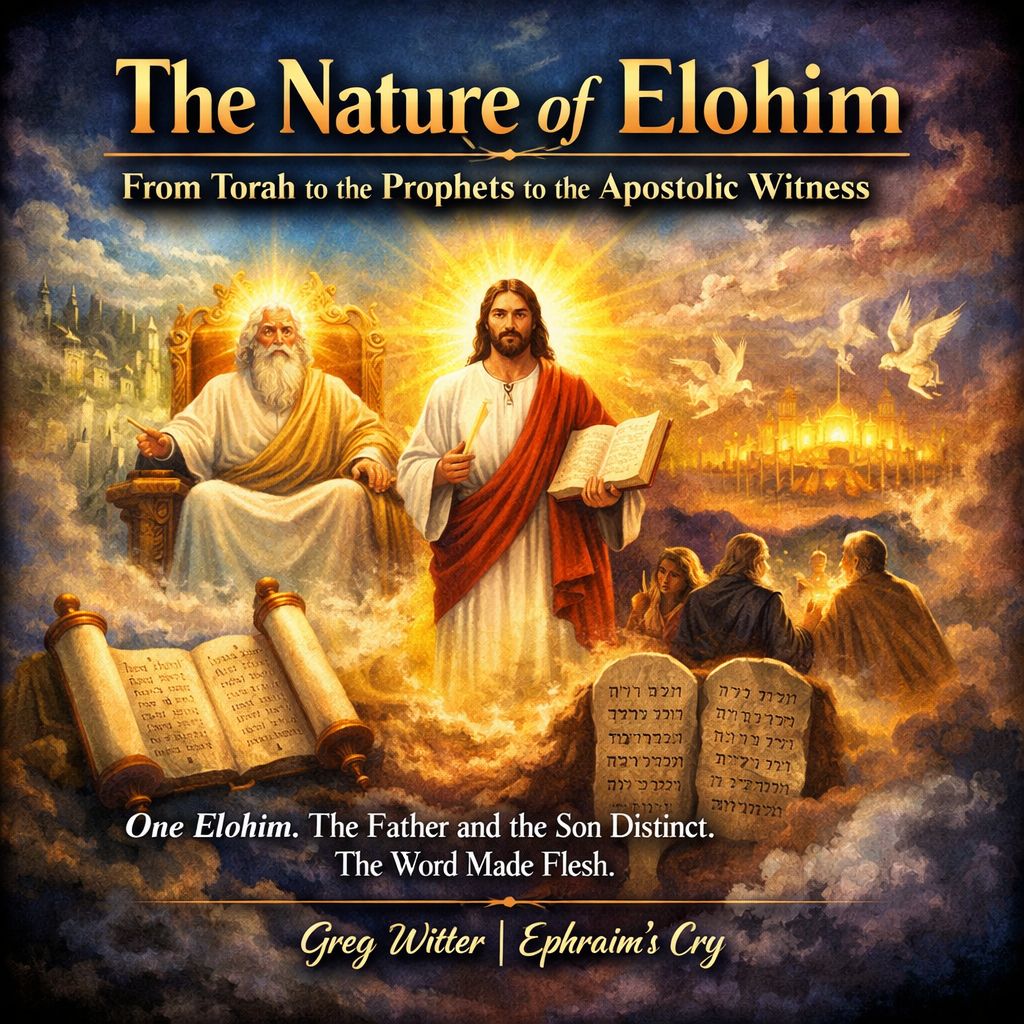
The Nature of Elohim
From Torah to the Prophets to the Writings to the Apostolic Witness
One Elohim. The Father and the Son Distinct. The Son Not an Angel, but the Revealed Word Made Flesh.
Greg Witter | Ephraim’s Cry
Hebraic Mindset Study Series
Study Learn Apply Grow Share Repeat
The question of the nature of Elohim has confused many people because most are handed a theological system before they are ever taught to simply read the text. Some are raised in Oneness teaching, where the Father and the Son are treated as the same person simply appearing in different forms. Others are raised in philosophical Trinitarian systems that use categories foreign to the language of Scripture. Others are told the Son is merely an exalted angel — the captain of the heavenly host — but nothing more.
The only safe way through that confusion is to step away from man-made systems and return to the full counsel of Elohim: Torah, the Prophets, the Writings, and the Apostolic witness. When the entire testimony of Scripture is allowed to speak together, the picture becomes clear.
The starting point must always be the same place Scripture begins.
Deuteronomy 6:4 declares the foundational confession of Israel:
“Hear, O Israel: Yahuah our Elohim, Yahuah is one.”
This statement, known as the Shema, establishes the absolute covenant truth that there is one Elohim. Scripture never presents multiple competing gods, a divine council of equal powers, or a divided deity. Yahuah alone is Elohim. Every discussion about the Father and the Son must begin there or it will drift into confusion immediately.
The Hebrew word translated “one” in this passage is echad. In Scripture, echad frequently describes a unified oneness rather than a simple mathematical singularity.
Genesis 2:24 says a man and a woman become “one flesh.” Two individuals remain distinct, yet they are united in covenant as one. Genesis 1:5 describes evening and morning forming “one day.” Multiple elements come together to form a single unified reality.
The Shema therefore establishes the unity of Elohim while leaving room for the distinctions the rest of Scripture reveals.
Already in the opening chapters of Torah we see this pattern unfolding.
Genesis 1:1 tells us that Elohim created the heavens and the earth. Genesis 1:2 tells us that the Spirit of Elohim was moving over the face of the waters. Genesis 1:3 tells us that Elohim spoke and creation came into existence.
So from the very beginning we see Elohim, His Spirit, and His active Word bringing creation into being.
Genesis also records statements that hint at complexity within the unity of Elohim.
Genesis 1:26 says:
“Let Us make man in Our image.”
Genesis 11:7 says:
“Come, let Us go down and confuse their language.”
These passages do not overturn the truth that Elohim is one, but they show that the biblical text itself allows the reader to recognize distinctions within the unity of Elohim.
The concept of the image of Elohim also begins in Torah.
Genesis 1:26–27 says mankind was created in the image of Elohim. That image language becomes extremely important later in Scripture because it establishes a pattern of representation.
When we arrive at the Apostolic writings, Messiah is described in those same terms.
Colossians 1:15 says:
“He is the image of the invisible Elohim.”
Hebrews 1:3 says:
“He is the radiance of His glory and the exact representation of His nature.”
Adam was created in the image of Elohim, but Messiah is presented as the perfect and visible expression of that invisible Elohim.
Torah also introduces the mysterious figure known as the Messenger of Yahuah.
In several passages the Messenger of Yahuah speaks as Yahuah, bears divine authority, and yet is distinguished from Yahuah.
In Genesis 16 Hagar encounters the Messenger of Yahuah and says she has seen Elohim who sees her. In Genesis 22 the Messenger of Yahuah stops Abraham and then speaks in the first person as Yahuah. In Exodus 3 the Messenger of Yahuah appears in the burning bush, yet the text immediately identifies the speaker as Elohim.
This pattern shows that the one Elohim can reveal Himself personally and actively while maintaining distinction within His revelation.
The Prophets expand these themes even further.
Isaiah speaks of a coming child who bears divine authority.
Isaiah 9:6 declares:
“For unto us a child is born, unto us a son is given… and his name shall be called Wonderful Counselor, Mighty El, Everlasting Father, Prince of Peace.”
Isaiah also speaks of the Servant of Yahuah who carries out the redemptive mission of Elohim.
Isaiah 48:16 states:
“And now the Master Yahuah has sent Me, and His Spirit.”
The Sender, the one sent, and the Spirit appear together in the prophetic text without destroying the unity of Elohim.
The prophets also reveal the eternal nature of the Messiah.
Micah 5:2 declares:
“From you shall come forth for Me one who is to be ruler in Israel, whose goings forth are from of old, from the days of eternity.”
That is not the language of a created angel. That is the language of one whose origins stretch into eternity.
Daniel adds another crucial witness.
Daniel 7 describes the Ancient of Days seated upon the heavenly throne. Then Daniel sees one like a Son of Man coming before Him and receiving everlasting dominion.
Daniel 7:14 says:
“To Him was given dominion and glory and a kingdom, that all peoples, nations, and languages should serve Him.”
The Son of Man is distinct from the Ancient of Days, yet he receives universal dominion. That level of authority is never given to angels.
The Writings confirm this pattern.
Psalm 110 records David saying:
“Yahuah said to my Master, sit at My right hand until I make Your enemies Your footstool.”
David distinguishes Yahuah from his Master, yet that Master is enthroned beside Yahuah Himself.
Psalm 110 then declares that this same figure is a priest forever according to the order of Melchizedek.
This Melchizedek priesthood becomes extremely important later in Hebrews because it shows that Messiah’s priesthood is eternal and not part of the Levitical priesthood established at Sinai.
Proverbs also contains a remarkable question.
Proverbs 30:4 asks:
“Who has ascended to heaven and come down? Who has gathered the wind in His fists? Who has established all the ends of the earth? What is His name, and what is His Son’s name, if you know?”
Long before the Apostolic writings, the Scriptures themselves already pointed toward the mystery of the Son.
When we arrive at the Apostolic witness, the picture becomes explicit.
John opens his Gospel by returning to Genesis.
“In the beginning was the Word, and the Word was with Elohim, and the Word was Elohim. All things were made through Him.”
John 1:1–3
John identifies the Word through whom creation came into existence.
Then John declares:
“The Word became flesh and dwelt among us.”
John 1:14
The Son is not a created angel. He is the Word of Elohim made flesh.
Yahusha Himself explained His relationship to the Father.
John 14:9 says:
“He who has seen Me has seen the Father.”
This does not collapse the Father and the Son into the same person. Instead it explains that the Son perfectly reveals the Father.
Paul expands the same truth.
Colossians 1:16 says:
“By Him all things were created in heaven and on earth, visible and invisible.”
If all things were created through Him, the angelic host is part of the creation that came through Him.
This destroys the claim that the Son is merely the captain of the host as a created angel.
Hebrews addresses that claim directly.
Hebrews 1:5 asks:
“To which of the angels did He ever say, ‘You are My Son’?”
Then the text declares:
“Let all the angels of Elohim worship Him.”
Hebrews 1:6
Angels worship the Son. Therefore the Son cannot be one of them.
Paul also reveals that Messiah was active in the covenant history of Israel.
1 Corinthians 10:4 says:
“They drank from the spiritual Rock that followed them, and the Rock was Messiah.”
This ties Messiah directly into the history of Israel in the wilderness.
Hebrews 7 then explains that Messiah is the eternal High Priest according to the order of Melchizedek, not according to the Levitical priesthood.
John adds another critical statement.
John 5:22–23 says:
“The Father judges no one, but has given all judgment to the Son… that all may honor the Son just as they honor the Father.”
Angels are never given that level of honor.
Finally, the book of Revelation reveals the heavenly throne.
Revelation 5 shows the Lamb entering the throne room and receiving the worship of heaven.
Revelation 5:13 declares:
“To Him who sits on the throne and to the Lamb be blessing and honor and glory and power forever.”
Revelation 22:1 then speaks of:
“The throne of Elohim and of the Lamb.”
One throne.
The Father and the Lamb together.
Revelation also applies divine titles to Messiah that originally belong to Yahuah.
Isaiah 44:6 declares:
“I am the first and I am the last.”
Yet in Revelation 1:17 Messiah says:
“I am the First and the Last.”
Hebrews 13:8 then ties the entire witness of Scripture together:
“Yahusha Messiah is the same yesterday, today, and forever.”
From Torah to the Prophets to the Apostolic witness, the testimony remains consistent.
There is one Elohim.
The Father is Elohim.
The Son is distinct from the Father, yet He is not a created angel. He is the Word made flesh, the image of the invisible Elohim, the one through whom creation came and through whom redemption is accomplished.
The Spirit of Elohim is the active presence and power of Elohim working in creation and within His people.
This understanding does not come from philosophical speculation.
It comes from the unified witness of Scripture itself.
If someone insists that the Father and the Son are the same person, they must explain away the baptism of Yahusha, His prayers to the Father, His being sent by the Father, and His return to the Father.
If someone insists the Son is merely an angel, they must explain away John 1, Colossians 1, Hebrews 1, Daniel 7, Psalm 110, Micah 5, and the worship of the Lamb in Revelation.
Neither position survives the whole counsel of Elohim.
The truth stands plainly in the text.
And the text is enough.
#EphraimsCry#GregWitter#HebraicMindset#NatureOfElohim#OneElohim#TheFatherAndTheSon#WordMadeFlesh
#Hebrews1#John1#Colossians1#Daniel7#Psalm110#MessiahNotAnAngel#BiblicalTheology#WholeCounselOfElohim
