
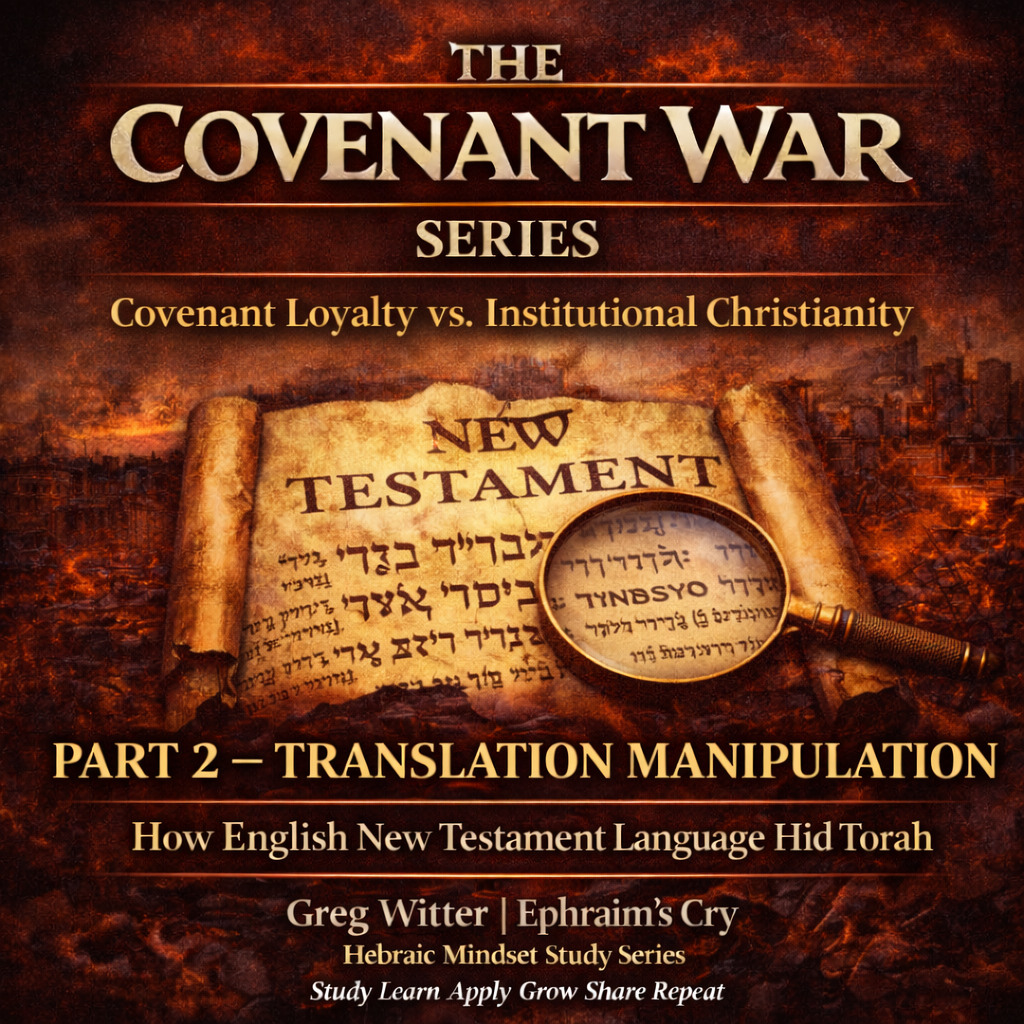
THE COVENANT WAR
Exposing Churchianity, Restoring Covenant Continuity, and Defending the Apostolic Witness
When Systems Replace Scripture, the Word Must Be Guarded
PART TWO — TRANSLATION MANIPULATION
How Western Theology Weaponized Words to Manufacture Lawless Doctrine
The Most Effective Way to Change Doctrine Is to Change the Words
Greg Witter | Ephraim’s Cry
Hebraic Mindset Study Series
Study Learn Apply Grow Share Repeat
Words build worlds.
You do not change theology first. You change vocabulary first.
Once vocabulary shifts, theology follows. Once theology shifts, practice changes. Once practice changes, identity fractures.
Translation is not mechanical. It is interpretive.
And when interpretation is filtered through institutional agendas, inherited doctrinal systems, or philosophical categories foreign to the Hebraic covenant framework, the text can be redirected without a single Greek word being altered.
The corruption did not begin by removing verses. It began by redefining them.
Modern Western Gentile translation tradition has repeatedly carried theological assumptions that reshape covenant categories into churchian categories. Translators are trained inside theological systems. Those systems already define “law,” “grace,” “church,” “Israel,” and “covenant” in post-biblical ways. Vocabulary is not neutral when the framework is not neutral.
This is how doctrine is manufactured without appearing to tamper with Scripture.
The Greek word nomos is rendered “law.” But Torah does not mean oppressive legal code. It means instruction. Direction. Covenant constitution. Psalm 19:7 declares that the Torah of Yahuah is perfect, restoring the soul. Psalm 119 celebrates Torah as wisdom, delight, and life.
Yet modern readers, trained under anti-legalism preaching, hear “law” and think bondage. So when Romans 6:14 says, “You are not under law but under grace,” the English reader hears “You are not under Torah.”
But Paul’s contrast is not Torah versus freedom. It is condemnation versus redemption. “Under law” refers to standing under penalty and judgment for transgression. It does not mean living inside covenant instruction.
When categories are flattened, Paul is made to sound anti-Torah. But the flattening is not in the Greek. It is in the reader’s theological conditioning.
Romans 10:4 declares that Messiah is the “end” of the law. The Greek word telos does not mean termination. It means goal, culmination, aim. If telos means termination, Torah is abolished. If telos means goal, Messiah is the embodiment and fulfillment of Torah’s purpose.
If Torah were terminated, sin could no longer be defined as lawlessness. Yet 1 John 3:4 defines sin precisely as lawlessness. Revelation 12:17 and 14:12 describe the saints as those who keep the commandments of Elohim and hold the testimony of Messiah. Termination theology collapses under its own contradictions.
Galatians’ phrase “under the law” has been weaponized to mean obedience equals bondage. But Paul’s argument is covenantal and forensic. To be under law is to stand under condemnation. A faithful son walking in instruction is not in bondage. A rebellious son under judgment is.
When obedience is equated with slavery, rebellion becomes rebranded as freedom.
Colossians 2:14 speaks of the “handwriting of ordinances” being nailed to the stake. The phrase refers to a certificate of debt — a record of charges. Yet sermons have declared that Torah itself was nailed away. If Torah were removed, then judgment, repentance, and the definition of sin would all collapse. But Scripture never states that the covenant constitution was erased. It states that debt was canceled.
Colossians 2:16 is used to dismiss Sabbath observance. But the text does not abolish Sabbath. It warns against external judgment regarding observance. Sabbath is a covenant sign (Exodus 31:13). The appointed times are declared to be Yahuah’s mo’edim (Leviticus 23:2). When these are replaced with institutional calendars, covenant identity is displaced.
Ekklesia means assembly. But “church” carries institutional freight — hierarchy, denomination, clergy-laity divide. Once ekklesia becomes “church,” identity shifts from covenant assembly to religious institution. Replacement theology grows from that shift. “Church versus Israel” is not apostolic language. It is institutionallanguage.
Grace is another casualty. Titus 2:11–14 teaches that grace trains us to deny ungodliness and live righteously. Grace empowers obedience. Yet modern preaching reframes grace as exemption from obedience. If grace produces lawlessness, it is not biblical grace. It is counterfeit mercy.
The Spirit has been pitted against Torah. But Jeremiah 31 declares that Torah is written on the heart. Ezekiel 36 promises that the Spirit will cause obedience. The Spirit does not nullify Torah. The Spirit internalizes it. “Spirit-led” does not mean Torah-free. It means Torah-enabled.
Translation committees do not operate in a vacuum. Many are trained within theological institutions shaped by inherited creeds and doctrinal frameworks. Even sincere translators are shaped by categories already accepted as unquestioned truth. Vocabulary becomes constrained by tradition. Tradition shapes interpretation. Interpretation shapes discipleship.
The fruit is visible:
Sabbath abandoned.
Appointed times replaced.
Torah labeled obsolete.
Grace turned into license.
Denominations multiplying.
Holiness reduced to sentiment.
Prophecy turned into spectacle.
This is not the fruit of the apostolic witness. It is the fruit of layered interpretation imposed upon it.
The reaction against the New Testament often arises from seeing this corruption. But the target is misidentified. The apostles are not the source of lawless churchianity. Distorted translation and inherited theological frameworks are.
Deuteronomy 4:2 commands: do not add or subtract. Deuteronomy 12:32 repeats the guard. Revelation 22:18–19 warns against tampering with the words.
If vocabulary inserts foreign theology, subtraction occurs. If institutional creeds are imposed as interpretive lenses, addition occurs.
Guard the Word.
Test the categories.
Strip away inherited freight.
Return to a Torah-rooted, Messiah-centered covenant reading.
Weapon Three will address the counterfeit gospel that grew out of these distortions.
#CovenantWar #TranslationManipulation #GuardTheWord #TorahAndMessiah #CovenantContinuity #RejectLawlessness
#EkklesiaNotChurch #HebraicMindset #EphraimsCry #GregWitter
