
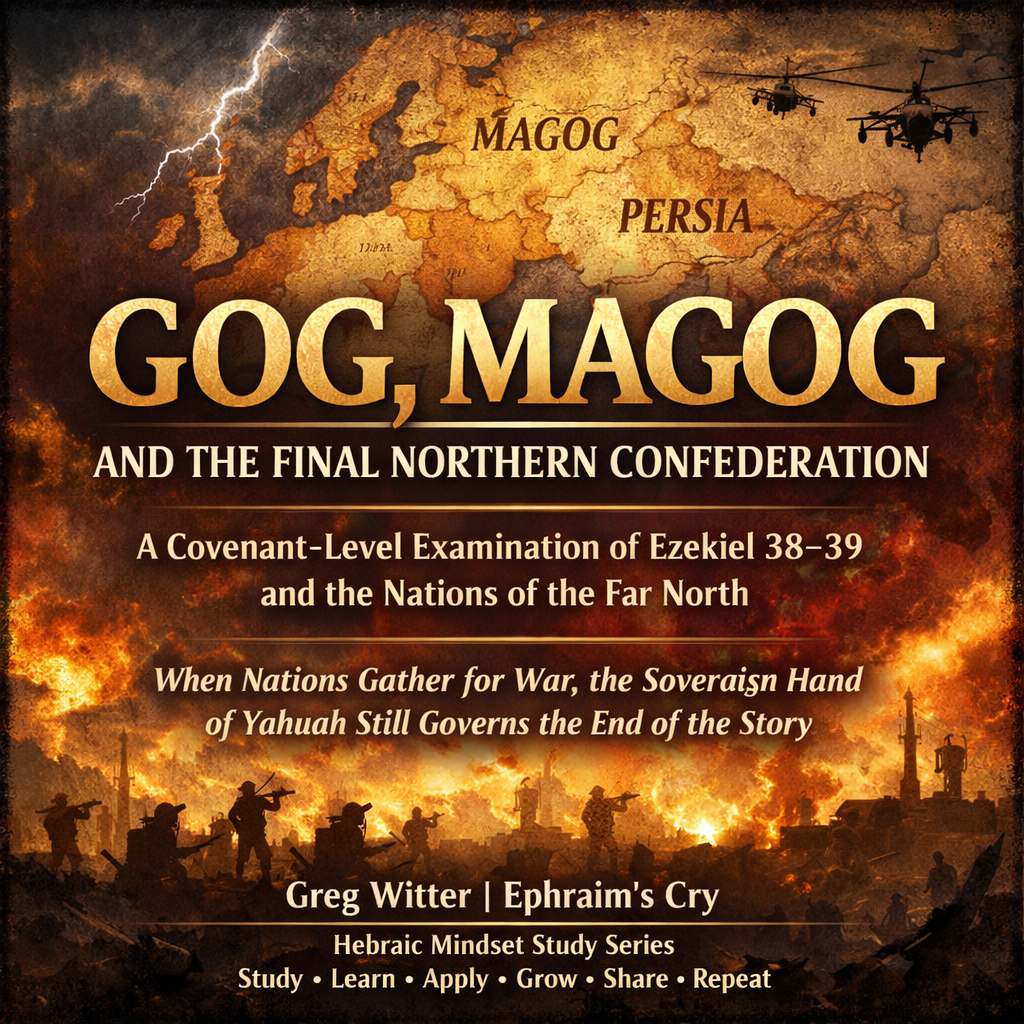
GOG, MAGOG, AND THE FINAL NORTHERN CONFEDERATION
A Covenant-Level Examination of Ezekiel 38–39, the Nations of the Far North, and Why the Headlines of Today May Be Only a Prelude
When Nations Gather for War, the Sovereign Hand of Yahuah Still Governs the End of the Story
Greg Witter | Ephraim’s Cry
Hebraic Mindset Study Series
Study Learn Apply Grow Share Repeat
The prophecy of Gog and Magog in Ezekiel 38–39 is one of the most frequently cited passages whenever tensions rise in the Middle East. Every generation that watches global alliances shift is tempted to immediately insert modern headlines into the text and declare that the prophecy is unfolding before our eyes.
But prophecy does not belong to speculation. It belongs to covenant revelation.
If we are going to handle this passage faithfully, we must do what the prophets themselves did: allow the text to define the framework. Only after that framework is established can we carefully ask how present events might relate to the prophetic pattern.
When that approach is taken, Ezekiel 38–39 becomes far deeper than a geopolitical guess. It becomes a prophetic window into how Yahuah will ultimately confront the arrogance of the nations and reveal Himself before the world.
The Restoration Context That Many Interpretations Ignore
One of the most important details in Ezekiel’s prophecy is the context in which it appears.
Ezekiel 36 describes the restoration of Israel.
Ezekiel 37 describes the valley of dry bones, where scattered Israel is brought back to life and gathered again as one people.
Only after restoration does the Gog invasion occur.
Ezekiel 38:8 says:
“After many days you will be visited. In the latter years you will come into the land of those brought back from the sword and gathered from many people.”
This detail is critical because it means Gog’s invasion occurs after a regathering of Israel from many nations.
Whether one sees that regathering as partially fulfilled in modern times or still awaiting a greater future restoration, the text clearly places the invasion after Israel has been reestablished in the land.
Many popular interpretations skip this covenant sequence and jump directly to identifying Gog with modern political powers.
But Ezekiel’s prophecy begins with restoration first, invasion second, and divine judgment third.
The Identity of Gog: Leader of the Northern Coalition
The prophecy identifies Gog as the chief prince of a northern power structure connected with Magog, Meshech, and Tubal.
These names come from the Table of Nations in Genesis 10, where the descendants of Japheth spread into regions north of Israel.
In Ezekiel’s world, these names represented real geographic and ethnic territories known to the ancient Near East.
The prophecy emphasizes that Gog comes from “the far north.”
This direction becomes a repeated marker throughout the prophetic literature. The north in biblical prophecy often represents the direction from which invading powers descend upon Israel.
However, Ezekiel does not give us a modern political map. The text does not say “Russia,” “NATO,” or any contemporary state. It simply identifies a northern confederation leader emerging from territories associated with the ancient Table of Nations.
This means any attempt to attach a modern country to Gog must remain tentative, because the prophecy describes regions and peoples rather than modern nation-states.
The Coalition of Nations
The invading force includes a broad alliance:
Persia
Cush
Put
Gomer
Beth-Togarmah
Persia corresponds to the historical region of Iran. Cush and Put are regions associated with areas of Africa. Gomer and Togarmah relate to territories north of Israel around Anatolia and the Caucasus.
The picture is not a single empire but a large multinational confederation stretching across several regions.
This is why the prophecy repeatedly emphasizes the size of the force.
“You will ascend, coming like a storm… covering the land like a cloud.” (Ezekiel 38:9)
The imagery describes a military coalition so vast that it appears overwhelming.
Yet even this overwhelming power is not the real focus of the prophecy.
The Motive Behind the Invasion
The coalition’s motivation is surprisingly straightforward: plunder.
Ezekiel 38:12 says the invaders come
“To take plunder and to take booty.”
The prophecy portrays Israel as prosperous and secure at the time of the invasion.
This detail raises important interpretive questions. The passage describes Israel as a people dwelling in relative safety and prosperity.
“Dwelling without walls, having neither bars nor gates.” (Ezekiel 38:11)
Many interpreters struggle with this description because modern Israel does not currently match this condition. The nation is heavily fortified and constantly under threat.
This suggests that the conditions described in Ezekiel may reflect a future period of perceived peace or security, rather than the present geopolitical climate.
The Divine Hook in the Jaw
One of the most striking elements in the prophecy is Yahuah’s declaration that He Himself draws Gog into the conflict.
“I will turn you around, put hooks into your jaws, and lead you out.” (Ezekiel 38:4)
This language echoes earlier prophetic descriptions of how Yahuah used foreign empires as instruments of judgment.
In this case, Gog believes he is acting according to his own ambition. Yet behind the scenes, Yahuah is orchestrating events to reveal His authority before the nations.
This theme appears throughout Scripture.
Human rulers imagine they are directing history. In reality, they are often unwitting participants in a larger divine plan.
The Collapse of the Invasion
The climax of the prophecy does not involve Israel defeating Gog through military strength.
Instead, the invading armies collapse under divine judgment.
A massive earthquake shakes the land.
Mountains collapse.
Confusion spreads through the armies.
“All men who are on the face of the earth shall shake at My presence.” (Ezekiel 38:20)
Then chaos erupts among the invading forces.
“Every man’s sword will be against his brother.” (Ezekiel 38:21)
This internal collapse mirrors other biblical moments where Yahuah caused enemy armies to destroy themselves.
The judgment continues with natural and supernatural catastrophe:
Flooding rain
Great hailstones
Fire and brimstone
The scale of the destruction makes it clear that the outcome is not a conventional military victory. It is a demonstration of divine authority.
The Purpose of the Prophecy
The final verse of the chapter reveals the ultimate reason for this event.
“Thus I will magnify Myself and sanctify Myself, and I will be known in the eyes of many nations.” (Ezekiel 38:23)
The Gog invasion is therefore not primarily about the identity of Gog.
It is about the revelation of Yahuah to the nations.
Through this dramatic confrontation, the nations will see that history is not governed by human power alone.
How This Relates to Current Events
Many people look at current alliances—Russia, Iran, Turkey, and others—and immediately assume Ezekiel 38 is unfolding right now.
It is understandable why such connections are made. Some modern alliances resemble parts of the ancient list of nations.
However, several details in the prophecy suggest that the final Gog invasion may not yet be occurring.
The prophecy describes Israel dwelling securely and prosperously without defensive barriers.
The current geopolitical reality does not yet match that condition.
Additionally, the invasion appears to involve a sudden, overwhelming coalition that believes Israel is an easy target.
Modern Israel is not currently perceived that way.
What current events may represent is a prelude.
Prophecy often unfolds through gradual developments that prepare the stage for the final event.
Alliances form.
Regional powers align.
Conflicts reshape the political landscape.
These developments do not necessarily fulfill the prophecy themselves, but they may create the conditions that eventually make it possible.
The Watchman’s Responsibility
The role of the watchman is not to force prophecy into headlines.
The watchman’s role is to understand the pattern and remain alert.
Ezekiel’s prophecy teaches several enduring truths:
Nations will continue to rise against Israel.
Human alliances will grow increasingly complex.
Military coalitions will form.
But the ultimate outcome does not depend on human power.
The final victory belongs to Yahuah.
Empires may rage, armies may gather, and alliances may shift, but history is not ultimately written in war rooms or government halls.
It is written by the One who declared the end from the beginning.
And when the moment arrives, the nations themselves will see it.
#GregWitter, #EphraimsCry, #HebraicMindset, #HebraicMindsetStudySeries, #StudyLearnApplyGrowShareRepeat,
#GogAndMagog, #Ezekiel38, #Ezekiel39, #BibleProphecy, #EndTimes, #PropheticScripture,
#WatchmanTeaching, #CovenantPerspective, #TorahAndProphets, #BiblicalWorldview, #ScriptureStudy, #KingdomPerspective
