
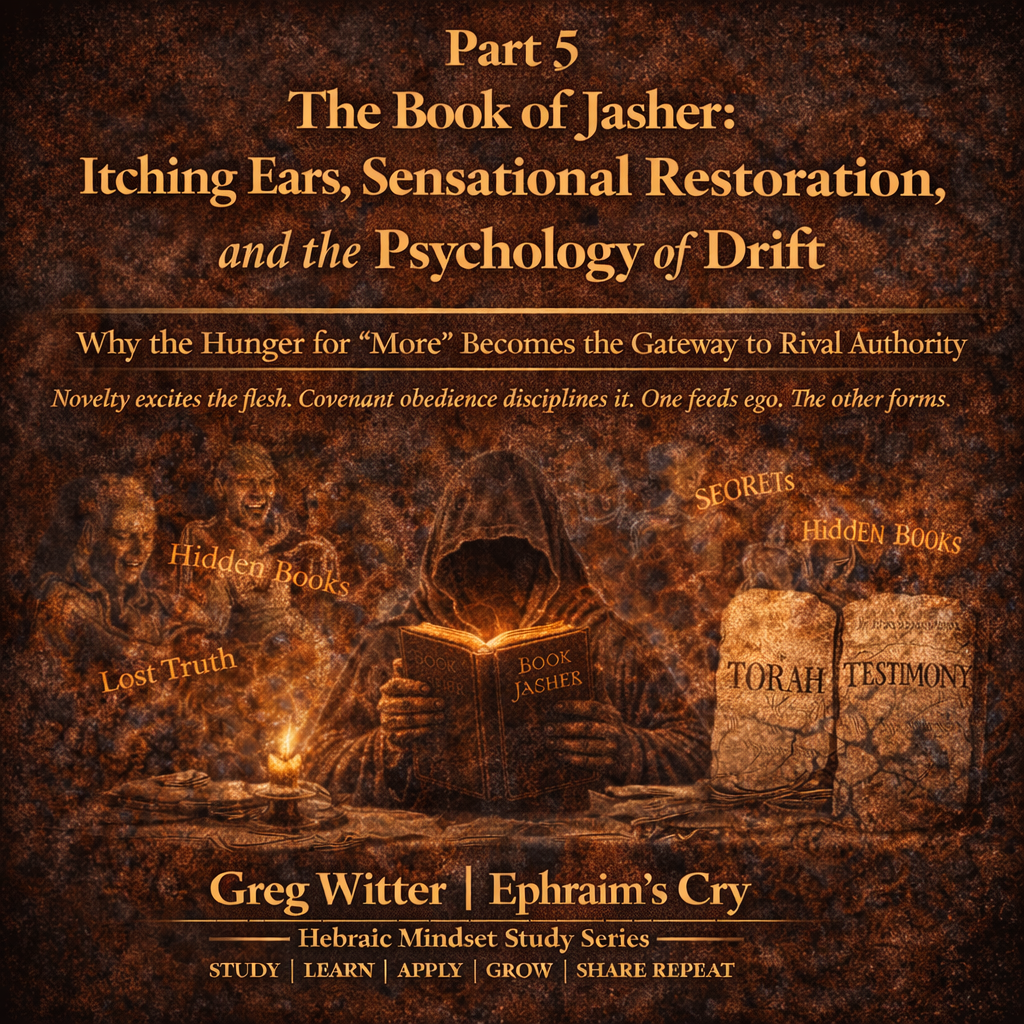
PART 5
The Book of Jasher: Itching Ears, Sensational Restoration, and the Psychology of Drift
Why the Hunger for “More” Becomes the Gateway to Rival Authority
Novelty excites the flesh. Covenant obedience disciplines it. One feeds ego. The other forms endurance.
Greg Witter | Ephraim’s Cry
Hebraic Mindset Study Series
Study Learn Apply Grow Share Repeat
The final layer of the Jasher issue is not textual.
It is psychological.
People do not chase extra books because they lack access to Scripture.
They chase extra books because Scripture feels too simple.
Torah is disciplined.
Torah is repetitive.
Torah is structured.
Torah calls for obedience, not speculation.
That is not entertaining to the flesh.
So the flesh looks for stimulation.
Scripture already warned that this would happen.
“There will come a time when people will not endure sound doctrine, but having itching ears they will accumulate teachers to suit their own desires, and will turn aside to myths” (2 Timothy 4:3–4).
That is not describing atheists.
That is describing religious people.
Religious people who grow restless with restraint.
Religious people who want something new.
Religious people who crave depth without submission.
The Book of Jasher fits that appetite perfectly because it carries three powerful psychological triggers:
- It is “mentioned in Scripture.”
- It feels ancient and mysterious.
- It promises expanded understanding.
Those three combined create spiritual adrenaline.
And adrenaline is addictive.
When people feel they are discovering something hidden, they experience elevation. When they feel they have access to something others reject, they experience superiority. When they believe they are restoring suppressed truth, they experience identity.
That is the psychological engine behind sensational restoration movements.
But covenant identity is not built on novelty. It is built on endurance.
Revelation 12:17 describes the remnant as those who keep the commandments of Elohim and hold the testimony of Yahusha. Revelation 14:12 calls for the endurance of the saints.
Notice what is absent.
No mention of secret books.
No mention of hidden chronologies.
No mention of expanded narratives.
The remnant is defined by obedience and testimony, not by possession of additional literature.
Now we must examine how instability develops.
When Jasher becomes central in a community, several patterns emerge:
– Endless discussion threads dissecting details.
– Arguments over interpretations.
– Suspicion toward those who refuse the book.
– Teachers building platforms on “restored knowledge.”
– Identity forming around acceptance of the extra text.
Division is not accidental in these environments. It is structural.
Because speculative literature allows endless interpretive elasticity.
Torah has boundaries.
Speculation has none.
When speculation becomes central, stability erodes.
Scripture warns against myths and endless genealogies because they promote arguments rather than stewardship from Elohim (1 Timothy 1:4). They produce learning without arrival (2 Timothy 3:7). They produce instability and winds of doctrine (Ephesians 4:14).
Jasher fascination, when elevated beyond literature, fits that pattern.
Now confront the deeper spiritual risk.
When believers become addicted to novelty, they lose tolerance for repetition. When repetition feels dull, obedience feels insufficient. When obedience feels insufficient, they seek something more dramatic.
That is the drift.
The enemy does not need you to deny Torah.
He only needs you distracted from it.
He does not need you to renounce Yahusha.
He only needs you chasing supplementary narratives.
He does not need you to abandon faith.
He only needs you chasing depth without discipline.
This is how addition becomes subtraction.
Addition of extra narrative.
Subtraction of covenant focus.
Addition of speculative debate.
Subtraction of humility.
Addition of identity based on “hidden truth.”
Subtraction of unity based on shared obedience.
Now we must expose the pride element directly.
Knowledge puffs up (1 Corinthians 8:1).
Hidden-book culture feeds pride because it creates a two-tier system:
Those who “see.”
Those who “don’t see.”
That division produces elitism disguised as restoration.
True restoration does not inflate ego. It humbles it.
True restoration returns to Torah.
It does not expand the canon.
It does not install rival authorities.
It does not require supplemental texts to feel complete.
Scripture declares sufficiency. The servant of Elohim is equipped through what has been given (2 Timothy 3:16–17). If someone feels incomplete without Jasher, that feeling is not revelation. It is appetite.
And appetite must be disciplined.
Covenant faithfulness is not built on appetite. It is built on obedience.
So the line must be drawn clearly.
You may read Jasher as literature.
You may study it historically.
You may examine it critically.
You may not enthrone it.
You may not build doctrine from it.
You may not use it to interpret Torah as a superior lens.
You may not allow it to govern obedience.
Because the moment it governs you, it has become an added authority.
And Deuteronomy forbids added authority.
The covenant spine remains unchanged:
Torah as foundation.
Prophets as covenant prosecutors.
Writings as covenant memory.
Apostolic witness as testimony of Yahusha.
Everything else is tested, weighed, and subordinated.
Restoration is not expansion.
Restoration is return.
Return to obedience.
Return to sufficiency.
Return to boundaries.
Return to endurance.
The remnant does not chase every book with a biblical name.
The remnant guards what was delivered.
Stand there.
#GregWitter, #EphraimsCry, #HebraicMindset, #TorahFirst, #BookOfJasher, #CovenantAuthority, #DoNotAdd, #DoNotTakeAway, #SoundDoctrine, #Discernment, #ItchingEars, #WindsOfDoctrine, #NoMyths, #TestEverything, #HoldFast, #ReturnToTorah, #WholeCounselOfElohim, #Remnant, #ObedientFaith, #StandFirm, #FaithOnceDelivered
