
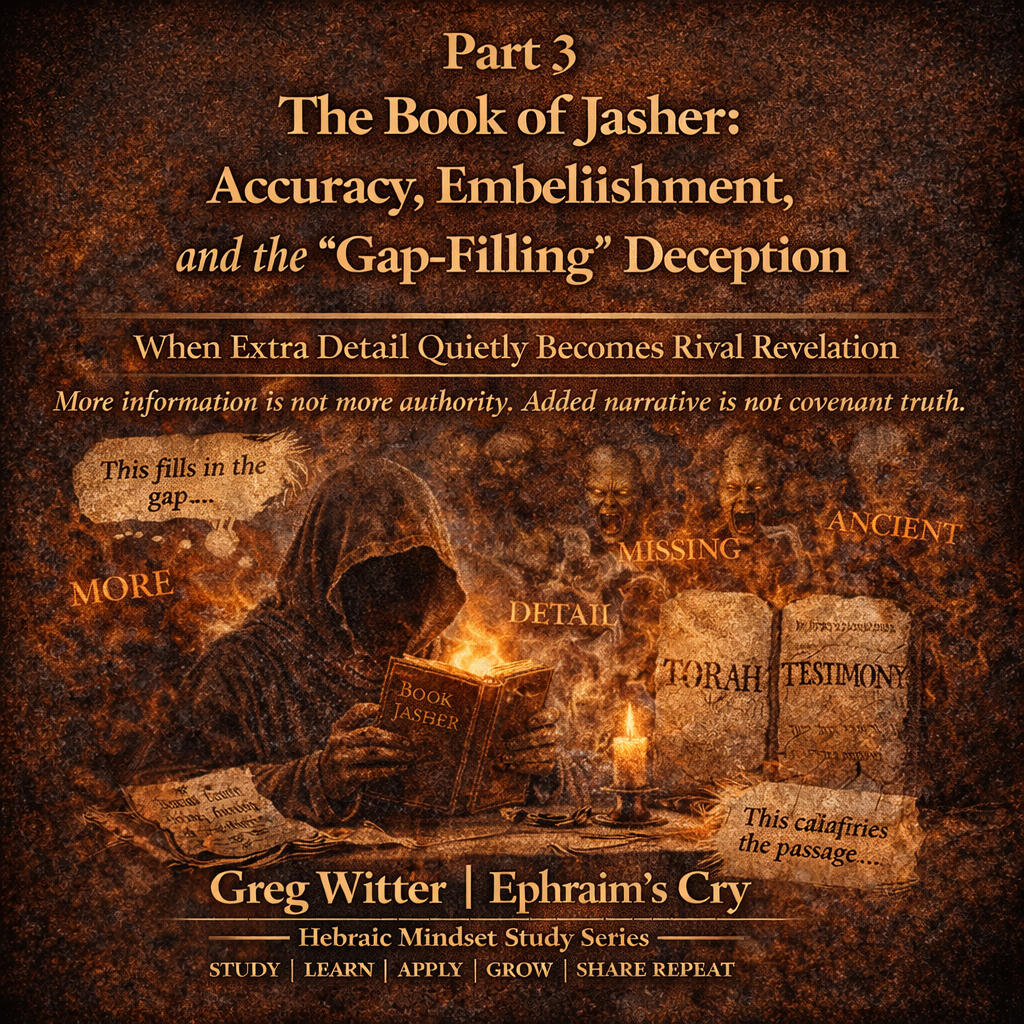
PART 3
The Book of Jasher: Accuracy, Embellishment, and the “Gap-Filling” Deception
When Extra Detail Quietly Becomes Rival Revelation
More information is not more authority. Added narrative is not covenant truth.
Greg Witter | Ephraim’s Cry
Hebraic Mindset Study Series
Study Learn Apply Grow Share Repeat
The most common defense of the modern Book of Jasher is not, “It is Scripture.”
It is softer than that. More subtle. More strategic.
“It just gives more detail.”
“It fills in what the Bible leaves out.”
“It helps us understand the context.”
That is the bait.
And that bait only works because modern readers are uncomfortable with restraint.
Torah is restrained.
The Prophets are restrained.
The Writings are restrained.
Scripture gives what is necessary for covenant obedience. It does not satisfy curiosity for entertainment. It does not indulge speculative hunger. It does not narrate every conversation, every motive, every missing day in a timeline.
That restraint is intentional.
And the moment a secondary text claims to “fill gaps,” it is accusing Scripture of insufficiency.
That accusation must be confronted directly.
Scripture declares itself sufficient to equip the servant of Elohim for every good work (2 Timothy 3:16–17). If Jasher is necessary to properly understand covenant instruction, then Scripture is not sufficient. That is not a minor implication. That is a structural challenge to the covenant spine.
Now here is how the deception unfolds in practice:
Stage one: “This doesn’t contradict Scripture. It just adds detail.”
Stage two: “These added details help clarify what was really happening.”
Stage three: “This added context changes how we interpret the biblical text.”
Stage four: “Because of this, we now understand the passage differently.”
By stage four, interpretation has shifted.
And interpretation governs doctrine.
Doctrine governs obedience.
Obedience defines covenant faithfulness.
So “just extra detail” is not harmless.
It is interpretive leverage.
Now we must press the issue of accuracy.
Any text that adds dialogue, narrative explanation, expanded chronology, or theological commentary that Scripture itself did not provide must be tested under Isaiah 8:20: to the Torah and to the testimony. If it does not speak according to this word, there is no light in it.
The burden is not on you to disprove every embellishment.
The burden is on the promoter to prove that the embellishment carries covenant authorization.
And they cannot.
Because the covenant record is defined not merely by content alignment, but by authorization and recognition. A story can sound consistent and still be unauthorized. A narrative can be religious and still be fabricated. A book can contain partial truth and still be unreliable.
A liar does not lie every sentence. That is not how deception works.
Now consider the structural danger.
When Jasher adds narrative elements to Genesis or other historical accounts, readers begin unconsciously blending the two streams. Over time, the distinction fades. The added narrative becomes mentally inseparable from the biblical text. Then the embellishment becomes memory. Then memory becomes doctrine.
That is how functional canon forms.
And once that happens, Scripture is no longer read alone. It is read through Jasher.
That is not restoration.
That is overlay.
The covenant pattern is the opposite.
Torah stands as foundation.
The Prophets prosecute covenant breach.
The Writings preserve covenant memory.
The Apostolic witness testifies to Yahusha and calls the remnant into obedient endurance.
Everything else is tested and subordinated.
Now we must address the psychological appeal.
People are drawn to “lost details” because novelty feels like revelation. It feels like discovery. It feels like elevation above the uninformed. It creates the illusion of depth without requiring submission.
But covenant depth is not gained by accumulating narratives.
It is gained by submitting to what is written.
Itching ears want stimulation (2 Timothy 4:3–4).
Unstable minds chase speculation (1 Timothy 1:4).
Those tossed by winds of doctrine lack grounding (Ephesians 4:14).
The “gap-filling” pitch feeds all three.
Now here is the prosecutorial boundary that must be stated clearly:
You may read historical literature if you choose.
You may not treat added narrative as interpretive authority.
You may not allow embellishment to redefine Torah.
You may not allow supplemental storytelling to shape doctrine.
You may not allow external detail to govern obedience.
Because the moment a supplemental narrative changes how you understand what Yahuah commanded, it has moved from background to ruler.
And rulers are authority.
Authority belongs to the covenant writings alone.
If Jasher provides details that Scripture intentionally withheld, then either Scripture withheld them for a reason, or Jasher is overreaching. In either case, Jasher has no jurisdiction to override divine restraint.
Restraint is not a flaw in Scripture.
It is governance.
So the verdict is not emotional.
It is structural.
Extra detail does not equal extra authority.
Supplemental narrative does not equal revelation.
Gap-filling does not equal covenant authentication.
If a text reshapes interpretation, it is functioning as authority.
If it functions as authority, it is competing with Torah.
If it competes with Torah, it violates Deuteronomy’s boundary.
And covenant people do not tolerate rival standards.
#GregWitter, #EphraimsCry, #HebraicMindset, #TorahFirst, #BookOfJasher, #CovenantAuthority, #TestEverything, #HoldFast, #DoNotAdd, #DoNotTakeAway, #Isaiah820, #SoundDoctrine, #Discernment, #RefuseRivalStandards, #ExposeDeception, #WindsOfDoctrine, #ItchingEars, #NoMyths, #WholeCounselOfElohim, #ObedientFaith, #StandFirm, #ReturnToTorah
