
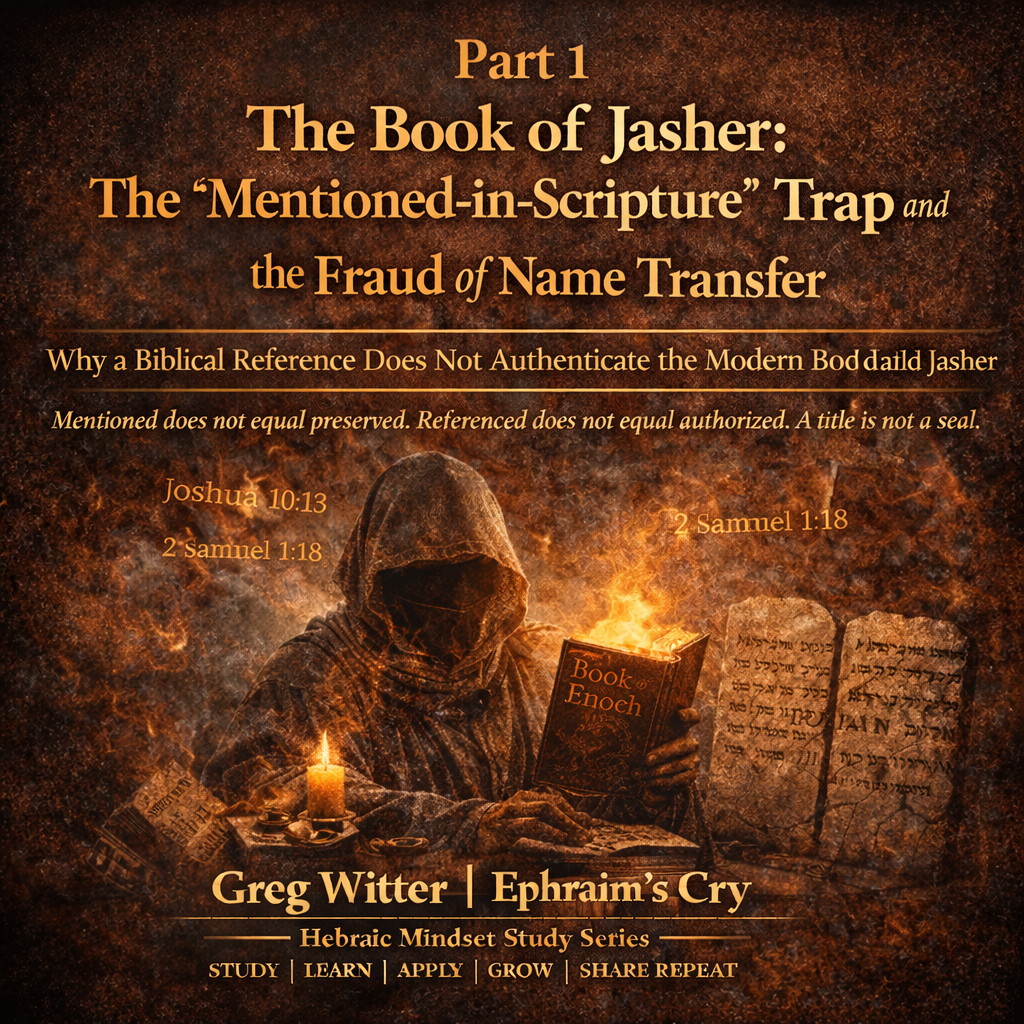
PART 1
The Book of Jasher: The “Mentioned-in-Scripture” Trap and the Fraud of Name Transfer
Why a Biblical Reference Does Not Authenticate the Modern Book Called Jasher
Mentioned does not equal preserved. Referenced does not equal authorized. A title is not a seal.
Greg Witter | Ephraim’s Cry
Hebraic Mindset Study Series
Study Learn Apply Grow Share Repeat
The Book of Jasher is mentioned in Scripture. That is true. And that truth is exactly why it is weaponized.
Because people take a single fact—“Jasher is mentioned”—and use it as a shortcut to authority: “Therefore the Jasher we have today must be the real one.” That is not discernment. That is gullibility wearing Hebrew clothing.
Scripture references “the Book of Jasher” (Joshua 10:13; 2 Samuel 1:18). That proves one thing and one thing only: a work by that name existed in Israel’s historical memory—likely a collection of songs, heroic poems, war chronicles, or national commemorations. It does not prove we possess it today. It does not prove later manuscripts using the name are identical to it. It does not prove a modern printed “Jasher” carries covenant authority. It does not prove anything about authorship, authenticity, accuracy, or authority.
A reference is not a chain-of-custody.
And that is the first prosecution point: name transfer is not identity.
A title can be copied. A name can be borrowed. A brand can be hijacked. A modern document can be dressed in an ancient label. That is how deception travels: not by denying Scripture, but by exploiting Scripture’s references as a credibility bridge.
Now we must force the distinction that most people refuse to make:
There are two different issues that must never be blended.
- The fact that a “Book of Jasher” existed and was referenced.
- The claim that the modern published “Book of Jasher” is that same book.
The first is biblical.
The second is an assertion that requires proof.
And the entire deception relies on collapsing those two into one idea so the modern book inherits the biblical reference by title alone.
That is fraudulent logic.
Mention proves existence.
Mention does not prove identity.
Mention does not prove preservation.
Mention does not prove authorization.
If a person cannot prove identity, then all they have is a name match, and a name match proves nothing. You can find ten books today with biblical names. That does not authenticate them as the originals. This is basic evidence law: if you can’t prove custody and identity, you cannot demand authority.
Torah already established the boundary: do not add to what Yahuah commanded and do not take from it (Deuteronomy 4:2; 12:32). Proverbs warns that adding to His words makes you a liar (Proverbs 30:5–6). Isaiah gives the measuring rod: to the Torah and to the testimony (Isaiah 8:20). Paul commands a hard boundary: do not go beyond what is written (1 Corinthians 4:6). Jude says the faith has been once delivered and must be guarded (Jude 3). Those boundaries exist precisely because men will always try to smuggle extra authority into covenant life.
And Jasher is one of the most effective smuggling vehicles because it comes with a built-in talking point: “But it’s mentioned in the Bible.”
That is not a seal. That is a marketing angle.
Now hear this clearly: Scripture does not tell us we are missing covenant instruction because Jasher is absent. Scripture never commands Israel to retrieve Jasher to be faithful. Scripture never establishes Jasher as a doctrinal ruler. Scripture never places Jasher into the covenant constitution alongside Torah. In fact, the covenant pattern is the opposite: Yahuah preserves what He authorizes and authorizes what He preserves. What He intended to govern obedience was kept within the covenant stream. That is the whole point of covenant continuity.
So here is the real question, and it’s the one you stated plainly: is the “Jasher” we have today the authentic Jasher that Scripture referenced?
That is the issue. And the answer is: you do not get to assume authenticity because of a name.
Covenant people do not run on assumptions. Covenant people run on verification.
Test spirits (1 John 4:1).
Test everything (1 Thessalonians 5:21).
Hold fast what is good (1 Thessalonians 5:21).
Refuse winds of doctrine (Ephesians 4:14).
Reject empty deception (Colossians 2:8).
Here is how Jasher is used to trap “restoration” people:
- They begin with the Bible mention.
- They imply suppression: “they removed it.”
- They accuse you of fear if you question it.
- They claim it “fills gaps” and “restores truth.”
- They then start using it to interpret Torah, Genesis, prophets, calendar, giants, angels, or end-times frameworks.
That last step is the tell. The moment a text is used to interpret Torah as if Torah is insufficient, that text is being installed as functional canon. That violates Deuteronomy’s boundary regardless of what you say about it.
So Part 1 verdict is simple:
- A biblical reference does not authenticate a modern publication.
- A borrowed title does not establish identity.
- A “missing book” narrative is not proof of covenant authority.
- The covenant standard remains Torah and testimony, not “what sounds ancient.”
If a man wants to use Jasher as authority, he must prove chain-of-custody and covenant recognition—not just wave a verse reference like a magic wand.
And if he cannot prove it, he has no right to demand your trust.
Now the courtroom boundary must be stated in plain covenant terms:
You may read extra literature as literature if you choose.
You may not enthrone it as authority.
You may not let it interpret Torah.
You may not let it create doctrine.
You may not let it govern obedience.
You may not let it function as canon in practice.
Because the moment it governs you, it has become an added authority stream, and that is exactly what Torah forbids.
#GregWitter, #EphraimsCry, #HebraicMindset, #TorahFirst, #BookOfJasher, #CovenantAuthority, #TestEverything,
#HoldFast, #DoNotAdd, #DoNotTakeAway, #Isaiah820, #FaithOnceDelivered, #SoundDoctrine, #Discernment,
#RefuseRivalStandards, #ExposeDeception, #WindsOfDoctrine, #NoMyths, #WholeCounselOfElohim, #ObedientFaith,
#StandFirm, #ReturnToTorah
