
PART 5
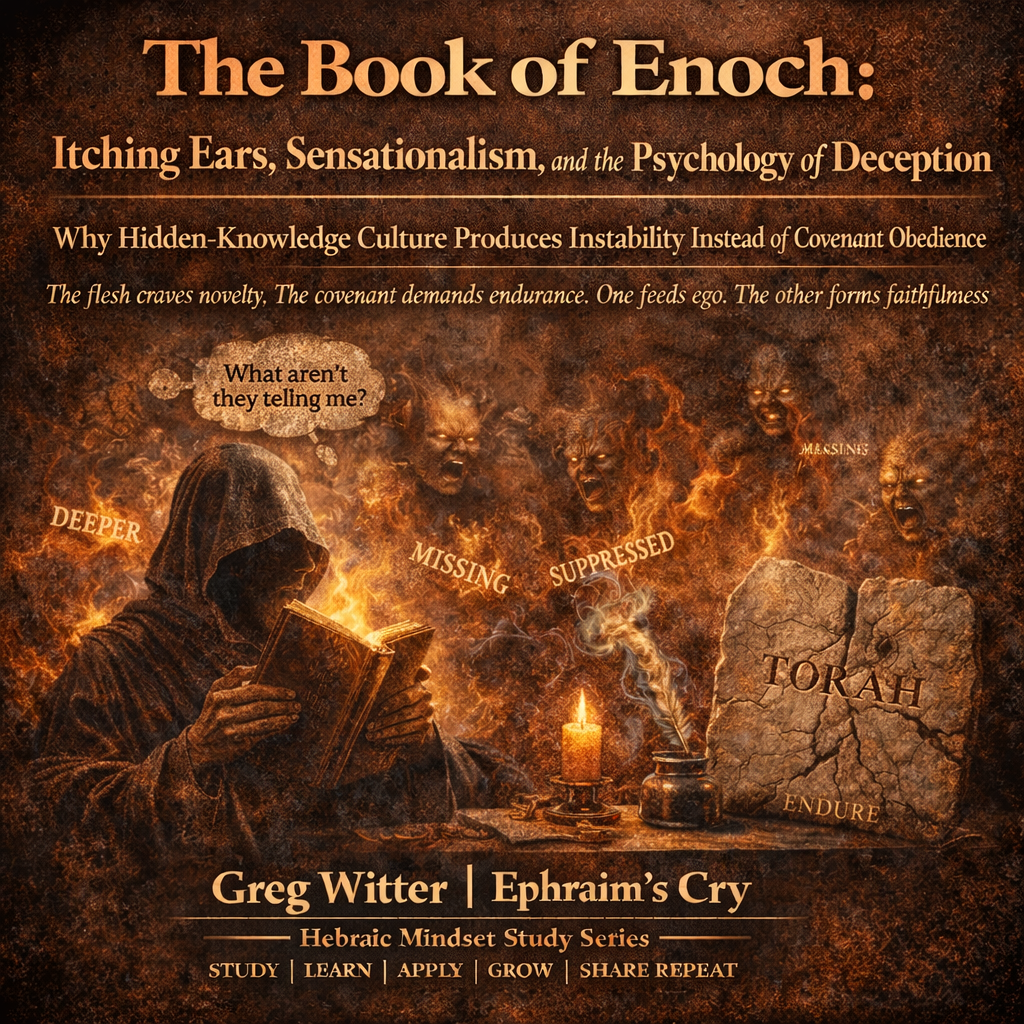
The Book of Enoch: Itching Ears, Sensationalism, and the Psychology of Deception
Why Hidden-Knowledge Culture Produces Instability Instead of Covenant Obedience
The flesh craves novelty. The covenant demands endurance. One feeds ego. The other forms faithfulness.
Greg Witter | Ephraim’s Cry
Hebraic Mindset Study Series
Study Learn Apply Grow Share Repeat
There is a reason Scripture warns repeatedly about itching ears.
It is not because people hate truth.
It is because people grow bored with discipline.
Paul did not say people would reject belief altogether. He said they would not endure sound doctrine (2 Timothy 4:3). That word endure is critical. Sound doctrine is stable, consistent, repetitive, rooted in covenant structure. It demands submission. It demands correction. It demands obedience when obedience is not exciting.
But itching ears want stimulation.
Itching ears want something new.
Something deeper.
Something hidden.
Something others do not know.
That is the psychological entry point of Enoch fascination.
The Book of Enoch thrives in an environment where people feel they are missing something. Where ordinary covenant obedience feels too simple. Where repetition of Torah feels insufficient. Where hidden knowledge promises elevation.
And hidden knowledge culture always produces the same fruit.
First, it produces excitement.
Then it produces identity.
Then it produces superiority.
Then it produces division.
Then it produces instability.
Scripture already diagnosed this pattern.
“Having itching ears, they will accumulate teachers to suit their own passions” (2 Timothy 4:3).
“They will turn away from listening to the truth and wander off into myths” (2 Timothy 4:4).
“Certain persons… devote themselves to myths and endless genealogies, which promote speculations rather than stewardship from Elohim” (1 Timothy 1:4).
“They are always learning and never able to arrive at the knowledge of the truth” (2 Timothy 3:7).
Myths in Scripture are not cartoon stories. They are religious narratives that generate endless speculation without producing covenant fruit.
The Book of Enoch easily feeds that appetite because it is dramatic.
Angelic rebellion.
Cosmic secrets.
Forbidden knowledge.
Hidden heavenly realms.
End-times imagery.
All of it stimulates imagination.
But imagination is not sanctification.
Covenant obedience is intentionally ordinary. Keep the Sabbath. Guard the appointed times. Walk in justice. Care for the poor. Love your neighbor. Fear Yahuah. Refuse idolatry. Guard your tongue. Practice holiness. Endure persecution. Remain faithful.
There is nothing sensational about that.
And that is exactly why itching ears drift toward spectacle.
Sensationalism creates adrenaline.
Obedience requires endurance.
When believers begin to crave spiritual adrenaline more than covenant endurance, they become vulnerable to every wind of doctrine (Ephesians 4:14).
Let’s expose the psychological engine clearly.
Hidden-knowledge culture feeds the ego.
“If I understand this, I am ahead.”
“If I see this, I am more restored.”
“If I reject mainstream teaching, I am enlightened.”
Knowledge puffs up (1 Corinthians 8:1). And puffed-up spirituality is unstable spirituality.
Pride does not always appear arrogant. It often appears enlightened.
It says:
“We are the true remnant.”
“We know what others refuse to see.”
“We are not like them.”
But Scripture defines the remnant differently.
Revelation 12:17 describes the remnant as those who keep the commandments of Elohim and hold the testimony of Yahusha. Revelation 14:12 describes them as those who keep the commandments and endure in faith.
No mention of secret texts.
No mention of hidden cosmology.
No mention of expanded angelology.
The remnant is defined by obedience and endurance, not by possession of extra literature.
Now examine the instability pattern more closely.
When Enoch becomes central in a community:
Debates multiply over interpretation.
Calendar disputes intensify.
Speculation overtakes repentance.
Teachers build followings around decoded mysteries.
Assemblies fracture over secondary conclusions.
This is not hypothetical. It is observable.
Why?
Because speculative frameworks are inherently elastic. They allow endless interpretive expansion. Torah is fixed. Its commands are clear. Its boundaries are concrete. Speculative literature is interpretively fertile ground for argument.
Argument feeds ego.
Ego feeds division.
Division feeds instability.
Scripture warns that Elohim is not the author of confusion (1 Corinthians 14:33). Hidden-knowledge culture thrives in confusion because it depends on ongoing revelation and reinterpretation.
The more layers added, the more dependency created.
That dependency often shifts from Scripture to teacher.
And here is where it becomes dangerous.
When teachers build authority on hidden knowledge, their influence is tied to mystery. If mystery is exposed as ordinary or secondary, their platform weakens. So mystery must remain elevated. It must remain essential. It must remain urgent.
This is how spiritual movements become sensational movements.
Fear becomes a tool.
Urgency becomes a hook.
Suppression narratives become glue.
“If you don’t see this, you’re blind.”
“If you reject this, you’re compromised.”
“If you question this, you’re afraid.”
That is manipulation. Not restoration.
Restoration is simple. Return to Torah. Return to covenant obedience. Return to the testimony of Yahusha. Guard the commands. Endure faithfully.
It is not expansion. It is return.
Now address the spiritual consequence.
When believers become addicted to novelty, they lose tolerance for stability. When stability feels boring, they seek stimulation. When stimulation becomes the standard, ordinary obedience feels insufficient.
That is the beginning of drift.
The enemy does not need you to renounce Torah. He only needs you distracted from it.
He does not need you to deny Yahusha. He only needs you preoccupied with cosmic speculation.
He does not need you to abandon faith. He only needs you chasing depth instead of practicing discipline.
The covenant requires endurance.
“Here is the endurance of the saints” (Revelation 14:12). Not their speculation. Not their decoded mysteries. Their endurance.
Endurance means staying with what has been delivered.
The faith once delivered (Jude 3) does not require expansion. It requires guarding.
So here is the dividing line.
If a text produces humility, obedience, endurance, repentance, covenant stability, and clarity—it strengthens faithfulness.
If a text produces pride, speculation, division, sensationalism, dependency, and interpretive chaos—it weakens covenant stability.
The Book of Enoch, when elevated beyond historical curiosity, consistently produces the latter pattern.
That is not accidental. It is structural.
Covenant obedience thrives on sufficiency. Sensationalism thrives on deficiency narratives.
If someone must convince you that you are missing something essential in order to sell you something deeper, that is not restoration. That is appetite manipulation.
The boundary stands firm:
Do not add.
Do not subtract.
Test everything.
Refuse myths.
Endure sound doctrine.
Hold fast to Torah and testimony.
The remnant is not defined by how much hidden knowledge they collect.
The remnant is defined by who endures in obedience when novelty fades.
Stand there.
#GregWitter, #EphraimsCry, #HebraicMindset, #TorahFirst, #CovenantAuthority, #BookOfEnoch, #DoNotAdd,
#DoNotTakeAway, #SoundDoctrine, #Discernment, #ItchingEars, #WindsOfDoctrine, #NoMyths, #TestEverything,
#HoldFast, #ReturnToTorah, #WholeCounselOfElohim, #Remnant, #ObedientFaith, #StandFirm,
#ExposeDeception, #FaithOnceDelivered
