
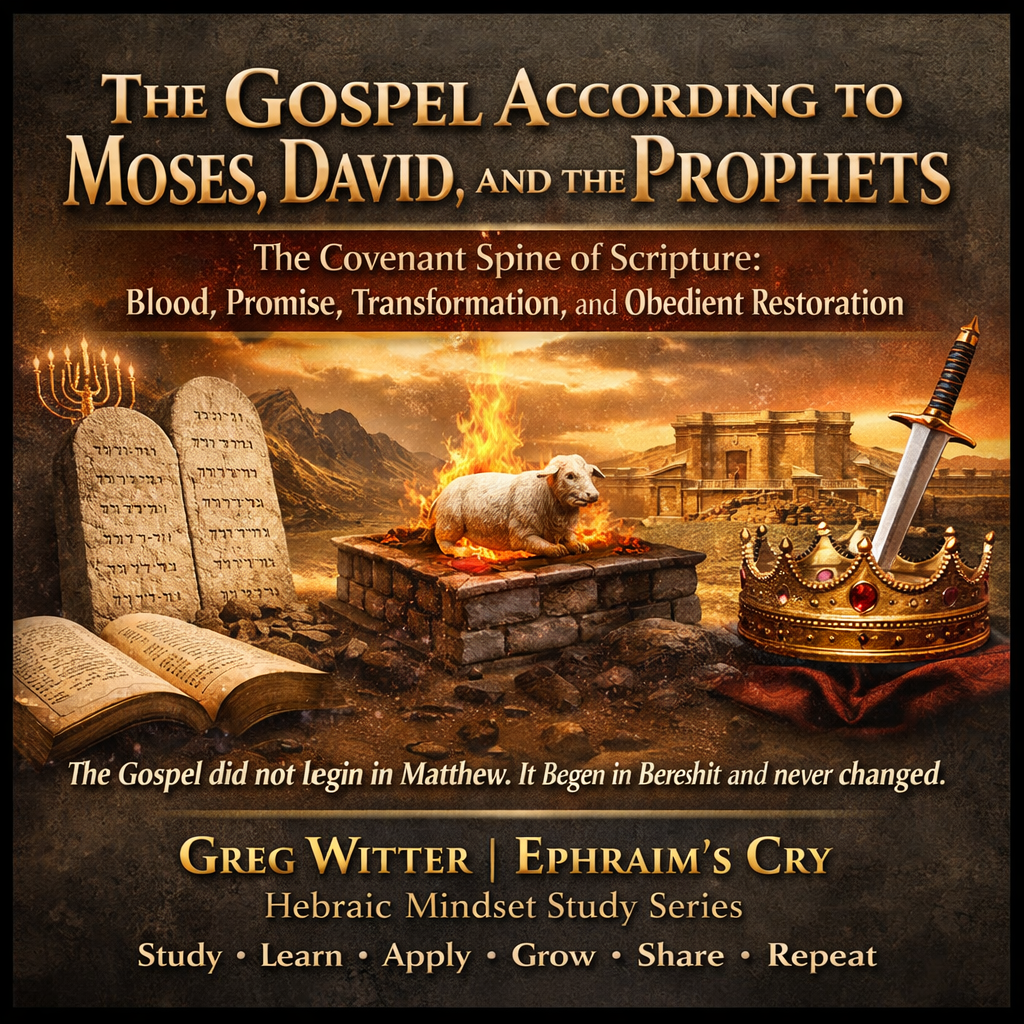
The Gospel According to Moses, David, and the Prophets
The Covenant Spine of Scripture: Blood, Promise, Transformation, and Obedient Restoration
The Gospel did not begin in Matthew. It began in Bereshit and never changed.
Greg Witter | Ephraim’s Cry
Hebraic Mindset Study Series
Study • Learn • Apply • Grow • Share • Repeat
The Gospel Did Not Start in the Apostolic Writings
The Gospel is not a New Testament invention. It is not a Pauline innovation. It is not a later theological refinement. It is the covenant thread that runs from Genesis to Malachi without interruption.
If you remove the Apostolic Writings entirely, the Gospel still stands. It bleeds through Torah. It thunders in the Prophets. It sings in the Psalms. It culminates in the promised Redeemer.
The early disciples did not preach from a leather-bound New Testament. They preached from Moses, the Prophets, and the Writings. When they said “Scripture,” they meant the Tanakh.
The question is not whether the Gospel exists in the Old Testament. The question is whether we have been reading it covenantally.
Creation: Kingship Before Sin
Genesis 1:26–28 establishes mankind as image-bearer and vice-regent under Yahuah’s authority. Dominion language is covenant language. Humanity was commissioned to rule under divine instruction.
Before rebellion, there was responsibility. Before blood, there was throne. Humanity was created to reflect divine authority and exercise righteous dominion under the Creator’s rule.
This is the law of first mention for kingship and image-bearing. The first time humanity appears, it appears under mandate. The Gospel, therefore, is not merely about escaping judgment. It is about restoring rightful dominion under divine authority.
Sin, therefore, is not merely moral weakness. It is treason against kingship. It is rebellion against divine government. It is the attempt of the creature to seize autonomous rule from the King.
Psalm 8 returns to this dominion mandate. Daniel 7 speaks of dominion restored to the Son of Man and the saints. The Davidic covenant (2 Samuel 7) promises an eternal throne. Isaiah 9 and Isaiah 11 expand the vision of righteous government. Psalm 2 declares the Son installed as King. Daniel 2 speaks of a stone kingdom crushing earthly empires.
The Gospel restores rightful rule under the Creator. It is covenantal kingship restoration. It is the return of lawful governance under divine throne authority.
The Seed War: The Conflict Architecture
Genesis 3:15 declares enmity between the seed of the woman and the seed of the serpent. This is the law of first mention for redemptive conflict. The war between the two seeds becomes the structural architecture of Scripture.
Cain and Abel.
Ishmael and Isaac.
Esau and Jacob.
Pharaoh and Israel.
Haman and the Jews.
Babylon and the remnant.
This conflict is not incidental. It is covenantal. The Gospel is the promised crushing of the serpent through covenant seed. The conflict begins in Eden and unfolds through every covenant until the serpent’s authority is broken.
The Problem: Covenant Rebellion
The Gospel begins with indictment, not inspiration.
Genesis 6:5 declares that every inclination of the thoughts of man’s heart was only evil continually.
Jeremiah 17:9 exposes the heart as deceitful and desperately sick.
Isaiah 53:6 says all we like sheep have gone astray.
This is covenant language.
Hosea 8:1 defines sin plainly: they transgressed My covenant and rebelled against My Torah.
Isaiah 24:5 expands it: they transgressed the laws, changed the ordinance, broken the everlasting covenant.
Sin is covenant breach.
Genesis 2:17 — in the day you eat, you shall surely die.
Ezekiel 18:4 — the soul that sins shall die.
This is the law of first mention for death as covenant consequence. Death is not arbitrary; it is judicial.
Leviticus 26 and Deuteronomy 28 outline escalating covenant discipline, including the sevenfold intensification of judgment. This seven-structure mirrors the creation pattern. Six cycles of labor, discipline, exile — and then restoration and rest. Covenant history follows creation architecture.
The Torah and the Prophets do not flatter humanity. They prosecute it under covenant law.
The First Sermon: Blood Before Words
Genesis 3:21 — Yahuah makes garments of skin and clothes Adam and Chavah.
This is the first mention of substitutionary covering. Blood precedes theology. Life is taken to cover shame.
Genesis 4 intensifies the principle. Abel brings blood. Cain brings produce. The first accepted offering is blood.
Leviticus 17:11 clarifies: the life of the flesh is in the blood.
Dam — blood — in Hebrew carries the concept of life poured out. Brit — covenant — carries the concept of cutting. Covenant and blood are inseparable in Hebrew thought.
Genesis 22 further strengthens the substitution pattern. The ram provided in place of Isaac establishes the Akedah as covenant typology. Yahuah provides Himself the lamb.
No blood. No covering. No atonement.
Covenant Oath: Genesis 15
Animals are divided. Abram sleeps. Yahuah passes between the pieces.
This is covenant cutting. The one who passes through invokes the curse upon Himself if the covenant fails.
The Gospel is Yahuah binding Himself to His promise. It is unilateral oath grounded in divine faithfulness.
Passover: Applied Blood
Exodus 12 demonstrates applied substitution. The blood must be placed on the doorposts.
“When I see the blood, I will pass over you.”
Redemption precedes Sinai. Exodus 12 precedes Exodus 20. Obedience follows deliverance.
This is covenant order.
Torah: Instruction for the Redeemed
Torah means instruction. It defines righteous life within covenant relationship.
Psalm 19 declares it restoring. Psalm 119 celebrates it as light.
Jeremiah 31:33 and Ezekiel 36:26–27 promise internalization. Shuv — to return — becomes covenant repentance. Tzedakah — righteousness — becomes covenant alignment.
The promise is not abolition. It is internal transformation.
Sacrifice without obedience is condemned. Jeremiah 7. Isaiah 1. Ezekiel 18. The prophets reject ritual divorced from covenant faithfulness.
Substitution opens the door. Transformation walks through it.
Covenant Lawsuit and Legal Satisfaction
Isaiah 1 calls heaven and earth as witnesses.
Micah 6 presents covenant litigation.
Jeremiah indicts.
Isaiah 53 answers the legal indictment.
He bears iniquity. He carries covenant violation. He satisfies judicial curse.
Habakkuk 2:4 declares the righteous live by faith — covenant trust under judgment.
Justice is not erased. It is fulfilled.
Temple and Presence
Eden is proto-temple. Cherubim guard access.
The Tabernacle replicates Eden’s structure: outer court, inner court, Holy of Holies. Veil separates presence. Priest mediates access.
Genesis 1:1 contains seven Hebrew words, structurally ordered. Creation itself is covenantally patterned.
The Day of Atonement allows entry once yearly by blood. Presence is restored through substitution and priesthood.
Sabbath: Covenant Sign and Kingdom Rest
Genesis 2:3 sanctifies the seventh day.
Exodus 31:13 calls Sabbath a sign.
Ezekiel 20:12 affirms it as sanctification marker.
Sabbath functions as covenant seal — identity marker of allegiance. It reflects creation, redemption, and sanctification.
The seven-structure of history reflects six thousand years of labor and one thousand years of rest, echoing prophetic architecture. Covenant discipline intensifies sevenfold before restoration.
Sabbath anticipates kingdom rest.
Land and Inheritance
Genesis 15 promises land.
Deuteronomy 30 promises regathering.
Ezekiel 36–37 connects new heart with return.
Exile mirrors Eden expulsion. Return mirrors resurrection. Dry bones rising represent national restoration.
The Gospel restores inheritance. It restores co-regency under the King.
Priesthood: Melchizedek Pattern
Genesis 14 introduces Melchizedek — king and priest united.
Psalm 110 promises eternal priesthood.
Priest and king converge. Throne and altar unite. Permanent mediation replaces failing lineage.
Davidic Throne and Government
2 Samuel 7 promises eternal throne.
Psalm 2 declares the Son installed.
Daniel 7 reveals court seated, books opened, dominion transferred to the Son of Man and the saints.
The Gospel culminates in judicial kingdom transfer. Beasts lose authority. The saints receive dominion.
Resurrection and Victory
Psalm 16:10 — not abandoned.
Hosea 6:2 — raised on third day.
Isaiah 25:8 — death swallowed.
Resurrection follows exile. Restoration follows curse.
Marriage Covenant Restoration
Hosea 2:19 promises eternal betrothal.
Jeremiah 3 references divorce and restoration.
Ezekiel 16 remembers covenant.
Marriage is covenant formula: “I will be your Elohim; you will be My people.”
Salvation restores lawful relationship.
New Creation
Isaiah 65–66 proclaim new heavens and new earth. Jerusalem restored. Nations aligned.
Genesis 1–2 finds mirror in prophetic restoration. Eden lost becomes Eden restored.
The Covenant Spine
Creation.
Kingship.
Seed conflict.
Covenant breach.
Blood substitution.
Oath sworn.
Passover applied.
Torah internalized.
Legal satisfaction.
Temple access.
Sabbath seal.
Inheritance restored.
Priesthood united.
Throne transferred.
Resurrection declared.
Marriage renewed.
New creation established.
This is the Gospel according to Moses, David, and the Prophets.
It is covenantal.
It is legal.
It is governmental.
It is prophetic.
It is restorative.
It began in Bereshit.
It never changed.
#GregWitter #EphraimsCry #HebraicMindset #GospelInTorah #CovenantRestored #TorahAndProphets
#Isaiah53 #Jeremiah31 #Ezekiel36 #PassoverLamb #Melchizedek #DavidicThrone
#KingdomCovenant #WholeCounselOfElohim
