
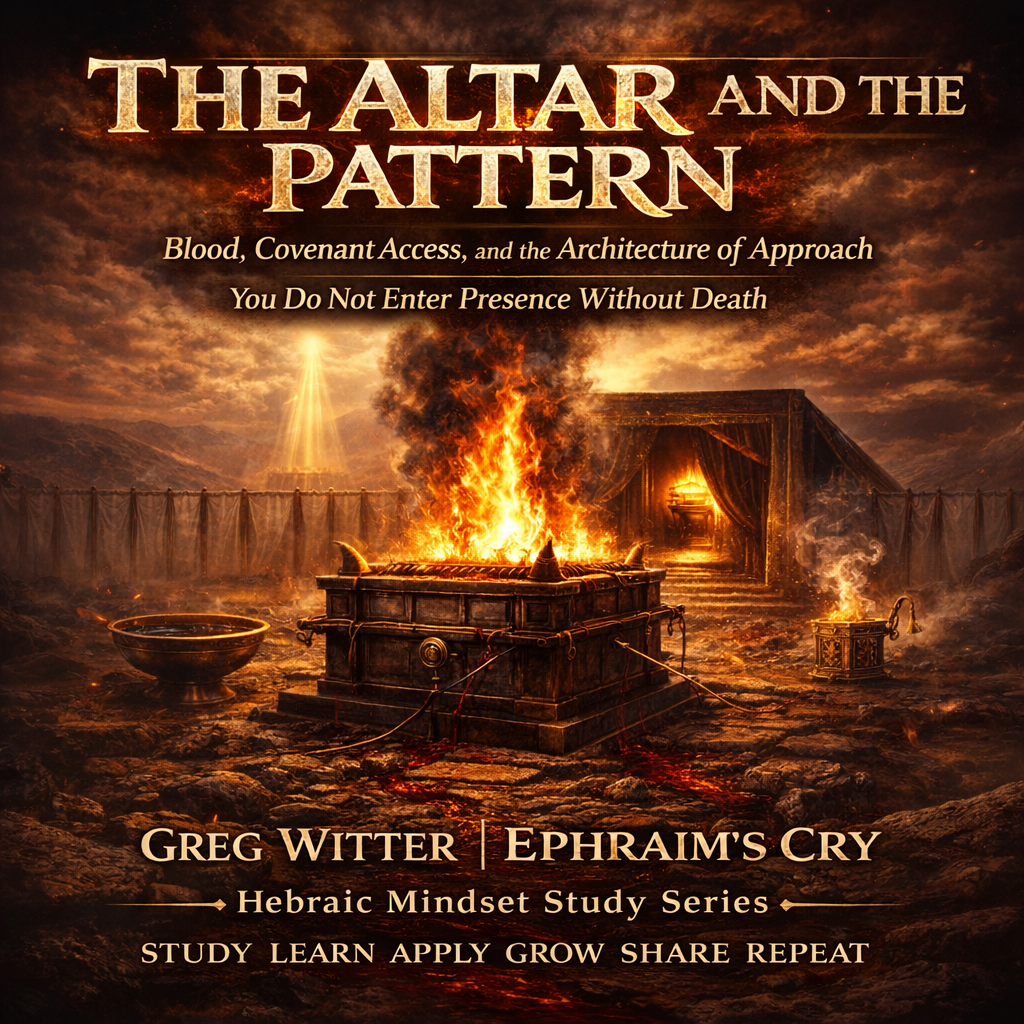
THE ALTAR AND THE PATTERN
Blood, Covenant Access, and the Architecture of Approach
You Do Not Enter Presence Without Death
Greg Witter | Ephraim’s Cry
Hebraic Mindset Study Series
Study Learn Apply Grow Share Repeat
INTRODUCTION — BEFORE THERE WAS A NATION, THERE WAS AN ALTAR
Before Sinai thundered.
Before tablets were carved.
Before priesthood garments shimmered in gold and blue and scarlet.
There was an altar.
From the earliest pages of Scripture, the altar stands as the silent witness to a truth humanity resists: access to the Holy One is never casual. It is never sentimental. It is never negotiated.
Cain and Abel approach with offerings in Genesis 4. One offering is accepted. One is rejected. Why? Because covenant approach is not defined by sincerity. It is defined by obedience.
Noah exits the ark in Genesis 8 and the first thing he builds is not shelter. It is an altar. Why? Because survival does not equal reconciliation. The earth has been judged. Blood has been shed. The altar restores relational order.
Abraham, father of covenant promise, marks geography with altars. Wherever Yahuah reveals Himself, Abraham responds with sacrifice. Presence demands response. Revelation demands surrender.
The altar predates Sinai because the altar is foundational to covenant reality.
The altar teaches something modern religion tries to avoid:
You cannot approach Yahuah without death.
I. THE ALTAR DEFINES HOW APPROACH WORKS
When Yahuah gives instruction for the tabernacle in Exodus 25–31, He does not begin with incense or lampstand or bread. He begins with blood.
Exodus 27 describes the bronze altar in exact dimensions. Specific. Measured. Structured. Nothing vague. Nothing symbolic in a loose way. The altar is placed at the entrance. It blocks the way inward.
You cannot skip it.
The entire architecture of the tabernacle teaches progression:
Altar → Laver → Holy Place → Veil → Ark → Mercy Seat.
Access narrows as holiness intensifies.
The altar stands at the gate as a declaration:
Life for life.
Blood for sin.
Death before access.
This is not cruelty.
This is covenant justice.
Leviticus 17:11 anchors the theology:
“The life of the flesh is in the blood… it is the blood that maketh atonement.”
Sin is not emotional imbalance.
Sin is legal transgression.
The altar addresses legal reality.
Hebrews 9:22 confirms the pattern remains:
“Without shedding of blood is no remission.”
Grace does not erase law.
Grace satisfies its penalty.
II. THE ALTAR IS WHERE PRIDE COLLAPSES
When a man brought his offering, he laid his hands upon it (Leviticus 1:4). This was not ritual theater. It was identification. The life of the animal symbolically bore the guilt of the offerer.
Imagine the weight of that moment.
You bring what costs you.
You confess without words.
You watch life leave what stands in your place.
The altar strips self-righteousness.
No one boasts at an altar.
The altar destroys the illusion that sin is small.
And this is why the narrow gate is narrow.
Few want to die.
Few want surrender.
Few want to lose control.
The altar narrows the way because the altar removes autonomy.
III. GRACE IS BORN AT THE ALTAR, NOT APART FROM IT
Many speak of grace as if it floats above justice.
Torah reveals grace emerges from sacrifice.
Exodus 24:8 — “Behold the blood of the covenant.”
Covenant is ratified in blood.
Ephesians 1:7 — redemption through His blood.
Colossians 2:14 — the record of debt removed.
The handwriting against us was canceled — not the instructions themselves.
The altar removes penalty.
It does not abolish covenant responsibility.
Titus 2:11–12 declares grace teaches us to deny ungodliness. Grace does not excuse sin; it empowers obedience.
Blood restores access.
Access restores relationship.
Relationship demands alignment.
IV. THE FIRE MUST NEVER GO OUT
Leviticus 6:12–13 commands that the fire upon the altar never be extinguished.
The priest tended it daily. Morning and evening. No gaps.
Fire represents divine acceptance.
Fire represents presence.
Fire represents approval.
Unattended fire dies.
Unattended devotion dies.
Unattended obedience weakens.
This is why altar life cannot be occasional. It is not a conference moment. It is daily maintenance.
Romans 12:1 reframes altar life under Messiah:
“Present your bodies a living sacrifice…”
Living sacrifices remain on the altar.
Not once. Continually.
V. THE ALTAR AND THE NARROW GATE
When Yahusha speaks of the narrow gate in Matthew 7, He is not introducing a new idea. He is echoing covenant architecture.
The narrow gate is altar entry.
It is narrow because it excludes:
• Pride
• Self-definition
• Lawlessness
• Mixture
The broad way avoids sacrifice.
The narrow way begins with surrender.
Proverbs 24:16 reminds us the righteous fall yet rise. The altar is not perfectionism. It is direction.
Without Him, it is impossible (John 15:5).
With Him, obedience is empowered (Philippians 4:13).
The narrow gate is dependence.
VI. MESSIAH FULFILLS THE ALTAR, HE DOES NOT REMOVE IT
Hebrews 13:10 — “We have an altar.”
The execution stake is not abolition of the altar. It is fulfillment.
He becomes:
• The Lamb (John 1:29)
• The Priest (Hebrews 7)
• The Mediator (Hebrews 8)
• The Blood (Hebrews 9)
Revelation 5 shows the Lamb standing as slain.
The altar pattern runs from Genesis to Revelation uninterrupted.
The blood justifies.
The Spirit empowers.
The covenant directs.
VII. THE CONSEQUENCE OF BUILDING WITHOUT ALTAR
Scripture is clear about unauthorized approach.
• Nadab and Abihu — strange fire (Leviticus 10)
• Saul — unlawful sacrifice (1 Samuel 13)
• Uzziah — priestly intrusion (2 Chronicles 26)
Approach outside covenant order invites judgment.
Modern religion often builds platform without altar.
Platform without altar produces collapse.
Gift without surrender produces scandal.
Authority without obedience produces exposure.
The altar protects character.
VIII. APPLICATION — WHAT ALTAR LIFE LOOKS LIKE TODAY
Altar life now includes:
• Daily repentance
• Guarding thought life
• Sabbath discipline
• Prayer and fasting
• Obedience when unseen
• Refusal of compromise
• Holding fast to Torah and testimony
Revelation 12:17
They keep the commandments and hold the testimony.
Revelation 14:12
Commandments and faith.
Blood and obedience are never divorced.
SUMMARY
The altar is:
• Covenant entry point
• Legal satisfaction
• Pride destroyer
• Grace birthplace
• Narrow gate doorway
• Daily surrender ground
Without altar:
Grace becomes cheap.
Obedience becomes optional.
Fire fades.
With altar:
Character forms.
Presence rests.
Endurance grows.
This is Part One.
Part Two will move from structure to endurance — from architecture to remnant identity under pressure.
HASHTAGS
#EphraimsCry #GregWitter #CovenantWalk #AltarLife #TorahAndTestimony #NarrowGate #ReturnToCovenant
#HebraicMindset #WatchmanCall #FaithfulEndurance
