
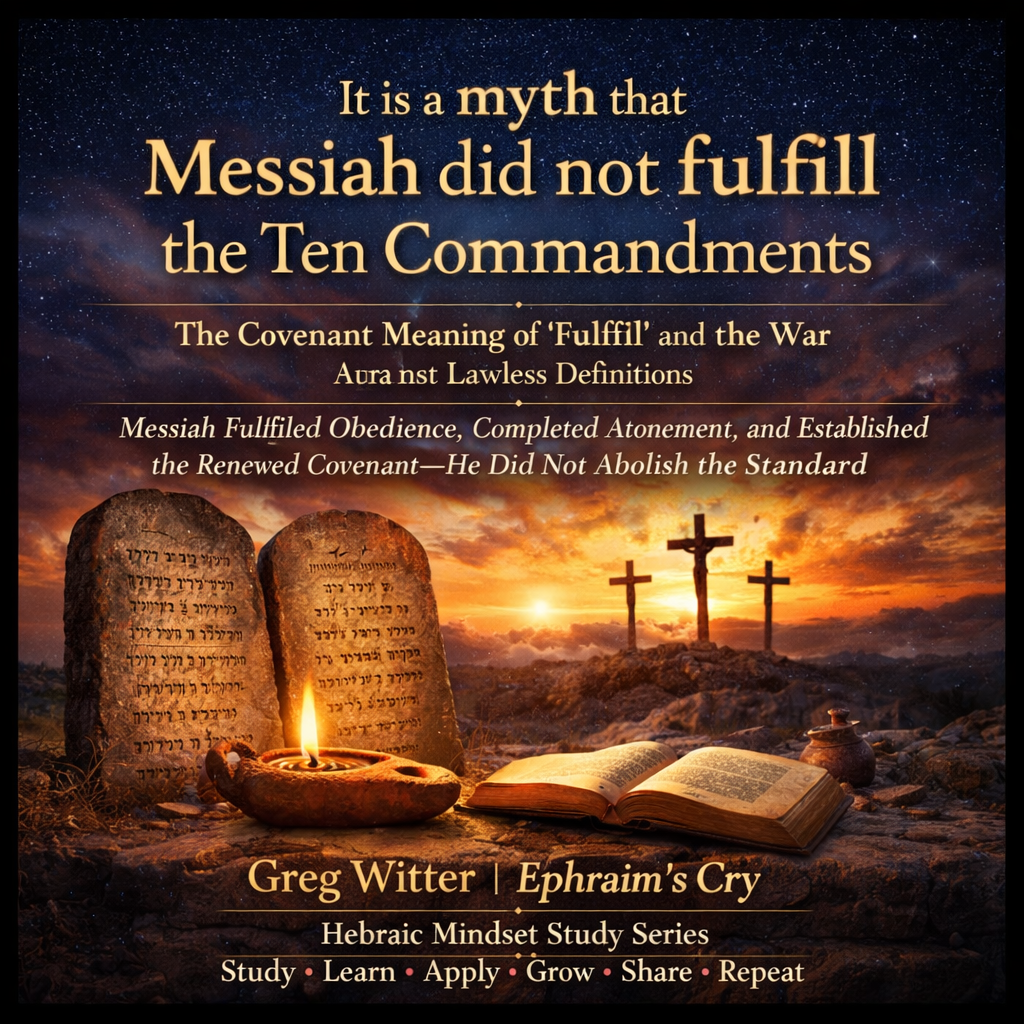
It is a myth that Messiah did not fulfill the Ten Commandments
The Covenant Meaning of “Fulfill” and the War Against Lawless Definitions
Messiah Fulfilled Obedience, Completed Atonement, and Established the Renewed Covenant — He Did Not Abolish the Standard
Greg Witter | Ephraim’s Cry
Hebraic Mindset Study Series
Study Learn Apply Grow Share Repeat
Introduction — The Word “Fulfill” Is the Battlefield
One sentence can expose a whole religious system.
“It is a myth that Jesus Christ did not fulfill the Ten Commandments.”
If someone says that and means, “Messiah obeyed perfectly,” that statement is true.
But in practice, most people don’t use “fulfilled” that way.
They use it as a weapon.
They use “fulfilled” to smuggle in abolition.
They use “fulfilled” to cancel obedience.
They use “fulfilled” to turn covenant into sentiment.
They use “fulfilled” to rebrand lawlessness as grace.
So the issue is not whether Messiah “fulfilled” the Ten Commandments.
The issue is what kind of “fulfill” you’re preaching.
Because there is a fulfill that produces obedience, and there is a counterfeit fulfill that produces rebellion.
And Scripture draws the line plainly.
I. Define the Terms or You’ll Be Deceived
The most dangerous deception is not denial.
It is redefinition.
People keep using biblical words while changing biblical meanings.
• “Grace” becomes permission
• “Faith” becomes mental agreement
• “Spirit-led” becomes unaccountable feelings
• “Fulfilled” becomes abolished
That is how deception survives.
It never has to reject Scripture.
It only has to twist the definition.
So we define “fulfill” the way Messiah defined it — in context, in covenant, and in the courtroom of Torah + testimony.
II. Messiah Did Fulfill the Ten Commandments — In the Only Way Righteousness Can Fulfill Them
If “fulfill” means “obey perfectly,” Messiah did.
“He committed no sin.” (1 Peter 2:22)
“Tempted in all points as we are, yet without sin.” (Hebrews 4:15)
And Scripture defines sin:
“Sin is lawlessness.” (1 John 3:4)
So if Messiah had no sin, then Messiah had no lawlessness.
That means His entire life was covenant alignment.
He walked in obedience.
He embodied righteousness.
Not as theory.
Not as spirituality.
As an actual way of life.
That alone destroys the idea that Torah is inherently opposed to Messiah.
If Torah were the enemy, Messiah would have been fighting it.
Instead, He lived it.
III. Messiah Settled the “Abolish vs Fulfill” Question With His Own Mouth
Messiah did not leave this unclear.
“Do not think that I came to destroy the Torah or the Prophets. I did not come to destroy but to fulfill.” (Matthew 5:17)
That is not a suggestion.
That is a prohibition.
Do not think I came to destroy.
Then He gives the time-marker that crushes abolition:
“Till heaven and earth pass away, one jot or one tittle shall by no means pass from the Torah till all be done.” (Matthew 5:18)
Then He gives the warning that destroys “least-commandment” theology:
“Whoever then breaks one of the least of these commandments, and teaches men so, shall be called least in the reign of the heavens.” (Matthew 5:19)
So if someone uses “fulfilled” to mean “abolished,” they are contradicting Messiah.
They are not interpreting Him.
They are overriding Him.
And at that point, it is not misunderstanding.
It is rebellion.
IV. The Two Verbs in Matthew 5:17–18 — The Linguistic Line in the Sand
Verse 17 uses the verb plēroō — to fill up, bring to fullness, bring to full expression, establish.
Verse 18 uses a different verb — genētai (from ginomai) — meaning to come to pass, to occur, to come into being.
Until heaven and earth pass away, not one jot or tittle will pass from the Torah until all has come to pass (genētai).
Two different verbs.
Two different functions.
Verse 17: Messiah brings Torah to fullness in Himself.
Verse 18: Nothing in Torah passes away until everything written comes into historical fulfillment.
If “fulfill” in verse 17 meant “terminate,” then verse 18 would be self-contradictory.
But Messiah is not confused.
He says nothing passes until everything happens.
So the linguistic structure itself destroys abolition theology.
V. The Jot and the Tittle — Textual Permanence, Not Temporary Relevance
A jot refers to the Hebrew yod — the smallest letter.
A tittle refers to the small stroke that distinguishes similar Hebrew letters.
Messiah anchors Torah permanence in its written form.
Psalm 119:89
“Forever, O Yahuah, Your word stands firm in the heavens.”
Isaiah 40:8
“The grass withers, the flower fades, but the word of our Elohim stands forever.”
Messiah is not speaking symbolically.
He is speaking textually.
Until heaven and earth pass.
Last time anyone checked — heaven and earth are still here.
So the permanence of Torah is tied to cosmic duration.
Abolition theology has to erase either heaven and earth — or Messiah’s words.
VI. What “Fulfill” Actually Means in Covenant Context
A man fulfills a vow by keeping it — not by canceling it.
A judge fulfills a law by enforcing it — not by discarding it.
A son fulfills a father’s instruction by embodying it — not by rewriting it.
Messiah fulfills Torah by:
• Embodying its righteousness
• Interpreting it correctly
• Stripping away man-made distortions
• Establishing its true intent
• Bringing prophetic elements to their appointed completion
Fulfillment is not destruction.
Fulfillment is embodiment.
VII. The Cancellation Test — The Logic Exposes the Lie
If fulfilling the Ten Commandments means they no longer matter, then logically:
• He fulfilled “Do not murder,” so murder is irrelevant.
• He fulfilled “Do not commit adultery,” so adultery is optional.
• He fulfilled “Do not steal,” so theft is permitted.
No one argues that openly.
So they selectively cancel.
That selective cancellation exposes the deception.
It is not theology.
It is convenience.
VIII. What Messiah Completed — Atonement and Priesthood
Hebrews clarifies what was completed.
“The blood of bulls and goats is unable to take away sins.” (Hebrews 10:4)
“But we have been set apart through the offering of the body of Yahusha Messiah once for all.” (Hebrews 10:10)
What was fulfilled in the sense of completion:
• The sacrificial shadows
• The repeated offerings
• The Levitical mediation structure
• The animal blood system
What was not abolished:
• Moral definition of sin
• Covenant standard of righteousness
• Commandments defining holiness
The standard remains.
The atonement is completed.
IX. Hebrews 8:13 — Context Matters
Hebrews says the former covenant was “becoming obsolete.”
This was written before 70 AD.
The Temple was still standing.
The context is priesthood administration.
Not moral annihilation.
The covenant administration changed.
The moral definition of righteousness did not.
X. The Curse of the Law vs The Law
Galatians 3:13
“Messiah redeemed us from the curse of the law.”
The curse is Deuteronomy 28 — the penalties for breaking Torah.
Messiah redeemed us from the penalty — not from obedience.
Removing the curse is not removing the command.
That distinction is foundational.
XI. Messiah Is the Goal (Telos) of Torah — Not Its Funeral
Romans 10:4 says Messiah is the telos of the law.
Telos means goal, aim, destination, culmination.
A race has a telos — its finish line.
A process has a telos — its intended outcome.
Messiah is the goal Torah points toward.
He is not its trash can.
Torah aims at righteousness.
Messiah embodies righteousness.
We are conformed into His image.
Goal does not mean termination.
XII. Pre-Sinai Morality — Torah Did Not Begin at Sinai
Before Sinai:
• Cain was guilty of murder (Genesis 4).
• Joseph called adultery sin (Genesis 39:9).
• Abraham obeyed commandments and statutes (Genesis 26:5).
• The seventh day was sanctified (Genesis 2:3).
Sinai codified what already reflected divine order.
Torah did not invent morality.
It formalized covenant administration.
XIII. Sinai vs Renewed Covenant Structure
Old Covenant:
• Tablets of stone
• Mediated by Moses
• Animal blood
• National priesthood
• Repeated sacrifices
Renewed Covenant:
• Torah written on hearts
• Mediated by Messiah
• Messiah’s blood
• Expanded access
• Once-for-all atonement
Jeremiah 31:33
“I will put My Torah within them.”
Hebrews 8:10 repeats it verbatim.
Internalization is not abolition.
XIV. The Law of Messiah
Some argue: “We are under the law of Messiah.”
Messiah said:
“If you love Me, guard My commandments.” (John 14:15)
His commandments do not contradict Torah.
He correctly interprets Torah.
The law of Messiah is Torah lived through Him and empowered by the Spirit.
XV. Isaiah 66 — Sabbath in the New Creation
Isaiah 66:22–23
“As the new heavens and the new earth… from Sabbath to Sabbath all flesh shall come to worship before Me.”
If Torah is abolished, why does Sabbath appear in the new creation?
Future continuity destroys abolition theology.
XVI. The End-Time Standard
Revelation 12:17
“Those guarding the commandments of Elohim and holding the testimony of Yahusha.”
Revelation 14:12
“Here is the endurance of the set-apart ones…”
Commandments + testimony.
Both.
XVII. Diagnostic Section — Test Yourself
Do I redefine commandments that inconvenience me?
Do I call obedience legalism?
Do I reduce grace to permission?
Do I resist correction from Scripture?
Do I treat fulfillment as cancellation?
The fruit reveals the doctrine.
XVIII. Genesis 1 and Textual Authority
Light appears before the sun (Genesis 1:3–16).
Revelation precedes visible structure.
Torah precedes Sinai in principle.
Sinai formalizes what already existed in creation order.
Even the enlarged Bet tradition in Genesis 1:1 reflects reverence for textual integrity.
Messiah’s jot-and-tittle declaration anchors that same reverence.
Conclusion — Fulfillment Produces Resemblance
Messiah fulfilled the Ten Commandments by living them.
He fulfilled sacrifice by becoming it.
He fulfilled priesthood by mediating perfectly.
He fulfilled covenant promises by sealing them in His blood.
He did not abolish righteousness.
He did not redefine sin.
He did not die to legalize rebellion.
He died to restore covenant fidelity.
Fulfillment does not erase obedience.
It empowers it.
The Spirit writes Torah on the heart.
The redeemed walk as He walked.
If someone claims fulfillment equals abolition, they are not interpreting Messiah.
They are contradicting Him.
And in the end, the dividing line will not be gifting.
It will be obedience.
#GregWitter #EphraimsCry #HebraicMindset #FulfillNotAbolish #TenCommandments #TorahAndTestimony
#RenewedCovenant #Romans331 #Matthew517 #Isaiah66 #Revelation1412 #GuardHisCommandments #NarrowPath
