
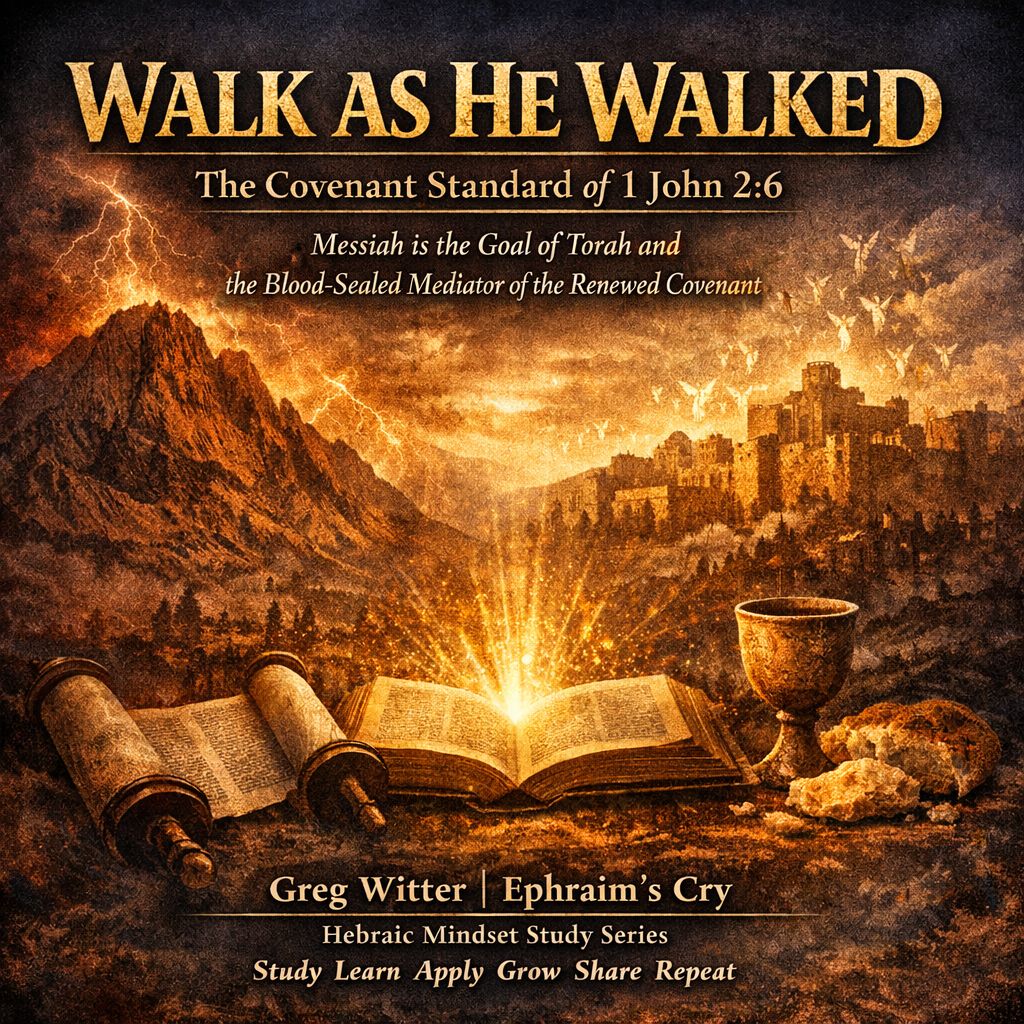
Walk As He Walked
The Covenant Standard of 1 John 2:6
Messiah Is the Goal of Torah and the Blood-Sealed Mediator of the Renewed Covenant
Greg Witter | Ephraim’s Cry
Hebraic Mindset Study Series
Study Learn Apply Grow Share Repeat
Introduction — The Measuring Rod of Authentic Covenant Faith
1 John 2:6 is not devotional poetry.
It is a covenant measuring rod.
“He who says he stays in Him ought himself also to walk even as He walked.”
This is not about emotion. This is not about religious affiliation. This is not about claiming Messiah.
It is about resemblance.
John removes all ambiguity:
“He who says, ‘I know Him,’ and does not guard His commandments, is a liar, and the truth is not in him.” (1 John 2:4)
That is not commentary. That is courtroom language.
This is legal testimony language. This is covenant lawsuit language. John is drawing a line between confession and conduct. Between profession and pattern. Between claim and covenant.
If Messiah is your confession, Messiah must be your pattern.
Anything else is self-deception.
I. What Does “Walk” Mean? (Halakha in Covenant Context)
“Walk” in Scripture is covenant conduct.
From Genesis forward, walking describes lifestyle alignment.
“Walk before Me and be perfect.” (Genesis 17:1)
“What does Yahuah require of you but to fear Him, to walk in all His ways…” (Deuteronomy 10:12)
“Blessed is the man who does not walk in the counsel of the wicked.” (Psalm 1:1)
“Come, let us walk in the light of Yahuah.” (Isaiah 2:3–5)
Walking is direction. Walking is pattern. Walking is covenant lifestyle.
It is not theoretical. It is observable.
It is how you conduct business.
How you speak.
How you rest.
How you worship.
How you treat others.
How you obey when no one sees.
Walking is halakha — a whole-life pattern of movement aligned with covenant instruction.
So when John says walk as He walked, he is saying:
Your life must reflect Messiah’s covenant alignment.
Not selectively. Not seasonally. Not symbolically.
Consistently.
II. He Walked in Torah Obedience
Messiah did not invent righteousness. He embodied it.
When tempted, He responded:
“It is written.” (Matthew 4:4, 7, 10)
Every response came from Torah (Deuteronomy 6–8).
He did not say, “The Spirit told Me something new.”
He did not say, “That was old covenant.”
He stood on written covenant instruction.
He declared:
“Do not think that I have come to abolish the Torah or the Prophets… not one jot or one tittle shall pass…” (Matthew 5:17–19)
He warned against breaking even the least commandment.
He defined sin as lawlessness (Matthew 7:23).
John defines sin as lawlessness (1 John 3:4).
Torah is not the enemy. Sin is.
Messiah came to destroy the works of the devil (1 John 3:8) — not the commandments of Yahuah.
If Torah defines sin, and Messiah came to remove sin, then Torah cannot be what He came to abolish.
He did not come to protect lawlessness. He came to expose and defeat it.
III. Messiah Is the Goal (Telos) of Torah — Not Its Termination
Romans 10:4 says Messiah is the “end” of the law.
The Greek word is telos.
Telos means goal, aim, purpose, outcome, destination, intended completion.
It does not mean cancellation.
It does not mean abolition.
It does not mean disposal.
Paul cannot mean abolition because he also writes:
“Do we nullify Torah through faith? Let it not be! We establish Torah.” (Romans 3:31)
“The law is holy, and the commandment holy and just and good.” (Romans 7:12)
“The doers of Torah shall be declared right.” (Romans 2:13)
If Romans 10:4 meant termination, Paul would be contradicting himself.
Messiah is the telos because:
Torah defines righteousness.
Messiah embodies righteousness.
Torah defines covenant loyalty.
Messiah lives covenant loyalty.
Torah defines love.
Messiah walks love in obedience.
Torah reveals sin.
Messiah removes sin.
Torah sketches the standard.
Messiah is the living form.
He is the destination Torah was always pointing toward.
And then the Spirit writes that same Torah within (Jeremiah 31:33; Hebrews 8:10; Hebrews 10:16).
Torah is not erased. It is internalized.
If Messiah is the goal, Torah is not ended.
Torah is the shape of righteousness. Messiah is the embodiment of it. The Spirit reproduces that embodiment in His people.
If someone uses Messiah to cancel Torah, they are preaching a Messiah who excuses sin.
That Messiah does not exist.
IV. He Kept Sabbath — and Restored Its Proper Meaning
Luke 4:16 — it was His custom.
He healed on Sabbath. He did good on Sabbath. He rebuked man-made distortions.
“The Sabbath was made for man.” (Mark 2:27)
“Lord of the Sabbath” means authority over — not abolisher of.
Authority clarifies. Authority protects. Authority restores original intent.
Isaiah 66:22–23 shows Sabbath in the renewed creation.
If it exists in restoration, it was never abolished.
Messiah did not cancel Sabbath. He cleansed it from hypocrisy and misuse.
V. The Renewed Covenant in His Blood
“This cup is the renewed covenant in My blood.” (Luke 22:20)
“This is My blood of the covenant, which is poured out for many for the forgiveness of sins.” (Matthew 26:28)
This is covenant ratification language.
Exodus 24:8: “See, the blood of the covenant…”
Messiah intentionally echoes Sinai.
Covenants in Scripture are life-and-death agreements ratified by blood.
The covenant was broken by people.
Jeremiah promised renewal:
“I will put My Torah within them…” (Jeremiah 31:33)
Hebrews repeats it verbatim (Hebrews 8:10; Hebrews 10:16).
The renewed covenant is not new morality.
It is renewed mediation.
It is covenant restoration sealed in blood.
What is new?
Melchizedek priesthood (Hebrews 7).
Final atonement (Hebrews 9–10).
Internalized Torah (Hebrews 8:10).
Spirit empowerment (Ezekiel 36:27).
The blood does not erase covenant terms.
It seals them.
It validates them.
It enforces them.
The blood removes covenant breach. It does not remove covenant loyalty.
“This is My body” (Luke 22:19) is not religious theater.
It means: He becomes the covenant sacrifice. He pays for covenant violation. Those who partake become covenant participants.
A blood covenant is not a permission slip.
It is a binding oath.
You cannot claim covenant benefits while rejecting covenant fidelity.
VI. Torah + Testimony — The Legal Standard
Isaiah 8:20:
“To the Torah and to the testimony…”
This is the courtroom rule.
If a teaching contradicts Torah and the testimony of Messiah, it has no light.
Revelation confirms the remnant:
“Those guarding the commandments of Elohim and the testimony of Yahusha.” (Revelation 14:12)
“And the dragon was enraged with the woman… to make war with the remnant of her seed, those guarding the commandments of Elohim and holding to the testimony of Yahusha.” (Revelation 12:17)
Both.
Not commandments without Messiah. Not Messiah language without commandments.
Commandments + testimony.
VII. Messiah and Matthew 7 — The Final Warning
“Not everyone who says to Me, ‘Master, Master,’ shall enter the reign of the heavens… Depart from Me, you workers of lawlessness.” (Matthew 7:21–23)
They called Him Lord.
They prophesied.
They did miracles.
But they practiced lawlessness.
The end-times deception is Messiah language without Messiah lifestyle.
Miracles without obedience. Confession without submission. Grace without covenant.
That is the deception John exposes.
VIII. Grace Defined Correctly
Titus 2:11–14:
Grace teaches us to deny ungodliness and worldly lusts, and to live soberly, righteously, and reverently in the present age.
Grace trains obedience.
Grace does not excuse rebellion.
Grace empowers covenant faithfulness.
IX. Abraham — Pre-Sinai Continuity
Genesis 26:5:
“Abraham obeyed My voice and guarded My charge, My commandments, My statutes, and My laws.”
This is pre-Sinai.
Torah principles existed before Sinai codification.
Sinai formalized covenant with a nation.
It did not invent righteousness.
The covenant pattern predates Moses.
Messiah fulfills that covenant pattern — He does not erase it.
X. Spirit-Led Obedience
Ezekiel 36:27:
“I will put My Spirit within you and cause you to walk in My statutes.”
Spirit and obedience are not opposites.
Spirit empowers what Torah requires.
Walking as He walked means:
Denying flesh (Luke 9:23)
Loving commandments (John 14:15)
Enduring suffering (1 Peter 2:21)
Speaking truth (Matthew 23)
Guarding Sabbath
Living covenant loyalty
XI. The Deceptions Exposed
Claim without obedience.
Grace as license.
Spirit-talk without Scripture alignment.
Messiah used as loophole.
Covenant benefits without covenant submission.
John calls that lying.
Not misunderstanding.
Lying.
Conclusion — The Covenant Standard
Messiah is not just Savior.
He is example. He is standard. He is telos. He is mediator. He is covenant seal.
If you say you abide in Him, your life must resemble Him.
Not perfection — but direction.
Not performance — but submission.
Not sentiment — but covenant fidelity.
Walk as He walked.
Anything else is self-deception.
If the teaching has strengthened you, strengthen it.
Support here: https://www.facebook.com/greg.witter/subscribenow…
Stand with the work if the work has stood with you.
See more @ ephraimscry.com/blog
#GregWitter#EphraimsCry#HebraicMindset#WalkAsHeWalked#1John2#TelosNotTermination#RenewedCovenant
#TorahWrittenOnTheHeart#CovenantFaithfulness#MessiahOurExample#SabbathTruth#TorahAndTestimony
#KingdomLiving#GuardHisCommandments#NarrowPath
