
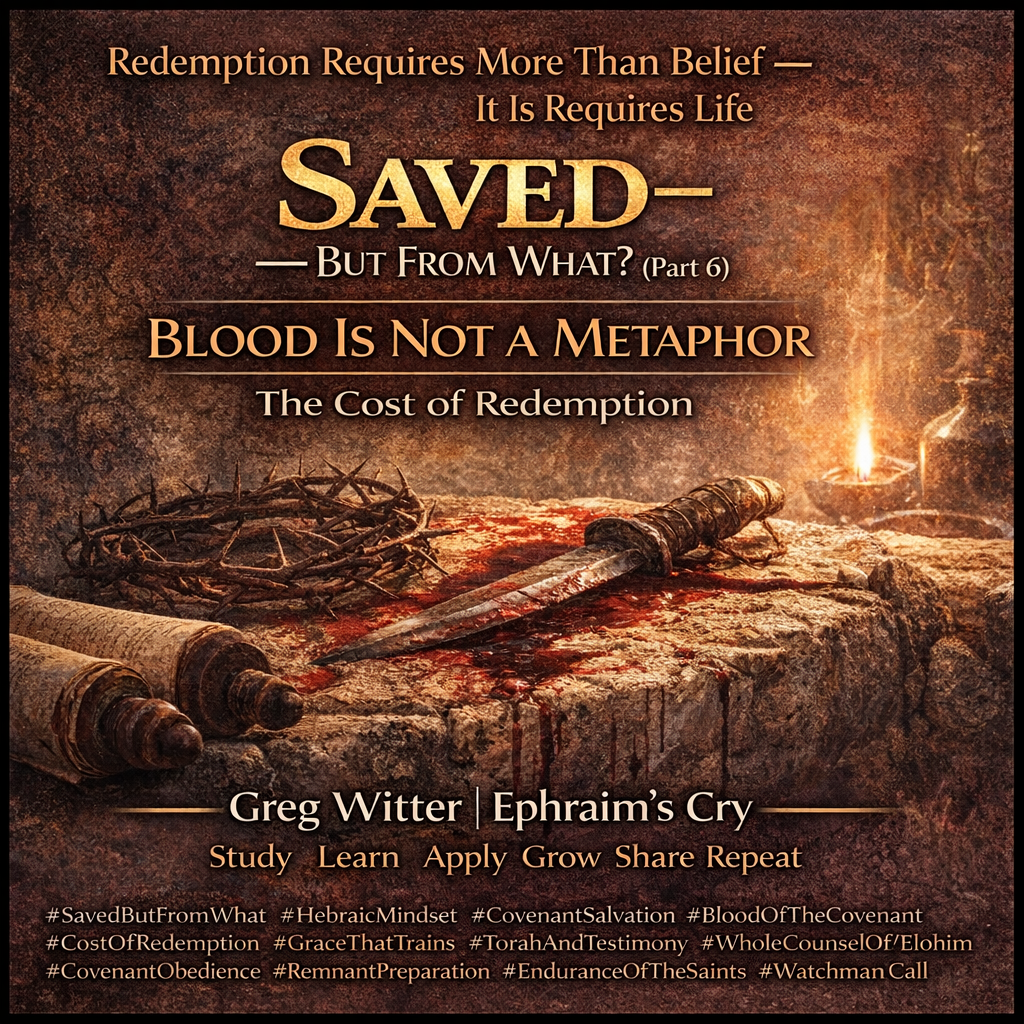
Saved — But From What? (Part 6)
Salvation, Covenant, and the End of Believism
Blood Is Not a Metaphor
The Cost of Redemption
Greg Witter | Ephraim’s Cry
Hebraic Mindset Study Series
Study Learn Apply Grow Share Repeat
From the beginning of Scripture to its final testimony, blood is never treated as symbolism, poetry, or religious imagery. Blood is treated as life itself—sacred, accountable, and costly—because life belongs to Yahuah alone. Any gospel that minimizes blood minimizes covenant. Any salvation message that sentimentalizes blood empties redemption of its weight.
This is where modern religion collapses under scrutiny.
Scripture never presents redemption as convenient. Grace is never cheap. Salvation is never detached from consequence. Redemption requires life because covenant violation incurs death. That is not theology—it is law.
Blood as a Creation-Level Reality
Long before Sinai, long before Israel, long before priesthood or altar, blood is established as a creation boundary.
“Flesh with the life thereof, which is the blood thereof, shall ye not eat. And surely your blood of your lives will I require…” (Genesis 9:4–5)
Blood accountability is rooted in creation itself. It is tied directly to the image of Elohim.
“Whoso sheddeth man’s blood, by man shall his blood be shed: for in the image of Elohim made He man.” (Genesis 9:6)
Blood is not a ritual rule—it is a creation law. Life carries accountability because life bears image. To violate blood is to violate the order Yahuah established at creation.
This is why blood guilt exists outside Israel.
This is why nations are judged.
This is why innocence matters.
Blood demands reckoning.
Blood as Covenant Enforcement
When Torah is given, blood does not lose weight—it gains structure.
“For the life of the flesh is in the blood: and I have given it to you upon the altar to make atonement for your souls: for it is the blood that maketh an atonement for the soul.” (Leviticus 17:11)
Blood does not merely open covenant—it enforces it. Covenant violation accumulates guilt. Guilt does not evaporate. It requires accounting.
That is why Scripture speaks of blood crying out.
“The voice of thy brother’s blood crieth unto Me from the ground.” (Genesis 4:10)
Blood records injustice.
Blood testifies against rebellion.
Blood marks the boundary between mercy and judgment.
Blood as Testimony and Witness
Blood is not silent. Blood bears witness.
Scripture consistently treats blood as testimony—either for the innocent or against the guilty.
“Your hands are defiled with blood, and your fingers with iniquity…” (Isaiah 59:3)
“I sought for a man among them, that should make up the hedge… but I found none.” (Ezekiel 22:30)
The prophets indict nations not merely for belief failure, but for accumulated blood guilt—violence, injustice, corruption, and covenant betrayal layered over time.
Blood stands as evidence.
Blood testifies in judgment.
Blood confirms accountability.
This is why repentance delayed becomes repentance denied. Blood reaches a point where testimony is complete.
Covenant Is Ratified in Blood
Covenant is never abstract. It is a legally binding agreement sealed with life.
When Yahuah covenants with Abram, He does not ask Abram to promise loyalty. He binds Himself.
“Take Me a heifer of three years old… and he divided them in the midst…” (Genesis 15:9–10)
Abram does not walk between the pieces. Yahuah does.
“And it came to pass… that a smoking furnace and a burning lamp passed between those pieces.” (Genesis 15:17)
This is covenant cutting. It means: May I become like these if I break this covenant.
At Sinai, the same pattern appears:
“Moses took the blood, and sprinkled it on the people, and said, Behold the blood of the covenant…” (Exodus 24:8)
Covenant carries consequence because covenant carries blood.
Passover: Blood as Boundary, Not Belief
Passover dismantles modern salvation myths.
Egypt was under judgment. Israel was not spared by heritage, sincerity, or belief alone. Deliverance required obedience.
“They shall take of the blood, and strike it on the two side posts and on the upper door post of the houses…” (Exodus 12:7)
The blood was visible.
The blood was applied.
The blood marked households.
“When I see the blood, I will pass over you.” (Exodus 12:13)
Those inside the blood lived.
Those outside the blood died.
There was no neutrality.
There was blood—or judgment.
This pattern never disappears.
Life for Life — Covenant Justice
“If any mischief follow, then thou shalt give life for life.” (Exodus 21:23)
This is not cruelty. This is justice. Life carries value because life is sacred.
Sin violates covenant. Covenant violation creates legal debt. Debt demands restitution. The penalty is death.
Yahuah, in mercy, allows substitution:
“It is the blood that maketh atonement for the soul.” (Leviticus 17:11)
Forgiveness does not cancel justice.
Forgiveness satisfies justice through substitution.
Blood, Land, and Corporate Guilt
Blood defiles land.
“Blood defileth the land: and the land cannot be cleansed… but by the blood of him that shed it.” (Numbers 35:33)
This is why exile happens.
This is why land is lost.
This is why inheritance is forfeited.
Blood guilt accumulates. Judgment is not arbitrary—it is measured.
“That upon you may come all the righteous blood shed upon the earth…” (Matthew 23:35)
Corporate guilt reaches fullness. When it does, judgment is irreversible.
Blood and Irreversibility
Once blood is shed, something permanent occurs.
Scripture teaches that there are points of no return—moments when testimony is complete and judgment proceeds.
“He that being often reproved hardeneth his neck, shall suddenly be destroyed, and that without remedy.” (Proverbs 29:1)
Blood creates irreversible accountability. Some doors close forever. Some judgments cannot be delayed. Some consequences cannot be undone.
This is why end-time pressure exposes hearts.
This is why neutrality disappears.
This is why covenant loyalty matters.
Messiah’s Blood: Fulfillment, Not Cancellation
Yahusha does not create a new covenant logic. He fulfills the existing one.
“This cup is the renewed covenant in My blood, which is shed for you.” (Luke 22:20)
“Without shedding of blood is no remission.” (Hebrews 9:22)
This was not symbolism. This was covenant execution.
His blood satisfies covenant justice so restoration can begin—not so obedience can end.
Grace Is Costly — Therefore It Trains
“For the grace of Elohim that bringeth salvation hath appeared… teaching us that, denying ungodliness and worldly lusts, we should live soberly, righteously, and godly…” (Titus 2:11–12)
Grace trains because grace was purchased with life.
“Shall we continue in sin, that grace may abound? Elohim forbid.” (Romans 6:1–2)
Grace does not excuse rebellion.
Grace delivers from it.
Blood Restores Responsibility
Redemption through blood does not remove covenant expectation. It restores the ability to walk faithfully.
“Hereby we do know that we know Him, if we keep His commandments.” (1 John 2:3)
Blood cleanses.
Blood reconciles.
Blood restores access.
But covenant life must still be walked.
The Weight of This Truth
If blood is real, salvation is serious.
If blood was required, grace is not casual.
If life was exchanged, obedience matters.
The blood of Yahusha does not produce lawless freedom.
It produces covenant restoration.
It removes condemnation so obedience can resume.
It restores belonging so inheritance can be pursued.
Salvation is not escape from responsibility.
It is restoration to it.

#SavedButFromWhat #HebraicMindset #CovenantSalvation #BloodOfTheCovenant #CostOfRedemption #GraceThatTrains #TorahAndTestimony #WholeCounselOfElohim #CovenantObedience #RemnantPreparation #EnduranceOfTheSaints #GregWitter #EphraimsCry
