
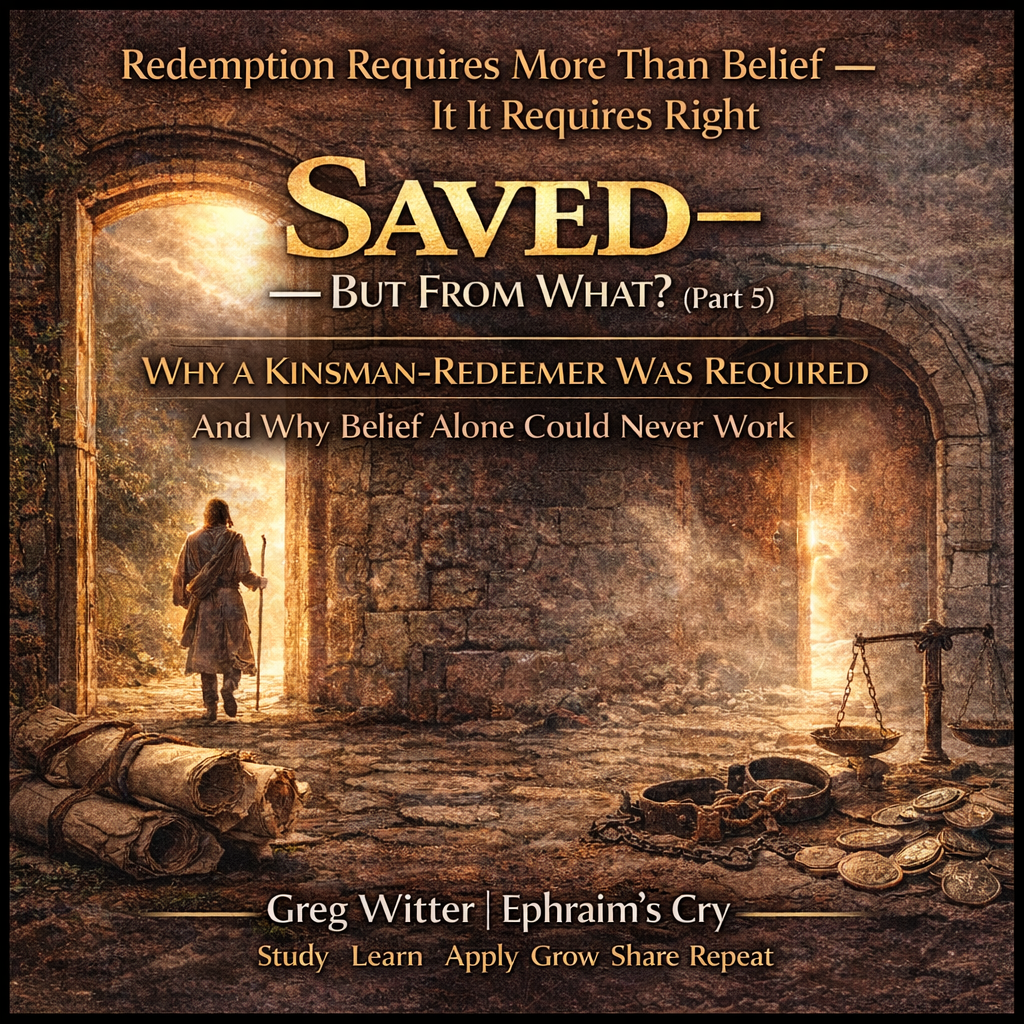
Saved-But From What? (Part 5)
Salvation, Covenant, and the End of Believism
Redemption Requires More Than Belief — It Requires Right
Why a Kinsman-Redeemer Was Require Saved d
And Why Belief Alone Could Never Work
Greg Witter | Ephraim’s Cry
Hebraic Mindset Study Series
Study Learn Apply Grow Share Repeat
By this point, one reality should no longer be avoidable:
Redemption is not sentimental.
If redemption is legal, relational, and restorative—as Scripture repeatedly testifies—then redemption cannot be accomplished by sincerity, intention, or belief alone. Good intentions do not resolve legal claims. Emotional conviction does not restore inheritance. Desire does not confer authority.
Redemption requires right.
And Scripture is unyielding about what kind of right that must be.
Redemption Requires a Kinsman
Torah establishes the rule without ambiguity:
“If thy brother be waxen poor, and hath sold away some of his possession, and if any of his kin come to redeem it, then shall he redeem that which his brother sold.” (Leviticus 25:25)
Redemption is not open-market charity.
It is not humanitarian compassion.
It is not religious goodwill.
It is family responsibility.
Only a kinsman—one who shares bloodline, covenant identity, and inheritance standing—may redeem what was lost. Without kinship, redemption is impossible, no matter how sincere the desire.
This principle governs every form of redemption in Torah:
- Land redemption
- Debt redemption
- Slavery redemption
- Inheritance restoration
Redemption restores what belonged to the family. Outsiders may sympathize, but they cannot lawfully intervene.
Kinship Is About Bloodline Continuity, Not Just Compassion
Scripture does not define kinship abstractly. Kinship exists to preserve lineage, name, and inheritance.
Redemption is not merely about freeing an individual from hardship. It is about preventing the extinction of a family line within the covenant people.
This is why redemption language is inseparable from inheritance language.
“If brethren dwell together, and one of them die, and have no child… that his name be not put out of Israel.” (Deuteronomy 25:5–6)
To redeem is to keep a name alive.
To redeem is to preserve covenant continuity.
To redeem is to ensure that inheritance does not disappear from among the people.
This dimension destroys modern adoption-only frameworks that sever redemption from lineage. Scripture does not replace bloodline logic with sentiment; it fulfills it by restoring it.
The Book of Ruth: Redemption in Plain Sight
The book of Ruth exists precisely to make this logic visible.
Boaz does not redeem Ruth and Naomi merely because he is kind. He redeems because he is:
- A near kinsman (Ruth 2:20)
- Legally qualified to redeem (Ruth 4:4)
- Willing to pay the full cost (Ruth 4:9–10)
The nearer kinsman refuses—not because he lacks belief or compassion—but because redemption would jeopardize his own inheritance:
“I cannot redeem it for myself, lest I mar mine own inheritance.” (Ruth 4:6)
This matters.
Redemption always costs the redeemer something real.
Redemption always transfers inheritance risk.
Boaz redeems not only land, but name.
He raises up the name of the dead upon his inheritance (Ruth 4:10).
This is not romantic imagery.
It is covenant preservation.
Outsiders Cannot Redeem
Redemption restores inheritance, not merely freedom. Only someone who already belongs to the covenant structure can restore covenant standing.
This is why foreign nations could not redeem Israel from exile. This is why charity cannot replace Jubilee. This is why mercy alone cannot restore land.
Compassion without right is powerless.
Redemption is not about generosity.
It is about lawful claim.
Angels Cannot Redeem
Angels are not kin.
They are servants and messengers, sent to minister for those who will inherit salvation (Hebrews 1:14). But they do not share human lineage. They do not possess Adamic inheritance rights. They do not hold covenant land claims.
Power does not equal authority.
Redemption cannot come from above humanity.
It must come from within the family.
Belief Cannot Redeem
This is where believism collapses.
Belief is response—not payment.
Belief is alignment—not qualification.
Belief is necessary—but belief does not redeem.
A debtor may believe they should be free.
A slave may believe chains are unjust.
An exiled heir may believe the land should be restored.
Belief does not satisfy legal claims.
Scripture never presents belief as the mechanism of redemption. It presents belief as the response to redemption already accomplished.
Redemption acts.
Belief receives.
Humanity Could Not Redeem Itself
Humanity could not self-redeem because the entire family line was compromised.
A debtor cannot pay when he has nothing left.
A slave cannot purchase himself when he is owned.
An exiled people cannot restore inheritance without right.
This is why salvation cannot be reduced to moral reform, spiritual discipline, or belief alone. The problem was not lack of sincerity—it was lack of lawful standing.
Redemption required someone inside the family line who was not under the same claim.
The Redeemer Possesses Authority — Not Only Compassion
This is a critical covenant truth often ignored.
The same authority that qualifies one to redeem also qualifies one to govern covenant outcome.
In Torah, the redeemer does not merely restore inheritance; he enforces rightful order. He defines who belongs, who remains outside, and under what conditions restoration occurs.
Redemption is not optional sentiment.
It is covenant action with authority.
This is why Scripture consistently links redemption and rule. The one who redeems has the right to establish order.
There is no redemption without authority.
And there is no authority without consequence.
The Destabilizing Truth Most People Avoid
If redemption required a qualified kinsman, then something unsettling must be faced:
You were not free.
You did not belong to yourself.
Your belief did not activate redemption.
Redemption acted upon you.
That means salvation did not begin with your decision. It began with a lawful act you could not perform for yourself. Your response did not create redemption—it acknowledged it.
This dismantles autonomy at the root.
Salvation is not self-possession improved.
It is ownership transferred.
Core Teaching of Part 5
Redemption requires:
- Shared family identity
- Bloodline continuity
- Legal authority
- Willingness to bear real cost
- Authority to restore inheritance and enforce covenant standing
Without kinship, there is no redemption.
Without authority, there is no restoration.
Without cost, there is no release.
Belief alone cannot redeem.
Angels cannot redeem.
Outsiders cannot redeem.
Only a qualified kinsman can.
The Unavoidable Question
If redemption required a kinsman,
and if humanity could not redeem itself,
and if angels were disqualified,
then only one question remains:
Who became our kinsman?
And if a kinsman redeemed us,
what did it cost Him?

#SavedButFromWhat, #HebraicMindset, #CovenantSalvation, #KinsmanRedeemer, #RedemptionAuthority, #InheritancePreserved, #BelievismExposed, #TorahAndTestimony, #WholeCounselOfElohim, #GraceThatTrains, #KingdomGospel, #RemnantFaith, #EnduranceOfTheSaints, #WatchmanCall, #GregWitter, #EphraimsCry
