
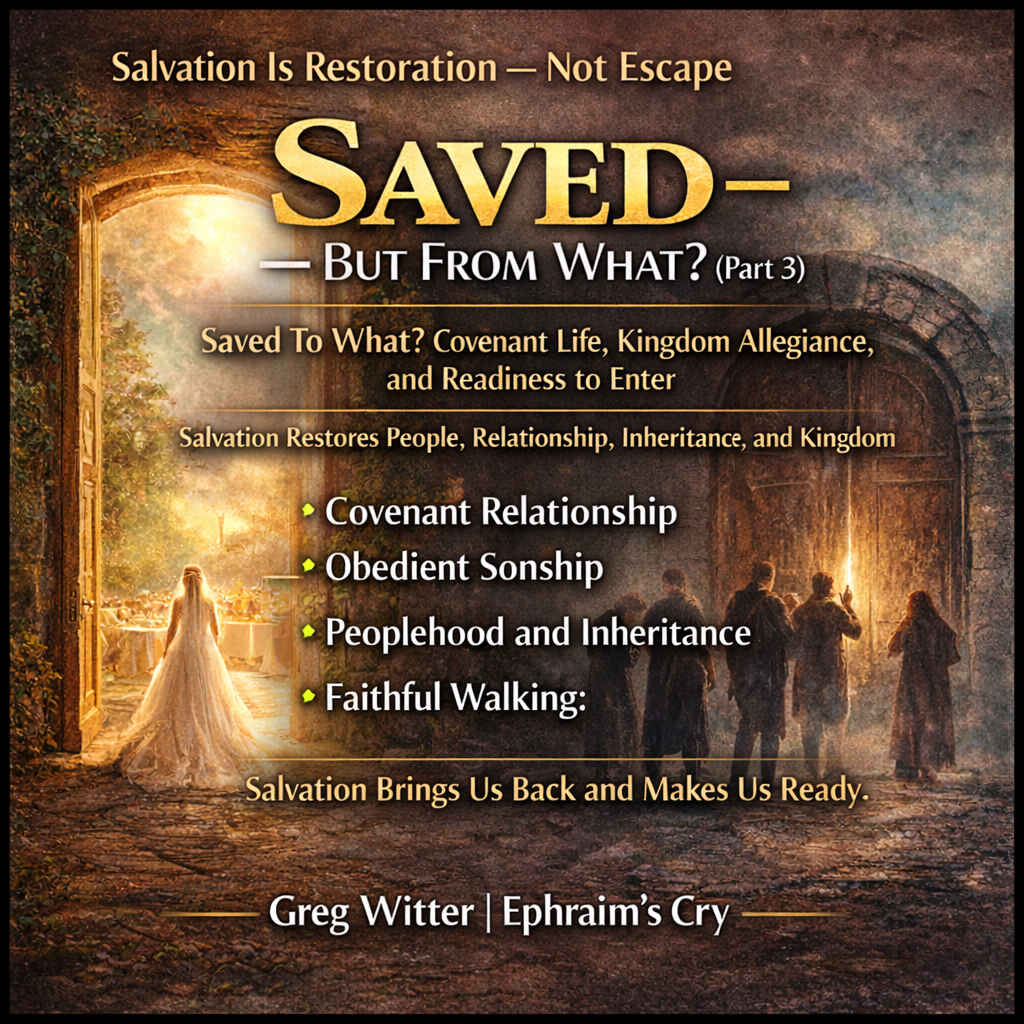
Saved — But From What? (Part 3)
Salvation, Covenant, and the End of Believism
Salvation Is Restoration — Not Escape
Saved To What? (Restoration, Not Escape)
Salvation Does Not Remove Responsibility — It Restores It
Greg Witter | Ephraim’s Cry
Hebraic Mindset Study Series
Study Learn Apply Grow Share Repeat
Once salvation is no longer reduced to “saved from hell,” the question sharpens immediately.
If we are saved from lawlessness, slavery, exile, and being cut off, then salvation must be moving us somewhere. Elohim does not rescue people merely to leave them suspended in spiritual limbo. He does not redeem lives simply to grant relief. Salvation has direction. It has purpose. It has an intended outcome.
Salvation is not escape from responsibility.
Salvation is restoration to responsibility.
This is where modern gospels fracture. They often speak as though salvation’s highest goal is departure—leaving the world, leaving accountability, leaving obligation. Scripture presents salvation as return—return to covenant order, return to rightful authority, return to identity, return to inheritance, and return to faithful walking.
Salvation Is Restoration to Original Design
The biblical story does not begin with redemption. It begins with design.
Humanity was created to live within covenant boundaries—under Elohim’s authority, walking in trust, obedience, and relational nearness (Genesis 2:15–17). Life was not chaotic. It was ordered. Protection, provision, and purpose all existed inside the boundaries Elohim established.
When those boundaries were rejected, expulsion followed.
“So He drove out the man; and He placed at the east of the garden of Eden cherubims, and a flaming sword…” (Genesis 3:24)
That expulsion was not merely punishment—it was loss of access. Loss of nearness. Loss of position.
Salvation does not invent something new. It restores what was lost.
Throughout Scripture, salvation is consistently portrayed as a return to rightful order. Elohim restores what rebellion dismantled. He does not abandon His design; He redeems people back into it.
Salvation Is Restoration to Covenant Relationship
Sin is not merely wrongdoing. Sin is covenant breach. It disrupts nearness and fractures relationship.
That is why salvation language in Scripture is relational at its core:
- Returning
- Drawing near
- Being reconciled
- Being gathered
- Being restored
The prophets describe salvation as Elohim cleansing, renewing, and re-establishing His people in relationship:
“I will sprinkle clean water upon you… a new heart also will I give you… and I will put My Spirit within you, and cause you to walk in My statutes.” (Ezekiel 36:25–27)
Relationship and obedience are never separated. Nearness produces alignment. Alignment preserves nearness.
Sha’ul affirms this covenant reality when he writes:
“But now in Messiah Yahusha ye who sometimes were far off are made nigh.” (Ephesians 2:13)
Salvation restores proximity. Proximity requires covenant order.
Salvation Is Restoration to Obedient Sonship
Sonship in Scripture is not sentimental language. It is covenant identity with covenant expectation.
A son represents the household. A son carries the name. A son is trained, corrected, disciplined, and entrusted. A son is not lawless.
This is why Yahusha repeatedly tied salvation to obedience:
“If ye love Me, keep My commandments.” (John 14:15)
“He that hath My commandments, and keepeth them, he it is that loveth Me.” (John 14:21)
Love is not defined by emotional affirmation. Love is defined by covenant faithfulness.
Sha’ul explains that those led by the Spirit of Elohim are the sons of Elohim (Romans 8:14). That Spirit does not remove instruction; it internalizes it. The Spirit restores people to sonship so they can walk faithfully—not so they can reject covenant authority.
Salvation restores sonship.
Sonship restores obedience.
Obedience confirms relationship.
Salvation Is Restoration to Peoplehood, Not Isolated Spirituality
One of the greatest distortions of modern religion is the idea that salvation is primarily individual and private.
Scripture never presents salvation that way.
Elohim delivers a people. He gives Torah to a people. He disciplines a people. He scatters a people. And He restores a people.
To be “cut off” is to be removed from the covenant community (Exodus 12:15; Numbers 15:30–31). Salvation reverses that status. It restores belonging, identity, accountability, and shared purpose.
Sha’ul reminds those from the nations:
“Ye were without Messiah, being aliens from the commonwealth of Israel, and strangers from the covenants of promise… But now… ye are made nigh.” (Ephesians 2:12–13)
Nearness is not abstract spirituality. It is covenant inclusion.
A gospel that saves individuals while leaving people disconnected from covenant identity is incomplete. Salvation restores peoplehood.
Salvation Is Restoration to Inheritance Trajectory
Inheritance is not a secondary theme in Scripture. It is the goal of redemption.
From Abraham onward, covenant promise is framed in inheritance terms—land, blessing, continuity, and Kingdom purpose (Genesis 12:1–3; 17:7–8). Israel was delivered from Egypt not merely to escape suffering, but to inherit what Elohim promised.
Exile is loss of inheritance. Restoration is return to inheritance.
In the renewed covenant writings, this language remains central:
“And if children, then heirs; heirs of Elohim, and joint-heirs with Messiah.” (Romans 8:17)
“Come, ye blessed of My Father, inherit the kingdom prepared for you…” (Matthew 25:34)
Inheritance implies responsibility. Sons inherit. Faithful servants inherit. Rebels forfeit. Covenant governs inheritance, not sentiment.
Salvation places a person back on the inheritance path.
Salvation Is Restoration to Kingdom Allegiance
Yahusha did not preach escape. He preached the Gospel of the Kingdom (Matthew 4:23).
A Kingdom has a King. A King has authority. A Kingdom has laws. Salvation restores allegiance to Elohim’s rule.
This is why salvation is not merely personal—it is political in the truest sense. It transfers a person from one dominion to another:
“Who hath delivered us from the power of darkness, and hath translated us into the kingdom of His dear Son.” (Colossians 1:13)
Translation implies jurisdiction change. Salvation restores a person under rightful governance.
Wedding Imagery: Salvation Is Readiness, Not Assumption
Scripture uses wedding imagery to describe covenant readiness and separation.
Yahusha spoke of a wedding feast where one man was cast out for lacking proper garment (Matthew 22:11–14). The issue was not invitation—it was preparedness.
He described ten virgins awaiting the bridegroom (Matthew 25:1–13). All expected entrance. All had lamps. The distinction was readiness.
The wise had oil. The foolish did not.
Oil is not emotional enthusiasm. It is internal preparation. It is formed faithfulness. It is a life shaped by covenant obedience that cannot be borrowed when pressure arrives.
When the door was shut, it was final.
Salvation is not knowing a wedding exists.
Salvation is being ready to enter.
Inside and Outside: Salvation Places You Somewhere
Scripture consistently draws a boundary between inside and outside.
Inside is covenant order, protection, inheritance, and purpose. Outside is separation, loss, and judgment.
Yahusha spoke of those who would sit in the Kingdom and those cast out (Matthew 8:11–12). Revelation ends with clear boundary language—those within the city and those outside (Revelation 22:14–15).
Salvation places you inside—inside covenant, inside obedience, inside readiness.
That placement produces a walk.
Core Teaching of Part 3
Salvation is not escape.
Salvation is restoration.
Saved to:
- Covenant relationship
- Obedient sonship
- Peoplehood and belonging
- Inheritance trajectory
- Kingdom allegiance
- Readiness and faithful walking
Salvation does not remove responsibility—it restores it.
Where This Leads Next
If salvation restores us to covenant life, then the next question is unavoidable:
What were we redeemed from—and why was redemption required at all?
Part 4 will ground redemption in the lived reality of Scripture: slavery, debt, bondage, land loss, and exile—so that redemption regains its full weight and meaning.
#SavedButFromWhat, #HebraicMindset, #CovenantSalvation, #RestorationNotEscape, #KingdomGospel, #ObedientSonship, #PeoplehoodRestored, #InheritancePath, #BrideReady, #TorahAndTestimony, #WholeCounselOfElohim, #GraceThatTrains, #RemnantFaith, #EnduranceOfTheSaints, #WatchmanCall, #GregWitter, #EphraimsCry
