
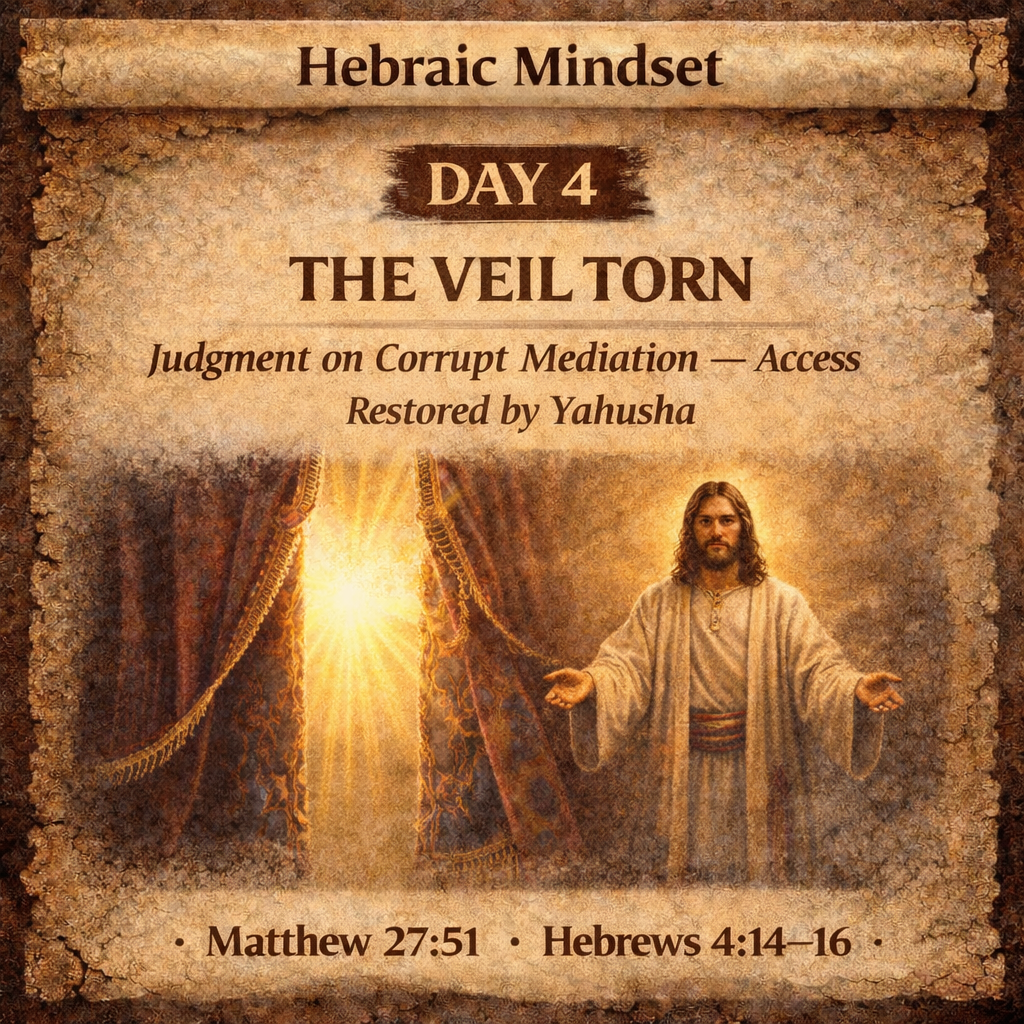
THE VEIL TORN
Judgment on Corrupt Mediation — Access Restored by Yahusha
What actually changed, and what did not
Greg Witter | Ephraim’s Cry
Hebraic Mindset Study Series
Study Learn Apply Grow Share Repeat
Orientation
Day One established the standard: all things must be tested by Torah and testimony.
Day Two exposed the failure: priesthood becomes corrupted when it departs from Torah.
Day Three revealed the consequence: rejected knowledge leads to rejection and destruction.
Day Four now addresses the turning point in redemptive history—the tearing of the veil.
Few events in Scripture are more misunderstood or more abused than this moment. The tearing of the veil has been used to justify lawlessness, abolish obedience, erase Torah, and promote spiritual autonomy. Scripture does none of those things.
This teaching establishes what the torn veil actually means, what it judged, what it restored, and what it never abolished.
The Veil Was a Boundary, Not a Barrier to Obedience
Exodus 26:31–33; Leviticus 16:2
The veil separated the Most Set-Apart Place. It was not evil. It was not arbitrary. It existed because Yahuah is holy and sinful man cannot casually enter His presence.
The veil communicated three realities:
Elohim is set apart
access requires atonement
mediation must be faithful
The problem was never the veil itself.
The problem was corrupted mediation behind it (Jeremiah 7:9–11; Matthew 23:27–28).
The Veil Was Torn by Elohim, Not Man
Matthew 27:51; Mark 15:38; Luke 23:45
All three Gospel accounts emphasize the same detail:
the veil was torn from top to bottom.
This was not human rebellion.
This was divine judgment.
In Scripture, when Yahuah tears, rends, or exposes, it signals:
judgment on corruption (Joel 2:13)
removal of false covering (Ezekiel 16:37)
transition in covenant administration
The torn veil is Yahuah declaring:
“This corrupted system no longer stands between Me and My people.”
What Was Judged: Corrupt Levitical Mediation
Matthew 23:37–38; Hebrews 7:11–12
The priestly system had become lawless, hypocritical, and oppressive. Yahusha condemned it openly—not Torah, but those who claimed to guard it while violating it (Matthew 23:13–36).
The veil tearing signaled:
judgment on corrupt priesthood
removal of human gatekeeping
the end of that house’s authority
This aligns with Hebrews, which teaches not the abolition of Torah, but a change of priesthood—from Levitical to Melchizedek order (Hebrews 7:12).
What Was Restored: Access Through Yahusha
Hebrews 4:14–16; Hebrews 10:19–22
The torn veil does not say “no mediator.”
It says no corrupt mediator.
Scripture is explicit:
We now draw near through Yahusha
He is our High Priest
He mediates perfectly, eternally, without corruption
Access is restored not by autonomy, but by Messiah’s priestly work.
Yahusha did not remove mediation.
He fulfilled it.
What Was NOT Abolished: Torah
This must be stated plainly, because Scripture does.
Yahusha upheld Torah and warned against breaking even the least commandments (Matthew 5:17–19).
Paul declared that faith does not void Torah but establishes it (Romans 3:31).
The renewed covenant promise is Torah written on hearts, not erased from existence (Jeremiah 31:33).
The Spirit is given to cause obedience, not independence (Ezekiel 36:27).
If the veil tearing abolished Torah:
Yahusha contradicted Himself
Paul contradicted himself
Jeremiah’s promise is null
Revelation’s definition of the remnant collapses (Revelation 12:17; 14:12)
Scripture does not contradict itself.
Interpretations that claim Torah ended are the problem.
Access Does Not Mean Lawlessness
Titus 2:11–14; Hebrews 12:14
Grace restores access.
Grace does not excuse rebellion.
The purpose of redemption is:
purification
obedience
a set-apart people
Lawlessness after access is precisely what Messiah warned against (Matthew 7:21–23).
The torn veil removes fear-based distance, not covenant obligation.
The True Meaning of the Torn Veil
Put simply:
The veil tearing judged corrupted mediation
The veil tearing restored access through Yahusha
The veil tearing did not abolish Torah
The veil tearing did not authorize autonomy
The veil tearing magnified accountability
Access without obedience is presumption.
Access with obedience is covenant faithfulness.
Watchman Conclusion
The torn veil is not a permission slip for lawlessness.
It is a summons to draw near rightly.
Yahuah removed false gatekeepers, not His instructions.
He restored approach, not rebellion.
He established a perfect High Priest, not spiritual independence.
Tomorrow, we will conclude this series by confronting the final line Scripture draws—lawlessness versus obedience—and how Yahusha Himself defines who truly belongs to Him.
#EphraimsCry #GregWitter #HebraicMindset #HebraicMindsetStudySeries #VeilTorn #Matthew2751 #Hebrews4 #Hebrews7 #Hebrews10 #Melchizedek #HighPriest #TorahTruth #Covenant #AccessRestored #Obedience
