
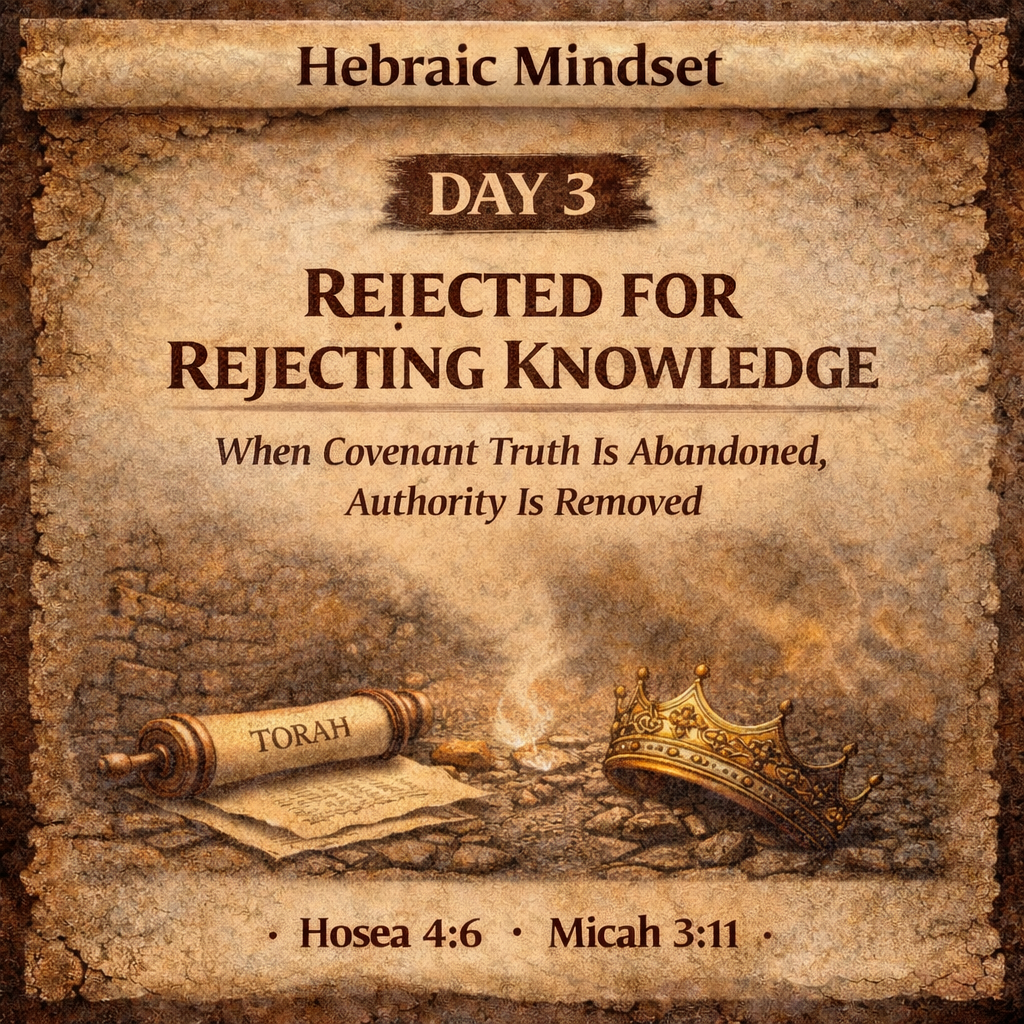
REJECTED FOR REJECTING KNOWLEDGE
When Covenant Truth Is Abandoned, Authority Is Removed
Destruction follows willful ignorance
Greg Witter | Ephraim’s Cry
Hebraic Mindset Study Series
Study Learn Apply Grow Share Repeat
Orientation
Day One established the standard: all things must be tested by Torah and testimony.
Day Two exposed the failure: priesthood becomes corrupted when it departs from Torah.
Day Three now addresses the consequence.
Scripture is unambiguous: when knowledge is rejected—especially by leadership—Yahuah responds by removing authority and allowing destruction to follow. This is not because Elohim delights in judgment, but because covenant order cannot be sustained where truth is despised.
This teaching dismantles the modern excuse that ignorance is neutral or that sincerity compensates for disobedience. Scripture teaches the opposite: rejected knowledge produces rejection, and the people suffer for it.
Knowledge Is Covenant Responsibility, Not Optional Information
Hosea 4:6
“My people are destroyed for lack of knowledge. Because you have rejected knowledge, I also reject you from being priest for Me; because you have forgotten the Torah of your Elohim, I also will forget your children.”
This verse is routinely misunderstood. Hosea does not say the people lacked access to knowledge. He says knowledge was rejected. The Hebrew idea is willful refusal, not accidental ignorance.
The progression is devastating and precise:
knowledge is rejected
Torah is forgotten
priesthood is rejected
the next generation suffers
This is covenant cause and effect.
Yahuah never judged Israel for not knowing what He withheld. He judged them for rejecting what He revealed (Deuteronomy 30:15–19). Knowledge in Scripture is not abstract data; it is relational and obedient—knowing Yahuah by walking in His ways (Jeremiah 9:23–24; Psalm 119:33–34).
Rejecting Torah Always Precedes Destruction
Throughout Scripture, destruction never appears without warning. It is always preceded by a rejection of instruction.
In the wilderness, Israel refused to trust and obey despite clear revelation (Numbers 14:22–23).
In the period of the judges, everyone did what was right in their own eyes (Judges 21:25).
In the days of the prophets, leaders ignored Torah and silenced correction (Jeremiah 6:16–19).
Hosea stands in that same line. The destruction he warns of is not random catastrophe—it is covenant consequence.
This directly contradicts the modern idea that obedience is optional or that “relationship” replaces instruction. Scripture never separates the two. Relationship is defined by obedience (Exodus 19:5; John 14:15).
Leadership Bears the Heavier Judgment
Micah 3:11
“Her heads judge for a bribe, her priests teach for pay, and her prophets divine for money; yet they lean on Yahuah and say, ‘Is not Yahuah among us?’”
Micah exposes religious hypocrisy at its most dangerous: leadership using Yahuah’s name while operating in corruption.
Notice the pattern:
authority is monetized
truth is adjusted for gain
false security is proclaimed
And yet they still claim Yahuah’s presence.
This is not atheism. It is religious exploitation. And Scripture treats it with severity because it misleads the people while shielding leaders from accountability.
Yahuah never condemned leaders for being imperfect. He condemned them for being unfaithful while claiming legitimacy (Ezekiel 34:1–10; Matthew 23:13–36).
Sincerity Does Not Cancel Responsibility
One of the most destructive lies in modern faith culture is the idea that sincerity overrides truth. Scripture rejects this completely.
Saul was sincere when he spared what Yahuah commanded destroyed—yet he was rejected (1 Samuel 15:22–23).
Israel was sincere in worship while ignoring justice—yet Yahuah rejected their feasts (Amos 5:21–24).
Messiah warned that many would sincerely call Him “Lord” while practicing lawlessness—and be rejected (Matthew 7:21–23).
Sincerity without obedience is not faith. It is presumption.
Knowledge Lost Is Knowledge Replaced
When Torah knowledge is rejected, something always fills the vacuum:
tradition replaces instruction (Mark 7:7–9)
emotion replaces discernment (Jeremiah 17:9)
leaders replace Scripture (Isaiah 29:13)
This is why Hosea’s warning extends beyond one generation. When leaders forget Torah, the children grow up without it. The result is compounded loss—spiritual, moral, and communal (Judges 2:10–12).
This is not merely theological. It is generational.
Rejection Is Not Permanent—If Repentance Occurs
Even in judgment, Yahuah’s purpose is restoration.
Hosea’s message includes a call to return:
“Come, let us return to Yahuah” (Hosea 6:1)
“I desire mercy and not sacrifice, knowledge of Elohim rather than burnt offerings” (Hosea 6:6)
Knowledge can be restored if repentance is real. But repentance in Scripture is not emotional regret; it is turning back to obedience (Deuteronomy 30:1–3; Proverbs 28:13).
This is why teaching matters. This is why correction matters. This is why testing matters.
Watchman Conclusion
Day Three confronts a truth that cannot be softened: destruction follows rejected knowledge, and authority is removed when Torah is forgotten.
Yahuah does not reject His people casually. He rejects persistent rebellion masked as spirituality. When leadership refuses to guard knowledge, the people suffer—and Yahuah intervenes.
The question every generation must answer is simple: Will we receive instruction, or will we reject it?
Tomorrow, we will address the turning point—the tearing of the veil—and what Scripture actually means when corrupted mediation is judged and access is restored.
#EphraimsCry #GregWitter #HebraicMindset #HebraicMindsetStudySeries #Hosea46 #Micah311 #RejectedKnowledge #TorahTruth #Covenant #Watchman #WholeCounsel #Obedience #WalkAsHeWalked
