
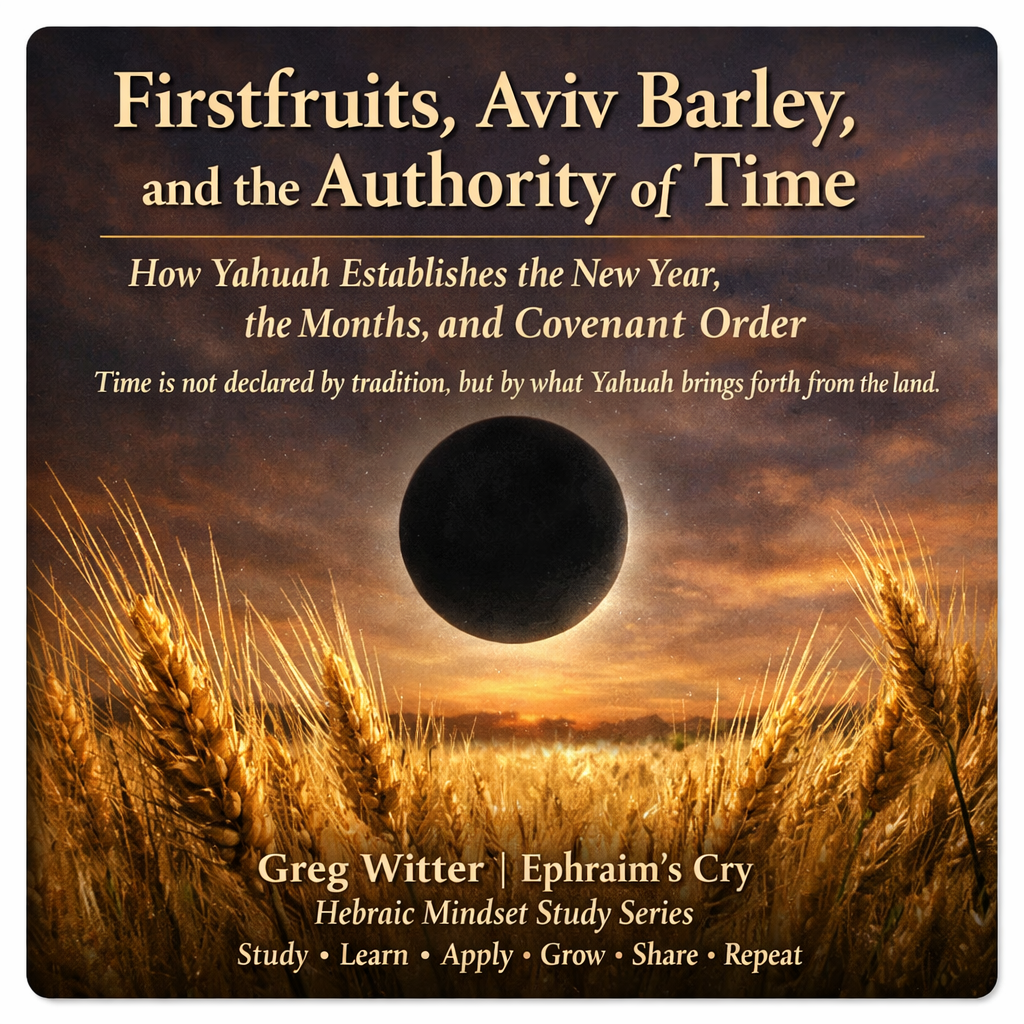
Firstfruits, Aviv Barley, and the Authority of Time
How Yahuah Establishes the New Year, the Months, and Covenant Order
Time is not declared by tradition, calculation, or sight alone, but by covenant witnesses established in creation
Greg Witter | Ephraim’s Cry
Hebraic Mindset Study Series
Study Learn Apply Grow Share Repeat
In Scripture, time is not abstract, theoretical, or symbolic. Biblical time is witnessed, covenantal, agricultural, and obedient. The calendar of Yahuah is not a man-made scheduling system; it is a living framework anchored in creation itself. The Feast of Firstfruits stands at the center of this framework, not merely as a celebration, but as an authority marker that governs the year, the months, the harvest, and obedience.
Firstfruits is not symbolic poetry layered onto the calendar after the fact. It is one of the mechanisms by which Yahuah governs time itself. Modern religious systems reduce it to metaphor, resurrection language only, or tradition. Scripture presents it as functional, legal, and determinative. It establishes when the year may begin, when Passover may be kept, when food may be eaten, and who owns the increase of the land. To misunderstand Firstfruits is to misunderstand the calendar. To misunderstand the calendar is to sever covenant from creation.
The biblical new year does not begin because a calculation says it should. It begins when barley in the land of Israel reaches the state called aviv. Aviv does not mean “green.” It describes a precise stage of maturity: grain that has developed enough to be parched, ground, and turned into food. If the barley cannot yet sustain life, it is not aviv, and the year cannot begin. This is why the first month is called Aviv. The month is named after the condition of the barley, not the other way around. Time follows creation. Creation does not follow tradition.
If there is no aviv barley, there is no biblical New Year. Passover cannot be lawfully observed, and Firstfruits cannot be offered. Barley is the anchor witness of the year. Astronomy alone is insufficient. Fixed calendars are insufficient. Human decree is insufficient. Yahuah tied time to the land.
This is where the monthly cycle must also be understood correctly. Just as the year is anchored to aviv barley, the month is anchored to the renewal of the moon—not by sight first, but by reality. The true beginning of the month is the conjunction, the dark moon, when the moon completes its cycle and is renewed. This is the actual event. This is the birth. This is the moment the month begins.
The visible sliver does not start the month. It confirms the month has already begun. The sliver is not the witness of initiation; it is the witness of verification. Scripture consistently teaches that reality precedes sight. Life begins before it is seen. Covenant action occurs before it is observed. The conjunction is the lawful beginning; the sighting is the confirmation.
This mirrors Firstfruits itself. The barley reaches aviv before it is harvested. The year begins before it is celebrated. The month begins before it is seen. In every case, Yahuah establishes reality first, then provides a visible witness. The error of modern calendars is reversing this order—allowing sight to define reality instead of reality producing sight.
Firstfruits is inseparable from the principle of first acknowledgment. Before man eats, before man benefits, before man claims provision, Yahuah is honored. This is why Torah forbids eating bread, roasted grain, or fresh grain from the new crop before the Firstfruits offering. The harvest belongs to Yahuah before it belongs to man. Eating from the harvest before Firstfruits is not freedom; it is theft. It is taking what has not yet been acknowledged as belonging to the Most High.
This prohibition establishes covenant order. Yahuah gives the increase. Yahuah is acknowledged first. Provision follows obedience. Rambam did not invent this logic; he preserved it. The land yields under covenant, not entitlement.
This is also why the waving of the Omer matters. It is not symbolic theater. It is legal recognition of ownership and authority. The Omer is waved during the Feast of Unleavened Bread, on the day after the weekly Sabbath. This timing is precise and intentional. Firstfruits is anchored to the Sabbath cycle, just as the month is anchored to the moon’s renewal and the year to the barley’s maturity.
You cannot move Firstfruits without moving the Sabbath.
You cannot move the Sabbath without breaking the calendar.
You cannot break the calendar without breaking covenant order.
The same pattern governs resurrection language. Life emerges in its appointed time, not by human declaration. Just as barley rises from the ground when it is ready, just as the moon is renewed before it is seen, so life is revealed when Yahuah determines it is time. Firstfruits is the declaration that life belongs to Yahuah first.
When Firstfruits is removed or redefined, time becomes tradition-driven instead of creation-witnessed. When the month is defined by sight alone, obedience becomes reactive instead of ordered. When the calendar is divorced from the land, covenant becomes symbolic instead of embodied. But when Firstfruits is restored—along with the true lunar witness—creation, covenant, and time realign.
Firstfruits governs the year.
The conjunction governs the month.
The Sabbath governs the rhythm.
Obedience governs the walk.
Without this structure, the calendar collapses into tradition.
With it, time itself bears witness to Yahuah’s order.
#Firstfruits #AvivBarley #BiblicalCalendar #ConjunctionMoon #DarkMoon #TrueNewMoon #Omer #UnleavenedBread #SabbathOrder #HebraicMindset #CovenantTime #AppointedTimes #EphraimsCry #GregWitter
