
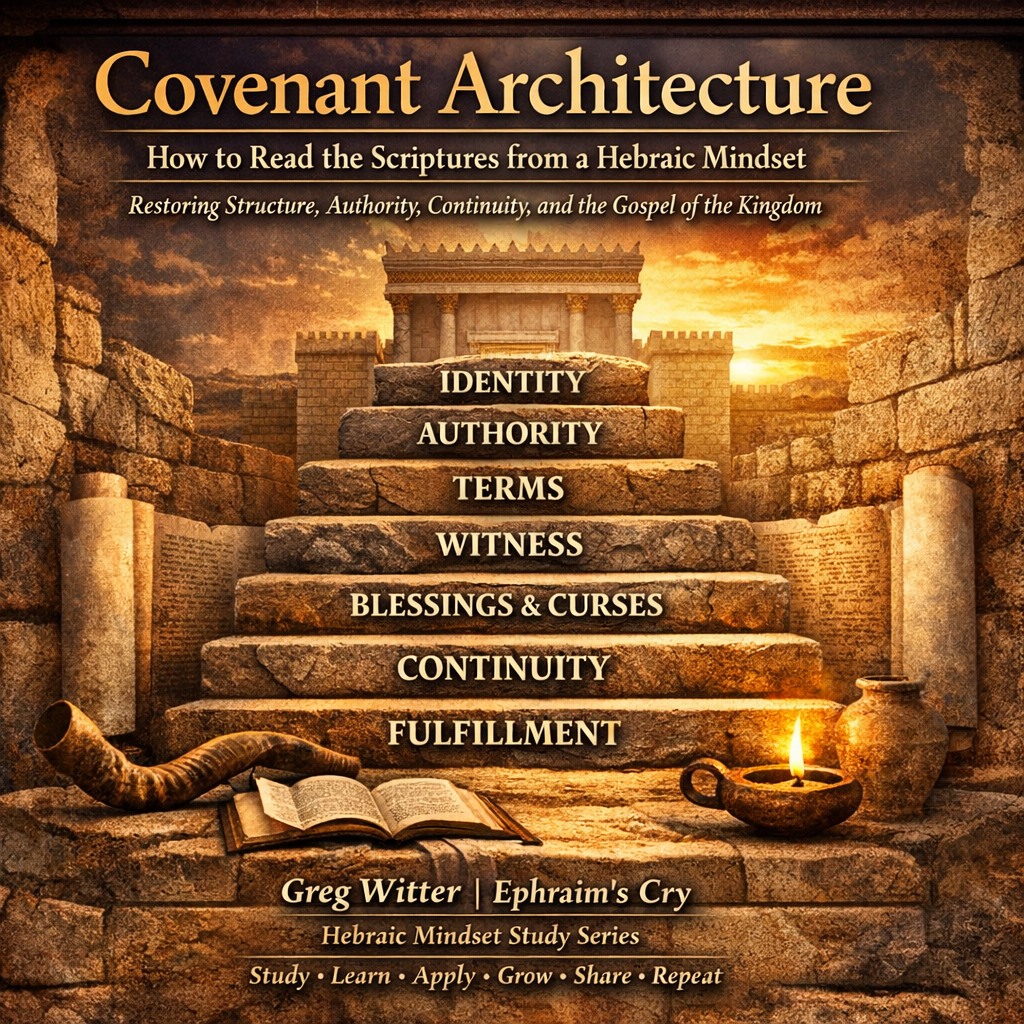
Covenant Architecture
How to Read the Scriptures from a Hebraic Mindset
Restoring Structure, Authority, Continuity, and the True Gospel of the Kingdom
Greg Witter | Ephraim’s Cry
Hebraic Mindset Study Series
Study Learn Apply Grow Share Repeat
Introduction — Why Scripture Is Read Wrong Before It Is Read at All
Most people approach Scripture already assuming the wrong category. They assume the Bible is primarily a book of rules, or a religion, or a set of beliefs one agrees with. Those assumptions are not neutral. They shape interpretation before the first verse is even read.
Scripture itself never presents itself that way.
From the opening words of Genesis to the closing vision of Revelation, Scripture presents itself as covenant governance—Yahuah revealing who He is, who His people are, how authority functions, what obedience looks like, how rebellion is judged, how restoration works, and how the Kingdom is ultimately established.
This is why Scripture says, “My people are destroyed for lack of knowledge” (Hosea 4:6). The issue is not lack of verses. It is lack of structural understanding.
This is not a new observation. This way of reading Scripture has been taught, documented, and practiced throughout Hebraic study for generations, and it has been foundational to How to Study the Scriptures from a Hebraic Mindset from its earliest form. What follows is not a replacement of that teaching, but an expanded articulation of what has already been taught and applied.
Scripture is not flat. It is layered. And those layers govern meaning.
The Nature of Covenant — Architecture, Not Abstraction
Yahuah does nothing randomly. Creation itself reveals order: light before life, separation before filling, authority before dominion (Genesis 1). Covenant follows the same pattern. This is why Scripture repeatedly says Yahuah is “not the author of confusion” (1 Corinthians 14:33).
When Scripture is read without recognizing its architecture, people argue isolated verses while ignoring the structure those verses sit within. That is why Yahusha rebuked the Pharisees for knowing Scripture yet missing its weightier matters (Matthew 23:23). They knew verses. They did not honor structure.
Covenant operates in seven interdependent layers. These layers do not compete. They govern one another. They are visible across Torah, the Prophets, the Writings, and the Apostolic witness. Removing any layer distorts the whole.
Layer 1 — Identity: Who Is the Covenant With?
Covenant always begins with identity. Before command, before obedience, before blessing or judgment, Yahuah reveals who He is and who His people are.
“I am Yahuah your Elohim, who brought you out of the land of Egypt” (Exodus 20:2).
“This is My Name forever, and this is My memorial to all generations” (Exodus 3:15).
Identity is not optional. Covenant cannot exist without knowing who the covenant-maker is. This is why Scripture places such emphasis on the Name, on lineage, on peoplehood, and on belonging.
“You shall be My people, and I will be your Elohim” (Leviticus 26:12).
“You only have I known of all the families of the earth” (Amos 3:2).
This layer is where the temple pattern functions descriptively. The tabernacle and later the Temple were not merely worship centers; they were architectural expressions of identity and access. Inner and outer courts, clean and unclean distinctions, priesthood roles, and boundaries all communicate who may draw near and on what terms (Leviticus 10:1–3; Ezekiel 44:23).
The Eden account belongs here as well. Adam and Chavah were given identity and assignment before prohibition (Genesis 1:26–28; 2:15–17). Exile followed identity breach. Restoration always begins by restoring identity, not behavior alone.
When identity is ignored, obedience becomes performance and faith becomes detached belief.
Layer 2 — Authority: Who Has the Right to Command?
Once identity is established, authority must be recognized. Covenant does not exist without authority. Someone defines righteousness. Someone sets the calendar. Someone establishes the terms.
“The earth is Yahuah’s, and the fullness thereof” (Psalm 24:1).
“The heavens are Yours, the earth also is Yours” (Psalm 89:11).
This layer is where time functions as authority. The appointed times are repeatedly called “My appointed times” by Yahuah (Leviticus 23:2). Time is not neutral. Whoever sets time establishes rhythm, remembrance, and allegiance.
This is why Sabbath is not a preference or cultural marker. It is an authority marker.
“It is a sign between Me and the children of Israel forever” (Exodus 31:16–17).
Authority is also where emissary structure must be understood. Yahusha does not act independently. He repeatedly declares His submission to the Father’s authority:
“I was sent by Him” (John 7:29).
“I do nothing of My own authority” (John 8:28).
“The words that I speak are not My own” (John 14:24).
This is covenant legality. Messiah restores obedience to the authority chain that had been broken. Any theology that presents Yahusha as abolishing the Father’s authority is structurally broken.
Layer 3 — Terms: What Does the Covenant Require?
Every covenant has terms. Always. Scripture never presents covenant without instruction.
“If you will indeed obey My voice and keep My covenant…” (Exodus 19:5).
“These words I command you today shall be on your heart” (Deuteronomy 6:6).
This is where Torah belongs. Torah is not a method of salvation. It is covenant instruction. It defines righteousness, not merit.
This is why Sinai is legal in nature. Blessings and curses are not emotional manipulation; they are covenant enforcement (Deuteronomy 28). This is also why the prophets speak as prosecutors, not philosophers (Isaiah 1; Jeremiah 11; Hosea 4).
When John 1:17 says, “The Torah was given through Moses; grace and truth came through Yahusha,” covenant reading is required. Moses articulates covenant terms. Grace restores covenant relationship. Truth measures alignment. There is no replacement implied, only restoration.
Yahusha confirms this explicitly:
“Do not think that I came to abolish the Torah or the Prophets” (Matthew 5:17–19).
Layer 4 — Witness: How Is Covenant Demonstrated?
Covenant is never private. It is always witnessed.
“I call heaven and earth to witness against you today” (Deuteronomy 30:19).
“You are My witnesses, says Yahuah” (Isaiah 43:10).
Faith that produces no obedience is not covenant faith. This is why James writes, “Faith without works is dead” (James 2:17). He is not contradicting salvation by grace; he is stating covenant reality.
Walking, doing, keeping, guarding—these are covenant verbs. Sabbath functions here as a visible witness of allegiance, not as identity theater (Exodus 20:8–11).
Layer 5 — Blessings and Curses: Consequences of Faithfulness or Breach
Covenant includes consequence. Scripture never apologizes for this.
“If you walk in My statutes… I will give you rain in its season” (Leviticus 26:3–4).
“If you will not listen… I will discipline you” (Leviticus 26:14–28).
Judgment and mercy are not opposites. They are covenant partners. Remove consequences and obedience becomes meaningless. Remove mercy and restoration becomes impossible.
Layer 6 — Continuity: Covenant Across Time
Covenant is generational.
“I establish My covenant… for an everlasting covenant” (Genesis 17:7).
“The word of our Elohim stands forever” (Isaiah 40:8).
This layer destroys replacement theology. Covenant does not reset. Messiah does not replace Israel. He restores Israel and grafts in faithful Gentiles (Romans 11:17–24).
Faithfulness is proven over time, under pressure, through endurance (Deuteronomy 8; Hebrews 3–4).
Layer 7 — Fulfillment: Where Covenant Is Headed
Fulfillment does not mean cancellation. It means completion.
“The law is holy, and the commandment holy and righteous and good” (Romans 7:12).
“The Kingdoms of this world have become the Kingdom of our Elohim” (Revelation 11:15).
Yahusha embodies Torah, restores obedience, and brings the Kingdom to earth. The promise is resurrection and restored earth, not escape to heaven.
“No one has ascended into heaven except He who descended from heaven” (John 3:13).
“The meek shall inherit the earth” (Matthew 5:5).
This Has Been Taught — And Continues to Be Taught
This covenant framework is not new. It has been taught consistently through How to Study the Scriptures from a Hebraic Mindset, through the Hebraic Mindset Study Series, and through the Academy. The terminology may expand. The explanations may deepen. But the structure has remained the same.
This teaching does not replace earlier teaching. It reveals what has already been there.
Conclusion — How Scripture Must Be Studied
Scripture must be read covenantally or it will be misused.
It must be read structurally or it will be fragmented.
It must be read with authority or it will be sentimentalized.
This is not innovation.
This is restoration.
This covenant architecture—and far more than what has been laid out here—is already taught, established, and worked through in depth in my study guide, How to Study the Scriptures from a Hebraic Mindset. This is not a new idea being introduced, borrowed, or retrofitted; it is the methodological backbone of how Scripture is approached, tested, and understood throughout that guide. Readers are trained not merely to learn conclusions, but to learn how to read, how to identify covenant layers, how to test doctrine against Torah, how to recognize authority, and how to read Scripture as a unified, continuous covenant witness rather than a collection of disconnected verses. That same framework is then expanded, reinforced, and applied across a wide range of teachings within Ephraim’s Cry Academy, where students are equipped to move beyond surface-level belief into disciplined, covenantally aligned study, obedience, and application. What has been presented here is only a portion of that instruction—an introduction to the architecture. The depth, training, practical application, and ongoing discipleship that flows from it is where this framework is fully lived out and strengthened.
Once covenant architecture is seen, Scripture can no longer be treated as a religious opinion book. It becomes what it has always been: the governance document of the Kingdom of Yahuah.
#GregWitter#EphraimsCry#HebraicMindset#HowToStudyTheScriptures#CovenantArchitecture
#TorahAndTestimony#RestoredNames#GospelOfTheKingdom#CovenantContinuity
#AuthorityAndObedience#KingdomGovernance#ScriptureInContext#StudyLearnApplyGrowShareRepeat
