
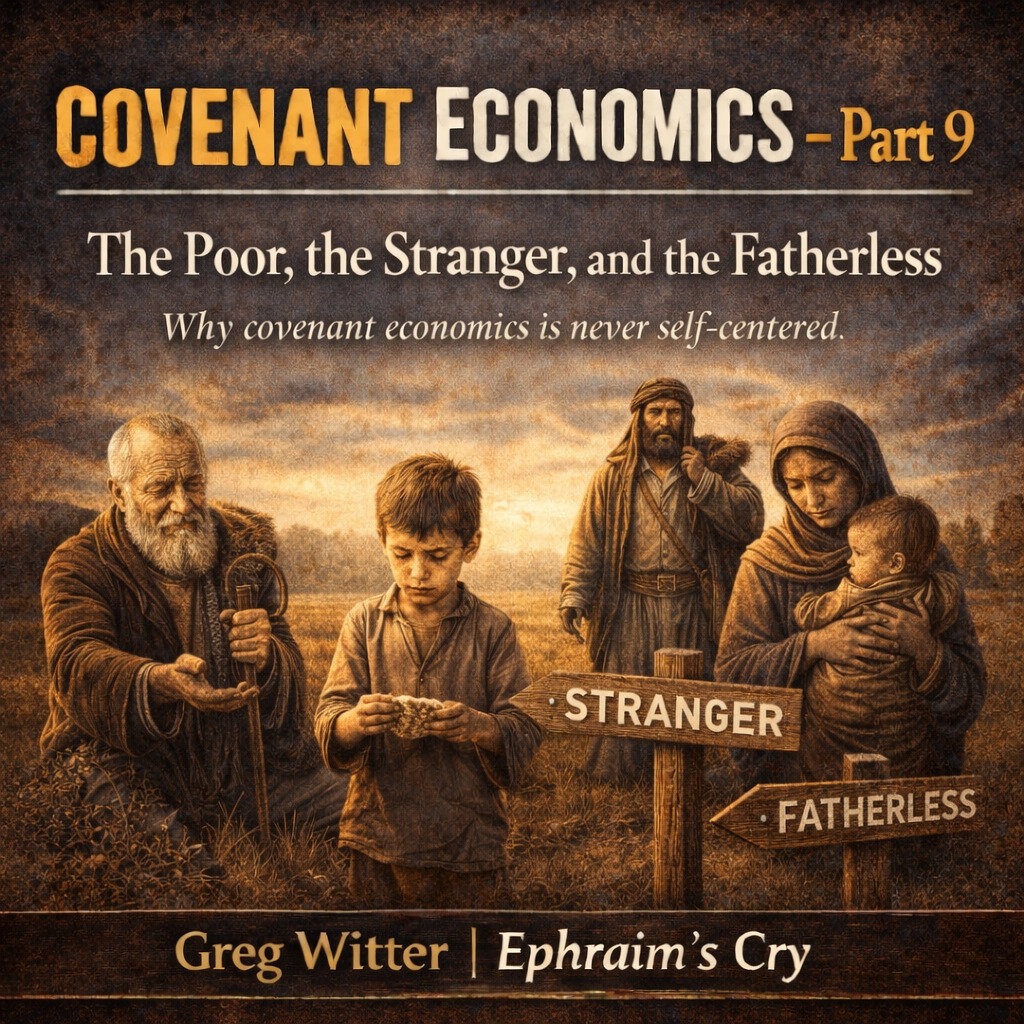
COVENANT ECONOMICS – Part 9
The Poor, the Stranger, and the Fatherless
Why covenant economics is never self-centered
Greg Witter | Ephraim’s Cry
Hebraic Mindset Study Series
Study • Learn • Apply • Grow • Share • Repeat
INTRODUCTION: COVENANT ECONOMICS HAS A FACE
Covenant economics is not theoretical. It has faces, names, and real human needs attached to it.
From beginning to end, Scripture makes one thing unmistakably clear: Yahuah’s economic order is never designed to enrich individuals at the expense of others. It is designed to preserve life, uphold justice, and protect the most vulnerable within the covenant community.
Any system of giving that forgets the poor, the stranger, and the fatherless has already departed from covenant truth—no matter how spiritual its language sounds.
YAHUAH’S HEART REVEALED THROUGH TORAH
Torah consistently reveals Yahuah’s concern for those without protection, inheritance, or power.
“You shall not afflict any widow or fatherless child.”
(Exodus 22:22)
“You shall love the stranger, for you were strangers in the land of Mitsrayim.”
(Deuteronomy 10:19)
The poor, the widow, the orphan, and the stranger are not peripheral concerns. They are central to covenant obedience. How Yasharal treated them was a direct measure of covenant faithfulness.
THE TITHE WAS NEVER ONLY ABOUT PRIESTS
While the tithe supported priestly labor, Scripture also makes clear that provision was intentionally structured to reach beyond the priesthood.
Every third year, a tithe was set aside specifically for:
the Levite
the stranger
the fatherless
the widow
“So that they may eat within your gates and be satisfied.”
(Deuteronomy 14:28–29)
This reveals a crucial truth: covenant economics includes social responsibility, not just religious maintenance.
GLEANING: BUILT-IN MERCY, NOT CHARITY
Torah did not rely on charity alone to care for the poor. It embedded mercy directly into economic practice.
Landowners were commanded to:
leave the edges of their fields
not gather everything
allow the poor and stranger to glean
This preserved dignity. The needy were not reduced to beggars; they were given access to provision through participation.
Covenant economics does not humiliate the vulnerable. It protects them.
THE PROPHETS AND THE MEASURE OF JUSTICE
The prophets repeatedly declared that neglecting the poor was not a social failure but a covenant violation.
“Is not this the fast that I have chosen… to share your bread with the hungry?”
(Isaiah 58)
Through Amos, Micah, and others, Yahuah condemns those who:
trample the poor
exploit the needy
enrich themselves while others suffer
Religious activity without justice is rejected outright.
MESSIAH AND THE CONTINUATION OF COVENANT CARE
Yahusha did not introduce concern for the poor; He reaffirmed it.
He identified with:
the hungry
the thirsty
the stranger
the naked
the sick
What is done—or neglected—toward them is treated as done toward Him (Matthew 25).
This is not metaphor. It is covenant accountability.
POVERTY IS NOT A MORAL FAILURE
Scripture never teaches that poverty equals laziness or lack of faith. It recognizes oppression, injustice, loss, and circumstance.
Yahuah consistently warns against systems that blame the poor while enriching the powerful.
Covenant economics does not ask: “Why don’t they have more?”
It asks: “How do we preserve life, dignity, and justice?”
GIVING THAT FLOWS FROM COVENANT ORDER
Covenantal giving:
follows provision, not pressure
protects households first
extends mercy outward
seeks restoration, not dependency
It is careful, discerning, and rooted in love of neighbor—not guilt or spectacle.
COVENANT ECONOMICS VS RELIGIOUS SELF-FOCUS
Covenantal economics:
remembers the vulnerable
distributes provision justly
values people over systems
reflects Yahuah’s character
Religious distortion:
hoards resources
prioritizes institutions
neglects real need
spiritualizes indifference
One reflects covenant faithfulness.
The other reflects hypocrisy.
WHY THIS MATTERS TODAY
Any modern expression of covenant economics must ask:
Are the poor being protected?
Are strangers welcomed or ignored?
Are the vulnerable exploited or upheld?
If the answer is wrong, the system is wrong—no matter how orthodox it claims to be.
Yahuah measures faithfulness not by accumulation, but by care.
CLOSING ORIENTATION
Covenant economics does not end with obedience to commands. It moves outward into justice, mercy, and compassion.
The tithe was never meant to stop at the altar. It was meant to reach the gates.
As this series draws near its conclusion, one final teaching remains—one that speaks directly to leadership, accountability, and judgment.
That will be addressed in COVENANT ECONOMICS – Part 10
Warnings, Accountability, and the Judgment of Shepherds.
HASHTAGS
#EphraimsCry#GregWitter#HebraicMindset#CovenantEconomics#CovenantalTithing
#CareForThePoor#JusticeAndMercy#TorahTruth#ScriptureOverTradition#KingdomOrder#FaithInAction#LoveYourNeighbor
See less
