
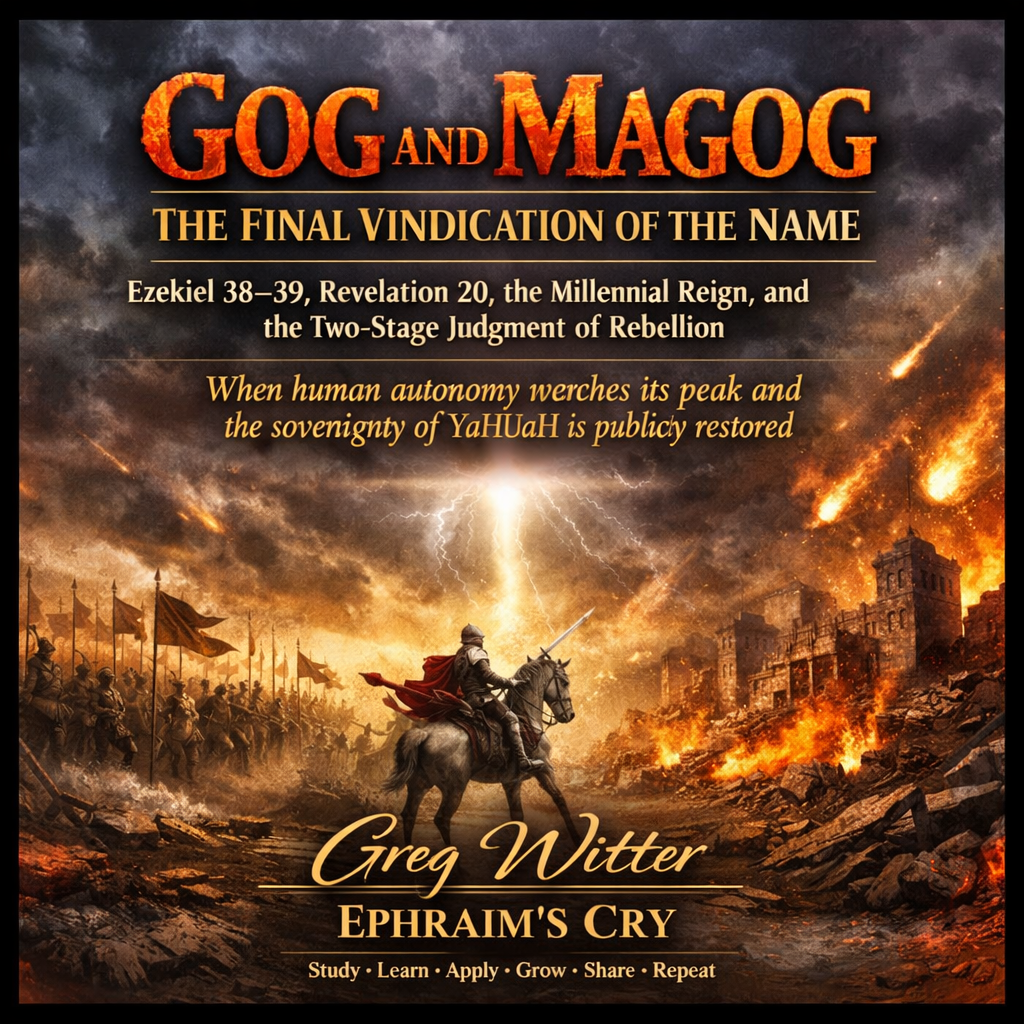
Gog and Magog: The Final Vindication of the Name
Ezekiel 38–39, Revelation 20, the Millennial Reign, and the Two-Stage Judgment of Rebellion
When human autonomy reaches its peak and the sovereignty of YaHUaH is publicly restored
Greg Witter | Ephraim’s Cry
Hebraic Mindset Study Series
Study • Learn • Apply • Grow • Share • Repeat
Orientation: Why Gog–Magog Is a Covenant Issue, Not a Curiosity
The Gog–Magog prophecy is not given to satisfy curiosity about the end of days. It is given to explain history, justify judgment, and reveal the final collision between human autonomy and divine authority. From Eden forward, Scripture has been documenting a single unresolved question: Can humanity rule itself apart from Elohim?
Gog–Magog is the final attempt to answer “yes.”
This prophecy sits at the intersection of covenant loyalty versus rebellion, Creator authority versus human self-rule, obedience versus autonomy, and the Name of YaHUaH versus man-madesystems.
It is not an isolated end-times event. It is the culmination of a trajectory that began at creation.
Prophecy in Scripture is covenantal, not speculative. Ezekiel is functioning as a covenant witness and prosecutor. Gog–Magog is presented as a public reckoning in which the nations are summoned, evidence is revealed, and judgment is rendered openly so that no accusation of injustice can stand.
The Eden Root: Autonomy as the Original Sin
The Gog–Magog spirit is not new. It is Edenic. In Genesis 3, the serpent’s temptation was not merely disobedience—it was autonomy: the promise that man could define truth and morality apart from Elohim.
“You shall be like Elohim, knowing good and evil.” (Genesis 3:5)
This was the original program of rebellion: self-rule, self-definition, self-authority. From that moment forward, Scripture traces how autonomy expands from the individual to the household, from the household to the city, from the city to the nation, and from the nation to the empire.
Babel unified humanity without submission, attempting centralized identity and security apart from YaHUaH (Genesis 11:1–9).
Egypt institutionalized autonomy against the Name, with Pharaoh directly confronting the authority of YaHUaH (Exodus 5:1–2).
Empires weaponized autonomy through power, law, and worship.
Modern global systems normalize autonomy through ideology, economics, and culture.
Gog–Magog is autonomy fully matured—militarized, globalized, and openly hostile to divine authority.
YaHUaH Initiates the Confrontation: “Hooks in Your Jaws”
One of the most critical details in Ezekiel 38 is that Gog’s rise is not portrayed as independent chaos beyond Elohim’s reach. YaHUaH speaks as the One who initiates the confrontation.
“I shall turn you around, put hooks into your jaws, and bring you out…” (Ezekiel 38:4)
This establishes sovereignty. Gog is being summoned into judgment. The rise of rebellion is not evidence of divine absence but of divine timing. Judgment is allowed to mature so that it can be publicly exposed and decisively answered.
Throughout Scripture, YaHUaH allows rebellion to rise to full expression before judgment falls. Partial exposure leaves room for excuse. Full exposure removes all defense.
Pharaoh was allowed to harden his heart so the power and Name of YaHUaH would be made known (Exodus 9:16).
Nations were allowed to rage so that their futility would be revealed (Psalm 2:1–6).
Gog is drawn forward so that human power can be shown incapable of standing against Elohim.
“In the Latter Days”: A Moral and Covenant Condition
Ezekiel repeatedly places this confrontation “in the latter days” (Ezekiel 38:8, 16). This phrase describes a covenant condition, not merely a date. The latter days are marked by normalized rebellion, dulled reverence, and widespread lawlessness.
Israel is described as regathered from many nations and dwelling in the land (Ezekiel 38:8), yet the world around her remains hostile. Nations still rage. Organized rebellion still exists. Security is assumed but not guaranteed.
This aligns with the warnings of YaHUsHaʽ that the end would resemble the days of Noah—ordinary life continuing while judgment approaches (Matthew 24:37–39). Wars, deception, and lawlessness increase, while many assume accountability has been escaped (Matthew 24:6, 11–12).
Gog rises in a world convinced that judgment will never come.
The Central Purpose: The Vindication of the Name of YaHUaH
Ezekiel does not leave the purpose of the Gog–Magog confrontation to interpretation. YaHUaH states it plainly and repeatedly.
“And I shall magnify Myself and set Myself apart, and I shall be known in the eyes of many nations. And they shall know that I am YaHUaH.” (Ezekiel 38:23)
The Gog–Magog war exists for the public vindication of the Name. This event is not centered on Gog, military strategy, or geopolitical dominance. It is centered on the restoration of divine authority in the sight of the nations.
The Name of YaHUaH has been suppressed, replaced, diluted, and obscured. Titles have displaced identity. Commandments have been rebranded as optional. Obedience has been redefined as legalism. Covenant has been reduced to sentiment.
Gog represents the climax of this rejection. It is the moment when humanity, confident in systems, power, and alliances, rises openly against the authority of Elohim. The judgment that follows answers the question the nations have been asking since Eden: Who truly reigns?
The outcome leaves no ambiguity. YaHUaH is set apart. His Name is restored to visibility. His authority is established beyond dispute.
Where YaHUsHaʽ the Messiah Fits
Though YaHUsHaʽ is not named directly in Ezekiel 38–39, He is inseparably connected to the fulfillment of the prophecy. Ezekiel describes the judgment itself. Revelation reveals the One through whom that judgment is executed.
Ezekiel records divine intervention from the heavens—pestilence, flooding rain, hailstones, fire, and sulfur (Ezekiel 38:22). He describes confusion among the armies, brother turning against brother, and a victory not achieved by Israel’s strength (Ezekiel 38:21).
Revelation identifies the returning Messiah as the righteous Judge who carries out this authority.
“And I saw heaven opened, and see, a white horse. And He who sat on it was called Trustworthy and True, and in righteousness He judges and fights.” (Revelation 19:11)
YaHUsHaʽ is revealed as the visible manifestation of YaHUaH’s judgment. Grace delayed judgment to allow repentance. Grace did not cancel judgment. The same Messiah who proclaimed mercy and forgiveness now returns to establish righteousness and justice upon the earth.
This aligns with the consistent testimony of Scripture that YaHUaH judges the world through the Son (Acts 17:31).
How This Reflects on Us Today
The Gog–Magog prophecy is not only future-oriented. It exposes a present reality. The conditions Ezekiel describes are already visible: regathering, global hostility toward righteousness, moral inversion, and widespread resistance to divine authority.
Truth is labeled intolerance. Obedience is dismissed as extremism. Lawlessness is normalized. Systems promise security while removing accountability to Elohim.
Ezekiel reveals that YaHUaH cleanses His people in conjunction with this confrontation.
“And I shall not hide My face from them any longer, for I shall have poured out My Spirit on the house of Yisra’ĕl.” (Ezekiel 39:29)
The outpouring of the Spirit does not abolish covenant standards. It restores them.
“And I shall put My Spirit within you, and cause you to walk in My laws and guard My right-rulings and do them.” (Ezekiel 36:27)
The Spirit is given to produce obedience, not exemption. This directly contradicts teachings that claim spiritual empowerment replaces covenant faithfulness. Scripture presents the Spirit as the means by which YaHUaH brings His people back into alignment.
Judgment begins with the house of Elohim (1 Peter 4:17). Before the nations are confronted, the remnant is refined.
Trust in YaHUaH, Not in Systems
Gog’s defeat exposes the weakness of every human system. Military power fails. Political alliances collapse. Economic leverage proves useless. Technology cannot prevent judgment.
“Do not trust in princes, nor in the son of man, in whom there is no salvation.” (Psalm 146:3)
This is not a rejection of governance; it is a rejection of idolatry. Systems become idols when they are trusted to deliver what only YaHUaH can provide. Gog represents a world that has placed ultimate trust in human capability. Its destruction proves the futility of that trust.
Timing Clarified: Ezekiel 38–39 Before the Millennial Reign
The Gog–Magog conflict recorded in Ezekiel 38–39 takes place before the Millennial Reign of YaHUsHaʽ. The text itself establishes this through its details and conditions.
Israel is regathered from many nations and dwelling in the land (Ezekiel 38:8), yet the world remains in its present fallen state. Death still exists. Warfare still exists. Nations still act in rebellion. The Kingdom of Messiah has not yet been fully established on the earth.
After the defeat of Gog, Ezekiel records extended, time-bound processes:
“And those who dwell in the cities of Yisra’ĕl shall go out and set on fire and burn the weapons… and they shall burn them for seven years.” (Ezekiel 39:9)
“And for seven months the house of Yisra’ĕl shall be burying them, in order to cleanse the land.” (Ezekiel 39:12)
Men are appointed to continually pass through the land searching for remaining bones (Ezekiel 39:14–15). These activities require time, decay, death, and ceremonial cleansing—conditions that do not exist during the Millennial Reign or in the renewed creation.
This confrontation serves a preparatory purpose. It humbles the nations. It exposes the emptiness of human power. It vindicates the Name of YaHUaH in the sight of the world before the return and reign of Messiah described in Revelation 19.
This aligns with the words of YaHUsHaʽ, who spoke of wars, deception, and global upheaval before His return, not after His Kingdom is established (Matthew 24:6–14).
Timing Clarified: Revelation 20 After the Millennial Reign
A second confrontation identified as “Gog and Magog” occurs after the thousand-year reign of Messiah.
“And when the thousand years have ended, Satan shall be released from his prison, and shall go out to deceive the nations which are in the four corners of the earth, Gog and Magog…” (Revelation 20:7–8)
This event is fundamentally different from Ezekiel’s prophecy. Messiah has already ruled. Torah has gone forth from Zion. Justice has been enforced. Peace has been demonstrated under righteous governance.
There is no extended battle. There is no cleanup. There is no burial of bodies. Fire comes down from Elohim and devours the rebels immediately (Revelation 20:9).
This is not a warning. This is not preparation. This is final judgment.
Immediately afterward, Satan is cast into the lake of fire (Revelation 20:10), followed by the Great White Throne judgment (Revelation 20:11–15). Rebellion is permanently ended.
The name “Gog and Magog” here is representative. It identifies the final global expression of the same rebellious spirit, not a repetition of Ezekiel’s military campaign.
Why Satan Is Released Again
The release of Satan after the Millennial Reign answers a foundational question that has existed since Eden: is rebellion caused by environment or by the human heart?
During the thousand years, the earth experiences righteous governance. Messiah rules with justice (Isaiah 9:6–7). Torah is taught and enforced (Isaiah 2:2–4). Deception is restrained (Revelation 20:1–3). Peace is established.
Yet when Satan is released, rebellion resurfaces immediately.
This reveals that rebellion is not the result of circumstances, oppression, or lack of knowledge. It is the result of an unsubmitted heart. Even perfect conditions cannot produce loyalty where obedience is refused.
This final rebellion vindicates the justice of Elohim. No one can claim ignorance. No one can claim unfairness. Judgment is rendered after every excuse has been removed.
Purification Before Vindication
Before judgment falls on the nations, YaHUaH restores and purifies His people.
“And I shall not hide My face from them any longer, for I shall have poured out My Spirit on the house of Yisra’ĕl.” (Ezekiel 39:29)
The outpouring of the Spirit restores covenant obedience.
“And I shall put My Spirit within you, and cause you to walk in My laws and guard My right-rulings and do them.” (Ezekiel 36:27)
The Spirit does not replace Torah. The Spirit writes Torah on the heart and empowers obedience. This stands in direct opposition to teachings that claim spiritual empowerment removes covenant responsibility.
Judgment begins with the house of Elohim (1 Peter 4:17). The remnant is refined before the nations are confronted. Obedience is restored before rebellion is judged.
System Collapse: Why Nothing Human Survives
The defeat of Gog exposes the ultimate weakness of every human system. Military strength fails. Political alliances fracture. Economic power proves useless. Technology offers no refuge. None of these can stand when covenant judgment is executed by YaHUaH.
“Do not trust in princes, nor in the son of man, in whom there is no deliverance.” (Psalm 146:3)
Gog represents a world that has invested ultimate trust in human capability. The judgment demonstrates that no structure built on autonomy can endure. Power without submission collapses. Unity without covenant disintegrates. Security without obedience is revealed as illusion.
This judgment is not arbitrary. It is revelatory. It shows the nations that salvation does not come from systems, but from submission to the authority of YaHUaH. When human strength is stripped away, the truth becomes undeniable: deliverance belongs to Elohim alone.
Gog as a Heart Posture
Gog is not only a future geopolitical enemy. Gog is a heart posture. It is the disposition that resists authority, redefines obedience, and seeks autonomy while still claiming blessing.
The spirit of Gog manifests wherever people desire the benefits of covenant without the submission of covenant. It appears in selective obedience, conditional allegiance, and resistance to correction. It is the same spirit that says, “We will decide for ourselves,” even while invoking the Name.
Every generation must confront this choice.
“Choose this day whom you serve.” (Joshua 24:15)
Neutrality does not exist in covenant. Silence is alignment. Delay is decision. Refusal to submit is itself rebellion.
Final Synthesis: Two Judgments, One Message
Ezekiel’s Gog–Magog confrontation occurs before the Millennial Reign. It publicly vindicates the Name of YaHUaH in the sight of the nations and prepares the way for the Kingdom of Messiah.
Revelation’s Gog–Magog confrontation occurs after the Millennial Reign. It permanently eradicates rebellion after righteousness has been fully demonstrated.
Together, these two events declare a single, unchanging truth:
YaHUaH reigns.
YaHUsHaʽ rules.
Rebellion is temporary.
Covenant faithfulness endures.
The nations are given opportunity. The nations are shown truth. The nations are judged only after every excuse has been removed.
Final Watchman Charge
This prophecy was not given so that dates could be calculated or armies identified. It was given so that allegiance could be settled before judgment arrives.
The Gog–Magog spirit is already present in the world. Autonomy is celebrated. Obedience is mocked. Truth is redefined. Systems promise security while removing accountability to Elohim.
The question is not when the war comes. The question is where you stand before it does.
There will be no middle ground.
There will be no revision of truth.
There will be no refuge in systems.
Only the Name will stand.
#GregWitter, #EphraimsCry, #HebraicMindset, #GogAndMagog, #Ezekiel38, #Ezekiel39, #Revelation20, #MillennialReign, #YaHUaH, #YaHUsHa, #CovenantFaithfulness, #TorahTruth, #Remnant,
