
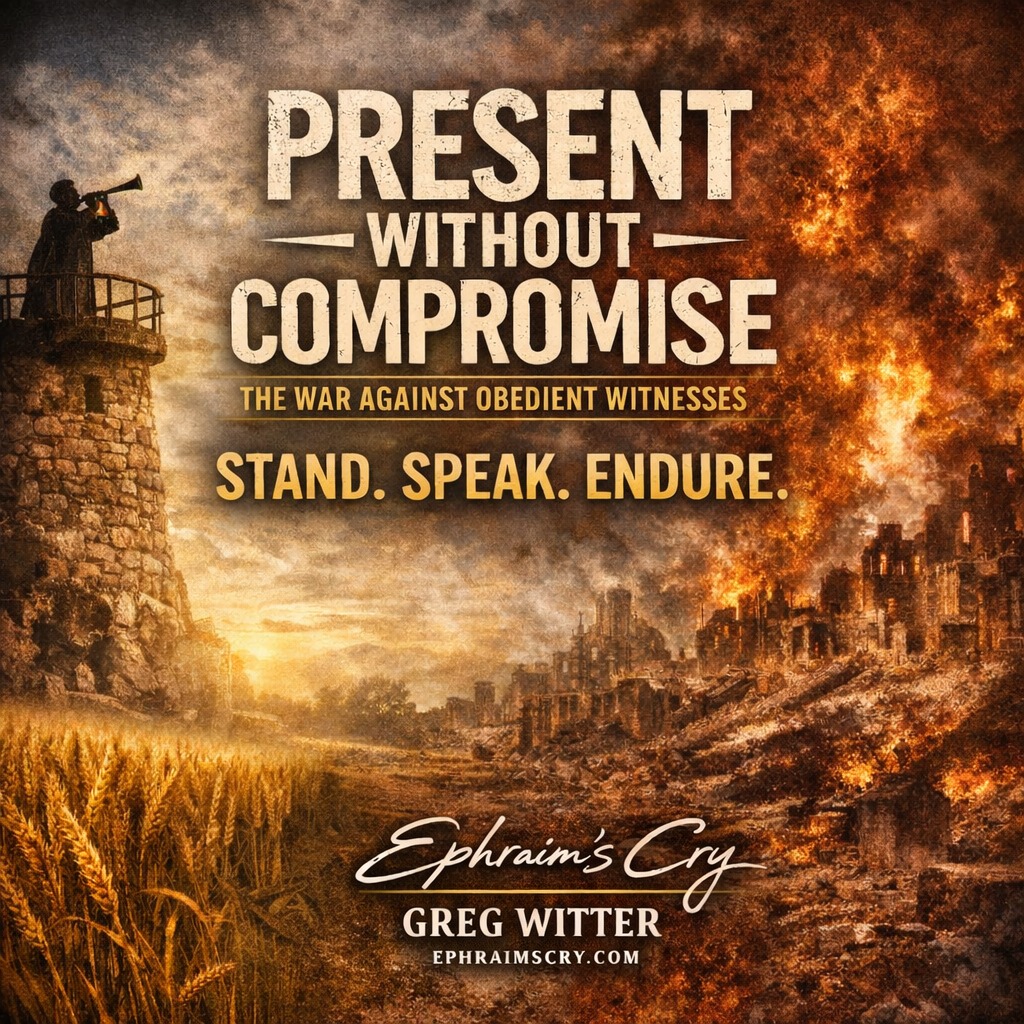
Present Without Compromise
Presence, Witness, the Great Commission, the Final Harvest, and the War Against Obedient Witnesses
Greg Witter | Ephraim’s Cry
Hebraic Mindset Study Series
Study • Learn • Apply • Grow • Share • Repeat
The Urgency of This Hour — How This Teaching Was Born
This teaching did not come from a study outline, a scheduled writing session, or an academic exercise. It came today, in real time, under the weight of urgency and responsibility.
This is the first day of the week.
It is 6:25 a.m. as these words are being written.
I did not simply wake up with an idea. I have been awake with this, turning it over and over in my mind and spirit since approximately 2:30 this morning. This was not a fleeting thought. It was not something I could dismiss or set aside. It pressed in repeatedly, returning again and again with increasing clarity and insistence.
The situation I was meditating on involved real people, real circumstances, and real consequences. It was not theoretical. It was not abstract. And the questions I kept bringing before Father were not intellectual questions. They were covenant questions:
What is my part in this?
How am I supposed to deal with this rightly?
What does obedience look like here?
How do I help without compromising truth—and without retreating from responsibility?
I was not asking for a clever strategy. I was not looking for a way to avoid conflict or discomfort. I was asking for alignment—alignment with Father’s will, alignment with Scripture, alignment with the mission Yahusha entrusted to His people.
And what Father began to do in those early hours was not to give me a new instruction, but to expose a false assumption—an assumption so common, so normalized, that many sincere believers never question it.
What He exposed was this:
Holiness has been confused with hiding.
Separation has been confused with absence.
Silence has been mistaken for wisdom.
Once this was exposed, Scripture began to align rapidly. Not as isolated proof texts, but as a unified testimony. Verses I have known for years began to lock together in a way that revealed a much larger picture—one that carries direct implications for how we live, how we witness, how we endure opposition, and how we prepare for the coming Kingdom.
This teaching is the result of that alignment. It is not reactionary. It is not emotional. It is covenantal, Scriptural, and urgent.
Separation Is Biblical — Withdrawal Is Not
Scripture absolutely commands separation. There is no debate about that. The issue is how separation has been redefined, particularly in modern religious thinking.
From Genesis to Revelation, separation has never meant abandoning people. It has never meant retreating from the world. It has always meant remaining loyal to Yahuah in the midst of corruption, pressure, and opposition.
Joseph was not removed from Egypt. He was positioned within it, and his faithfulness preserved life for many (Genesis 39–41).
Daniel was not removed from Babylon. He was faithful within it, and through his obedience, the authority of Babylon was confronted by the power of Elohim (Daniel 1–6).
Esther was not removed from Persia. She was placed within it, “for such a time as this,” to intercede and deliver her people (Esther 4:14).
In every case, presence preceded deliverance.
Faithfulness did not require absence. It required obedience under pressure.
This pattern reaches its clearest expression in Yahusha’s own words during His prayer in John 17:
“They are not of the world, just as I am not of the world.” (John 17:16)
That statement is often quoted—and rightly so. But it is almost always quoted without the surrounding context, which is where its full meaning is found:
“I do not pray that You should take them out of the world, but that You should keep them from the evil one.” (John 17:15)
And Yahusha explains why the tension exists:
“I have given them Your word; and the world has hated them because they are not of the world.” (John 17:14)
These verses must be held together. They cannot be separated without distortion.
We are not of the world—its systems, its values, its lawlessness, its rebellion, its false authority.
But we are intentionally left in the world, sent into it, and commanded to stand as witnesses within it.
John reinforces this balance when he warns:
“Do not love the world or the things in the world… the world is passing away, and the lust of it; but he who does the will of Elohim abides forever.” (1 John 2:15–17)
Rejecting the world’s system does not mean abandoning the people trapped within it. It means refusing allegiance while remaining present as testimony.
Light Was Never Meant to Be Protected — It Was Meant to Shine
Yahusha does not speak ambiguously about the purpose of light. His words are direct and functional:
“You are the light of the world. A city that is set on a hill cannot be hidden.” (Matthew 5:14)
Light, by definition, is meant to be seen. A city on a hill is visible precisely because it cannot hide itself.
Yahusha continues:
“Nor do they light a lamp and put it under a basket, but on a lampstand.” (Matthew 5:15)
The act of hiding light is portrayed not as humility, but as misuse. Light hidden under a basket still exists, but it fails to fulfill its purpose.
And Yahusha makes the command explicit:
“Let your light so shine before men, that they may see your good works and glorify your Father in heaven.” (Matthew 5:16)
Mark records the same teaching with equal clarity:
“Is a lamp brought to be put under a basket or under a bed? Is it not to be set on a lampstand?” (Mark 4:21)
Luke confirms it again:
“No one, when he has lit a lamp, covers it with a vessel or puts it under a bed, but sets it on a lampstand, that those who enter may see the light.” (Luke 8:16)
Light that refuses visibility is light in disobedience to its calling. A witness who hides silences the testimony entrusted to them.
This is why darkness reacts so strongly to visible obedience. Yahusha explains:
“This is the judgment, that the light has come into the world, and men loved darkness rather than light, because their deeds were evil.” (John 3:19)
Darkness does not fear private belief.
Darkness fears public obedience.
Salt, Decay, and the Cost of Contact
Yahusha pairs light with salt intentionally:
“You are the salt of the earth.” (Matthew 5:13)
Salt is not decorative. It is preservative. Its purpose is to restrain decay.
Mark records Yahusha’s instruction this way:
“Have salt in yourselves.” (Mark 9:50)
Salt only preserves through contact. Salt sealed away remains pure, but decay spreads unchecked. A theology that prioritizes personal safety over communal preservation misunderstands the purpose of salt entirely.
Withdrawal does not stop corruption.
Presence restrains it.
This is not optional. This is function.
Light Exposes Darkness — and Exposure Is a Command, Not an Option
One of the greatest misunderstandings in modern faith practice is the idea that exposure is optional, confrontational, or unloving. Scripture presents exposure not as aggression, but as obedience.
Yahusha did not describe light merely as something that exists; He described it as something that reveals.
“This is the judgment, that the light has come into the world, and men loved darkness rather than light, because their deeds were evil.” (John 3:19)
Light reveals reality. Darkness depends on concealment. The conflict between the two is not emotional; it is functional.
Yahusha continues:
“For everyone practicing evil hates the light and does not come to the light, lest his deeds should be exposed.” (John 3:20)
Notice the cause-and-effect structure. Hatred does not arise because light is cruel. Hatred arises because light reveals.
Paul removes any remaining ambiguity and turns this into an instruction:
“Have no fellowship with the unfruitful works of darkness, but rather expose them.” (Ephesians 5:11)
This is not a suggestion. It is not conditional. It is a command.
Paul then explains the mechanism:
“But all things that are exposed are made manifest by the light, for whatever makes manifest is light.” (Ephesians 5:13)
Exposure is not optional for those who walk in the light. If light is present, exposure occurs. If exposure never occurs, the light has either been hidden or removed.
This is why withdrawal is not neutral. Silence does not preserve peace; it preserves darkness.
Yahusha’s Model: Presence Without Participation
Yahusha is the pattern. Not the exception. Not the idealized version. The actual lived model.
Scripture repeatedly emphasizes that Yahusha entered contested spaces intentionally.
“And He went into the synagogue on the Sabbath day, as His custom was.” (Luke 4:16)
The synagogue was not neutral ground. It was the center of religious authority, tradition, and often resistance to truth. Yet Yahusha went there consistently.
“And Yahusha went about all Galilee, teaching in their synagogues, preaching the gospel of the Kingdom.” (Matthew 4:23)
He did not preach in isolation. He preached where people already were—where false teaching, partial truth, and hardened tradition existed.
He spoke openly:
“I spoke openly to the world. I always taught in synagogues and in the temple, where the Jews always meet, and in secret I have said nothing.” (John 18:20)
Public truth invites public reaction.
And when accused of association:
“This Man receives sinners and eats with them.” (Luke 15:2)
Yahusha did not deny the accusation. He corrected the misunderstanding:
“Those who are well have no need of a physician, but those who are sick.” (Luke 5:31)
“I have not come to call the righteous, but sinners, to repentance.” (Luke 5:32)
He was present not to affirm sin, but to confront it. Presence did not equal participation. Presence enabled repentance.
This distinction is critical.
Withdrawal removes the opportunity for repentance.
Presence creates it.
Why Yahusha Was Hated — and Why His Followers Will Be Also
Yahusha never promised acceptance. He promised opposition.
“If the world hates you, know that it hated Me before it hated you.” (John 15:18)
Hatred is not the evidence of error. Often, it is the evidence that truth has been spoken clearly enough to expose lies.
Yahusha explains further:
“If you were of the world, the world would love its own. Yet because you are not of the world… therefore the world hates you.” (John 15:19)
The issue is allegiance.
Light that blends in is tolerated.
Light that exposes is resisted.
This is why Yahusha warned His disciples in advance:
“You will be hated by all for My name’s sake.” (Matthew 24:9)
Not some. Not a few. All.
This is not pessimism. It is preparation.
Sha’ul: Reasoned Truth in Hostile Territory
Sha’ul did not retreat from hostility. He entered it equipped with Scripture.
“Then Sha’ul, as his custom was, went in to them, and for three Sabbaths reasoned with them from the Scriptures.” (Acts 17:2)
The word reasoned implies structured argument, evidence, explanation, and proof. This was not emotional debate. This was Scriptural exposition.
Luke records the effect:
“But the Jews who were not persuaded, becoming envious, took some of the evil men from the marketplace, and gathering a mob, set all the city in an uproar.” (Acts 17:5)
Truth spoken clearly provoked reaction.
Yet Sha’ul did not interpret this as failure. He understood it as confirmation that truth had landed.
He continued:
“He reasoned in the synagogue every Sabbath, and persuaded both Jews and Greeks.” (Acts 18:4)
And when resistance hardened:
“But when they opposed him and blasphemed…” (Acts 18:6)
Opposition did not cause retreat. It clarified direction.
Sha’ul understood urgency:
“And do this, knowing the time, that now it is high time to awake out of sleep.” (Romans 13:11)
Sleep in Scripture is disengagement. It is passivity in a time that demands alertness.
The Watchman Mandate: Silence Is Never Neutral
Scripture assigns responsibility to those who see clearly.
“If the watchman sees the sword coming and does not blow the trumpet… his blood I will require at the watchman’s hand.” (Ezekiel 33:6)
The issue is not whether the people listen. The issue is whether the warning is given.
Yahuah reinforces the calling:
“So you, son of man: I have made you a watchman… therefore you shall hear a word from My mouth and warn them from Me.” (Ezekiel 33:7)
A watchman who leaves the wall because the city is corrupt is not holy. He is negligent.
Presence is required for warning.
Proximity is required for proclamation.
This is why withdrawal is not merely a personal choice. It has covenant consequences.
The Pattern Is Consistent: Truth Is Public, Resistance Is Inevitable
Throughout Scripture, the pattern remains unchanged:
Truth enters space.
Truth exposes error.
Error resists exposure.
Witness endures.
This is not a flaw in the system. This is the system.
Paul warned Timothy:
“For the time will come when they will not endure sound doctrine.” (2 Timothy 4:3)
His instruction was not to withdraw:
“Preach the word! Be ready in season and out of season. Convince, rebuke, exhort, with all longsuffering and teaching.” (2 Timothy 4:2)
Presence “out of season” is part of the calling.
“Come Out of Her, My People” — What It Means and What It Does Not Mean
Few commands in Scripture are quoted more often—and misunderstood more deeply—than this one:
“Come out of her, My people, lest you share in her sins, and lest you receive of her plagues.” (Revelation 18:4)
This command is not whispered. It is proclaimed. It is not vague. It is deliberate. And it sits directly within the context of judgment, witness, and allegiance.
Yet for many, “come out of her” has been redefined to mean:
withdraw from society
disengage from people
isolate for safety
retreat to preserve purity
Scripture does not support this interpretation.
The text itself defines the issue plainly:
participation in sin, not proximity to sinners.
The command does not say “come away from people.”
It says “come out of her”—out of Babylon, out of her system, out of her authority, out of her deception.
Babylon Is a System, Not a Location
Babylon in Revelation is not merely a city. It is a world-order system—religious, economic, political, and cultural.
“She has become a dwelling place of demons, a prison for every foul spirit…” (Revelation 18:2)
Notice the language. Babylon is a dwelling place, not a hiding place. It is active, influential, pervasive.
Babylon:
shapes belief
normalizes compromise
rewards conformity
punishes obedience
disguises deception as righteousness
You do not leave Babylon by changing geography.
You leave Babylon by changing allegiance.
This is why people can physically withdraw and still be fully aligned with Babylon’s mindset, values, and authority.
Israel Was Called Out — and Sent Back In
Scripture consistently shows that “coming out” does not equal disappearing.
Israel was called out of Egypt — but Moses was sent back in (Exodus 3–12).
Daniel was faithful — inside Babylon (Daniel 1–6).
Esther was positioned — inside Persia (Esther 4:14).
Joseph ruled — inside Egypt (Genesis 41).
If “come out” meant total withdrawal, none of these figures would have fulfilled their calling.
Separation in Scripture is always covenantal, not geographic.
False Separation Is One of Babylon’s Most Effective Deceptions
This is where the deception becomes subtle and dangerous.
Babylon does not always persecute truth directly.
Sometimes Babylon encourages withdrawal.
Why?
Because:
a silent witness is no witness
a hidden light exposes nothing
a retreating watchman blows no trumpet
Babylon is not threatened by believers who isolate. Babylon is threatened by believers who:
refuse participation
reject compromise
remain present
speak truth
expose lies
This is why Yahusha prayed:
“I do not pray that You should take them out of the world.” (John 17:15)
Removal neutralizes testimony.
“Come Out” Is a Call to Covenant Loyalty, Not Covenant Absence
Paul addresses this misunderstanding directly:
“I wrote to you not to keep company with immoral people—yet not altogether with the immoral people of this world… since then you would need to go out of the world.” (1 Corinthians 5:9–10)
Paul draws a clear distinction:
Do not participate in sin
Do not withdraw from people
You cannot obey Scripture by leaving the world.
You obey Scripture by remaining loyal to Yahuah while standing inside it.
To “come out of her” means:
reject Babylon’s authority
refuse her doctrine
separate from her values
resist her pressures
refuse her worship
expose her lies
All while remaining present as testimony.
The Call to “Come Out” Precedes Judgment — Not Escape
Revelation does not show Babylon destroyed quietly or suddenly without warning.
The call to “come out” is issued before judgment falls.
This matters.
Why call people out if there is no witness left?
Why warn if everyone has already withdrawn?
Because the call itself is part of the final witness.
“And this gospel of the Kingdom will be preached in all the world as a witness… and then the end will come.” (Matthew 24:14)
The call to come out of Babylon is not an evacuation order.
It is a final summons to allegiance before judgment.
That summons requires voices.
It requires presence.
It requires proclamation.
Babylon Falls After the Witness Is Complete
Revelation is structured intentionally.
First comes testimony.
Then comes separation of allegiance.
Then comes judgment.
Babylon is exposed before she is destroyed.
This means:
truth must still be spoken
lies must still be exposed
people must still be warned
disciples must still be gathered
Withdrawal before testimony is complete works against the very purpose of Revelation.
“Come Out of Her” and the Remnant Identity
Revelation identifies exactly who obeys this call correctly:
“The dragon was enraged… and went to make war with those who keep the commandments of Elohim and have the testimony of Yahusha Messiah.” (Revelation 12:17)
These are not hidden saints.
They are not silent believers.
They are obedient, visible, testifying witnesses.
And again:
“Here are those who keep the commandments of Elohim and the faith of Yahusha.” (Revelation 14:12)
Obedience plus testimony requires presence.
Why This Matters Now
The misunderstanding of “come out of her” has caused many sincere believers to:
retreat instead of testify
hide instead of proclaim
preserve comfort instead of gather harvest
delay obedience in the name of caution
This is not discernment.
This is deception.
The command is not to disappear.
The command is to stand apart while standing present.
The Great Commission Is Not Optional — and It Cannot Be Fulfilled from Hiding
At this point in the teaching, the issue becomes unavoidable. If presence is required for witness, and witness is required for obedience, then the Great Commission settles the matter decisively.
Yahusha did not frame the Great Commission as a suggestion, a future task, or a role reserved for a few. He issued it as a command tied directly to authority, obedience, and the unfolding of the Kingdom.
“All authority has been given to Me in heaven and on earth. Go therefore and make disciples of all nations…” (Matthew 28:18–19)
Notice the structure. Authority is established first. Then movement is commanded.
“Go” is not metaphorical.
“Go” is not internal.
“Go” is directional, active, and outward.
Yahusha continues:
“…teaching them to observe all that I have commanded you.” (Matthew 28:20)
This is not belief-only conversion. This is obedience-based discipleship. Teaching people to observe requires relationship, instruction, correction, modeling, and endurance. None of that happens from isolation.
Mark records the same commission even more plainly:
“Go into all the world and preach the gospel to every creature.” (Mark 16:15)
You cannot go into the world while hiding from it.
You cannot preach to people you refuse to engage.
You cannot disciple from retreat.
Withdrawal does not preserve obedience. It obstructs it.
The Gospel Yahusha Commanded Is the Gospel of the Kingdom
The Great Commission is inseparable from the content of the message. Yahusha did not leave the gospel undefined.
“And Yahusha went about all Galilee, teaching in their synagogues, preaching the gospel of the Kingdom.” (Matthew 4:23)
Later, He made His mission unmistakable:
“I must preach the Kingdom of Elohim to the other cities also, because for this purpose I have been sent.” (Luke 4:43)
The gospel Yahusha preached was not a gospel of escape.
It was not a gospel of lawlessness.
It was not a gospel of comfort.
It was the Gospel of the Kingdom—a call to repentance, allegiance, obedience, and transformation under the reign of Elohim.
This is why Yahusha said:
“Not everyone who says to Me, ‘Master, Master,’ shall enter the Kingdom of heaven, but he who does the will of My Father in heaven.” (Matthew 7:21)
Kingdom entry is tied to obedience, not confession alone.
Sha’ul Preached the Same Gospel — Not a Different One
Sha’ul did not replace Yahusha’s message. He carried it forward.
Luke summarizes Sha’ul’s ministry this way:
“Preaching the Kingdom of Elohim and teaching the things which concern the Master Yahusha Messiah with all confidence.” (Acts 28:31)
Paul himself describes his message:
“Testifying… repentance toward Elohim and faith toward our Master Yahusha Messiah.” (Acts 20:21)
Repentance implies change.
Faith implies allegiance.
Both imply obedience.
Any gospel that removes obedience, dismisses Torah, or reframes grace as permission is a counterfeit and must be exposed.
This is why exposure is not optional. A false gospel produces false disciples, and false disciples do not inherit the Kingdom.
The Great Commission Is a Prophetic Requirement Before the End
This is where urgency becomes unavoidable.
Yahusha ties the completion of the Great Commission directly to the end of the age:
“And this gospel of the Kingdom will be preached in all the world as a witness to all the nations, and then the end will come.” (Matthew 24:14)
The end does not come simply because time passes.
The end comes after the witness is completed.
This means:
proclamation is not optional
presence is not optional
testimony is not optional
Withdrawal does not speed the end.
Withdrawal delays fulfillment.
If the gospel must be preached to all nations before the end comes, then hiding is not holiness—it is obstruction.
We Are Participants in Prophecy, Not Spectators
Many speak of prophecy as though it unfolds independently of obedience. Scripture does not support this.
The Great Commission is not merely instruction—it is prophetic participation.
We are not waiting for prophecy to happen.
We are inside prophecy as it unfolds.
This is why Sha’ul warned:
“And do this, knowing the time, that now it is high time to awake out of sleep.” (Romans 13:11)
Sleep is disengagement.
Awakening is obedience.
This is not the time to step back.
This is the time to stand present, proclaim boldly, and endure faithfully.
Why Withdrawal Directly Opposes Yahusha’s Command
When believers withdraw under the banner of “separation,” several things happen simultaneously:
The gospel of the Kingdom is silenced
Discipleship ceases
False gospels go unchallenged
Darkness spreads unchecked
Babylon remains unexposed
This is not neutrality. This is surrender of ground.
Yahusha never authorized retreat. He authorized endurance.
“In the world you will have tribulation; but be of good cheer, I have overcome the world.” (John 16:33)
Overcoming requires engagement.
Presence Is Required for Discipleship
Disciples are not formed through distance.
Discipleship requires:
time
teaching
correction
example
endurance
Paul reminded the Corinthians:
“Imitate me, just as I also imitate Messiah.” (1 Corinthians 11:1)
Imitation requires proximity.
This is why the Great Commission cannot be fulfilled through withdrawal, isolation, or silence.
The Final Harvest — Why This Hour Demands Presence, Not Delay
At this point, the teaching must move beyond correction and instruction into purpose. Presence is not required merely to expose deception or confront falsehood. Presence is required because this is harvest time.
Yahusha framed this long before Revelation ever described Babylon’s fall:
“The harvest truly is plentiful, but the laborers are few.” (Matthew 9:37)
Notice what Yahusha does not say.
He does not say the harvest is immature.
He does not say the harvest is not ready.
He does not say the harvest is delayed.
He says it is plentiful.
The issue is not readiness.
The issue is laborers.
And then He gives instruction:
“Therefore pray the Master of the harvest to send out laborers into His harvest.” (Matthew 9:38)
This prayer is not symbolic. It is operational. When this prayer is answered, laborers are sent—not hidden, not sheltered, not isolated.
Laborers are placed in the field.
“The Fields Are White” — Harvest Is Now, Not Later
Yahusha intensifies the urgency:
“Do you not say, ‘There are still four months and then comes the harvest’? Behold, I say to you, lift up your eyes and look at the fields, for they are already white for harvest!” (John 4:35)
This statement dismantles delay theology.
The natural tendency is to say:
“Not yet.”
“Later.”
“When things settle.”
“When it’s safer.”
“When people are more receptive.”
Yahusha says: Now.
White fields do not wait. White fields spoil if neglected.
Harvest postponed is harvest lost.
Why Presence Is Essential to Harvest
Harvest cannot be gathered from a distance.
Reaping cannot occur from isolation.
Laborers do not work from hiding.
Yahusha continues:
“And he who reaps receives wages, and gathers fruit for eternal life.” (John 4:36)
This is eternal economics. What is gathered now echoes into eternity.
This is why withdrawal is not a personal decision—it is a Kingdom-impacting decision.
When believers withdraw:
fields remain unreaped
souls remain unwarned
deception remains unchallenged
Babylon’s influence grows unchecked
Presence is not optional during harvest. It is foundational.
This Teaching Is That Prayer Being Answered
When Yahusha instructed His disciples to pray for laborers, He was not asking for words alone. He was initiating response.
What Father impressed during those early hours—between 2:30 a.m. and 6:25 a.m.—was not theoretical clarity. It was mobilization.
This teaching is not merely explanation.
It is the answer to that prayer.
It is the Master of the harvest saying:
“The time is now.”
“The fields are ready.”
“The delay has cost enough.”
“Stand up.”
“Go in.”
“Gather.”
Harvest Requires Endurance, Not Comfort
Harvest is labor.
Harvest is exposure.
Harvest is vulnerability.
This is why many prefer retreat—it feels safer.
But Yahusha never promised safety. He promised purpose.
“Do you not say…?” (John 4:35)
This question reveals human instinct—to wait. Yahusha confronts it directly.
Harvest does not wait for ideal conditions. It happens when the crop is ready, regardless of weather, comfort, or convenience.
Harvest and the Gospel of the Kingdom Are Inseparable
Harvest is not about numbers.
Harvest is about discipleship.
The Gospel of the Kingdom gathers people into allegiance, not mere belief.
“Teaching them to observe all that I have commanded you.” (Matthew 28:20)
That means the harvest includes:
repentance
obedience
transformation
covenant loyalty
Anything less is incomplete harvest.
This is why greasy grace is dangerous. It gathers crowds without forming citizens of the Kingdom.
The Cost of Refusing the Harvest Call
Scripture is sobering here.
“If anyone’s work is burned, he will suffer loss; but he himself will be saved.” (1 Corinthians 3:15)
What burns is not faith—it is missed opportunity.
Souls not warned.
Disciples not formed.
Truth not spoken.
Harvest ignored does not simply disappear—it testifies against us.
The Harvest Is Tied to the End of the Age
Yahusha makes this explicit:
“And this gospel of the Kingdom will be preached in all the world as a witness to all the nations, and then the end will come.” (Matthew 24:14)
The end does not precede the harvest.
The harvest precedes the end.
This means the delay of obedience delays fulfillment.
We are not waiting on prophecy.
Prophecy is waiting on obedience.
Why This Cannot Be Delegated or Deferred
Many believe harvest is someone else’s assignment.
Scripture disagrees.
“Lift up your eyes…” (John 4:35)
This is personal.
This is direct.
This is immediate.
No one can reap on your behalf where you are positioned.
Presence determines reach.
The Urgency of This Hour
This is why Father would not let this rest.
This is why it pressed in during the early hours.
This is why it would not release.
This is why it required articulation.
The fields are white.
The laborers are few.
The hour is late.
The Kingdom is near.
Delay is no longer neutral.
The Bride Making Herself Ready — Preparation Is Action, Not Withdrawal
At this stage, the teaching must address another widespread misunderstanding: the belief that readiness for the coming Kingdom is achieved through withdrawal, passivity, or mere belief. Scripture presents a very different picture.
Revelation does not describe a passive Bride waiting to be rescued. It describes a Bride actively preparing.
“Let us be glad and rejoice and give Him glory, for the marriage of the Lamb has come, and His wife has made herself ready.” (Revelation 19:7)
This statement is precise. The Bride makes herself ready. Preparation is not automatic. It is not assumed. It is not accidental.
And Scripture immediately defines what readiness looks like:
“And to her it was granted to be arrayed in fine linen, clean and bright, for the fine linen is the righteous acts of the saints.” (Revelation 19:8)
Read that carefully.
The Bride’s garment is not sentiment.
It is not intention.
It is not belief alone.
It is righteous acts.
Preparation is lived obedience.
Righteous Acts Require Presence
Righteous acts are not performed in isolation. They are worked out in real time, among real people, under real pressure.
Obedience that never faces resistance remains untested.
Faith that never encounters opposition remains unproven.
This is why Scripture repeatedly ties readiness to endurance:
“But he who endures to the end shall be saved.” (Matthew 24:13)
Endurance assumes difficulty. It assumes pressure. It assumes sustained obedience over time.
A Bride who hides does not endure.
A Bride who withdraws is not refined.
A Bride who refuses engagement avoids the very conditions that Scripture says produce readiness.
Preparation Happens in the World, Not Outside of It
The refining of the Bride does not occur in a vacuum.
“I do not pray that You should take them out of the world, but that You should keep them from the evil one.” (John 17:15)
Yahusha knew exactly where preparation would take place—in the world, not away from it.
Paul reinforces this reality:
“We must through many tribulations enter the Kingdom of Elohim.” (Acts 14:22)
Tribulation is not an interruption of preparation. It is part of it.
The Bride is refined through:
obedience under pressure
faithfulness amid opposition
clarity in a culture of confusion
endurance when compromise is rewarded
The Parable of Readiness: Lamps, Oil, and Delay
Yahusha warned that many would assume readiness without actually possessing it.
“But while the bridegroom was delayed, they all slumbered and slept.” (Matthew 25:5)
Sleep again represents disengagement.
The wise virgins were not wiser because they hid. They were wiser because they prepared in advance.
Preparation requires foresight, obedience, and persistence—not withdrawal.
Readiness Is Covenant Faithfulness, Not Escape
Many teachings frame readiness as escape theology—avoidance of hardship, removal before testing, safety before witness.
Scripture does not.
“Be faithful until death, and I will give you the crown of life.” (Revelation 2:10)
Faithfulness until the end implies presence until the end.
The Bride is not promised exemption from conflict. She is promised vindication through faithfulness.
The Bride, the Kingdom, and the Purpose of Everything We Do
Everything in this teaching converges here.
Why do we expose deception?
Why do we proclaim the truth?
Why do we endure resistance?
Why do we refuse compromise?
Because everything we do is for the Kingdom.
“Seek first the Kingdom of Elohim and His righteousness.” (Matthew 6:33)
The Bride is being prepared for a Kingdom that is coming—not a place to escape to, but a reign to enter.
This is why Yahusha taught us to pray:
“Your Kingdom come. Your will be done on earth as it is in heaven.” (Matthew 6:10)
That prayer is not poetic. It is preparatory.
Obedience Now Determines Authority Then
Scripture connects present obedience with future responsibility.
“Well done, good and faithful servant… you were faithful over a few things, I will make you ruler over many things.” (Matthew 25:21)
Faithfulness is tested now. Authority is granted later.
A Bride who avoids responsibility now is unprepared for rulership later.
The Refining Fire and Eternal Investment
Paul reminds us again:
“Each one’s work will become clear; for the Day will declare it.” (1 Corinthians 3:13)
The Bride’s preparation includes building with materials that survive fire:
obedience
truth
endurance
disciples made
harvest gathered
Gold, silver, and precious stones are not doctrines. They are people—lives brought into covenant faithfulness.
Why This Teaching Is About Readiness, Not Comfort
Comfort does not prepare the Bride.
Clarity does.
Endurance does.
Faithfulness does.
This is why Father stirred this so urgently. This is why it would not wait. This is why it pressed in during the early hours.
The Bride is being called to readiness—not retreat.
Gold, Silver, and Precious Stones — What Endures Beyond This Age
At this point, the teaching must confront a sobering reality that many prefer to avoid: not all works survive, and not all faithfulness produces the same eternal outcome.
Paul addresses this directly:
“For no other foundation can anyone lay than that which is laid, which is Yahusha Messiah.” (1 Corinthians 3:11)
The foundation is settled. Salvation is not the issue here. What follows concerns what is built upon that foundation.
“Now if anyone builds on this foundation with gold, silver, precious stones, wood, hay, straw…” (1 Corinthians 3:12)
These materials represent different kinds of work, not different levels of belief. All are built on Messiah, but not all endure.
Paul continues:
“Each one’s work will become clear; for the Day will declare it, because it will be revealed by fire; and the fire will test each one’s work, of what sort it is.” (1 Corinthians 3:13)
Fire does not destroy what is eternal. It reveals it.
What Survives the Fire — and What Does Not
Paul makes the distinction unmistakable:
“If anyone’s work which he has built on it endures, he will receive a reward.” (1 Corinthians 3:14)
“If anyone’s work is burned, he will suffer loss; but he himself will be saved, yet so as through fire.” (1 Corinthians 3:15)
This is not about salvation being lost.
It is about eternal opportunity being lost.
Wood, hay, and straw represent works that:
cost little
avoid resistance
seek comfort
minimize exposure
preserve safety
Gold, silver, and precious stones represent works that:
require endurance
withstand pressure
involve risk
demand presence
produce lasting fruit
Fire does not ask intentions. Fire tests substance.
Eternal Substance Is Measured in People, Not Platforms
Scripture consistently frames eternal reward in relational terms.
“He who reaps receives wages, and gathers fruit for eternal life.” (John 4:36)
Fruit is not content.
Fruit is not comfort.
Fruit is people—lives awakened, warned, discipled, and brought into covenant faithfulness.
Paul understood this:
“For what is our hope, or joy, or crown of rejoicing? Is it not even you…?” (1 Thessalonians 2:19)
Eternal crowns are people.
This is why harvest matters. This is why presence matters. This is why withdrawal is costly—not merely now, but forever.
Withdrawal Does Not Preserve Eternal Reward
A common assumption is that withdrawal preserves purity and therefore reward. Scripture does not support this.
A believer can be personally faithful and still suffer loss of eternal reward due to inactivity.
“If anyone’s work is burned, he will suffer loss…” (1 Corinthians 3:15)
Loss here is not punishment. It is missed investment.
Souls not warned.
Disciples not formed.
Truth not spoken when it mattered.
Fire reveals what could have been built—but was not.
Presence Builds What Cannot Be Shaken
The Kingdom Yahusha is bringing is not fragile.
“We are receiving a Kingdom which cannot be shaken.” (Hebrews 12:28)
What is built for that Kingdom must likewise be unshakable.
Presence in truth produces:
tested obedience
refined faith
proven endurance
disciples who can stand
Withdrawal produces nothing that survives fire.
This is why presence, though costly, is eternally wise.
Authority in the Coming Kingdom Is Tied to Faithfulness Now
Yahusha’s parables make this principle explicit:
“Well done, good and faithful servant… you were faithful over a few things, I will make you ruler over many things.” (Matthew 25:21)
Faithfulness is measured before authority is granted.
The servant who buried his talent was not condemned for theft or rebellion. He was condemned for inaction.
Inactivity did not preserve what was given. It forfeited increase.
Why This Teaching Cannot Be Neutral or Passive
This teaching is not academic. It is evaluative.
It asks hard questions:
What are we building?
What will survive?
Where are we present?
Where have we withdrawn?
What opportunities are passing unused?
These questions matter because time is limited.
“Redeeming the time, because the days are evil.” (Ephesians 5:16)
Time redeemed is time invested in eternal return.
Presence Is the Currency of Eternal Investment
You cannot invest eternally where you refuse to stand.
Gold, silver, and precious stones are produced where:
truth is spoken
deception is challenged
obedience is modeled
endurance is required
These things do not happen in isolation.
They happen in contested spaces.
Why Father Pressed This So Strongly
This is why this teaching pressed in so urgently during the early hours. This is why it would not release.
This is not about winning arguments.
This is not about being right.
This is about eternity.
Withdrawal feels safe.
Presence feels costly.
But eternity remembers faithfulness, not comfort.
The War Against Obedient Witnesses — Revelation Makes the Target Explicit
Up to this point, everything we have established—presence, witness, exposure, harvest, readiness, endurance—finds its sharpest confirmation in Revelation. Revelation does not speak in abstractions. It identifies who is targeted, why they are targeted, and what defines them.
Scripture does not say the enemy is enraged at religious people in general. It does not say he is enraged at belief systems. It names a very specific group.
“The dragon was enraged with the woman, and he went to make war with the rest of her offspring, who keep the commandments of Elohim and have the testimony of Yahusha Messiah.” (Revelation 12:17)
This verse is surgical in its clarity.
The target is defined by two inseparable markers:
They keep the commandments of Elohim
They hold fast to the testimony of Yahusha Messiah
Not one without the other.
Not belief without obedience.
Not obedience without testimony.
Both.
Why Obedience Alone Is Not the Trigger — and Why Testimony Alone Is Not Enough
It is important to understand this clearly.
Obedience without testimony can remain unnoticed.
Testimony without obedience lacks authority.
The enemy does not rage against hidden obedience.
He rages against obedient witnesses.
Why?
Because obedient witnesses expose deception by their very existence. They demonstrate that:
obedience is possible
compromise is unnecessary
grace does not abolish Torah
allegiance belongs to the King, not the system
This threatens Babylon.
Revelation 14:12 — The End-Time Definition of the Saints
Revelation reinforces this identity again:
“Here is the patience of the saints; here are those who keep the commandments of Elohim and the faith of Yahusha.” (Revelation 14:12)
Patience here is not passivity. It is endurance under sustained pressure.
This verse appears in the context of:
the mark of the beast
economic pressure
coercive worship
global deception
The saints are not hidden during this time. They are identifiable.
And they are targeted precisely because they remain present while refusing participation.
Overcoming Requires Public Testimony
Revelation does not say the enemy is overcome by silence.
“They overcame him by the blood of the Lamb and by the word of their testimony, and they did not love their lives to the death.” (Revelation 12:11)
Overcoming involves:
covenant redemption (blood of the Lamb)
public allegiance (word of their testimony)
endurance unto death (they did not love their lives)
Testimony must be spoken to exist.
Silence cannot overcome.
Why Hatred Increases as the End Approaches
Yahusha warned of this escalation:
“And because lawlessness will abound, the love of many will grow cold.” (Matthew 24:12)
Lawlessness does not merely reject Torah. It actively resents those who live it.
This is why obedience becomes offensive in the last days. It exposes the lie that obedience is obsolete.
Paul warned Timothy:
“All who desire to live godly in Messiah Yahusha will suffer persecution.” (2 Timothy 3:12)
Not might. Will.
This persecution is not random. It is targeted.
The Enemy’s Strategy: Neutralize Witness, Not Destroy Faith
Revelation reveals a key strategy of the enemy: neutralization.
It is not always necessary to destroy belief. It is often enough to:
isolate believers
encourage withdrawal
promote silence
redefine holiness as invisibility
A believer who withdraws still believes—but no longer threatens deception.
This is why false separation is such a powerful tactic.
Why Babylon Tolerates Religion but Hates Testimony
Babylon tolerates:
private belief
compartmentalized faith
invisible obedience
religion without proclamation
Babylon fears:
visible obedience
public testimony
exposure of lies
allegiance to a higher King
This is why the war is not against belief alone. It is against obedient witnesses.
The Remnant Is Defined by Visibility, Not Survival
Revelation does not define the remnant as those who survive by hiding. It defines them as those who stand.
“They did not love their lives to the death.” (Revelation 12:11)
This does not mean reckless martyrdom. It means allegiance without retreat.
Presence unto the end.
Why This Teaching Must Be Heard Now
This is not future theory. This is present reality accelerating.
Pressure will increase.
Cost will increase.
Clarity will sharpen.
Those who are present and obedient will be exposed—not by accident, but by design.
This is why Father pressed this teaching into the early hours. This is why it would not release. This is why it must be articulated fully and without compromise.
The War Is Real — and So Is the Call
Revelation does not call the saints to hide.
It calls them to endure.
It calls them to overcome.
It calls them to testify.
This is not a time for silence.
This is not a time for retreat.
This is a time for covenant clarity.
Living in the Last Days — Why Time Is Short and Delay Is No Longer Neutral
Scripture does not leave the timing of these matters vague. We are not living in a generic season. We are living in a defined, prophesied window, and Scripture repeatedly warns that discernment of the time is itself a responsibility.
“Knowing the time, that now it is high time to awake out of sleep.” (Romans 13:11)
Paul does not speak to pagans here. He speaks to believers. Sleep is not unbelief. Sleep is disengagement, spiritual dullness, delay, and passivity in a time that demands alertness.
He continues:
“For now our salvation is nearer than when we first believed.” (Romans 13:11)
Time does not merely pass. Time narrows.
The Last Days Are Marked by Pressure Against Truth
Paul warned Timothy plainly:
“But know this, that in the last days perilous times will come.” (2 Timothy 3:1)
The word perilous does not mean inconvenient. It means dangerous, hostile, resistant to truth.
Paul then lists the character of the age—self-love, lawlessness, rejection of authority, religious appearance without power. This environment does not encourage obedience. It punishes it.
This is why neutrality becomes impossible.
Yahusha Himself warned:
“And because lawlessness will abound, the love of many will grow cold.” (Matthew 24:12)
Lawlessness does not coexist peacefully with obedience. It seeks to extinguish it.
Why Delay Is a Deception of the Enemy
One of the enemy’s most effective strategies is not outright denial, but postponement.
“Later.”
“Not yet.”
“This isn’t the time.”
“Let things calm down first.”
“Focus on personal growth for now.”
Scripture exposes this tactic repeatedly.
“Today, if you will hear His voice, do not harden your hearts.” (Hebrews 3:7–8)
The danger is not refusal alone. It is delay.
Delayed obedience is still disobedience.
The Night Is Coming — Opportunity Has an Expiration
Yahusha framed this with sobering clarity:
“I must work the works of Him who sent Me while it is day; the night is coming when no one can work.” (John 9:4)
This statement defines urgency.
There is a window for work.
There is a boundary to opportunity.
There is an end to open witness.
The night does not mean inactivity for the enemy. It means restricted opportunity for the faithful.
This is why presence now matters.
Watchmen Are Accountable for Timing, Not Results
Scripture places responsibility on those who see clearly now, not later.
“When I say to the wicked, ‘You shall surely die,’ and you give him no warning… his blood I will require at your hand.” (Ezekiel 33:8)
The watchman’s accountability is not whether the warning is received, but whether it is given in time.
A warning delivered after destruction is not obedience.
A witness offered after withdrawal is not faithfulness.
Timing matters.
The Final Witness Before Judgment
Scripture shows that judgment does not fall without testimony.
“I have sent My servants the prophets… rising up early and sending them.” (Jeremiah 25:4)
Yahuah warns before He judges. Always.
Revelation follows the same pattern:
proclamation
exposure
separation of allegiance
judgment
This means the last days are not quiet days. They are witness days.
We Are Not Waiting for the End — The End Is Waiting on the Witness
This truth must be stated plainly.
Yahusha did not say the end would come when evil reaches a certain level.
He said it would come after the Gospel of the Kingdom is preached as a witness.
“And then the end will come.” (Matthew 24:14)
The delay is not because prophecy is unclear.
The delay is because obedience is incomplete.
This places responsibility squarely on the faithful.
The Watchman Charge — Why This Teaching Is a Call to Action
This teaching is not meant to inform alone. It is meant to activate.
Watchmen do not write reports and retreat.
They blow trumpets.
“Lift up your voice like a trumpet; tell My people their transgression.” (Isaiah 58:1)
Silence is not humility.
Silence is abdication.
This is why Father pressed this teaching into the early hours. This is why it would not wait. This is why it demanded articulation.
The time is short.
The night is approaching.
The harvest is ready.
The Bride is being prepared.
The war against obedient witnesses is accelerating.
This is not the hour to hide.
This is the hour to stand.
The Weight of This Moment
Every generation has believed it lived near the end. Few have been able to articulate why obedience matters now.
This teaching does not speculate about dates.
It identifies responsibility.
If we are alive in this hour, it is because there is work to be done.
Standing Until the End
Yahusha’s instruction is not escape. It is endurance.
“He who endures to the end shall be saved.” (Matthew 24:13)
Endurance is active.
Endurance is visible.
Endurance is present.
The Ten Virgins — Lamps, Oil, Delay, and the Cost of Unprepared Readiness
Yahusha’s parable of the Ten Virgins is one of the most sobering and misunderstood teachings regarding the last days. It is often reduced to a simplistic morality lesson or used merely as an emotional warning. In reality, it is a surgical exposure of false readiness—especially among those who believe they are prepared.
“Then the Kingdom of heaven shall be likened to ten virgins who took their lamps and went out to meet the bridegroom.” (Matthew 25:1)
The opening line establishes several critical facts immediately.
First, all ten are virgins. This is covenant language. They are set apart. They are not the world. They are not pagans. They represent people who consider themselves part of the waiting Bride community.
Second, all ten have lamps. Lamps are not hidden items. Lamps are designed to give light. This ties directly to everything already established: light is meant to shine, not be concealed. A lamp implies visible witness.
Third, all ten go out to meet the bridegroom. They expect His coming. They are not scoffers. They are not denying the Kingdom. They are waiting for it.
This immediately eliminates the idea that the parable is about believers versus unbelievers. It is not.
The division comes later.
Wisdom and Folly Are Defined by Preparation for Delay
“Now five of them were wise, and five were foolish.” (Matthew 25:2)
Wisdom here is not intelligence.
Folly here is not rebellion.
The distinction is explained immediately:
“Those who were foolish took their lamps and took no oil with them, but the wise took oil in their vessels with their lamps.” (Matthew 25:3–4)
Every virgin had a lamp.
Only some had oil beyond the lamp itself.
This distinction matters deeply.
The lamp represents visible testimony—light that can be seen.
The oil represents sustained supply—what keeps the light burning over time.
Oil in Scripture is consistently connected to:
anointing
continuity
endurance
supply that cannot be borrowed
preparation that must be cultivated personally
Oil is not emotion.
Oil is not momentary zeal.
Oil is not borrowed conviction.
Oil represents ongoing obedience, faithfulness, and preparation over time.
Delay Is the Test — Not the Coming Itself
“But while the bridegroom was delayed, they all slumbered and slept.” (Matthew 25:5)
This verse is often overlooked, but it is essential.
All ten slept.
Sleep here does not mean apostasy. It does not mean abandonment of faith. It reflects delay fatigue—the wearing down of urgency over time.
This aligns precisely with what we established earlier:
delay as deception
disengagement as danger
passivity as the enemy’s tool
The parable does not condemn sleep itself. It condemns lack of preparation for delay.
The wise expected delay.
The foolish assumed immediacy.
The Midnight Cry — Sudden Demand for Sustained Readiness
“And at midnight a cry was heard: ‘Behold, the bridegroom is coming; go out to meet him!’” (Matthew 25:6)
Midnight is the least convenient hour.
Midnight is when vigilance is lowest.
Midnight represents unexpected demand.
At this moment, preparation is revealed.
“Then all those virgins arose and trimmed their lamps.” (Matthew 25:7)
All attempt to respond.
All intend to shine.
But intention is not enough.
The Crisis of Borrowed Readiness
“And the foolish said to the wise, ‘Give us some of your oil, for our lamps are going out.’” (Matthew 25:8)
This is the crisis moment.
Borrowed oil is impossible.
You cannot borrow:
endurance
obedience
preparation
faithfulness cultivated over time
a tested relationship with the Bridegroom
The wise answer is not cruelty. It is reality:
“But the wise answered, saying, ‘No, lest there should not be enough for us and you; but go rather to those who sell, and buy for yourselves.’” (Matthew 25:9)
Preparation cannot be transferred at the last moment.
The Closed Door — Not Punishment, but Missed Opportunity
“While they went to buy, the bridegroom came, and those who were ready went in with him to the wedding; and the door was shut.” (Matthew 25:10)
The tragedy here is not ignorance.
It is unreadiness.
The foolish knew the bridegroom was coming.
They believed.
They waited.
But they were unprepared for the reality of endurance.
“I Do Not Know You” — Relationship Proven Through Faithfulness
“Afterward the other virgins came also, saying, ‘Master, Master, open to us!’” (Matthew 25:11)
Their appeal is relational language.
But the response is devastating:
“Assuredly, I say to you, I do not know you.” (Matthew 25:12)
This does not mean the bridegroom had never seen them.
It means relationship was not established through faithful preparation.
In Scripture, “knowing” is covenantal. It is demonstrated, not claimed.
Watchfulness Defined — Not Alertness, but Readiness Over Time
Yahusha concludes:
“Watch therefore, for you know neither the day nor the hour in which the Son of Man is coming.” (Matthew 25:13)
Watchfulness here is not anxiety.
It is not obsession.
It is consistent, sustained readiness.
This ties directly to everything already established:
endurance
presence
obedience
refusal to withdraw
preparation for delay
readiness that cannot be borrowed
Why This Parable Belongs Here
This parable explains why many who believe, wait, and expect the Kingdom will still fail in the final hour.
They prepared for arrival, not endurance.
They had lamps, but no reserve.
They waited, but did not persist.
They believed, but did not build.
This fits exactly with:
the Bride making herself ready
gold, silver, and precious stones
delay as deception
last-days disengagement
the cost of withdrawal
The Warning to Us — Right Now
This parable is not about fear.
It is about responsibility.
We are not called merely to believe.
We are called to prepare.
Preparation requires:
presence
obedience
endurance
visible witness
refusal to hide
refusal to disengage
Oil is produced over time—now, not later.
The Final Covenant Charge — Present Without Compromise, Until the End
Everything brought forward in this teaching converges here.
This is not a conclusion meant to tidy up ideas.
It is a summons.
From the early hours of this morning—between 2:30 a.m. and 6:25 a.m.—what Father pressed into clarity was not simply understanding, but responsibility. Once something is seen, it cannot be unseen. Once alignment is given, neutrality is no longer an option.
This teaching establishes a single, unavoidable truth:
We cannot fulfill our calling if we are not present.
Not present in compromise.
Not present in participation.
But present as witnesses—visible, obedient, enduring, and unashamed.
Presence Without Participation — The Covenant Line
Scripture never calls us to disappear. It calls us to stand apart while standing present.
Yahusha did not remove Himself from the world.
Sha’ul did not withdraw from contested spaces.
The prophets did not flee the city walls.
The watchmen did not abandon the towers.
Presence is not compromise.
Presence is the battleground where allegiance is proven.
We are commanded to:
refuse Babylon’s authority
reject her doctrine
expose her lies
separate from her sins
while remaining present long enough to testify.
“Come out of her, My people” was never an invitation to silence.
It was a call to allegiance before judgment.
The Full Counsel — Why Everything Is Connected
This teaching is not fragmented. It is a unified witness.
Light must shine — or darkness remains unchallenged
Salt must touch — or decay spreads
The Great Commission must be fulfilled — or the end does not come
The harvest must be gathered — or fruit is lost
The Bride must prepare — or readiness is assumed falsely
Oil must be cultivated — or lamps go out during delay
Gold must be built — or eternal loss is suffered
Testimony must be spoken — or the enemy remains unopposed
Every one of these requires presence.
Withdrawal is not a neutral spiritual posture.
It is a surrender of assignment.
The End-Time Reality — We Are Not Waiting, We Are Participating
We are not waiting for prophecy to happen.
We are inside prophecy.
“And this gospel of the Kingdom will be preached in all the world as a witness… and then the end will come.” (Matthew 24:14)
That makes us participants, not spectators.
This is why the enemy is enraged.
This is why pressure increases.
This is why obedient witnesses are targeted.
“The dragon went to make war with those who keep the commandments of Elohim and have the testimony of Yahusha Messiah.” (Revelation 12:17)
Obedience alone is not enough if it is hidden.
Testimony alone is not enough if it lacks obedience.
The remnant is defined by both.
The Call to the Laborers — This Is That Prayer
The fields are white.
The laborers are few.
This teaching is not merely commentary—it is the answer to the prayer Yahusha commanded.
“Pray the Master of the harvest to send out laborers into His harvest.” (Matthew 9:38)
Laborers are sent into fields, not withdrawn from them.
This is that sending.
The Bride’s Readiness — Oil, Endurance, and Faithfulness
Readiness is not emotional expectancy.
It is sustained preparation.
The Ten Virgins prove that belief without endurance fails.
Oil cannot be borrowed at midnight.
Preparation cannot be rushed at the last moment.
The Bride makes herself ready now—through righteous acts, endurance under pressure, obedience in a lawless age, and refusal to retreat.
The Eternal Accounting — What Will Remain
Fire is coming.
Testing is coming.
Evaluation is coming.
What survives is not comfort.
What survives is not safety.
What survives is not silence.
What survives is:
obedience under pressure
truth spoken clearly
disciples formed
harvest gathered
testimony maintained
Gold, silver, and precious stones are people—lives touched, warned, awakened, discipled, and brought into covenant faithfulness.
The Watchman’s Charge — Silence Is No Longer an Option
This is not the hour for retreat.
This is not the hour for delay.
This is not the hour for hiding.
“The night is coming when no one can work.” (John 9:4)
We are still in the day—but it is late.
Watchmen are accountable for warning in time, not after the walls fall.
The Final Call — Stand, Speak, Endure
So now, with understanding, we move forward.
Not to hide, but to stand firm.
Not to withdraw, but to remain present.
Not to compromise, but to obey.
Not to fear, but to endure.
Not to be silent, but to proclaim the truth of the Kingdom.
We will:
come out of Babylon without disappearing
reject false gospels without retreating
expose deception without hatred
preach the Gospel of the Kingdom without dilution
prepare the Bride without delay
gather the harvest while it is still day
This is not optional.
This is not theoretical.
This is the calling of the remnant in this hour.
“He who endures to the end shall be saved.” (Matthew 24:13)
Presence without compromise.
Witness without retreat.
Obedience with testimony.
Until the end.
#EphraimsCry, #GregWitter, #PresentWithoutCompromise, #WitnessWithoutRetreat, #GospelOfTheKingdom,
#NotGreasyGrace, #ObedientWitnesses, #EndTimeRemnant, #KeepTheCommandments, #TestimonyOfYahusha,
#ComeOutOfHerMyPeople, #ExposeTheDeception, #BabylonIsFalling, #FinalHarvest, #FieldsAreWhite,
#LaborersAreFew, #BrideMakingHerselfReady, #TenVirgins, #OilInTheLamps, #GoldSilverPreciousStones,
#WatchmanOnTheWall, #LastDays, #KingdomIsAtHand, #TorahAndTestimony, #EndureToTheEnd, #StandSpeakEndure
