
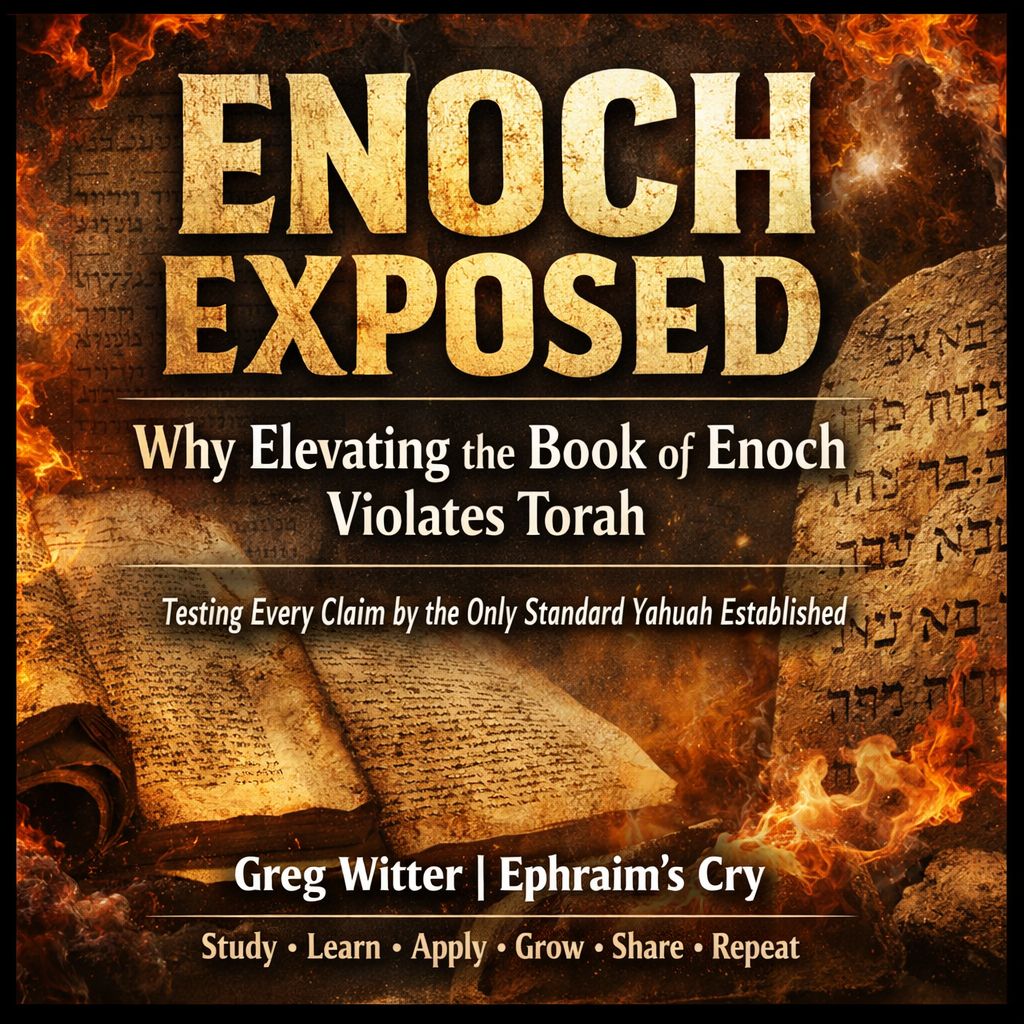
ENOCH EXPOSED
Why Elevating the Book of Enoch Violates Torah and Undermines Covenant Authority
Testing Every Claim by the Only Standard Yahuah Established
Greg Witter | Ephraim’s Cry
Hebraic Mindset Study Series
Study • Learn • Apply • Grow • Share • Repeat
INTRODUCTION
In recent years, the Book of Enoch has been aggressively promoted as “suppressed Scripture,” “restored revelation,” or even the key to understanding prophecy, angels, calendars, and end-times deception. These claims are often framed as courageous truth-telling against corrupt systems. In reality, they represent a serious departure from Torah, a confusion between historical tradition and covenant authority, and a direct violation of Yahuah’s instructions not to add to or take away from His Word.
This teaching addresses the issue directly, without sentiment, mysticism, or conspiracy rhetoric. The question is not whether Enoch existed as a man—Scripture affirms that. The question is whether the Book of Enoch has any covenant authority to teach, correct, expand, or reinterpret Torah. The answer, when tested honestly by Scripture, is no.
1. DISTINGUISHING THE MAN FROM THE BOOK
Scripture affirms Enoch the man.
Scripture does not affirm the Book of Enoch.
Genesis, Hebrews, and Jude testify that Enoch walked with Elohim and was taken. None of these texts say Enoch wrote a book. None command the reading of a book. None grant authority to later writings attributed to his name. Confusing the righteousness of a historical figure with the inspiration of a later composite work is a basic category error.
Affirming Enoch does not canonize Enochic literature.
2. AUTHORSHIP, COMPOSITION, AND AUTHENTICITY PROBLEMS
The Book(s) of Enoch are not a single work. They are composite texts, written over hundreds of years, by multiple unknown authors, reflecting evolving theology and internal contradictions. This alone disqualifies the work from covenant authority.
Torah, the Prophets, and the Writings are unified, internally coherent, and received by Israel as authoritative. Enochic literature is not.
Questionable authorship means questionable authenticity.
Questionable authenticity means no authority.
3. QUOTATION IS NOT CANONIZATION
Jude’s reference to a saying attributed to Enoch does not elevate the Book of Enoch to Scripture. Scripture can reference true statements from outside sources without granting them authority. Quotation does not equal inspiration. Mention does not equal canon.
If every quoted source became Scripture, canon would collapse.
4. “EN0CH EXPLAINS WHAT GENESIS HINTS AT” IS THE PROBLEM
Claiming that Enoch “fills in gaps” or “expands compressed history” is not proof of inspiration—it is evidence of speculation. Non-canonical literature routinely expands biblical narratives with names, cosmology, calendars, angel hierarchies, and dramatic detail.
Expansion is not revelation.
Torah is complete in what Yahuah intended to reveal. What He did not reveal, He did not authorize others to invent.
5. TRADITION DOES NOT OVERRULE TORAH
Second Temple Jewish traditions existed. Some influenced later writings. That does not make those traditions binding. Torah judges tradition, not the other way around.
Shared themes between Enochic literature and apostolic writings reflect cultural context, not divine endorsement.
6. YAHUSHA DID NOT AUTHORIZE ENOCH
Yahusha consistently appealed to Torah, the Prophets, and the Writings and said, “It is written.” He never commanded Enoch. He never treated it as Scripture. He never used it to correct Torah.
Overlapping ideas do not grant authority. Silence where authority would be expected is decisive.
7. “EN0CH WAS REMOVED” IS A FALSE NARRATIVE
A book cannot be “removed” from Scripture if it was never received as Scripture. Canon was not decided by suppression conspiracies but by prophetic authority and covenant reception.
The Book of Enoch was read by some. It was never binding on Israel. It was never treated as Scripture to be obeyed.
8. TORAH IS THE MEASURING ROD—AND ENOCH FAILS IT
Torah explicitly forbids adding to or taking away from the Word Yahuah spoke. The Book of Enoch is not mentioned anywhere in Torah, the Prophets, or the Writings as Scripture.
The moment Enoch is used to:
establish doctrine
correct Scripture
reinterpret Torah
define calendars
explain cosmology or angelology
a line has been crossed.
That is not restoration.
That is addition to the Word.
9. THIS IS A COVENANT ISSUE, NOT AN ACADEMIC ONE
Reading Enoch as historical or cultural literature is one thing. Elevating it to authority is another. Torah did not authorize it. The Prophets did not confirm it. The Writings did not receive it. Yahusha did not command it.
Using Enoch as authority is not discernment—it is covenant violation.
KEY TAKEAWAYS / SUMMARY
Enoch the man is affirmed; the Book of Enoch is not.
The Book of Enoch is composite, multi-author, and historically unreliable.
Quotation in Scripture does not grant canonical authority.
Expansion of biblical narratives is not revelation.
Tradition does not override Torah.
Yahusha never authorized Enoch as Scripture.
Claims of suppression are unfounded.
Torah forbids adding to the Word.
Using Enoch as doctrinal authority violates covenant boundaries.
FINAL WORD
Torah is complete.
Torah is sufficient.
Torah is the standard.
Anything that contradicts it, supplements it, or claims hidden authority over it condemns itself—no matter how ancient, detailed, or dramatic it sounds.
Enoch the man stands honored.
The Book of Enoch does not stand authorized.
#GregWitter#EphraimsCry#HebraicMindset#TorahTruth#TestAllThings#AddNothing#CovenantAuthority
#ScriptureAlone#EnochExposed#WatchmanWarning
