
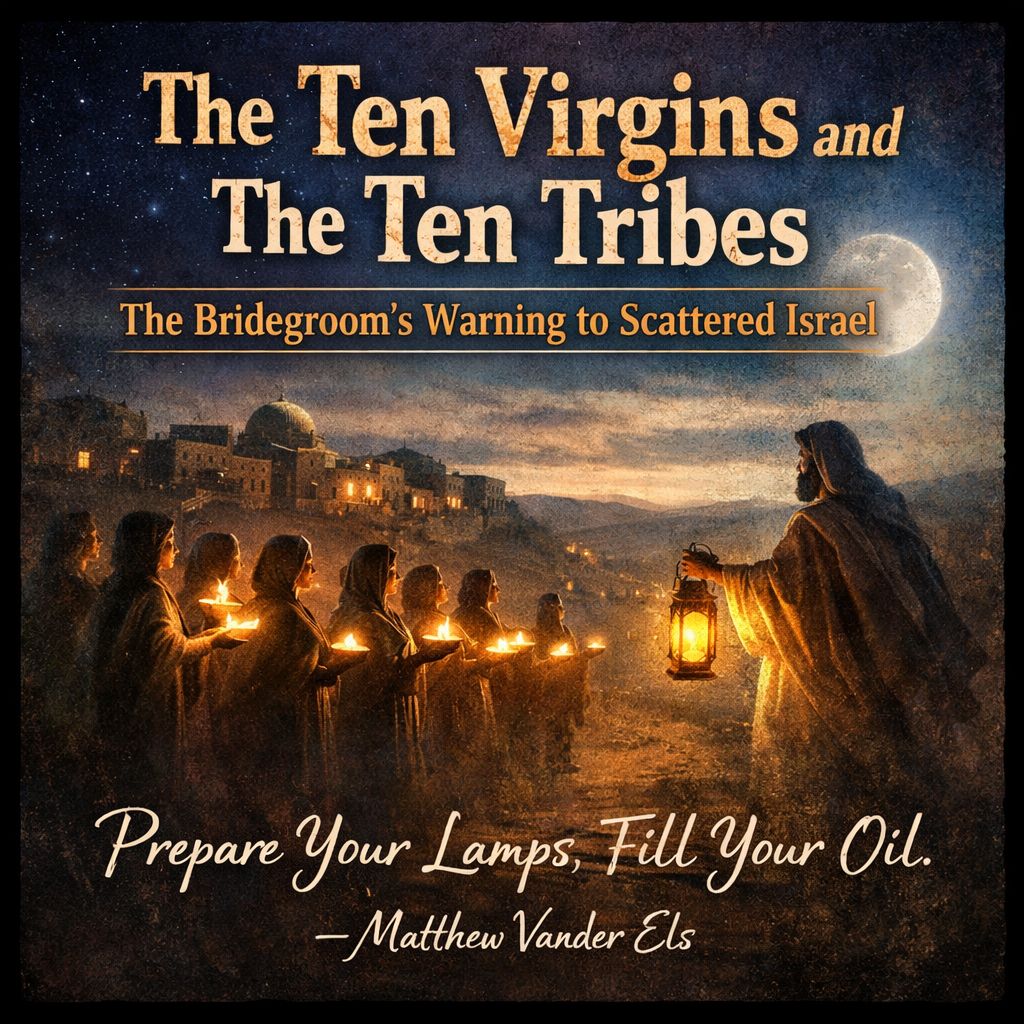
The Ten Virgins and the Ten Tribes
The Bridegroom’s Warning to Scattered Israel
Midnight is coming. Oil is not optional.
Greg Witter | Ephraim’s Cry
Hebraic Mindset Study Series
Study Learn Apply Grow Share Repeat
I have addressed this before, and I will address it again, because we are closer to the midnight hour than most people realize. Many are asleep. Many are distracted. Many are spiritually “busy” but covenant-empty. And Scripture is not gentle in the way it warns covenant people who assume they have time.
Judah: You may have Torah, but your heart can still be far (Isaiah 29:13; Matthew 15:8–9).
House of Israel / Ephraim / Joseph: You were scattered and assimilated among the nations, and many lost covenant readiness and Torah fidelity (Hosea 7:8–9; Hosea 8:8; Hosea 1:9–11).
And those from the nations who have been brought near are not exempt from this warning either, because being brought near is not a license to lawlessness but a call into covenant order (Ephesians 2:12–13; Romans 11:17–22).
The parable of the ten virgins (Matthew 25:1–13) is not random end-times imagery. It is covenant language. It is bridal language. It is restoration language. It is a precision warning aimed at those who claim to be waiting for the Bridegroom, those who claim they belong to Him, those who assume their identity, knowledge, association, or history automatically guarantees entrance.
The Setup: Why Ten? Why Virgins? Why This Warning?
Ten is not a meaningless number. It immediately echoes the covenant fracture of the divided kingdom.
In 1 Kings 11:30–32, the prophet Ahijah tore his garment into twelve pieces and gave ten to Jeroboam, declaring that Yahuah would tear the kingdom from Solomon and give ten tribes to the northern kingdom. Those ten tribes became the house of Israel, often prophetically summarized under Ephraim (Genesis 48:13–20; Hosea 5:3; Hosea 11:8–9). They spiraled into idolatry, and Yahuah judged them through exile and scattering (2 Kings 17; Hosea 1:2–9).
Hosea 1:9 is covenant severance language: “Call his name Lo-Ammi: for ye are not My people, and I will not be your Elohim.” Yet the very next breath in Hosea reverses the sentence by promise: the scattered will be multiplied and called sons again, and Judah and Israel will be gathered under one head (Hosea 1:10–11). That is restoration language. That is bridal reunion language.
By the first century, the scattered were everywhere. This is why James writes to “the twelve tribes which are scattered abroad” (James 1:1). This is why Peter addresses the dispersion (1 Peter 1:1). The background of the Gospels and the apostolic witness includes covenant scattering, covenant awakening, and covenant restoration.
So when Yahusha speaks of ten virgins waiting for the Bridegroom, He is speaking into covenant expectation and covenant accountability. This is not “generic church life advice.” This is a warning for covenant claimants.
The Midnight Cry: Behold the Bridegroom
Matthew 25:6 says, “At midnight there was a cry made, Behold, the bridegroom cometh; go ye out to meet him.”
Midnight in Scripture is a threshold hour. It is the moment of separation. It is the hour when false security is exposed.
At midnight in Egypt, Yahuah struck the firstborn, and the distinction between those under the blood and those outside the blood became irreversible (Exodus 12:29–30). Midnight is the hour when covenant protection proves real or proves absent.
And note this: the cry is not “Behold the Judge.” It is “Behold the Bridegroom.” That is covenant reunion language. That is the language of betrothal and restoration.
The Lamp Without Oil: Torah Without Life
All ten virgins carry lamps (Matthew 25:1). In Scripture, a lamp is consistently linked to instruction and light from the Word.
“Thy word is a lamp unto my feet, and a light unto my path.” (Psalm 119:105)
“For the commandment is a lamp; and the Torah is light.” (Proverbs 6:23)
So the visible picture is clear: they all have a form. They all have a claim. They all have lamps.
But five have oil and five do not (Matthew 25:3–4). That is the division.
A lamp can be carried without burning. A form can be held without power. A claim can be made without covenant substance.
Oil is not theological vocabulary. Oil is not online identity. Oil is not “I’m awake.” Oil is not “I know the calendar debate.” Oil is not “I have Torah knowledge.”
Oil is the inner reality of covenant life, proven over time. Oil is what keeps the lamp burning in darkness.
This is where many covenant claimants collapse: they carry lamps, but they do not carry oil. They know the words, but they reject the walk. They claim identity, but refuse obedience. They have information, but not transformation.
The Oil: The New Covenant Promise in Action
Scripture tells you exactly what this oil looks like in covenant terms.
Yahuah promised a new heart and His Spirit, and the result would be obedience, not lawlessness:
“I will give you a new heart… and I will put My Spirit within you, and cause you to walk in My statutes, and ye shall keep My judgments, and do them.” (Ezekiel 36:26–27)
Yahuah promised Torah written within, not merely Torah discussed externally:
“I will put My Torah in their inward parts, and write it in their hearts… and they shall be My people.” (Jeremiah 31:33)
So oil is covenant reality. It is Spirit-empowered obedience. It is Torah internalized and lived. It is a life that bears fruit because the Word is not merely on the lips but on the heart.
This is why Scripture exposes the counterfeit: a person can have a lamp and still be foolish.
Romans 2:28–29 cuts straight through externalism: being covenant-inward matters.
Matthew 3:9 warns against hiding behind ancestry or labels.
2 Timothy 3:5 warns about “a form of godliness” that denies power.
The Door Shut: “Lord, Lord” Is Not Enough
Matthew 25:10 says the wise enter, “and the door was shut.”
Matthew 25:11–12 says the others arrive crying “Lord, Lord,” and He answers, “I know you not.”
That language lines up perfectly with Yahusha’s warning in Matthew 7:21–23.
“Not every one that saith unto Me, Lord, Lord, shall enter… but he that doeth the will of My Father…” (Matthew 7:21)
“I never knew you: depart from Me, ye that work lawlessness.” (Matthew 7:23)
Lawlessness is not a small issue. It is covenant treason. It is living “without Torah” while claiming Messiah’s name.
So the dividing line in both passages is not emotional sincerity. It is not religious activity. It is not gifts, miracles, prophecy, or platform.
The dividing line is covenant obedience versus lawlessness.
John nails this down with no apology:
“By this we do know that we know Him, if we keep His commandments.” (1 John 2:3)
“He that saith, I know Him, and keepeth not His commandments, is a liar.” (1 John 2:4)
You Cannot Buy Oil at Midnight
The foolish virgins try to borrow oil. They try to buy oil at the last moment. They try to solve covenant reality with crisis religion.
But oil is not transferable. Oil is cultivated. Oil is accumulated through faithful walking over time. Oil is formed through endurance, testing, repentance, obedience, and daily submission.
When Yahusha says the door is shut, He is not being poetic. He is showing the finality of covenant judgment.
The lesson is not “quiet reflection.” The lesson is urgent readiness.
The Delay Is the Test
Matthew 25:5 says the Bridegroom delayed, and they all became drowsy.
That delay is not permission to drift. It is the proving ground.
“The Master is not slack… but is longsuffering… not willing that any should perish.” (2 Peter 3:9)
The delay reveals who has oil and who only has appearance.
Anyone can look prepared for a short time. The question is who stays faithful over the long haul.
That applies to Judah, to scattered Ephraim, and to those brought near from the nations. Covenant claims do not replace covenant living.
The Bride Makes Herself Ready
Revelation shows the same bridal truth:
“His wife hath made herself ready.” (Revelation 19:7)
“Fine linen… is the righteous deeds of the saints.” (Revelation 19:8)
That does not mean works save you. It means covenant reality produces visible fruit. Oil produces flame. Flame produces light. Light produces deeds. Deeds prove relationship.
So here is the warning, plain and sharp:
A lamp without oil is a covenant claim without covenant life.
A “Lord, Lord” confession without obedience is empty.
A last-minute scramble will not reopen a shut door.
And the midnight hour will expose everything.
The question is not whether you carry a lamp.
The question is whether you have oil.
Do not be caught with a form and no fire.
Return to covenant fidelity now, while the door is still open.
#TenVirgins#MidnightCry#BridegroomIsComing#CovenantReadiness#ReturnToTorah#TorahWrittenOnTheHeart
EphraimAwake#JudahReturn#WholeHouseOfIsrael#RemnantRising#ObedientFaith#WatchmanWarning
#GospelOfTheKingdom#Yahuah#Yahusha#Elohim#Matthew25#Exodus12#Ezekiel36#Jeremiah31
#Revelation19#1John2#Matthew7#James1#1Peter1#Romans11#Romans2
