
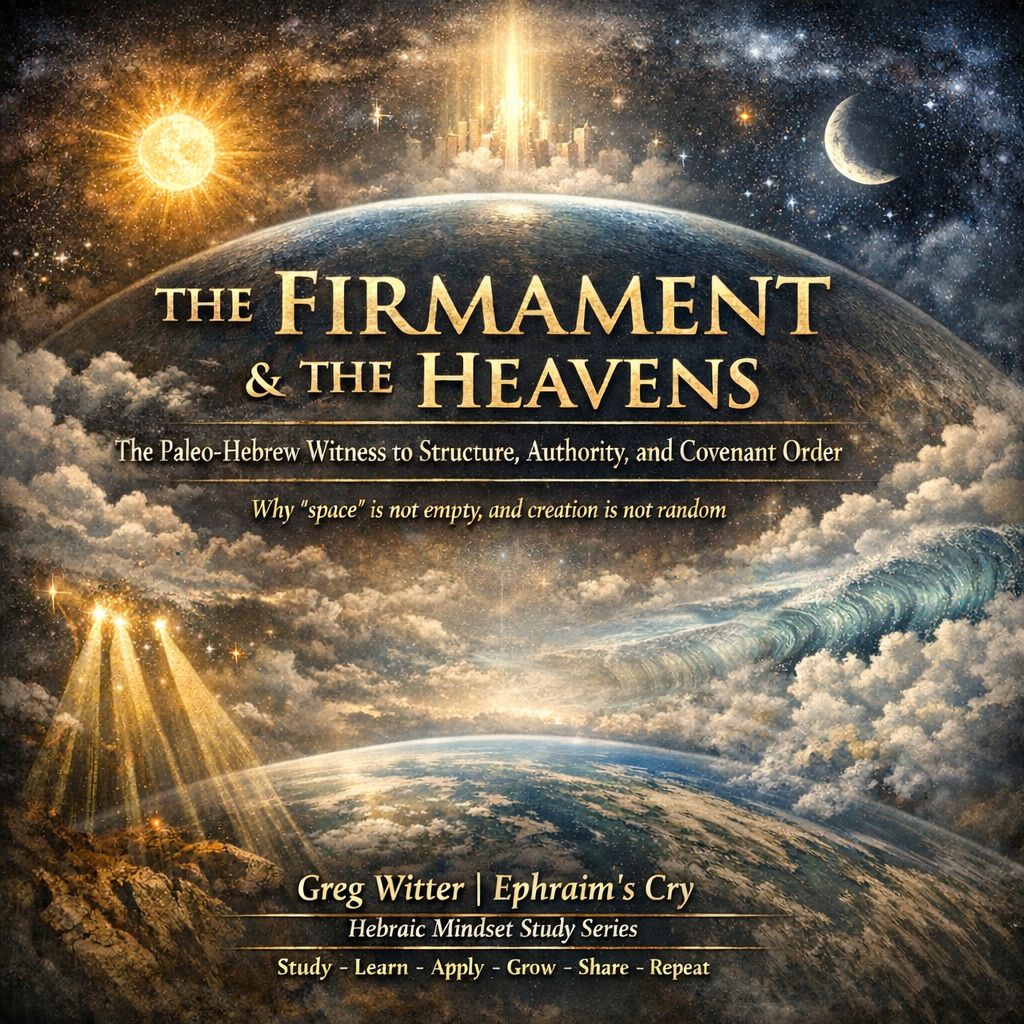
THE FIRMAMENT AND SHAMAYIM
Creation Order Reveals How Yahuah Separates, Governs, and Will Return His Kingdom
Raqia and Shamayim as Covenant Architecture, Boundary, and Authority
Greg Witter | Ephraim’s Cry
Hebraic Mindset Study Series
Study Learn Apply Grow Share Repeat
Scripture does not treat creation language as filler. It treats it as structure. When Yahuah builds reality, He builds it with order, boundaries, and declared functions that remain consistent from Genesis to Revelation. The reason “firmament” and “heaven(s)” matter is because the modern religious system has turned them into vague spiritual poetry, then used that vagueness to sell escape theology, lawlessness, and confusion. But the Word is concrete: Yahuah separates; Yahuah establishes domains; Yahuah rules by appointed times and appointed boundaries; and in the end, heaven does not “receive you permanently” as an eternal destination—heaven returns, and the Kingdom is manifested on earth (Genesis 1:6–8; Isaiah 66:1; Matthew 5:5; Revelation 21:1–3).
FIRMAMENT — רָקִיעַ — 𐤓𐤒𐤉𐤏
The first time the concept appears, it is not mystical. It is functional. “And Elohim said, Let there be a firmament in the midst of the waters, and let it divide the waters from the waters” (Genesis 1:6). That is separation language—division, boundary, placement, and constraint. Then Scripture repeats the function: “And Elohim made the firmament, and divided the waters which were under the firmament from the waters which were above the firmament” (Genesis 1:7). And then Yahuah names it: “And Elohim called the firmament Heaven” (Genesis 1:8). That single line already destroys a mountain of modern confusion: the firmament is directly tied to the biblical “heaven(s)” concept at the level of domain naming and boundary function (Genesis 1:8). The firmament is not merely “sky.” It is the boundary-space where separation is enforced and where created order is maintained by decree (Genesis 1:6–8).
Raqia (רָקִיעַ) is commonly linked to the idea of something spread out or beaten out—extended, hammered, stretched—like a structured expanse (Genesis 1:6–8). Scripture treats it as a real created expanse with real separating power, not a metaphor for “spiritual feelings.” This is why David says, “The heavens declare the esteem of Elohim; and the firmament shows His handiwork” (Psalm 19:1). The firmament is witness. It “shows.” It testifies. It displays handiwork—crafted work—meaning it is presented as something made, not imagined (Psalm 19:1). The prophets reinforce this created order: “Thus says El-Yahuah, He that created the heavens, and stretched them out; He that spread forth the earth” (Isaiah 42:5). Creation is described as stretched, spread, ordered—language of structure, not abstraction (Isaiah 42:5).
Now we lock in the letter-level picture using both scripts, because Scripture is not threatened by detail—only lies are.
Raqia — רָקִיעַ — 𐤓𐤒𐤉𐤏
Letters (square script): ר (Resh), ק (Qof), י (Yod), ע (Ayin)
Letters (Paleo): 𐤓 (Resh), 𐤒 (Qof), 𐤉 (Yod), 𐤏 (Ayin)
Resh (ר / 𐤓) carries the head/first/chief idea—what governs, what is foremost, what leads. Scripture consistently frames headship as authority order, not ego (Deuteronomy 28:13; 1 Corinthians 11:3).
Qof (ק / 𐤒) is commonly associated with the horizon/behind/least holy boundary idea in word-picture teaching—an image of the line where things are separated, where domains are distinguished. Whether one prefers that pictorial explanation or not, the biblical function is not in dispute: the firmament is literally created “to divide” (Genesis 1:6–7).
Yod (י / 𐤉) is the hand/work/deed marker—action, making, doing. The firmament is not said to “appear”; it is said to be made: “And Elohim made the firmament” (Genesis 1:7).
Ayin (ע / 𐤏) is the eye/seeing/perception marker—what is seen, revealed, witnessed. The firmament “shows” handiwork; the heavens “declare” (Psalm 19:1).
Prophetic word picture (Raqia): Authority establishes a boundary by an act of making, so that what is seen/testified remains ordered. That is not mysticism; it is covenant logic in creation form: Yahuah is teaching from the beginning that His world runs by separation, appointed domains, and visible witness (Genesis 1:6–8; Psalm 19:1). This is the same logic later applied to covenant boundaries: set-apart vs common, clean vs unclean, truth vs mixture, obedience vs rebellion (Leviticus 10:10; Deuteronomy 30:15–20). When boundaries collapse, judgment follows—because confusion is not neutral; it is lawlessness (Isaiah 5:20; Matthew 7:23).
SHAMAYIM — שָׁמַיִם — 𐤔𐤌𐤉𐤌
If “firmament” is boundary-expanse language, “shamayim” is domain language. In Genesis 1:8, Yahuah names the firmament “Heaven,” tying the concept of shamayim to created order and governance from the beginning (Genesis 1:8). Scripture then expands the testimony: “Praise Him, you heavens of heavens, and you waters that be above the heavens” (Psalm 148:4). That verse preserves the Genesis division logic (waters above; waters below) and shows that Scripture itself continues speaking this way long after Genesis—meaning this is not a one-time “story device”; it is a persistent biblical framework (Genesis 1:6–8; Psalm 148:4).
Now lock in the letter-level picture.
Shamayim — שָׁמַיִם — 𐤔𐤌𐤉𐤌
Letters (square script): ש (Shin), מ (Mem), י (Yod), מ (Mem)
Letters (Paleo): 𐤔 (Shin), 𐤌 (Mem), 𐤉 (Yod), 𐤌 (Mem)
Shin (ש / 𐤔) is commonly taught as teeth/consume/fire—devouring, pressing, refining. Scripture repeatedly ties Yahuah’s presence and judgment to fire imagery, not because He is chaotic, but because He purifies and judges what opposes His order (Deuteronomy 4:24; Malachi 3:2–3; Hebrews 12:29).
Mem (מ / 𐤌) is waters/mass/flow—often tied to chaos in ungoverned form, and life when governed by order. Genesis begins with waters and then immediately moves to separation and rulership—order imposed upon the deep (Genesis 1:2–10).
Yod (י / 𐤉) again marks hand/work/deed—governance enacted, not merely spoken as philosophy. Yahuah “made,” “set,” “appointed,” “called,” “separated”—verbs of action (Genesis 1:6–8, 1:14–18).
Mem (מ / 𐤌) repeats—reinforcing waters again, meaning the concept is not just “up there” but connected to the governance of waters, cycles, and ordering of the created system (Genesis 1:6–10; Psalm 104:2–9).
Prophetic word picture (Shamayim): Refining authority governs the waters by His hand, maintaining ordered cycles. That aligns perfectly with the creation function of the lights: “for signs, and for seasons (moedim), and for days, and years” (Genesis 1:14). Shamayim is not “escape space.” Shamayim is the authority domain where Yahuah’s rule is established and from which His will is executed, and His Kingdom is ultimately manifested here (Isaiah 66:1; Matthew 6:10; Revelation 21:1–3).
THE FOUR WITNESSES ON WHAT THIS MEANS
Torah: Yahuah creates by separation and assigns domains and functions. The firmament divides. The lights govern signs and appointed times. Creation is covenant architecture in physical form (Genesis 1:6–8; Genesis 1:14–18).
Prophets: Yahuah alone stretches out the heavens and rules as King; He declares Himself enthroned over heaven and earth; He promises restoration that is earthly and covenantal, not a permanent evacuation to another realm (Isaiah 42:5; Isaiah 66:1; Daniel 7:13–14).
Writings: The firmament and heavens testify. They declare. They show. They are witnesses to order and to Elohim’s craftsmanship, not metaphors for private spirituality (Psalm 19:1; Psalm 148:4).
Apostolic witness: The goal is the Kingdom revealed, not escape. “The meek shall inherit the earth” (Matthew 5:5). The pattern ends with the New Jerusalem coming down, not believers escaping up: “Behold, the dwelling of Elohim is with men” (Revelation 21:1–3). Yahusha teaches us to pray for the Father’s reign to come here: “Your Kingdom come… on earth” (Matthew 6:10). The times of restoration are spoken of as something that comes, not something we flee from (Acts 3:21). And when Scripture speaks of “new heavens and new earth,” it is not teaching abandonment of earth; it is teaching renewal and rule under Yahuah’s presence (Isaiah 65:17; Revelation 21:1).
WHY THIS DESTROYS ESCAPE THEOLOGY AND RESTORES COVENANT THINKING
The modern religious system trains people to treat heaven as the final destination and earth as disposable. Scripture does the opposite: earth is promised inheritance; the Kingdom is manifested; the presence of Yahuah returns; and the final biblical movement is downward—Yahuah’s dwelling with man (Matthew 5:5; Revelation 21:1–3). That matters because escape theology produces weak disciples: it removes urgency, weakens endurance, and teaches people to avoid the refining that Scripture says is required (Matthew 24:13; Revelation 14:12). If you believe you will be removed before testing, you will not prepare to stand when testing comes. That is not a minor doctrine error; it is an end-times vulnerability (Daniel 11:32; Matthew 24:9–13).
Firmament and shamayim expose the real issue: Yahuah built reality as ordered, bounded, and governed. Covenant works the same way. Mixture always produces confusion. Confusion always produces rebellion. And rebellion always ends in judgment unless repentance intervenes (Isaiah 24:5; Hosea 4:6). The firmament is not just “science talk.” It is a creation witness that Yahuah’s world has lines, separations, and appointed domains. That is why Torah insists on separation and set-apart living—because creation itself preached that sermon before Sinai ever arrived (Genesis 1:6–8; Leviticus 20:26). And that is why the Kingdom is not entered by religious talk but by obedience, endurance, and covenant loyalty to Yahuah with the testimony of Yahusha (Revelation 12:17; Revelation 14:12).
If you want to understand firmament and shamayim correctly, stop treating them like dreamy religious words. Treat them like what Scripture treats them as: created structure, covenant boundary, authority domain, and witness of order. The heavens are not your escape. They are the throne domain of Yahuah from which His will will be established here. And if you’re waiting to leave, you’re already being trained for the wrong ending. The Word says the ending plainly: the Kingdom comes, the King reigns, and Yahuah dwells with men (Matthew 6:10; Revelation 21:1–3).
#GregWitter, #EphraimsCry, #HebraicMindsetStudySeries, #HebraicMindset, #Yahuah, #Yahusha, #Elohim, #Torah, #Covenant, #Ekklesia, #KingdomOfElohim, #CreationOrder, #Firmament, #Raqia, #Shamayim, #PaleoHebrew, #HebrewWordStudy, #ScriptureFirst, #WholeCounsel, #TorahAndTestimony, #Revelation, #ReturnToAncientPaths, #EndTimesPreparation, #NoEscapeDoctrine, #KingdomComesToEarth, #NewJerusalem, #Watchman, #CovenantFaithfulness,
