
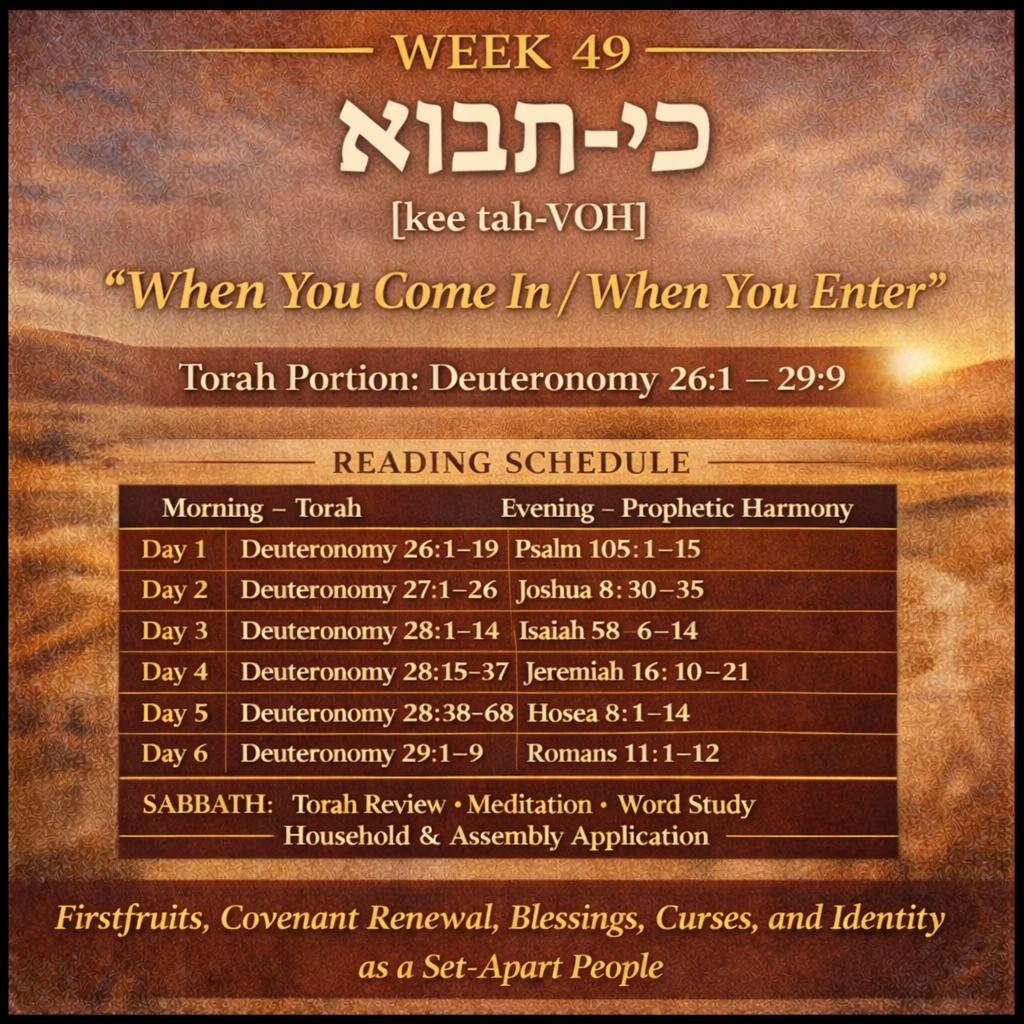
WEEK 49 — כִּי־תָבוֹא (Ki Tavo) [kee tah-VOH] — “When You Come In / When You Enter”
Torah Portion: Deuteronomy 26:1 – 29:9
READING SCHEDULE
| Day | Morning — Torah | Evening — Prophetic Harmony |
|---|---|---|
| Day 1 | Deuteronomy 26 : 1 – 19 | Psalm 105 : 1 – 15 |
| Day 2 | Deuteronomy 27 : 1 – 26 | Joshua 8 : 30 – 35 |
| Day 3 | Deuteronomy 28 : 1 – 14 | Isaiah 58 : 6 – 14 |
| Day 4 | Deuteronomy 28 : 15 – 37 | Jeremiah 16 : 10 – 21 |
| Day 5 | Deuteronomy 28 : 38 – 68 | Hosea 8 : 1 – 14 |
| Day 6 | Deuteronomy 29 : 1 – 9 | Romans 11 : 1 – 12 |
| SABBATH | Torah Review · Meditation · Word Study | Household & Assembly Application |
THEMATIC FLOW — FIRSTFRUITS, COVENANT RENEWAL, BLESSINGS, CURSES, AND IDENTITY AS A SET-APART PEOPLE
Ki Tavo marks a transition from preparation to commitment. Israel is about to enter the land, and Yahuah commands acts that root them in gratitude, covenant identity, and national responsibility.
Deuteronomy 26 commands the offering of firstfruits. Israel is to recite their history — from wandering Aramean to afflicted slaves to redeemed people — grounding their identity in Yahuah’s deliverance. Tithes for the Levite, the stranger, the orphan, and the widow emphasize justice and generosity.
Deuteronomy 27 commands Israel to set up large plastered stones on Mount Ebal with the Torah written on them, to build an altar, and to declare covenant blessings and curses from Mount Gerizim and Mount Ebal. Obedience brings blessing; disobedience brings curse.
Deuteronomy 28 is a sweeping declaration of covenant consequences. Verses 1–14 outline abundant blessings for obedience — fruitfulness, provision, victory, holiness, honor, and prosperity. Verses 15–68 detail devastating curses for disobedience — disease, drought, famine, defeat, madness, exile, oppression, and scattering among the nations. Israel’s history testifies to the weight of these words.
Deuteronomy 29:1–9 summarizes Yahuah’s faithfulness through the wilderness and urges Israel to obey in the land. Their eyes have seen miracles, yet understanding must be awakened to walk faithfully.
Ki Tavo reveals that covenant life is grounded in gratitude, written law, public commitment, tangible blessing, and sober warning. Entering the land is not merely physical — it is spiritual allegiance.
HEBREW WORD STUDY — כִּי־תָבוֹא (Ki Tavo)
Block: כי־תבוא Paleo: 𐤊𐤉 𐤕𐤁𐤀
Root: בוא — “to come,” “to enter,” “to bring in”
| Letter | Symbol | Meaning | Prophetic Role |
|---|---|---|---|
| 𐤊 Kaf | Palm | Allow / bend | Permission or entry granted |
| 𐤉 Yod | Hand | Action / work | Action required upon entering |
| 𐤕 Tav | Mark | Covenant | Entering into covenant responsibility |
| 𐤁 Bet | House | Household | Becoming part of Yahuah’s household |
| 𐤀 Aleph | Ox | Strength | Strength given to inhabit the promise |
Paleo Meaning:
“When you enter, act with covenant-marked obedience to dwell inside Yahuah’s provision and authority.”
PROPHETIC PALEO-HEBREW WORD PICTURE
Ki Tavo pictures entering the land as entering Yahuah’s house (bet) under His covenant mark (tav). Entry is not passive — the Yod signals action, responsibility, and faithfulness. The Aleph shows that strength for covenant life comes from Yahuah alone.
Entering the land means entering accountability.
SABBATH MEDITATION
Meditate on the blessings and curses. Ki Tavo teaches that covenant life is not theoretical — it is lived in obedience or disobedience, blessing or curse, life or death. Ask Yahuah to align your heart so that blessing follows your steps.
REFLECTION AND DISCUSSION QUESTIONS
Heart (Individual)
-
Do I enter each day with gratitude, remembering Yahuah’s deliverance?
-
Am I walking in obedience that invites blessing?
-
What areas of my life reflect Ki Tavo’s warnings instead of its blessings?
Household (Family)
-
Are we practicing generosity toward the poor, as commanded in the tithe?
-
Are we writing Yahuah’s instructions visibly into our home life?
Assembly (Corporate)
-
Are we willing to proclaim both blessing and curse — the fullness of covenant truth?
-
Do we disciple believers into obedience, not merely belief?
PRAYER FOR SABBATH
Yahuah,
Teach us to enter Your promises with gratitude,
obedience, and covenant loyalty.
Write Your Torah on our hearts
just as it was written on the stones of Mount Ebal.
Let blessing follow our steps
as we walk faithfully before You.
Give us humility to receive warning
and courage to pursue righteousness.
In Yahusha’s Name — Amein.
KEY THEMATIC INSIGHTS
Gratitude Anchors Covenant Identity
Firstfruits and tithes remind Israel of their deliverance and dependence on Yahuah.
Covenant Is Public, Written, and Binding
Stones on Mount Ebal and blessings/curses from the mountains make the covenant unmistakable.
Obedience Produces Abundance
Deut 28:1–14 describes blessing overflowing into every dimension of life.
Disobedience Produces Desolation
Deut 28:15–68 outlines judgment that history has proven true.
Entering the Land Requires Obedient Hearts
Deut 29:1–9 reminds Israel that miracles alone do not transform — obedience does.
FOOTNOTES
-
Deuteronomy 26 — firstfruits, tithes, and identity.
-
Deuteronomy 27 — covenant ceremony at Gerizim and Ebal.
-
Deuteronomy 28 — blessings and curses.
-
Deuteronomy 29 — call to obedience after the wilderness.
-
Joshua 8 — Israel fulfills the mountain ceremony.
