
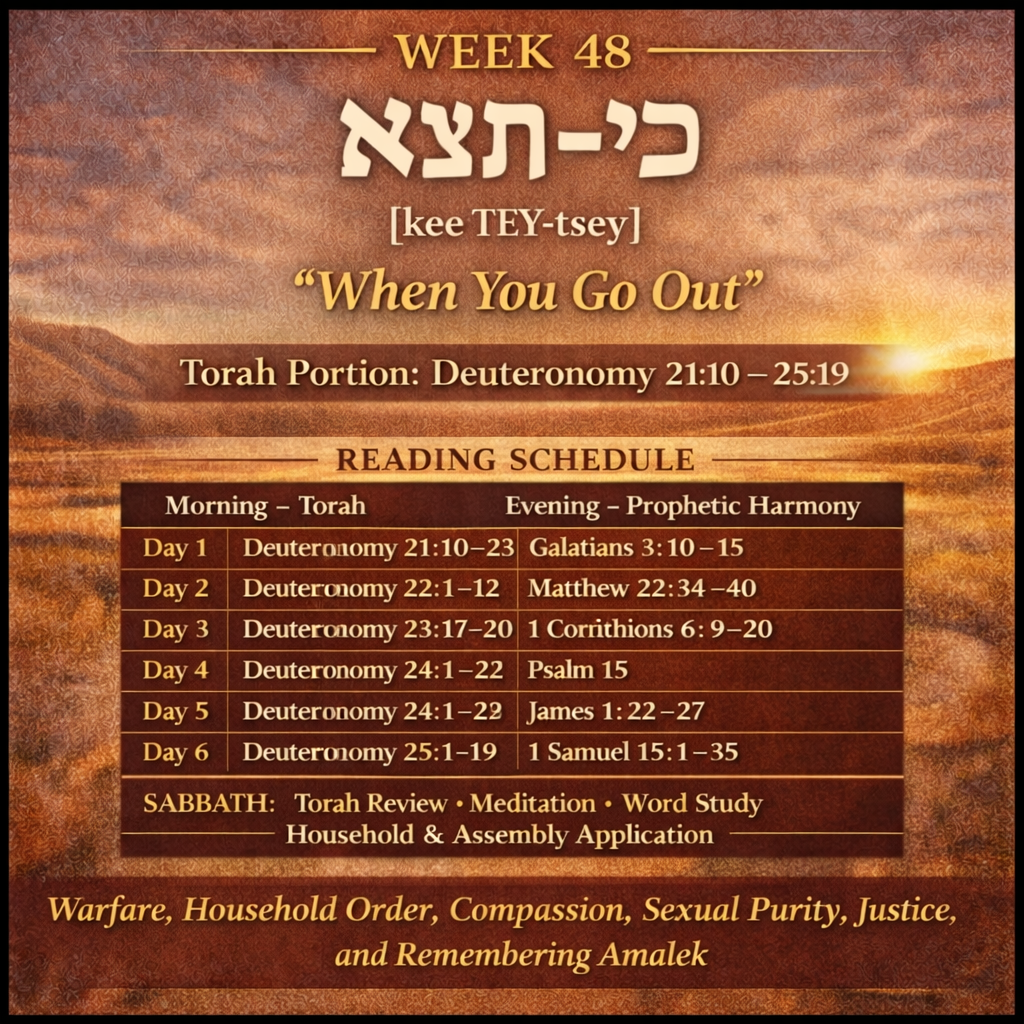
WEEK 48 — כִּי־תֵצֵא (Ki Teitzei) [kee TEY-tsey] — “When You Go Out”
Torah Portion: Deuteronomy 21:10 – 25:19
READING SCHEDULE
| Day | Morning — Torah | Evening — Prophetic Harmony |
|---|---|---|
| Day 1 | Deuteronomy 21 : 10 – 23 | Galatians 3 : 10 – 14 |
| Day 2 | Deuteronomy 22 : 1 – 12 | Matthew 22 : 34 – 40 |
| Day 3 | Deuteronomy 22 : 13 – 30 | 1 Corinthians 6 : 9 – 20 |
| Day 4 | Deuteronomy 23 : 1 – 25 | Psalm 15 |
| Day 5 | Deuteronomy 24 : 1 – 22 | James 1 : 22 – 27 |
| Day 6 | Deuteronomy 25 : 1 – 19 | 1 Samuel 15 : 1 – 35 |
| SABBATH | Torah Review · Meditation · Word Study | Household & Assembly Application |
THEMATIC FLOW — WARFARE, HOUSEHOLD ORDER, COMPASSION, SEXUAL PURITY, JUSTICE, AND REMEMBERING AMALEK
Ki Teitzei contains more individual mitzvot than any other Torah portion — a sweeping collection that shapes Israel’s daily moral, relational, and communal life. The central theme is that holiness reaches into every corner of covenant living.
Deuteronomy 21:10–23 deals with warfare ethics, protecting women captives, rights of the firstborn, and the execution of a rebellious son — showing that family structure, justice, and compassion remain essential even in conflict.
Deuteronomy 22 commands returning lost property, caring for animals, distinguishing between male and female apparel, and guarding sexual purity. Laws concerning marriage accusations, adultery, rape, and honor protect dignity and righteousness within the community.
Deuteronomy 23 outlines who may enter the assembly, hygiene in the camp, protection of runaway servants, and prohibitions against cult prostitution and interest charged to fellow Israelites. Personal holiness extends into economic and communal ethics.
Deuteronomy 24 instructs fairness in divorce, protection for the newly married, kindness toward the poor, and justice in pledges and wages. Israel must remember Egypt and show mercy.
Deuteronomy 25 commands fair justice, limits corporal punishment, preserves a brother’s name through levirate marriage, condemns dishonest weights and measures, and ends with the command to utterly blot out Amalek — the embodiment of covenant opposition.
Ki Teitzei reveals that Yahuah’s Torah transforms every aspect of life: warfare, sexuality, business, marriage, justice, compassion, and national memory.
HEBREW WORD STUDY — כִּי־תֵצֵא (Ki Teitzei)
Block: כִּי־תֵצֵא Paleo: 𐤊𐤉 𐤕𐤆𐤀
Root: יצא — “to go out,” “to proceed,” “to advance”
| Letter | Symbol | Meaning | Prophetic Role |
|---|---|---|---|
| 𐤊 Kaf | Palm | Bend / allow | Permission or opportunity |
| 𐤉 Yod | Hand | Work / action | Action taken in obedience |
| 𐤕 Tav | Mark | Covenant | Action within covenant boundary |
| 𐤆 Tsade | Fishhook | Righteousness / hunt | Pursuing righteousness |
| 𐤀 Aleph | Ox | Strength / leader | Strength given for the journey |
Paleo Meaning:
“When you go out, act with covenant-marked righteousness strengthened by Yahuah.”
PROPHETIC PALEO-HEBREW WORD PICTURE
Ki Teitzei describes going out into warfare, conflict, or daily life with covenant boundaries and righteous purpose. The Paleo imagery shows action (yod) guided by covenant marks (tav) and strengthened by divine authority (aleph). Every step must reflect Yahuah’s righteousness.
SABBATH MEDITATION
Meditate on how holiness governs the ordinary. Ki Teitzei teaches that righteousness is not abstract — it is lived in clothing, relationships, sexuality, property, money, justice, and memory. Covenant faithfulness is practical, visible, and daily.
REFLECTION AND DISCUSSION QUESTIONS
Heart (Individual)
-
Am I living holiness in the small details of daily life?
-
Do I guard purity, honesty, and compassion consistently?
-
What patterns in my life resemble Amalek — opposition to Yahuah’s ways?
Household (Family)
-
Are we building a home that honors dignity, purity, and compassion?
-
Is justice and mercy practiced within our relationships?
Assembly (Corporate)
-
Do we uphold righteous standards for purity, justice, and protection of the vulnerable?
-
Are we confronting dishonesty, corruption, and covenant compromise?
PRAYER FOR SABBATH
Yahuah,
Teach us to walk in holiness
in every detail of daily life.
Guard our homes, our hearts, our families,
and our assemblies from impurity and injustice.
Give us compassion for the vulnerable,
strength in righteousness,
and courage to remember and resist Amalek.
In Yahusha’s Name — Amein.
KEY THEMATIC INSIGHTS
Holiness Must Saturate Daily Life
Ki Teitzei shows that righteousness governs marriage, clothing, animals, sexuality, business, and community order.
Justice Protects the Weak and Honors the Image of Elohim
Laws concerning captives, servants, wages, pledges, and the vulnerable reflect Yahuah’s compassion.
Sexual Purity Preserves Covenant Identity
Deut 22–23 establishes boundaries that guard Israel from corruption.
Honesty Is Non-Negotiable in Covenant Economics
Weights, measures, pledges, and transactions must be righteous (Deut 25).
Amalek Must Be Remembered and Blotted Out
Israel must oppose what seeks to destroy covenant faithfulness.
FOOTNOTES
-
Deuteronomy 21 — warfare ethics and family structure.
-
Deuteronomy 22 — purity, dignity, and relational protection.
-
Deuteronomy 23 — holiness in the assembly and community life.
-
Deuteronomy 24 — justice, mercy, and memory.
-
Deuteronomy 25 — justice, economic righteousness, and Amalek.
