
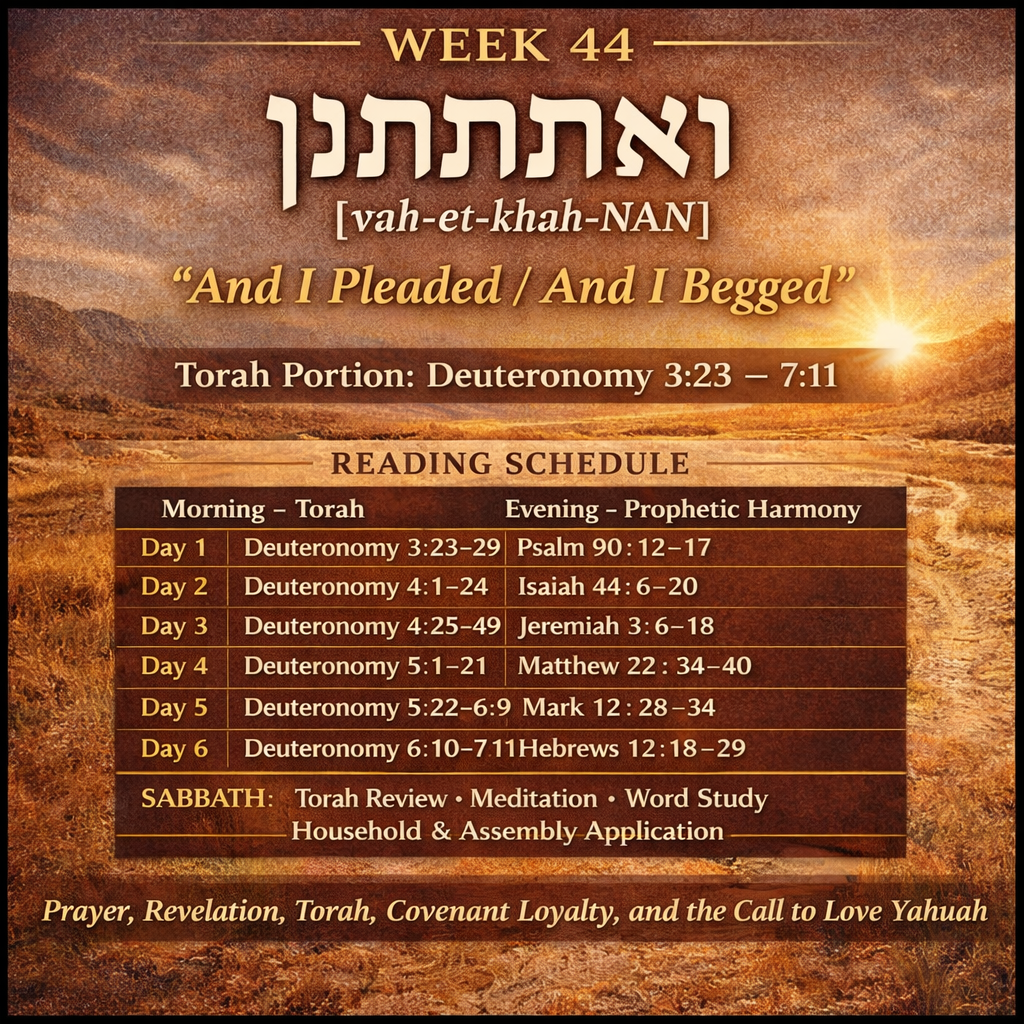
WEEK 44 — וָאֶתְחַנַּן (Va’etchanan) [vah-et-khah-NAN] — “And I Pleaded / And I Begged”
Torah Portion: Deuteronomy 3:23 – 7:11
READING SCHEDULE
| Day | Morning — Torah | Evening — Prophetic Harmony |
|---|---|---|
| Day 1 | Deuteronomy 3 : 23 – 29 | Psalm 90 : 12 – 17 |
| Day 2 | Deuteronomy 4 : 1 – 24 | Isaiah 44 : 6 – 20 |
| Day 3 | Deuteronomy 4 : 25 – 49 | Jeremiah 3 : 6 – 18 |
| Day 4 | Deuteronomy 5 : 1 – 21 | Matthew 22 : 34 – 40 |
| Day 5 | Deuteronomy 5 : 22 – 6 : 9 | Mark 12 : 28 – 34 |
| Day 6 | Deuteronomy 6 : 10 – 7 : 11 | Hebrews 12 : 18 – 29 |
| SABBATH | Torah Review · Meditation · Word Study | Household & Assembly Application |
THEMATIC FLOW — PRAYER, REVELATION, TORAH, COVENANT LOYALTY, AND THE CALL TO LOVE YAHUAH
Va’etchanan opens with Moshe pleading to enter the land. Yahuah denies the request yet commands Moshe to strengthen Yehoshua. Even in disappointment, Moshe models humility and obedience.
Deuteronomy 4 is a foundational chapter. Moshe urges Israel to hear, obey, and guard the Torah. Idolatry is forbidden with absolute clarity. Israel is reminded of the uniqueness of their calling — no other nation has heard Yahuah’s voice or received His statutes. Even in exile, return remains possible; repentance brings mercy.
Deuteronomy 5 restates the Ten Words (Commandments), grounding the covenant in moral and relational order. Torah is not merely instruction; it is revelation of Yahuah’s character.
Deuteronomy 6 contains the Shema — the central declaration of Israel’s faith:
“Hear, O Israel: Yahuah our Elohim, Yahuah is one.”
This is followed by the greatest command:
“You shall love Yahuah your Elohim with all your heart, soul, and strength.”
Moshe commands Israel to teach these words diligently to their children, binding them to heart, home, and life.
Deuteronomy 7:1–11 warns against covenant mixture. Israel must not intermarry with the nations or adopt their gods. Holiness demands loyalty, purity, and separation for Yahuah alone.
Va’etchanan reveals that inheritance requires obedience, love, vigilance, and loyalty to Yahuah’s commands.
HEBREW WORD STUDY — וָאֶתְחַנַּן (Va’etchanan)
Block: ואתחנן Paleo: 𐤅𐤀𐤕𐤇𐤍𐤍
Root: חנן — “to be gracious,” “to show favor,” “to plead for mercy”
| Letter | Symbol | Meaning | Prophetic Role |
|---|---|---|---|
| 𐤅 Waw | Hook | Connection | Moshe connecting to Yahuah in prayer |
| 𐤀 Aleph | Ox | Strength | Plea offered in humility before strength |
| 𐤕 Tav | Mark | Covenant | Pleading within covenant relationship |
| 𐤇 Chet | Fence | Boundary | Seeking mercy within covenant boundaries |
| 𐤍 Nun | Seed | Life | Mercy restores life |
| 𐤍 Nun | Seed | Life | Repetition emphasizes dependence |
Paleo Meaning:
“A plea for covenant mercy, connecting to Yahuah for restored life.”
PROPHETIC PALEO-HEBREW WORD PICTURE
Va’etchanan displays the heart of intercession — a humble plea for mercy from the One who holds power. The Paleo picture shows connection (waw) to divine strength (aleph), pleading within the covenant (tav), seeking restoration of life (nun). Moshe’s prayer becomes a model for how a leader approaches Yahuah.
SABBATH MEDITATION
Meditate on the Shema. Hear. Love. Obey. Teach. Va’etchanan calls us to align our hearts fully with Yahuah, to reject idolatry in every form, and to root our homes in covenant love and instruction.
REFLECTION AND DISCUSSION QUESTIONS
Heart (Individual)
-
Do I love Yahuah with all my heart, soul, and strength?
-
What areas of my life need purging from idolatry or mixture?
-
Am I guarding His commands diligently?
Household (Family)
-
Are we teaching Torah diligently to our children and household?
-
Is our home centered on the Shema — hearing, loving, obeying?
Assembly (Corporate)
-
Are we guarding against mixture and cultural idolatry?
-
Do we uphold the centrality of Torah and covenant love?
PRAYER FOR SABBATH
Yahuah,
Teach us to hear.
Teach us to love You with all our heart, soul, and strength.
Guard us from idolatry and mixture.
Give us humility like Moshe,
zeal like Yehoshua,
and devotion rooted in the Shema.
Let our lives reveal Your covenant love.
In Yahusha’s Name — Amein.
KEY THEMATIC INSIGHTS
Prayer Aligns Us With Yahuah’s Will, Not Our Own
Moshe pleads but submits; leadership requires surrender (Deut 3:23–29).
Torah Is Israel’s Wisdom and Identity
Deut 4 reveals the unmatched privilege of hearing Yahuah’s voice and receiving His statutes.
Idolatry Threatens Covenant Relationship
Israel must guard their hearts, homes, and generations from images, mixture, and forgetfulness.
The Shema Defines Covenant Life
“Hear, O Israel…” calls for total love, devotion, and obedience (Deut 6:4–9).
Holiness Requires Separation and Loyalty
Deut 7:1–11 warns that covenant mixture destroys identity and invites judgment.
FOOTNOTES
-
Deuteronomy 3–4 — Moshe’s plea and command to guard Torah.
-
Deuteronomy 5 — the Ten Words reaffirmed.
-
Deuteronomy 6 — Shema and covenant love.
-
Deuteronomy 7 — separation from the nations.
-
Hebrews 12 — reverence for divine holiness.
