
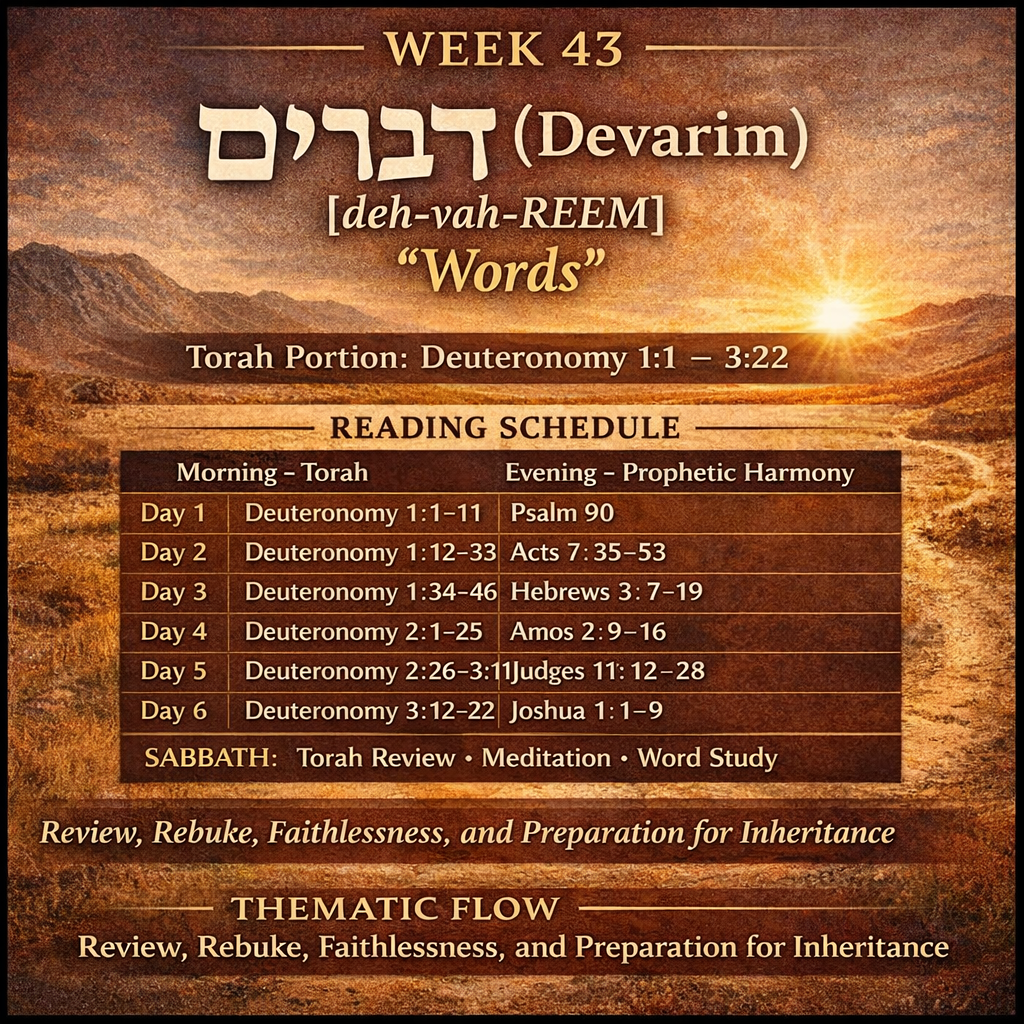
WEEK 43 — דְּבָרִים (Devarim) [deh-vah-REEM] — “Words”
Torah Portion: Deuteronomy 1:1 – 3:22
READING SCHEDULE
| Day | Morning — Torah | Evening — Prophetic Harmony |
|---|---|---|
| Day 1 | Deuteronomy 1 : 1 – 11 | Psalm 90 |
| Day 2 | Deuteronomy 1 : 12 – 33 | Acts 7 : 35 – 53 |
| Day 3 | Deuteronomy 1 : 34 – 46 | Hebrews 3 : 7 – 19 |
| Day 4 | Deuteronomy 2 : 1 – 25 | Amos 2 : 9 – 16 |
| Day 5 | Deuteronomy 2 : 26 – 3 : 11 | Judges 11 : 12 – 28 |
| Day 6 | Deuteronomy 3 : 12 – 22 | Joshua 1 : 1 – 9 |
| SABBATH | Torah Review · Meditation · Word Study | Household & Assembly Application |
THEMATIC FLOW — REVIEW, REBUKE, FAITHLESSNESS, AND PREPARATION FOR INHERITANCE
Devarim begins with Moshe recounting Yahuah’s dealings with Israel over forty years. Standing on the threshold of the land, he delivers “words” that review history, confront rebellion, and prepare the next generation for covenant faithfulness.
Deuteronomy 1 recounts the appointment of leaders, the journey from Horeb, and the sin of the spies that resulted in forty years of wandering. Moshe reminds Israel that unbelief and rebellion turned an eleven-day journey into decades of delay.
Deuteronomy 2 reviews Israel’s journey around Edom, Moav, and Ammon, showing how Yahuah protected their inheritance and prohibited Israel from taking land not given to them. Yahuah is sovereign over all nations; boundaries and inheritances are His to assign.
Deuteronomy 2:24–3:11 recounts Israel’s victories over Sihon king of Heshbon and Og king of Bashan — decisive demonstrations of Yahuah’s power. These victories are given as encouragement: as Yahuah delivered these kings, so He will deliver the nations ahead.
Deuteronomy 3 ends with Moshe encouraging Yehoshua to be strong and courageous, and with Moshe pleading to enter the land — a request Yahuah denies, demonstrating the seriousness of leadership responsibility.
Devarim reveals that preparation for inheritance requires remembering Yahuah’s works, confronting past failures, trusting His sovereignty, and strengthening faith for the battles ahead.
HEBREW WORD STUDY — דְּבָרִים (Devarim)
Block: דברים Paleo: 𐤃𐤁𐤓𐤉𐤌
Root: דבר — “word,” “speak,” “order,” “command”
| Letter | Symbol | Meaning | Prophetic Role |
|---|---|---|---|
| 𐤃 Dalet | Door | Entryway / pathway | Words open or close paths |
| 𐤁 Bet | House | Dwelling | Words establish order within the house |
| 𐤓 Resh | Head | Authority | Divine authority expressed in words |
| 𐤉 Yod | Hand | Action | Words shape action and obedience |
| 𐤌 Mem | Water | Chaos | Words bring order out of chaos |
Paleo Meaning:
“Authoritative words that open the path, establish order, and bring action under Yahuah’s authority.”
PROPHETIC PALEO-HEBREW WORD PICTURE
Devarim reveals that words determine destiny. Moshe’s final speeches become the doorway (dalet) into covenant inheritance, establishing order in Yahuah’s house and bringing action under His authority. The Paleo picture shows Yahuah’s words bringing order from chaos and directing the future of His people.
SABBATH MEDITATION
Meditate on the power of words — Yahuah’s words that create destiny, Moshe’s words that rebuke and restore, and your own words that shape obedience or disobedience. Devarim calls us to remember, repent, and walk forward in faith.
REFLECTION AND DISCUSSION QUESTIONS
Heart (Individual)
-
Which past failures do I need to acknowledge and learn from?
-
Do Yahuah’s words shape my decisions and direction?
-
Am I preparing my heart to receive the inheritance ahead?
Household (Family)
-
Are we remembering Yahuah’s works together as a family?
-
Are our words building faith, order, and obedience in the home?
Assembly (Corporate)
-
Are we equipping the next generation with memory, courage, and covenant identity?
-
Do we confront unbelief and rebellion with truth and patience?
PRAYER FOR SABBATH
Yahuah,
Open our hearts to Your words.
Teach us to remember Your works,
repent of our failures,
and walk forward with faith and courage.
Prepare us for the inheritance You have promised.
Strengthen our leaders, our families, and our assembly
to obey Your commands and trust in Your goodness.
In Yahusha’s Name — Amein.
KEY THEMATIC INSIGHTS
Memory Is Preparation for Inheritance
Moshe recounts Israel’s history so the next generation will enter the land with understanding and reverence.
Unbelief Turns Short Journeys into Long Wandering
Deuteronomy 1 reveals how rebellion delays destiny.
Yahuah Assigns Boundaries and Honors Inheritance
Israel is forbidden from attacking certain nations because their land was given by Yahuah (Deuteronomy 2).
Past Victories Build Courage for Future Battles
The defeat of Sihon and Og proves Yahuah’s faithfulness and power.
Leadership Carries Weight, Responsibility, and Sacrifice
Moshe’s denied entry (Deuteronomy 3:23–27) illustrates the seriousness of representing Yahuah.
FOOTNOTES
-
Deuteronomy 1 — review of leadership, rebellion, and delay.
-
Deuteronomy 2 — journey around nations with divine boundaries.
-
Deuteronomy 3 — victories and leadership transition.
-
Acts 7 — interpretation of Israel’s rebellion.
-
Joshua 1 — encouragement for Yehoshua.

2 Responses
I am new in the messianic walk , I can’t go back to my old ways knowing the little I received from the Holy Spirit through my own studies , I need help and direction on how to become a voice on this beautiful call , looking forward to learning and eventually teaching others in our journey back to our Eternal Father through Yeshua Messiah. I am 65 Year old but willing to do my best to help .
Thank you
Shalom. Thank you for your humility and honesty.
Let me say this plainly—and personally: I turned 66 in March, so I understand exactly where you’re coming from. Age is not a disadvantage in this walk. If anything, it sharpens discernment. Scripture never treats calling as something reserved for the young; it values wisdom that has been tested by time, hardship, and faithfulness.
You’re also right about something many try to ignore: once Yahuah opens your eyes, there is no going back. That inner unease toward your former ways is not guilt or fear—it’s conviction. That’s the Ruach doing what He does best: separating truth from habit. You haven’t “arrived,” but you have been called out, and that matters.
Now hear this carefully, because this is where many sincere people stumble:
👉 Do not rush to become a “voice.”
First, become rooted.
The Messianic walk is not built on excitement or fragments of truth. It is formed through order, structure, and submission to the whole counsel of Scripture—Torah, Prophets, Writings, and the Apostolic witness together. Zeal without grounding doesn’t produce clarity; it produces confusion, even with good intentions.
Here is the path forward—the one Scripture consistently affirms:
Sit before you speak.
Yahusha trained His disciples before He sent them. Time spent learning is not wasted time; it’s necessary preparation.
Unlearn before you relearn.
Many inherited teachings must be tested by Scripture, not defended by tradition. That process takes patience and humility.
Build foundations, not platforms.
Teaching flows from obedience, not from gifting or enthusiasm. Authority comes from alignment, not volume.
Let your life teach first.
Faithfulness, repentance, and consistency speak louder than any lesson you will ever give.
You are not late. I’m not late either. We’re right where obedience placed us.
If you’re willing to learn carefully, test everything by Scripture, and walk this out faithfully, Yahuah will open doors in His time—not ours. Teaching is a stewardship, not a title.
Stay hungry. Stay humble. Stay anchored in the Word.
The rest comes when it’s supposed to.
Shalom.