
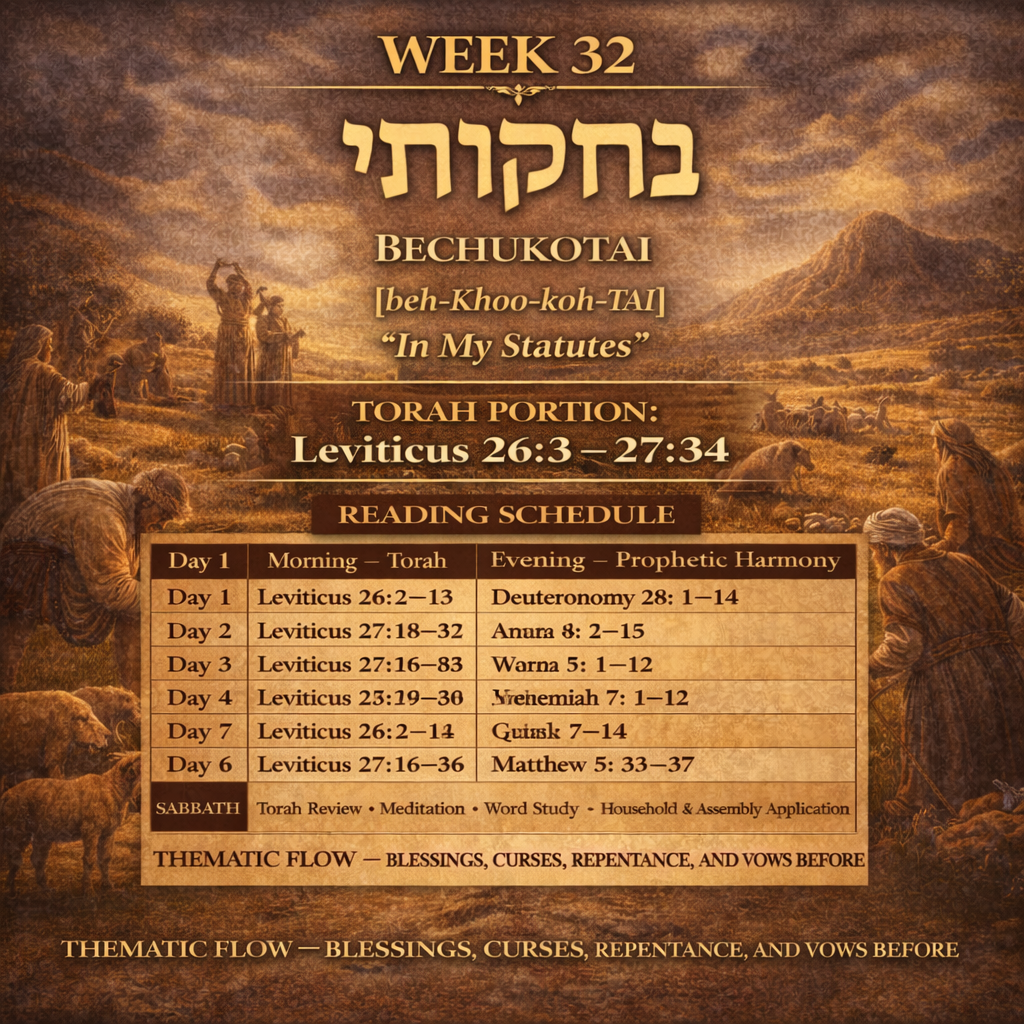
WEEK 32 — בְּחֻקֹּתַי (Bechukotai) [beh-khoo-koh-TAI] — “In My Statutes”
Torah Portion: Leviticus 26:3 – 27:34
READING SCHEDULE
| Day | Morning — Torah | Evening — Prophetic Harmony |
|---|---|---|
| Day 1 | Leviticus 26 : 3 – 13 | Deuteronomy 28 : 1 – 14 |
| Day 2 | Leviticus 26 : 14 – 26 | Amos 4 : 1 – 13 |
| Day 3 | Leviticus 26 : 27 – 39 | Hosea 5 : 1 – 15 |
| Day 4 | Leviticus 26 : 40 – 46 | Zechariah 10 : 6 – 12 |
| Day 5 | Leviticus 27 : 1 – 15 | Acts 5 : 1 – 11 |
| Day 6 | Leviticus 27 : 16 – 34 | Matthew 5 : 33 – 37 |
| SABBATH | Torah Review · Meditation · Word Study | Household & Assembly Application |
THEMATIC FLOW — BLESSINGS, CURSES, REPENTANCE, AND VOWS BEFORE YAHUAH
Bechukotai closes the book of Leviticus with a covenant summary. Leviticus 26 presents the blessings for obedience and the curses for disobedience, forming one of the most comprehensive covenant outlines in Scripture. If Israel walks in Yahuah’s statutes and keeps His commands, they receive rain in its season, peace in the land, victory over enemies, fruitfulness, and Yahuah’s dwelling among them (26:3–13). Blessing flows directly from obedience.
But if Israel rejects His statutes, abhors His judgments, and breaks covenant, the curses intensify step by step: terror, disease, famine, defeat, desolation, exile, and the land enjoying its Sabbaths while Israel is removed from it (26:14–39). Disobedience brings covenant consequences.
Yet even in judgment, Yahuah remembers the covenant. If Israel confesses their sin and humbles themselves, Yahuah will remember His covenant with Ya’aqov, Yitsḥaq, and Avraham, and restore them (26:40–46). Mercy follows repentance.
Leviticus 27 addresses vows — voluntary expressions of devotion. The chapter regulates valuations of persons, animals, houses, and land dedicated to Yahuah. Vows must be honored; holiness requires integrity.
Bechukotai reveals the covenant in its fullness: blessing for obedience, discipline for rebellion, mercy upon repentance, and integrity in devoted offerings.
HEBREW WORD STUDY — בְּחֻקֹּתַי (Bechukotai)
Block: בחקתי Paleo: 𐤁𐤇𐤒𐤕𐤉 Root: חק — “statute,” “engraving,” “inscription”
| Letter | Symbol | Meaning | Prophetic Role |
|---|---|---|---|
| 𐤁 Bet | House | Dwelling / family | Life ordered inside Yahuah’s house |
| 𐤇 Chet | Fence | Boundary | Covenant boundaries of holiness |
| 𐤒 Qof | Back of head | Horizon / holiness | Set-apart instructions that lift Israel apart |
| 𐤕 Tav | Mark | Covenant sign | Covenant mark of obedience |
| 𐤉 Yod | Hand | Work / action | Walking out His statutes in daily life |
Paleo Meaning:
“Within Yahuah’s house, His engraved covenant boundaries mark the path of obedience.”
PROPHETIC PALEO-HEBREW WORD PICTURE
Bechukotai reveals that Yahuah’s statutes are not suggestions — they are engravings, carved boundaries, covenant markers. The Paleo picture shows a house surrounded by boundaries, marked by covenant, and requiring action. Blessings flow when Israel walks within these engraved paths; curses arise when the boundaries are abandoned.
SABBATH MEDITATION
Consider the weight of the covenant: blessing or curse, life or desolation, determined by obedience or rebellion. Bechukotai calls us to examine our walk — are we living inside the boundaries Yahuah has engraved? Repentance opens the door to restoration; obedience opens the door to blessing. Holiness requires alignment with His statutes.
REFLECTION AND DISCUSSION QUESTIONS
Heart (Individual)
-
Am I walking in Yahuah’s engraved boundaries or creating my own?
-
Which areas of my life need repentance and alignment?
-
Do I honor my commitments and vows before Yahuah?
Household (Family)
-
Is our home structured around obedience to Yahuah’s commands?
-
How can we model repentance, restoration, and covenant integrity?
Assembly (Corporate)
-
Are we teaching the blessings of obedience and the consequences of rebellion?
-
Do we uphold integrity in offerings, commitments, and community standards?
PRAYER FOR SABBATH
Yahuah,
Engrave Your statutes on our hearts.
Teach us to walk in obedience,
to repent quickly,
and to honor the vows we make before You.
Let our homes and assemblies live inside
Your covenant boundaries
so that Your blessing may rest upon us.
In Yahusha’s Name — Amein.
KEY THEMATIC INSIGHTS
Blessings Flow from Obedience
Leviticus 26:3–13 outlines rain, fruitfulness, victory, peace, and Yahuah’s presence for those who walk in His statutes — obedience brings life.
Covenant Curses Intensify with Rebellion
Leviticus 26:14–39 reveals escalating discipline for disobedience, culminating in exile and desolation when Israel abandons Yahuah’s commands.
Repentance Opens the Door to Restoration
If Israel confesses their sin and humbles themselves, Yahuah remembers the covenant with the patriarchs and restores them (26:40–46).
Yahuah Owns the Land and Its Sabbaths
Israel’s exile allows the land to enjoy the Sabbaths they neglected (26:34–35), showing that creation itself responds to covenant obedience.
Vows Must Be Honored with Integrity
Leviticus 27 teaches that voluntary vows carry weight. Dedications to Yahuah require honesty, valuation, and faithfulness.
FOOTNOTES
-
Leviticus 26 — covenant blessings and curses.
-
Leviticus 27 — laws concerning vows and dedications.
-
Deuteronomy 28 — parallel covenant blessings and curses.
-
Hosea 5 — consequences of rebellion.
-
Zechariah 10 — restoration after repentance.
