
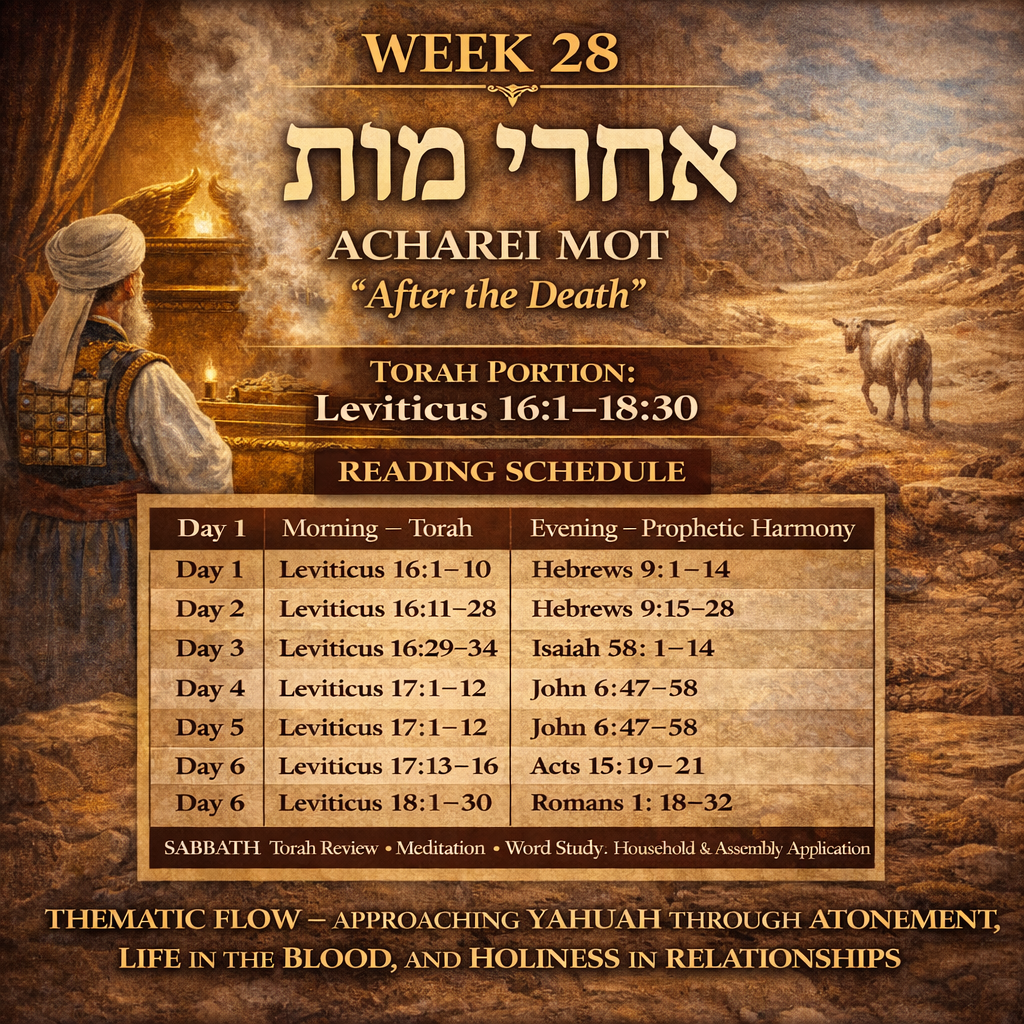
WEEK 28 — אַחֲרֵי מוֹת (Acharei Mot) [ah-khah-RAY moht] — “After the Death”
Torah Portion: Leviticus 16:1 – 18:30
READING SCHEDULE
| Day | Morning — Torah | Evening — Prophetic Harmony |
|---|---|---|
| Day 1 | Leviticus 16 : 1 – 10 | Hebrews 9 : 1 – 14 |
| Day 2 | Leviticus 16 : 11 – 28 | Hebrews 9 : 15 – 28 |
| Day 3 | Leviticus 16 : 29 – 34 | Isaiah 58 : 1 – 14 |
| Day 4 | Leviticus 17 : 1 – 12 | John 6 : 47 – 58 |
| Day 5 | Leviticus 17 : 13 – 16 | Acts 15 : 19 – 21 |
| Day 6 | Leviticus 18 : 1 – 30 | Romans 1 : 18 – 32 |
| SABBATH | Torah Review · Meditation · Word Study | Household & Assembly Application |
THEMATIC FLOW — APPROACHING YAHUAH THROUGH ATONEMENT, LIFE IN THE BLOOD, AND HOLINESS IN RELATIONSHIPS
Acharei Mot opens “after the death” of Aharon’s sons, reminding Israel that access to Yahuah is dangerous without obedience. Leviticus 16 outlines the Day of Atonement — the holiest day of the year — when the high priest enters the Most Set-Apart Place. This chapter reveals the seriousness of sin, the necessity of blood atonement, and the grace of Yahuah in providing a way for His people to be cleansed.
The scapegoat ceremony emphasizes the removal of iniquity, transgression, and sin from the people. One goat is sacrificed; the other is sent away into the wilderness — a prophetic picture of judgment, substitution, and cleansing.
Leviticus 17 establishes that life is in the blood, and therefore blood is reserved for atonement alone. Israel is forbidden from consuming blood, reinforcing the sanctity of life and the covenant boundaries Yahuah sets.
Leviticus 18 addresses forbidden relationships. These commands are not cultural but covenantal, separating Israel from the practices of Mitsrayim and Kena’an. Sexual purity becomes a guardrail protecting the sanctity of family, community, and worship. Defilement in these areas leads to the land itself expelling its inhabitants.
Acharei Mot reveals that holiness involves the inner life, the blood, the family, the body, and the boundaries of covenant relationships. Access to Yahuah requires purity, obedience, and respect for His appointed order.
HEBREW WORD STUDY — אַחֲרֵי מוֹת (Acharei Mot)
Block: אחרי מות Paleo: 𐤀𐤇𐤓𐤉 𐤌𐤕 Root: אחר — “after,” “behind” + מות — “death”
| Letter | Symbol | Meaning | Prophetic Role |
|---|---|---|---|
| 𐤀 Aleph | Ox | Strength / leader | Yahuah’s authority over life and death |
| 𐤇 Chet | Fence | Boundary | Sacred boundaries for approaching Yahuah |
| 𐤓 Resh | Head | Person | Humanity under divine order |
| 𐤉 Yod | Hand | Work | The priestly work required for atonement |
| 𐤌 Mem | Water | Chaos / blood | Life and atonement through blood |
| 𐤕 Tav | Mark | Covenant | Covenant restoration through appointed means |
Paleo Meaning:
“After death, covenant boundaries and priestly work restore life through blood.”
PROPHETIC PALEO-HEBREW WORD PICTURE
Acharei Mot reveals the seriousness of approaching Yahuah after judgment has fallen. The death of Nadav and Avihu sets the stage for the Day of Atonement: access requires order, blood, cleansing, separation, and covenant alignment. The Paleo picture shows the pathway from death back into covenant life through the priestly work and the blood that secures atonement.
SABBATH MEDITATION
Meditate on the holiness of Yahuah and the mercy that He provides through atonement. Access to His presence is a gift, not a right. Acharei Mot calls us to honor His boundaries, submit to His order, and allow His appointed means of cleansing to renew us. Holiness is not an ideal — it is a requirement for drawing near.
REFLECTION AND DISCUSSION QUESTIONS
Heart (Individual)
-
Am I approaching Yahuah with reverence, or with self-defined spirituality?
-
What does the Day of Atonement teach me about the seriousness of sin?
-
Where do I need to submit to Yahuah’s boundaries in my personal life?
Household (Family)
-
How can our family honor Yahuah’s standards for purity, relationships, and boundaries?
-
Are we teaching our home the sanctity of life found in the blood?
Assembly (Corporate)
-
Does our assembly reflect Yahuah’s holiness in how we approach Him?
-
Are we upholding and teaching the relational boundaries commanded by Yahuah?
PRAYER FOR SABBATH
Yahuah,
Teach us the fear of Your Name.
Cleanse us through Your appointed means.
Restore us through the atonement You provide.
Guard our homes, our hearts, and our relationships.
Lead us in holiness
as we walk in covenant with You.
In Yahusha’s Name — Amein.
KEY THEMATIC INSIGHTS
Atonement as Ordered Access
The Day of Atonement (Leviticus 16) establishes that sacred access to Yahuah is granted only through the priest, through blood, and through obedience to the commanded order.
The Scapegoat and Removal of Sin
The live goat carries the iniquities of Israel into the wilderness (Leviticus 16:21–22), portraying both substitution and the complete removal of sin from the community.
Life in the Blood
Leviticus 17 declares that life is in the blood and that blood is given for atonement on the altar. Israel is forbidden to eat blood, reinforcing the sanctity of life and sacrifice.
Boundaries in Relationships
Leviticus 18 lists forbidden relationships to protect family order, covenant identity, and the holiness of Israel. Violating these boundaries defiles the land (Leviticus 18:24–28).
Holiness as Separation from the Nations
Israel is commanded not to follow the practices of Mitsrayim or Kena’an (Leviticus 18:1–5). Holiness requires separation from the defilement of surrounding cultures.
FOOTNOTES
-
Leviticus 16 — the Day of Atonement and priestly access.
-
Leviticus 17 — sanctity of blood and covenant life.
-
Leviticus 18 — relational holiness and covenant boundaries.
-
Hebrews 9 — the heavenly pattern of Yom Kippur.
-
Romans 1 — consequences of rejecting divine boundaries.
