
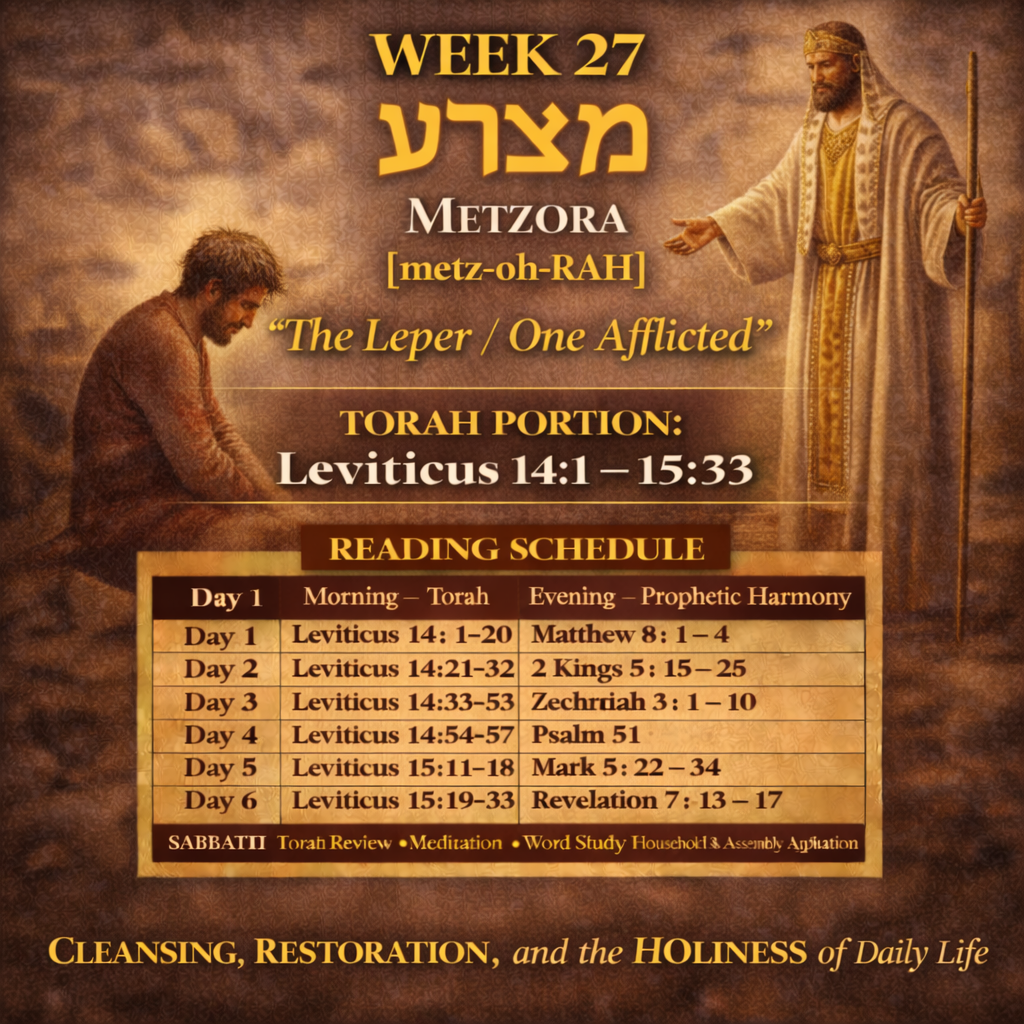
WEEK 27 — מְּצֹרָע (Metzora) [metz-oh-RAH] — “The Leper / One Afflicted”
Torah Portion: Leviticus 14:1 – 15:33
READING SCHEDULE
| Day | Morning — Torah | Evening — Prophetic Harmony |
|---|---|---|
| Day 1 | Leviticus 14 : 1 – 20 | Matthew 8 : 1 – 4 |
| Day 2 | Leviticus 14 : 21 – 32 | 2 Kings 5 : 15 – 27 |
| Day 3 | Leviticus 14 : 33 – 53 | Zechariah 3 : 1 – 10 |
| Day 4 | Leviticus 14 : 54 – 57 | Psalm 51 |
| Day 5 | Leviticus 15 : 1 – 18 | Mark 5 : 24 – 34 |
| Day 6 | Leviticus 15 : 19 – 33 | Revelation 7 : 13 – 17 |
| SABBATH | Torah Review · Meditation · Word Study | Household & Assembly Application |
THEMATIC FLOW — CLEANSING, RESTORATION, AND THE HOLINESS OF DAILY LIFE
Metzora continues the themes of impurity introduced in Tazria, but now shifts from diagnosis to restoration. Leviticus 14 opens with the detailed purification process for a person healed of ṣaraʿat. This ceremony includes living water, cedar wood, scarlet, hyssop, and the release of a living bird — symbols of cleansing, renewal, and restored life. The priest performs the ritual, declares the person clean, and reintegrates them into the community.
The chapter also addresses ṣaraʿat in houses, symbolizing how defilement can take root in the physical structures of life, requiring inspection, cleansing, and sometimes complete removal. Holiness is not abstract; it affects homes, dwellings, boundaries, and environments.
Leviticus 15 then outlines the laws concerning bodily discharges. Whether from natural functions or pathological conditions, these impurities affect not only the individual but everything they touch. These laws emphasize responsibility, awareness, and the sanctity of Israel’s camp. Yahuah’s presence dwells among them, and impurity cannot be ignored.
Metzora reveals the heart of Yahuah: impurity is real, but restoration is possible. Holiness requires vigilance, humility, and action. The priest becomes the mediator of cleansing, foreshadowing Yahusha, whose touch cleanses the unclean and restores the outcast.
HEBREW WORD STUDY — מְּצֹרָע (Metzora)
Block: מצרע Paleo: 𐤌𐤑𐤓𐤏 Root: צרע — “to be stricken,” “to be afflicted,” “to have leprosy”
| Letter | Symbol | Meaning | Prophetic Role |
|---|---|---|---|
| 𐤌 Mem | Water | Flow / chaos | Impurity flowing outward, affecting life |
| 𐤑 Tsade | Hook | Righteousness / desire | The need for righteousness to “hook” and separate impurity |
| 𐤓 Resh | Head | Person / authority | The afflicted person under priestly authority |
| 𐤏 Ayin | Eye | Seeing / revealing | The revealing of hidden defilement |
Paleo Meaning:
“Impurity flowing outward must be revealed and separated under righteous authority.”
PROPHETIC PALEO-HEBREW WORD PICTURE
Metzora shows the journey from exposure to restoration. Impurity spreads until it is confronted, seen, and separated. The priest becomes the eye of covenant authority, discerning what must be removed so life can be restored. The living water, the hyssop, the cedar wood, and the released bird foreshadow the cleansing found in Messiah, who restores what impurity has taken.
SABBATH MEDITATION
Consider that Yahuah does not leave impurity hidden. He reveals it so He can cleanse it. Metzora teaches that restoration is intentional and relational. The afflicted person must come forward, submit to examination, follow the process, and let Yahuah’s appointed order bring renewal. There is no shame in purification — only in refusing it.
REFLECTION AND DISCUSSION QUESTIONS
Heart (Individual)
-
What areas of my life need examination, cleansing, or renewal?
-
Am I willing to submit to Yahuah’s process for restoration?
-
Where has impurity touched my habits, environment, or relationships?
Household (Family)
-
Are there elements in our home that need cleansing, removal, or renewal?
-
How can our family practice awareness of what defiles and what restores?
Assembly (Corporate)
-
Do we embrace those seeking restoration as Yahusha did with the afflicted?
-
Are we discerning enough to recognize spiritual “plagues” affecting the community?
PRAYER FOR SABBATH
Yahuah,
Cleanse us from impurity,
restore what has been afflicted,
and renew our homes, our bodies, and our assemblies.
Reveal what lies hidden,
separate what must be removed,
and restore us to the fullness of covenant life.
In Yahusha’s Name — Amein.
KEY THEMATIC INSIGHTS
Cleansing as Restoration, Not Punishment
The purification rituals of Leviticus 14 emphasize restoration to community and covenant life, revealing Yahuah’s desire to heal rather than exile.
The Role of the Priest in Discernment and Renewal
The priest examines, declares, cleanses, and restores (Leviticus 14:1–20), modeling spiritual authority as a mediator of renewal.
Defilement in Homes and Environments
The laws concerning houses with ṣaraʿat (Leviticus 14:33–53) teach that impurity can affect physical spaces, requiring inspection, cleansing, and sometimes removal of corrupt structures.
The Contagious Nature of Impurity
Leviticus 15 shows that impurity spreads through contact, teaching Israel vigilance, awareness, and responsibility in daily life.
Holiness in Daily Bodily Realities
Natural bodily functions still require purification (Leviticus 15:1–33), revealing that holiness encompasses every dimension of human life — physical, emotional, relational, and spiritual.
FOOTNOTES
-
Leviticus 14 — ritual purification and symbolic restoration.
-
Leviticus 15 — bodily impurities and communal holiness.
-
Matthew 8 — Yahusha cleansing the leper.
-
2 Kings 5 — Na’aman’s cleansing and Gehazi’s judgment.
-
Zechariah 3 — cleansing and restoration of the priesthood.
