
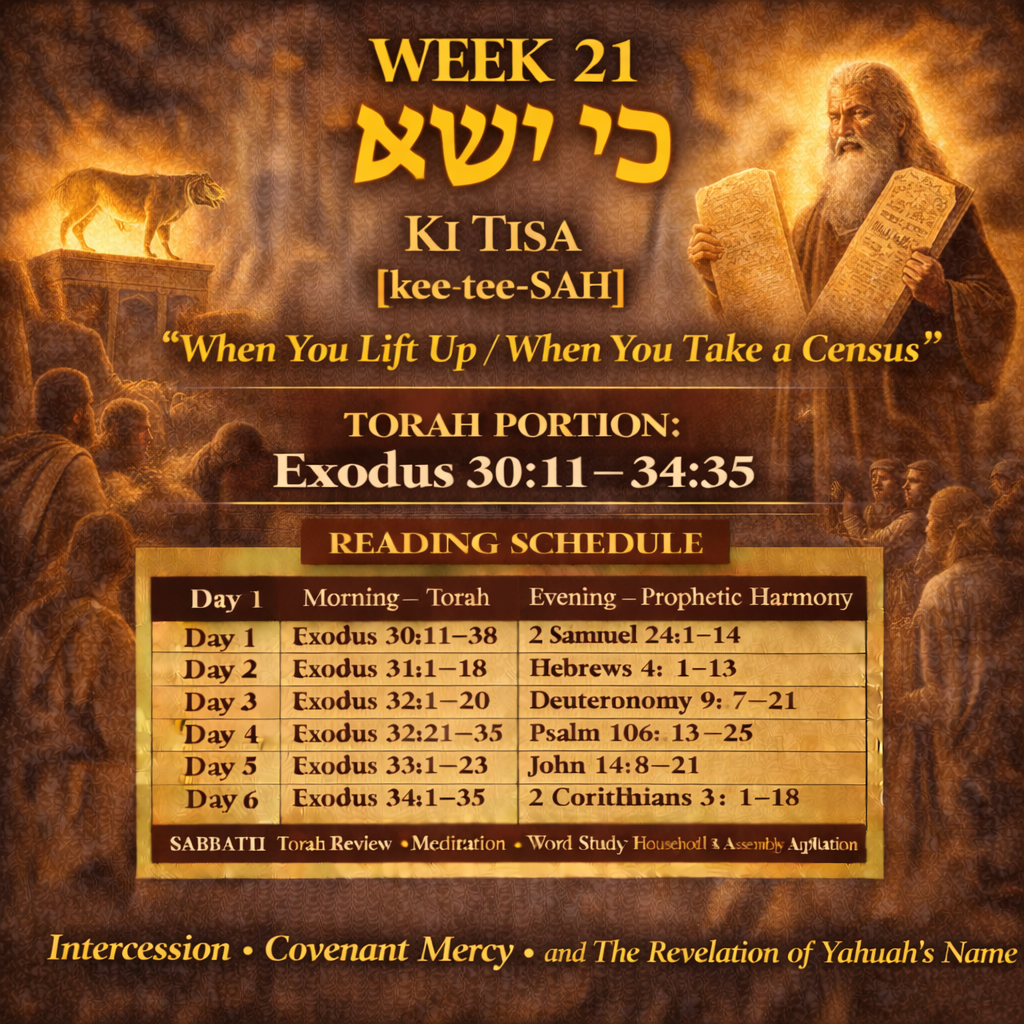
WEEK 21 — כִּי תִשָּׂא (Ki Tisa) [kee tee-SAH] — “When You Lift Up / When You Take a Census”
Torah Portion: Exodus 30 : 11 – 34 : 35
READING SCHEDULE
| Day | Morning — Torah | Evening — Prophetic Harmony |
|---|---|---|
| Day 1 | Exodus 30 : 11 – 38 | 2 Samuel 24 : 1 – 14 |
| Day 2 | Exodus 31 : 1 – 18 | Hebrews 4 : 1 – 13 |
| Day 3 | Exodus 32 : 1 – 20 | Deuteronomy 9 : 7 – 21 |
| Day 4 | Exodus 32 : 21 – 35 | Psalm 106 : 13 – 23 |
| Day 5 | Exodus 33 : 1 – 23 | John 14 : 8 – 21 |
| Day 6 | Exodus 34 : 1 – 35 | 2 Corinthians 3 : 1 – 18 |
SABBATH | Torah Review · Meditation · Word Study | Household & Assembly Application
THEMATIC FLOW — INTERCESSION, COVENANT MERCY, AND THE REVELATION OF YAHUAH’S NAME
“When you lift up (ki tisa) the heads of the children of Yisra’el…” (Exodus 30 : 12)
Ki Tisa opens with the census ransom — a half-shekel given by each man as atonement for his life. This teaches that every life in Israel is accounted for before Yahuah, and every soul carries equal value. No one may come before Yahuah without redemption.
We then see the anointing oil, the incense, the artisans Bezalel and Oholiab, and the command to guard the Sabbath — a perpetual sign of covenant. The tone shifts abruptly in chapter 32 as Israel commits one of its greatest sins: the golden calf.
While Moses is receiving the tablets of the covenant, the people grow impatient and demand a visible deity. Aharon compromises, and idolatry erupts. Yahuah’s anger burns; Moses intercedes, breaks the tablets, destroys the idol, confronts the people, and restores order. This moment becomes the defining example of Israel’s unfaithfulness — and of Moses’ intercession.
In chapter 33, Moses pleads: “Show me Your glory.” Yahuah reveals His goodness, His Name, and His character — merciful, gracious, slow to anger, abundant in kindness and truth. This revelation becomes the foundation of all covenant understanding.
In chapter 34, the covenant is renewed. Moses receives a second set of tablets. His face shines with the reflected glory of Yahuah.
Ki Tisa teaches the gravity of sin, the necessity of intercession, the wonder of mercy, and the glory of restored covenant.
HEBREW WORD STUDY — כִּי תִשָּׂא (Ki Tisa)
Block: כי תשא Paleo: 𐤊 𐤉 𐤕 𐤔 𐤀 Root: נשא (nasa) — to lift, carry, bear, forgive
| Letter | Symbol | Meaning | Prophetic Role |
|---|---|---|---|
| 𐤊 Kaf | Palm | Covering / Allowing | Covering or bearing guilt |
| 𐤉 Yod | Hand | Work / Deed | The act of lifting or accounting |
| 𐤕 Tav | Mark | Covenant | Accountability in covenant |
| 𐤔 Shin | Teeth | Consume / Judge | Sin confronted and judged |
| 𐤀 Aleph | Ox | Leader / Strength | Yahuah bearing and forgiving |
Paleo Meaning:
“The covering work lifts and bears the covenant people as sin is judged and forgiveness revealed.”
PROPHETIC PALEO-HEBREW WORD PICTURE
Ki Tisa reveals the tension between judgment and mercy. The people sin. Moses intercedes. Yahuah forgives — yet sin is not ignored. The lifted head is both accountability and redemption. Yahuah reveals His Name as the One who carries, forgives, restores, and renews.
SABBATH MEDITATION
Sabbath calls us to remember the seriousness of idolatry — not merely statues, but anything that replaces Yahuah’s authority in our lives. Israel’s impatience led to rebellion. We, too, are tested in the waiting.
Sabbath invites us to meditate on the mercy of Yahuah, who renews covenant even after great failure. His glory is revealed not only in fire and thunder, but in compassion and forgiveness. Moses’ shining face reminds us that intimacy with Yahuah transforms us into His likeness.
REFLECTION AND DISCUSSION QUESTIONS
Heart (Individual)
-
What “golden calves” tempt me when I grow impatient?
-
Do I understand the weight of intercession for others?
-
How am I reflecting the glory of Yahuah in my life?
Household (Family)
4. Are we guarding our home from idols, distractions, and impatience?
5. How can we cultivate intercession and mercy within our family?
Assembly (Corporate)
6. Do we handle sin, repentance, and restoration with Yahuah’s balance of justice and mercy?
7. Are we a community that seeks His presence rather than man-made substitutes?
PRAYER / DECLARATION FOR SABBATH
Yahuah,
You are merciful and gracious,
slow to anger and abounding in kindness and truth.
Lift our heads in covenant mercy.
Cleanse us from hidden idols.
Teach us the heart of intercession.
Reveal Your glory in our midst,
and renew Your covenant within our hearts.
In Yahusha’s Name — Amein.
JOTS & TITTLES
| Reference | Marker | Description | Prophetic Meaning |
|---|---|---|---|
| Exodus 30 : 12 | Half-shekel ransom | Atonement | Every soul accounted for |
| Exodus 31 : 13–17 | Sabbath sign | Perpetual covenant | Identity of Yahuah’s people |
| Exodus 32 : 19 | Broken tablets | Covenant shattered | Consequences of idolatry |
| Exodus 34 : 6–7 | Revelation of the Name | Mercy & justice | Yahuah’s character revealed |
FOOTNOTES
-
Exodus 30 — census, anointing oil, incense; holiness and atonement.
-
Exodus 31 — Sabbath as covenant sign.
-
Exodus 32 — golden calf rebellion and judgment.
-
Exodus 33 — intercession and divine presence.
-
Exodus 34 — renewed covenant and revelation of Yahuah’s Name.
-
Hebrews 4 — rest, obedience, and Yahuah’s Word.
