
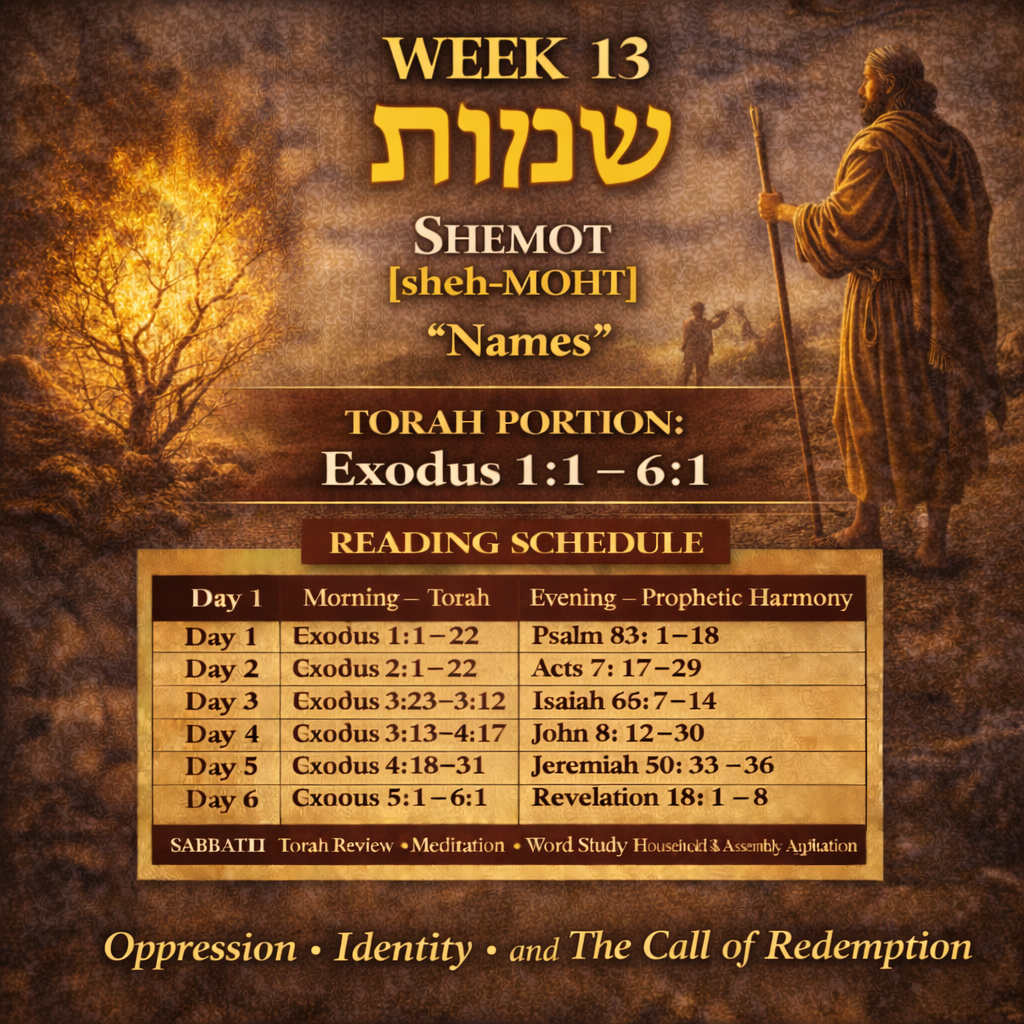
WEEK 13 — שְׁמוֹת (Shemot) [sheh-MOHT] — “Names”
Torah Portion: Exodus 1 : 1 – 6 : 1
READING SCHEDULE
| Day | Morning — Torah | Evening — Prophetic Harmony |
|---|---|---|
| Day 1 | Exodus 1 : 1 – 22 | Psalm 83 : 1 – 18 |
| Day 2 | Exodus 2 : 1 – 22 | Acts 7 : 17 – 29 |
| Day 3 | Exodus 2 : 23 – 3 : 12 | Isaiah 63 : 7 – 14 |
| Day 4 | Exodus 3 : 13 – 4 : 17 | John 8 : 12 – 30 |
| Day 5 | Exodus 4 : 18 – 31 | Jeremiah 50 : 33 – 36 |
| Day 6 | Exodus 5 : 1 – 6 : 1 | Revelation 18 : 1 – 8 |
SABBATH | Torah Review · Meditation · Word Study | Household & Assembly Application
THEMATIC FLOW — OPPRESSION, IDENTITY, AND THE CALL OF REDEMPTION
“These are the names (shemot) of the sons of Israel who came into Egypt…” (Exodus 1 : 1)
Shemot marks the beginning of Israel’s national story. Genesis ends with a family; Exodus begins with a nation under bondage. Egypt forgets Joseph, and the new Pharaoh fears the growing strength of Israel. Oppression intensifies — forced labor, bitter bondage, and eventually the decree to kill every male child.
Yet the more they are afflicted, the more they multiply. Covenant cannot be crushed by oppression.
Moses is born into this climate of death, yet Yahuah preserves him through the courage of midwives, the faith of his mother, and the unexpected kindness of Pharaoh’s daughter. Moses grows up between two worlds — Hebrew by birth, Egyptian by education — a tension that will later shape his calling.
After fleeing Egypt, Moses encounters Yahuah at the burning bush. Here Yahuah reveals His Name, His compassion, and His intention to redeem Israel: “I have surely seen… I have heard… I know their sorrows… and I have come down to deliver them.” The covenant promises given to Abraham, Isaac, and Jacob now move toward fulfillment.
Moses resists the call, offering excuses. But Yahuah equips him with signs, authority, and a commission. When Moses returns to Egypt and confronts Pharaoh, oppression increases. The people despair. Moses questions. Yet Yahuah reaffirms His plan: Pharaoh will not let Israel go until My mighty hand compels him.
Shemot teaches that redemption begins in the place of deepest oppression, and Yahuah always raises a deliverer whose weakness becomes the stage for His power.
HEBREW WORD STUDY — שְׁמוֹת (Shemot)
Block: שמות Paleo: 𐤔 𐤌 𐤅 𐤕 Root: שם (shem) — name, identity, character
| Letter | Symbol | Meaning | Prophetic Role |
|---|---|---|---|
| 𐤔 Shin | Teeth | Consuming / Fire | Fire reveals and refines identity |
| 𐤌 Mem | Water | Chaos / Nations | Identity preserved in exile and oppression |
| 𐤅 Vav | Nail | Connection | Connection of covenant name to the people |
| 𐤕 Tav | Mark | Sign / Covenant | Yahuah’s covenant mark upon His people |
Paleo Meaning:
“Identity refined in the midst of chaos, connected and marked by Yahuah’s covenant Name.”
PROPHETIC PALEO-HEBREW WORD PICTURE
Shemot reveals that Yahuah knows His people by name, even when the world forgets them. The burning bush shows that Yahuah’s fire refines but does not consume, and the Name revealed to Moses becomes the anchor of Israel’s identity.
SABBATH MEDITATION
Sabbath invites us to remember who we are — and whose we are. Israel was oppressed, but their identity was never lost. Their Names were recorded; their covenant remained intact. Even in exile, they were known by Yahuah.
Moses’ journey reveals the struggle of calling. He felt inadequate, unworthy, and afraid — yet Yahuah chooses flawed vessels to display perfect redemption.
The increase of oppression under Pharaoh teaches us that sometimes the darkest moments come just before deliverance. Yahuah hears. Yahuah remembers. Yahuah sees. And Yahuah acts.
REFLECTION AND DISCUSSION QUESTIONS
Heart (Individual)
-
Where have I forgotten my covenant identity under pressure?
-
What call of Yahuah am I resisting out of fear or inadequacy?
-
How has Yahuah preserved me in seasons of oppression or chaos?
Household (Family)
4. How can we speak and strengthen covenant identity in our home?
5. What “Pharaohs” (pressures) threaten our unity, faith, or obedience?
Assembly (Corporate)
6. Are we a community that remembers the oppressed and strengthens the weary?
7. How can we prepare ourselves for the deliverance Yahuah is bringing?
PRAYER / DECLARATION FOR SABBATH
Yahuah,
You are the Elohim who knows us by name,
who sees our affliction,
who hears our cries,
and who comes down to deliver.
Strengthen our identity,
purge our fears,
and make us faithful to Your calling.
Let Your covenant Name be upon our hearts, homes, and assemblies.
In Yahusha’s Name — Amein.
JOTS & TITTLES
| Reference | Marker | Description | Prophetic Meaning |
|---|---|---|---|
| Exodus 1 : 12 | Repetition | “The more they afflicted them, the more they multiplied” | Oppression fuels covenant growth |
| Exodus 2 : 10 | Name | “Moses” (drawn out) | Prophetic calling to draw Israel out |
| Exodus 3 : 14–15 | Divine Name | “I AM” revealed | Covenant identity of Yahuah |
| Exodus 4 : 10 | Moses’ weakness | “I am not eloquent” | Yahuah’s power made perfect in weakness |
FOOTNOTES
-
Exodus 1 — identity preserved in oppression.
-
Exodus 2 — Moses’ formative years and calling.
-
Isaiah 63 — Yahuah’s compassion in Israel’s affliction.
-
Exodus 3–4 — revelation of the Divine Name and commissioning.
-
Acts 7 — Stephen’s recounting of Moses and redemption history.
-
Revelation 18 — judgment on oppressive world systems.
