
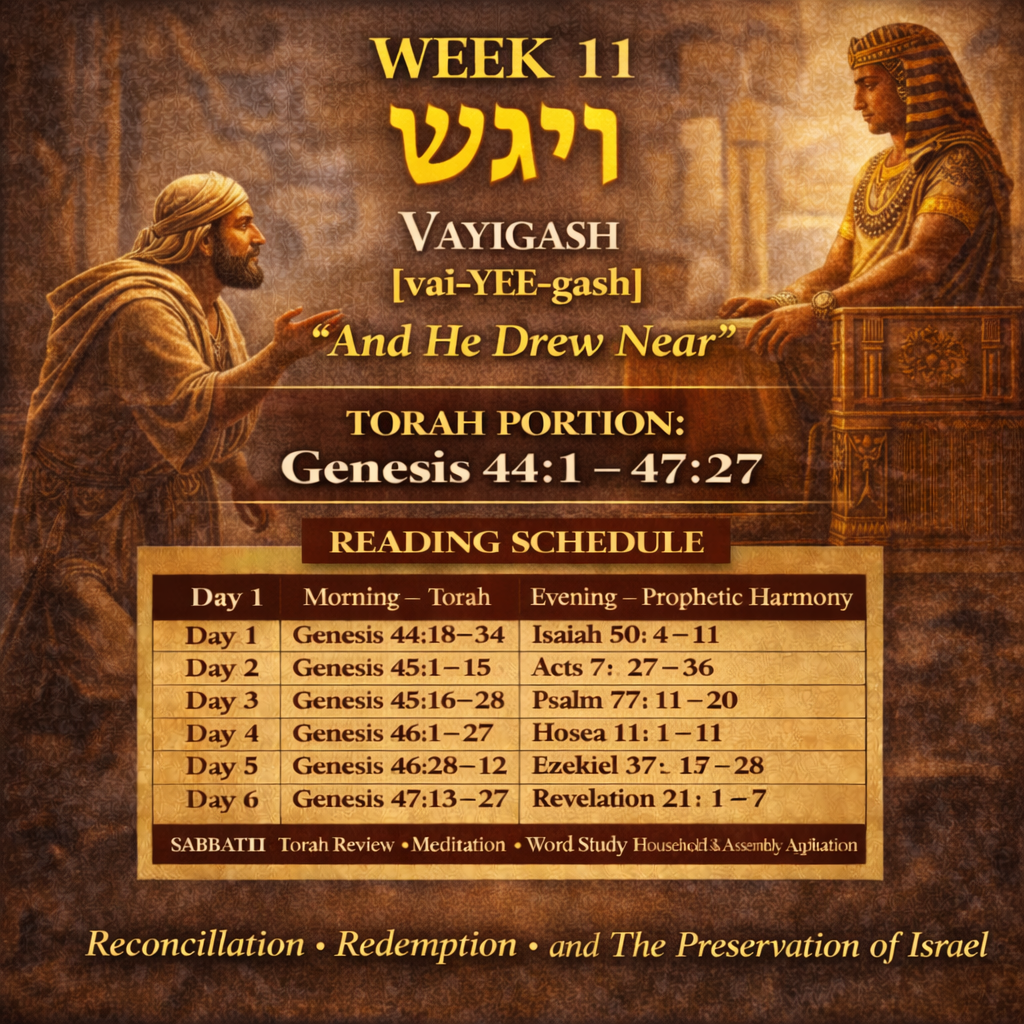
WEEK 11 — וַיִּגַּשׁ (Vayigash) [vai-YEE-gash] — “And He Drew Near”
Torah Portion: Genesis 44 : 18 – 47 : 27
READING SCHEDULE
| Day | Morning — Torah | Evening — Prophetic Harmony |
|---|---|---|
| Day 1 | Genesis 44 : 18 – 34 | Isaiah 50 : 4 – 11 |
| Day 2 | Genesis 45 : 1 – 15 | Acts 7 : 17 – 36 |
| Day 3 | Genesis 45 : 16 – 28 | Psalm 77 : 11 – 20 |
| Day 4 | Genesis 46 : 1 – 27 | Hosea 11 : 1 – 11 |
| Day 5 | Genesis 46 : 28 – 47 : 12 | Ezekiel 37 : 15 – 28 |
| Day 6 | Genesis 47 : 13 – 27 | Revelation 21 : 1 – 7 |
SABBATH | Torah Review · Meditation · Word Study | Household & Assembly Application
THEMATIC FLOW — RECONCILIATION, REDEMPTION, AND THE PRESERVATION OF ISRAEL
“And Judah drew near to him…” (Genesis 44 : 18)
Vayigash opens at the emotional and spiritual climax of the Joseph narrative. Judah steps forward — no longer the callous brother who sold Joseph, but a transformed man willing to offer himself as a substitute for Benjamin. His intercession becomes the turning point for the entire family.
Joseph, overwhelmed, can no longer conceal his identity. His revelation — “I am Joseph!” — breaks the brothers’ fear and guilt. He interprets his suffering not as tragedy but as divine orchestration: “Elohim sent me before you to preserve life.” What men meant for evil, Yahuah used for covenant preservation.
Jacob learns that Joseph is alive and journeys to Egypt. At Beersheba, Yahuah appears to him, assuring him that this descent is part of the covenant plan — a temporary exile where Israel will grow into a great nation. This moment affirms that even in foreign lands, Yahuah is faithful.
Joseph settles his family in Goshen, the best of the land, securing provision during famine. Meanwhile, Joseph manages Egypt’s crisis with wisdom, preserving both Egypt and Israel. His stewardship sets the stage for the later conflict with Pharaoh, but at this moment, it is pure blessing.
Vayigash is a portion of profound restoration. Family wounds are healed, destinies realigned, and the covenant people preserved for the future nation they will become.
HEBREW WORD STUDY — וַיִּגַּשׁ (Vayigash)
Block: ויגש Paleo: 𐤅 𐤉 𐤂 𐤔 Root: נגשׁ (nagash) — to draw near, approach
| Letter | Symbol | Meaning | Prophetic Role |
|---|---|---|---|
| 𐤅 Vav | Nail | Connection | Drawing near establishes covenant connection |
| 𐤉 Yod | Hand | Work / Action | Action toward reconciliation and responsibility |
| 𐤂 Gimel | Foot | Movement / Journey | Movement toward restoration |
| 𐤔 Shin | Teeth | Refining / Consuming | Purification through confession and truth |
Paleo Meaning:
“The act of drawing near requires action and movement that brings refinement and restoration.”
PROPHETIC PALEO-HEBREW WORD PICTURE
Vayigash portrays Judah stepping into prophetic destiny. His movement toward Joseph becomes the hinge upon which reconciliation turns. The house of Israel is restored because one man chose to draw near with humility, truth, and sacrificial love. This act foreshadows Messiah — the Lion of Judah — who draws near to redeem His brothers.
SABBATH MEDITATION
Sabbath invites us to draw near — to Yahuah, to truth, and to those from whom we have been estranged. Judah’s transformation demonstrates that leadership in Yahuah’s kingdom is built not on dominance but on sacrifice and intercession.
Joseph’s revelation teaches us to reinterpret our suffering through covenant eyes. Nothing is wasted. Nothing is random. Everything is woven by Yahuah for preservation, redemption, and future glory.
Jacob’s descent into Egypt reminds us that sometimes exile is part of the divine plan. Yahuah’s presence goes with us, guides us, and multiplies us in the places we least expect.
Rest in the certainty that drawing near brings revelation, healing, and restoration.
REFLECTION AND DISCUSSION QUESTIONS
Heart (Individual)
-
What steps do I need to take to “draw near” in reconciliation or repentance?
-
How has Yahuah used suffering for preservation rather than destruction in my life?
-
Am I willing to reinterpret painful seasons through covenant faith?
Household (Family)
4. How can our family model sacrificial love like Judah?
5. What wounds in our home need truth, humility, and restoration?
Assembly (Corporate)
6. Is our assembly a place where confession and reconciliation are encouraged?
7. How can we help preserve and strengthen the family of Israel in times of famine — spiritual or physical?
PRAYER / DECLARATION FOR SABBATH
Yahuah,
Teach us to draw near with humility,
to take responsibility,
and to walk in the courage of Judah.
Reveal Your purposes in our suffering,
restore what has been broken,
and preserve Your people through every season.
May our hearts, homes, and assemblies
be places of reconciliation and covenant faithfulness.
In Yahusha’s Name — Amein.
JOTS & TITTLES
| Reference | Marker | Description | Prophetic Meaning |
|---|---|---|---|
| Genesis 44 : 33 | Substitution | Judah offers himself | Foreshadows Messianic sacrifice |
| Genesis 45 : 5–8 | Repetition | “Elohim sent me” | Divine sovereignty over human evil |
| Genesis 46 : 2–4 | Vision | Jacob reassured | Covenant continuity through exile |
| Genesis 47 : 6 | Goshen blessing | Best of the land | Provision and protection for covenant people |
FOOTNOTES
-
Genesis 44 — Judah’s intercession as turning point.
-
Genesis 45 — Joseph’s revelation and theological interpretation.
-
Acts 7 — Stephen’s summary of Israel’s preservation.
-
Hosea 11 — Yahuah’s fatherly compassion for Israel.
-
Ezekiel 37 — unity and restoration of Judah and Ephraim.
-
Revelation 21 — ultimate restoration and dwelling with Elohim.
