
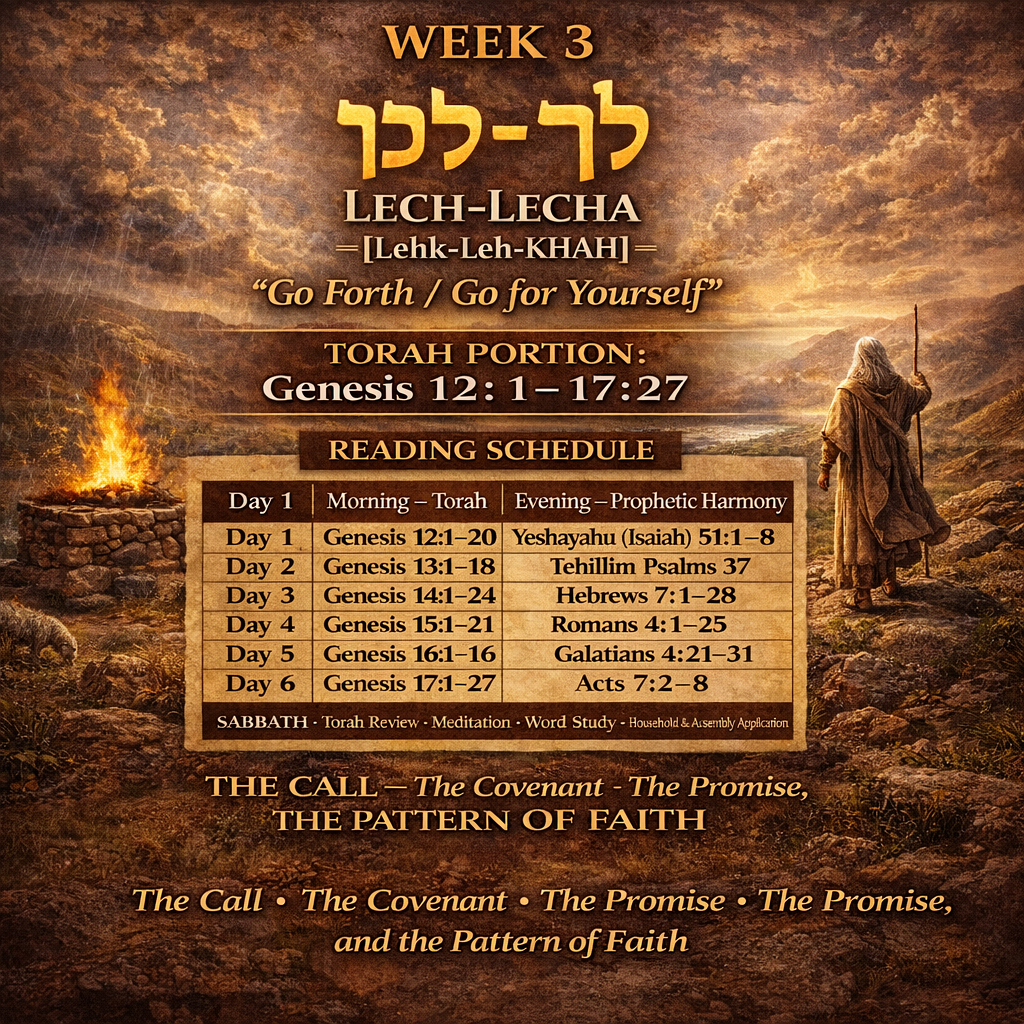
WEEK 3 — לֶךְ־לְךָ (Lech-Lecha) [Lehk-Leh-KHAH] — “Go Forth / Go for Yourself”
Torah Portion: Genesis 12 : 1 – 17 : 27
READING SCHEDULE
Day Morning — Torah Evening — Prophetic Harmony
Day 1 Genesis 12 : 1 – 20 Yeshayahu (Isaiah) 51 : 1 – 8
Day 2 Genesis 13 : 1 – 18 Tehillim (Psalms) 37
Day 3 Genesis 14 : 1 – 24 Hebrews 7 : 1 – 28
Day 4 Genesis 15 : 1 – 21 Romans 4 : 1 – 25
Day 5 Genesis 16 : 1 – 16 Galatians 4 : 21 – 31
Day 6 Genesis 17 : 1 – 27 Acts 7 : 2 – 8
SABBATH | Torah Review · Meditation · Word Study | Household & Assembly Application
THEMATIC FLOW — THE CALL, THE COVENANT, THE PROMISE, AND THE PATTERN OF FAITH
Lech-Lecha introduces the monumental shift from the universal dealings of Yahuah with all humanity to the specific covenant relationship established with Avram. The call of Yahuah is abrupt and uncompromising: “Go forth from your land, your kindred, and your father’s house.” This command demands complete detachment from former identity, security, culture, and generational influence. Avram’s obedience becomes the blueprint for covenant faith — hearing the Word, responding immediately, and walking into the unknown solely on the authority of Yahuah’s promise.
As Avram journeys, the land is immediately marked out by altars of worship. Every altar represents a declaration of ownership by Yahuah and a testimony that covenant relationship requires continual surrender and public acknowledgment of His Name. Conflict arises quickly with the peoples of the land, yet Yahuah sustains Avram, delivering him through famine, protecting him in Egypt, and blessing him materially. When strife emerges between the shepherds of Avram and Lot, Avram demonstrates covenant character — choosing peace, generosity, and trust in divine provision rather than asserting personal rights. Yahuah responds by reaffirming the land promise and expanding its boundaries.
Genesis 14 introduces Malki-Tzedek, the king of Shalem and priest of El Elyon. He blesses Avram and receives tithes, revealing a priesthood older and superior to Levi — a priesthood patterned after Yahusha Himself. This moment discloses the heavenly order guiding the covenant and establishes the prophetic link between Avraham’s seed and the eternal priest-king who will rule in righteousness.
Genesis 15 brings us to the covenant of the pieces — the dramatic cutting of a blood oath. Avram believes the promise, and righteousness is credited to him by faith. Yet Yahuah does not leave the covenant in words alone; He seals it with a unilateral act. While Avram sleeps, a smoking furnace and a burning torch — dual theophanies revealing Yahuah and Yahusha — pass between the pieces. This act binds the covenant to the very identity of Elohim. The land boundaries are established, the future exile and redemption of Avraham’s offspring foretold, and the promise sealed by divine fire.
Genesis 16 reveals the danger of attempting to fulfill divine promises through human reasoning. Sarai and Avram seek a solution through Hagar, producing Ishmael — a son of the flesh, not of the covenant. Yet even here, Yahuah shows mercy, promising to multiply Ishmael while clearly distinguishing between the natural seed and the covenant seed.
Genesis 17 completes the sequence with the establishment of circumcision as the covenant sign. Avram becomes Avraham; Sarai becomes Sarah. Names change because identity changes. Elohim walks before Avraham, commanding him to be perfect. The everlasting covenant is sealed in the flesh as a reminder that covenant requires consecration, separation, and obedience. This chapter forms the foundation of the Abrahamic covenant, which becomes the backbone of all Scripture, prophecy, redemption, and the coming of Messiah.
HEBREW WORD STUDY — לֶךְ־לְךָ (Lech-Lecha)
Block: לך־לך Paleo: 𐤋 𐤊 — 𐤋 𐤊 Root: הלך = to walk, go, proceed
Letter Symbol Meaning Prophetic Role
𐤋 Lamed Staff Authority / Teaching Following divine authority into covenant destiny
𐤊 Kaf Palm Submission / Blessing Surrendering to Yahuah’s hand and purpose
Paleo Meaning:
“Walk forward under divine authority with an open, submitted heart.”
PROPHETIC PALEO-HEBREW WORD PICTURE
“Lech-Lecha calls the believer to walk under Yahuah’s authority, surrendering personal identity and security in order to receive the covenant destiny prepared by Elohim.”
SABBATH MEDITATION
Sabbath invites us to return to the foundational call of Avraham — to leave behind whatever hinders obedience, to trust Yahuah’s promises over our circumstances, and to walk forward in faith. Sabbath becomes a weekly reminder that covenant journey requires separation, worship, obedience, and trust in the unseen. As Avraham built altars, Sabbath becomes our altar of remembrance, our place of covenant renewal, and our declaration of allegiance to Yahuah alone.
REFLECTION AND DISCUSSION QUESTIONS
Heart (Individual)
-
What is Yahuah calling me to leave behind in order to walk in covenant destiny?
-
Am I trusting His promise or attempting to fulfill it through my own strength?
-
Where do I need to build “altars” — places of surrender and worship?
Household (Family)
4. How can our home reflect the obedience and hospitality of Avraham?
5. What generational patterns must be broken for us to walk in covenant blessing?
Assembly (Corporate)
6. Are we teaching the Abrahamic covenant as the foundation of redemption?
7. How can our assembly encourage one another to walk forward in faith?
PRAYER / DECLARATION FOR SABBATH
Yahuah Elohim,
Caller of covenant families,
Teach us the faith of Avraham.
Lead us to walk forward into Your promises.
Separate us from every hindrance,
renew our hearts,
and establish Your covenant within us.
Let our lives become altars of obedience,
and let Your Word guide our steps.
In Yahusha’s Name — Amein.
JOTS & TITTLES
Call Formula — Genesis 12:1
Words: לֶךְ־לְךָ
Feature: Repeated imperative
Meaning: Intensified personal call to leave and follow
Promise Sequence — Genesis 12:2–3
Feature: Sevenfold blessing
Meaning: Covenant completeness and prophetic destiny
Name Patterns — Genesis 12–17
Feature: Abram → Abraham; Sarai → Sarah
Meaning: Covenant identity transformation
Melchizedek Encounter — Genesis 14:18
Word: מַלְכִּי־צֶדֶק
Feature: Compound name
Meaning: “My king is righteousness” — priestly kingship pattern
Covenant Ritual — Genesis 15:17
Words: תַּנּוּר עָשָׁן וְלַפִּיד אֵשׁ
Feature: Dual theophany
Meaning: Yahuah and Yahusha passing between the pieces
Numerical Boundary — Genesis 15:18–21
Feature: Ten nations
Meaning: Complete territorial promise
Wordplay — Genesis 16:11–12
Name: יִשְׁמָעֵאל
Meaning: “Elohim hears”
Feature: Prophetic destiny embedded in name
Covenant Sign — Genesis 17:10–11
Word: מוּל
Feature: Circumcision
Meaning: Covenant consecration in the flesh
Age Markers — Genesis 17
Feature: Chronological precision
Meaning: Covenant timing and divine order
Everlasting Covenant — Genesis 17:7
Word: בְּרִית עוֹלָם
Meaning: Eternal covenant structure
KEY THEMATIC INSIGHTS
Covenant Requires Separation
Avraham’s journey begins with leaving everything familiar in order to receive identity and destiny from Yahuah.
Faith Is Obedience in Motion
Avraham’s immediate response to Yahuah’s call becomes the definition of covenant faith.
Blessing Is Linked to Purpose
The promises to Avraham are not self-centered; they are designed for the nations.
Worship Establishes Dominion
Every altar marks covenant territory and acknowledges Yahuah’s ownership.
The Heavenly Priesthood Precedes Torah
Melchizedek reveals a priesthood patterned after Yahusha.
Covenant Is Cut in Blood
Genesis 15 shows that covenant is not symbolic — it is sealed by divine oath.
Human Effort Cannot Produce Covenant Promise
Ishmael reveals the consequences of attempting to fulfill divine promise through flesh.
Covenant Identity Requires Transformation
Avraham and Sarah receive new names, marking new destiny.
Week Summary
Week 3 (Genesis 12 : 1 – 17 : 27) establishes the foundation of the Abrahamic covenant, revealing the call to separation, the promise of land and seed, the pattern of faith, the divine oath of Genesis 15, the encounter with Melchizedek, the distinction between flesh and promise, and the covenant sign of circumcision. This portion reveals the shift from universal history to the formation of a covenant family through whom all nations will be blessed.
FOOTNOTES
-
The call of Avraham marks the beginning of covenant identity.
-
Altars function as territorial declarations of worship.
-
Melchizedek reveals a priesthood older than Levi.
-
Genesis 15 establishes covenant through divine oath.
-
Dual theophany signifies Yahuah and Yahusha sealing covenant.
-
Ishmael represents human effort outside covenant promise.
-
Circumcision marks covenant consecration.
-
Name changes mark identity transformation.
-
Land boundaries reflect divine sovereignty.
-
The Abrahamic covenant becomes the foundation of all redemption.
HASHTAGS
#GregWitter, #EphraimsCry, #HebraicMindsetStudySeries, #HebraicFaith, #CovenantRestoration, #ReturnToTorah, #KingdomRemnant, #AncientPaths, #WatchmanCalling, #PrepareTheWay, #RemnantRising, #TruthInLove, #Awakening, #DisciplesOfYahusha, #BibleStudents, #TorahKeepers, #RemnantBelievers, #NewToTorah, #TruthSeekers, #EndTimesWatchmen, #SetApartOnes, #GenesisStudy, #LechLecha, #AbrahamicCovenant, #Melchizedek, #CovenantPromise, #ScripturePatterns, #CovenantReadingCycle, #ScriptureStudy
